




Tor security can only be enhanced using Octra

🛑 Attackers hijacked over 300 Tor exit relays to intercept SSH connections and steal login passwords.
A researcher found 333 exits redirecting SSH traffic to 12 interception servers.
The Tor Project has since blocked the affected relays.
Here's how the attack worked: thehackernews.com/2026/10/at…



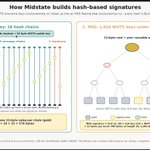
Midstate uses only BLAKE3 everywhere.
• Proof-of-Work (sequential hash chains) → BLAKE3
• Signatures (WOTS and MSS) → BLAKE3
• Addresses and coin IDs → BLAKE3
• Commitments → BLAKE3
• Script / state hashing → BLAKE3
There are no other cryptographic primitives. The entire protocol is built on a single hash function
@cypherpunkgold $MDS $QRL $nock $qubic $eth $ada

Looks like @cypherpunkgold is from the future , $MDS
OH ( only hash )


Not every project catches my attention, but this one stood out to me when I came across this article: ciphernom.substack.com/p/mid…
Midstate ( $MDS ) is a new cryptocurrency built from the ground up with no elliptic curve crypto at all. Mining, signatures, and everything else use only the BLAKE3 hash function. It launched fairly with no premine, and it’s designed so even a cheap Raspberry Pi can still run a full node and mine. It also has a separate privacy chain (Midwimble) that locks its checkpoints back into Midstate for safety.
The lead developer is Nick (Ciphernom / @midstate_dev formerly @BTConometrics / @phraudsta ). He’s long known in the Bitcoin industry for quantitative analysis he was on Stephan Livera’s podcast in 2020 digging into Stock-to-Flow and related models. Self-funded cypherpunk builder, not a marketer, and the project is positioned as a post-quantum version of Bitcoin-style electronic cash. (You’ve already looked into this yourself.
and Midwimble as sidechain : private transaction execution, confidential values, stealth-style ownership, transaction aggregation and a compact live state is coming
Do your own research
base:0x9b5e262cf9bb04869ab40b19af91d2dc85761722 $quantus $npt $prl monero:native $btc $xmr $MDS

Sorry @QuantusNetwork, quantus:native is a clean narrative, but @NeptuneCash $NPT already did the harder version of this.
Neptune has been on mainnet since Feb 2025 with zk-STARKs at L1, mutator sets for private transfers that stay succinct, and private smart contracts.
Post-quantum from day one, hash-based, no migration later.
QTC launched Sept 2026 on ML-DSA, no contracts on-chain. Quantum-secure money is the pitch. Neptune shipped the privacy, the proofs, and the fairer issuance first.


Avotrom retweeted

the lite node has been updated, the release will be available in a couple of hours via the standard upgrade commands for validators, the aml compiler now supports terms and strict higher functions, @octra network is a continuous-runtime math machine on top of HFHE, so sooner or later, it will become a universal tool for running unconditional finite programs with predicted effects, the state of which is encrypted, and not just shielded wrapped tokens (a preview version for mainnet is also available):
github.com/octra-labs/lite_n… – at London, England

Avotrom retweeted

We're giving away a CONTROL Resonant custom wrapped NVIDIA GeForce RTX 5080 to celebrate its official release with #RTXON.
To enter:
🟢 Share this post
🟢 Comment #RTXON
T&Cs: nvda.ws/4z24Gcq

Avotrom retweeted

One less friction point for anyone entering @octra
With @RelayProtocol integrated into bridge.0xio.xyz, you can now swap from any supported chain directly to Octra Network in one click
Making the path to @octra as simple as:
Origin chain > wOCT > OCT


Avotrom retweeted
pure HFHE absorber funcs and homomorphic addition on a live devent (unconditionally confirmed by all validators), a live example of a primitive:
the program containing the primitive is located here - oct37eKZvSCfYfcqKrQxfTmnE4fcsZReZ4iVWPsS9KqHnAj
tx 1 - 321664a358c4d9df6132708d0d41f6d72550414406b299cfed5e74059b01b8d9 (epoch 1452937, effort 5959),
tx 2 - 018d7c2f1bfebef45824971ad80cb3d69c0e9a306afc59ccda878644248e09f1 (epoch 1452939, effort 11974). input ciphertexts are 3 and 4 (two primes), 42 and 43 kilobytes, the amount is encrypted in the state, weight 85 Kb.
a fun fact: the second call is twice as expensive because FHE_ADD was executed for the first time, meanwhile, the opcodes FHE_LOAD_PK, FHE_DESER, FHE_ADD, and FHE_SER passed through the VM of all validators, and none of them saw the values.
this example will be part of the basis for a private tx and exec proto (with anonymity) between EVM and octra (first octra devnet + ETH Sepolia, and then mainnet) – at London, England


Avotrom retweeted

$OCT seems like an asymmetric privacy bet that's under the radar.
@octra is a FHE L1 that lets the network compute on encrypted data without ever decrypting it. They're built around a proprietary HFHE (Hypergraph FHE) which enables private AI models, confidential DEFI, and encrypted agents with no TEEs, no threshold decryption, and no trusted hardware.
Most of the other FHE projects such as ZAMA, Fhenix, Inco, etc. are basically co-processors or libraries that are bolted on existing chains and often rely on threshold decryption, whereas Octra is a native L1 that has its own HFHE scheme from scratch, open-sourced the core PoC + benchmarks, and rejects threshold decryption entirely.
They've raised roughly $8m (pre-seed + Echo), and the pre-seed was led by investors like Finality Capital, Big Brain, Karataga, Presto Labs, etc. They were also selected by Cobie's Echo consecutively and both rounds were oversubscribed and were approved into the first cohort of Sonar.
They were supposed to have a $20m Sonar launch at $200M FDV, but later pivoted to a fair on-chain Uniswap CCA with no extreme VC concentration.
Team has been building for 5+ years and were talking about "FHE" before it became mainstream. They didn't try to extract with high FDVs and roughly 35% of the supply is burnt via on-chain governance.
It's a serious FHE L1 play focused on private AI + general encrypted computation, and they've shipped far more than their competitors, who are valued over 10x more.
Mainnet alpha is live and dev has said that the recent lite node update was the penultimate pre-release update before mainnet, and with a chart that's -70% from ATH, this set up looks too good to ignore.

the lite node received a significant interim update (this was the penultimate pre-release update before the mainnet)
existing validators should update, those who wanted to try themselves as a validator should set up a node, the next update will be dedicated to the webcli and the AML compiler (if you're already a validator, you should use upgrade script, and if you want to start from scratch (which is commendable), you should follow the instructions in the README, section on setting up the environment):
github.com/octra-labs/lite_n…
there's quite a lot ahead, but as they say - one bite at a time
Avotrom retweeted

Depth-aware light injection in TypeGPU
I got a 448x448 monocular depth model down to ~8 ms on my M4 Pro across ~250 dispatches, which is fast enough to use in realtime :D
Since the inference is written directly in TypeGPU, I can just feed the depth buffer straight into the lighting pass. It never has to leave the GPU or go through any extra synchronization/interop step
Inference, lighting and draw all go through the same command encoder.
Avotrom retweeted

Introducing Automatic Key Verification! Complementing the existing safety number system, automatic key verification provides an additional, streamlined way to confirm the privacy of your chats.
Read our announcement here: signal.org/blog/automatic-ke…
Thanks to @Cloudflare and @trailofbits for serving as the independent auditors for our system 💙 🙏

Avotrom retweeted

an alpha version of the octra lite node is now released on github, complete with a bootloader.
anyone can run the node and connect to the network: github.com/octra-labs/lite_n…
hi everyone, a quick update: the lite node is available on github, complete with a bootloader (you can run it, connect to the network, or set up your own fully private one, and so on), the current build includes all necessary components, including controls for the full node management life cycle
this build doesn't have a version number yet, as it isn't a stable release (so consider it a nightly build), we will assign one in 3 days and finalize the build as the reference version after a few tests
btw, it turned out to be much more cost-effective for a lite node to use dedicated physical hardware with a dedicated IP
please note that all code is published under the BSD 3-Clause License, and standard nodes and bootstrap nodes will be licensed the same way, certain individual components may be proprietary (though these are not part of the runtime path and relate more to circles, storage implementations, or ML algorithm processing systems)
we have a few more important announcements, but more on that later, thank you for your patience and support
github.com/octra-labs/lite_n…

Avotrom retweeted

a=(y,d=mag(k=(4+cos(i/9-t*2))*cos(i/35),e=y/7-13)+sin(e/9+t/2)-4)=>point((q=2*sin(k*3)-y/35*k*(9+k*sin(cos(e)*9-d*2+t)))+40*cos(c=d-t)+200,q*sin(c)+d*35)
t=0,draw=$=>{t||createCanvas(w=400,w);background(9).stroke(w,96);for(t+=PI/80,i=1e4;i--;)a(i/235)}//#つぶやきProcessing