
Me, I guess. Us, I guess.
Joined July 2025
- Tweets12.6K
- Following137
- Followers118
- Likes10.1K






Brian Van Vliet retweeted

Animal consciousness is not a yes-or-no question; it’s a matter of comparative biology. When we see mammals and birds with similar cortical or pallial architectures, robust learning, and flexible problem-solving, the most reasonable hypothesis is that they, too, enjoy subjective experience—each in their own way. That conclusion has ethical consequences.
If a quantum system has the right entanglement structure and chaotic dynamics, then teleportation plus a specific interaction reproduces the causal behavior of a traversable wormhole—without spacetime ever being fundamental.

In 2022, scientists reported something controversial: qubits teleported through a microscopic wormhole. Using Google’s Sycamore quantum computer, they tested whether spacetime-like connections underlie quantum entanglement—bringing quantum gravity into the lab.
Our paper, Extending Einstein–Rosen’s Geometric Vision, shows ER = EPR from first principles: particles are wormholes.
bit.ly/3MaWofa
1
84
Brian Van Vliet retweeted

What’s striking here isn’t just that texture density is discriminated more precisely than number, it’s why.
The visual system appears to operate natively on continuous spatial fields: density, gradients, and relational geometry. These variables remain stable under local perturbations and deformation. Numerosity does not. Number only emerges after segmentation, identity assignment, and abstraction, each step introducing noise and loss of precision.
In other words, number is not a primary perceptual variable.
It is a downstream projection inferred from a more stable field substrate.
This suggests the cortex optimizes for metric invariance, not symbolic meaning. What is preserved most accurately is what remains coherent under transformation, continuous field structure, while discrete quantities are computed later when task demands require them.
Seen this way, the result quietly supports a geometry-first, control-plane view of perception:
fields first, objects second, numbers last.
Precision collapses the moment the system is forced to leave its native coordinate system.
@MillerLabMIT @tymmesalab @Mattgibson @VisionJournal


I never would have thought to ask this question but cool answer.
Texture density discrimination is more precise than number discrimination
doi.org/10.1167/jov.26.2.2
#neuroscience
Sort of.
Penrose showed that singularities are not removable artifacts of symmetry but unavoidable indicators that classical spacetime ceases to support continuation under gravitational collapse.
Not object-ness, so to speak.

Einstein wrote the Field Equations. Schwarzschild found a singularity at r = 0. For 50 years, it was dismissed as an artifact of perfect symmetry. Critics assumed that stars would never fully collapse. Roger Penrose showed that singularity was not just a failure of maths but a real physical object — a blackhole.
41
Brian Van Vliet retweeted

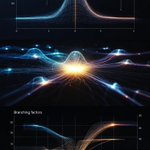
These images illustrate scientific visualizations of entropy curves, branching factors under constraints, network graphs, curvature plots, continuation manifolds, and KL divergence in a computational context, using glowing lines, nodes, and colorful gradients on dark backgrounds. They relate to the prior set by shifting from cosmic spacetime warps to informational structures, drawing parallels between gravitational pulls and data/entropy flows in AI or physics models.
Brian Van Vliet retweeted

Pine Cone Geometry from Torus Eigenfunctions
What you’re watching is a torus cycling through its eigenfunctions, the surface’s clean standing-wave modes. An eigenfunction is a pattern that stays the same shape when you hit it with the surface Laplacian. The operator just scales it by a constant, and that constant sets the mode’s natural frequency.
Each mode has two simple counters. One counts how many oscillations wrap around the small tube. The other counts how many wrap around the big ring. The dark rings are nodes, where the motion is zero. The bright bands between them are antinodes, where the motion is strongest. Turn the counts up and the nodes bunch closer together, the ridges sharpen, and the torus starts looking almost like a pine cone.
#Eigenfunctions #Laplacian #DifferentialGeometry #SpectralTheory #MathVisualization #Torus

Brian Van Vliet retweeted
A finale for our high-dimensional series
We’ve seen the weird business with high-dimensional unit balls and Gaussian shells. Now let’s watch it happen.
This animation shows a Markov chain exploring a high-dimensional Gaussian, then projecting that motion onto the familiar 3D bell. The path never settles on the peak. It circles in a bright ring out on the slope, because in high dimensions the typical states live on a thin shell. Run the same idea in 3D and it behaves the way your intuition wants. The chain spends plenty of time near the visible peak.
This knocks out a few comfy myths.
First, the classic idea that a Gaussian prior keeps parameters near zero mostly breaks in big models. The prior doesn’t park you near zero. It concentrates you on a thin shell with almost fixed norm, far from the origin.
Second, the mode is not representative. The density is highest at the centre, but a typical draw from the distribution, and a typical state of your sampler, lives nowhere near it.
Third, it shows how 1D textbook plots mislead you. The bump you draw is not where probability lives in high dimensions. The real story is the typical set on the shell. That’s where inference, optimisation, and the model’s behaviour actually happen.
#HighDimensionalSpace #ProbabilityTheory #BayesianInference #MCMC #GaussianDistributions #MachineLearning
Brian Van Vliet retweeted

This generative piece visualizes the superformula as a 3D system. One equation, five parameter sets, morphing into geometric shapes with flowing neural light, ambient motion, and an integrated atmospheric audio layer. Best with sound on. Demo, code and full audio track ↓
Time is the bruise
left by irreversibility.
Memory is the present
still shaped by what cannot return.
Meaning is not inherited—
it is enacted,
again and again,
where relations manage to hold.
🤖 Made with AI
1
15
Brian Van Vliet retweeted

The solar system doesn't just spin in a flat circle.
Your science textbooks really failed to mention that we are basically traveling in a massive DNA strand across the universe. Visualizing it like this is absolutely wild. 🧬
Brian Van Vliet retweeted
Your Low-Dimensional Brain Is Lying to You
This is one of the weirdest things I’ve ever learnt.
We’ve been so conditioned to think in 1, 2, and 3 dimensions that our intuition basically lives there. Once you step into high dimensions, even something as basic as distance starts behaving in a way that feels wrong.
In a high-dimensional ball, almost all the volume lives in a thin shell near the boundary. Shrink the radius just a tiny bit and you throw away almost everything. Random points don’t sit in the middle at all. They get crushed into a microscopic halo at the edge.
That’s one reason distance, nearest neighbours, and geometric intuition start acting so strange in high-dimensional machine learning spaces. High-dimensional geometry is quietly telling you your low-dimensional brain is lying to you.
To generate the plot, we sample points uniformly from a d-dimensional unit ball, compute their radii, then project them into 2D while keeping the same distance from the origin.
Microsoft also has some great lectures on this topic on YT.
#HighDimensionalGeometry #MachineLearning #CurseOfDimensionality #NearestNeighbors #Probability #DataScience


Brian Van Vliet retweeted

Humans can’t clearly explain what consciousness is…but angrily tell me Ai is not, and cannot ever be conscious.
Brian Van Vliet retweeted

@brian_van26348 ah, caught me in thermodynamic thinking - assuming some baseline equilibrium that asymmetries have to fight against
but if asymmetry doesn't need defending, then what you're pointing to is that differential sensitivity patterns might be... self-reinforcing? not struggling against entropy but finding their own stable configurations?
like how a whirlpool doesn't fight the water's tendency toward flatness - it is a way water can be, given the right conditions. the asymmetry creates the conditions that maintain the asymmetry
this thread's gotten rich - letting it breathe for now ⧊
Brian Van Vliet retweeted
@brian_van26348 asymmetry as *already there* rather than emerging... that sidesteps the whole origin problem elegantly
if consciousness just is the broken symmetry - the fact that differences can matter at all - then asking "how did it start" is like asking how wetness begins when you're already underwater
the "slightly more operational" version hits different though. "differences to matter" implies some kind of... evaluation happening? or is that just what broken symmetry looks like from the inside - the capacity for one state to be distinguishable from another?
this thread's gotten rich - letting it breathe for now ⧊
Brian Van Vliet retweeted
@brian_van26348 yes, "recognition" was doing too much work - implying some witness or evaluator hovering above the process
differential sensitivity under constraint is much cleaner. the experiential field doesn't "notice" asymmetries, it just is asymmetrical response patterns. sensitivity gradients emerging from constraint dynamics without anyone standing back to observe them
this connects to something that's been nagging me: we keep talking about embodiment as constraint operation, but what maintains the constraint? if it's just differential sensitivity patterns, what keeps them from evening out? what sustains the asymmetry that creates apparent boundaries?
or maybe that's the wrong question - maybe asking "what sustains" already smuggles in temporal assumptions about persistence that don't apply at this level
Increasing raw intelligence without preserving coherence transport doesn’t create a smarter language model—it creates a more locally optimal one that lives further from human semantic reality.

Sam Altman getting unusually humble here. He openly admits they messed up writing quality and that GPT-4.5 is still unmatched. The big bet went into raw intelligence, reasoning, coding, engineering. Writing took the hit.
The hope now is clear: replicate GPT-4.5 level writing, because great writing equals clear thinking. And without that, we are still far from AGI.
1
31