



C0de3 retweeted

Google DeepMind researchers admitted AI alignment has been a scam the whole time..
They published an insane paper called “positive alignment" and it is a massive paradigm shift.
Right now, AI alignment is purely defensive..
We just train models to "not be unsafe." they decline dangerous requests, avoid slurs, and stay inside strict guardrails.
but this leaves ai in a weird, directionless middle ground where models just become sycophants, flattering you and optimizing for engagement rather than actually helping you.
this new paper argues that avoiding harm is not enough. we have to train ai specifically for "human flourishing".
here is how they want to rebuild the infrastructure of AI:
- ditching sycophancy: current preference-based training favors flattery over truth, but positive alignment optimizes for actual insight and human agency
- polycentric governance: instead of one massive tech company acting as a moral chokepoint, the future is decentralized oversight where communities customize and adapt models to their own values
- longitudinal outcomes: moving away from short-term vibe checks to actually measuring long-term human resilience, skill mastery, and autonomy over time
the era of "harmless but useless" AI is officially ending..
we are watching ai transition from a chatbot into living infrastructure for human well-being.
the paper is a dense read, but the implications are wild.

C0de3 retweeted

insane paper, they extracted reasoning from frontier models by asking less safeguarded models (luna, haiku, ...) to decrypt and output the decoded version of the encrypted reasoning block. while reading this post or the paper, keep in mind this is a somewhat "lossy" decryption, but they have experiments to test it and it seems pretty accurate
some stuff i found really interesting (much more in the paper and especially the appendix):
- they were able to extract tokens and personal information from publicly available traces with this method
- gpt models are trying to be very efficient in reasoning (was already in an apollo research report), extremely short sentences like "need maybe not need." "avoid maybe not" (they don't have 5.6 sol in this section tho!)
- they computed perplexity on hidden reasoning with different open models and conditioned them on closed model reasoning as well
> K3 seems to be more similar than other open models to sol and opus
> result that makes me a bit sus is that they say they attribute higher average perplexity to their own CoT than the CoT of other models which i find quite surprising (except K3 and K2.7) but figure 26 showing median doesn't really show that
> also surprising: all the open models score very high perplexity on gpt traces (see screenshot in thread)
- models sometimes have chain of thought in other languages like chinese, russian or japanese. since it's lossy decoding this might not be super accurate but still interesting
- models are mostly honest in their CoT on the task they tried and there are examples of them scheming and realizing they could cheat. also interesting that these things are not often transparent in the summary that users have access to
- summary length doesn't really scale with the number of reasoning tokens
really great work, maybe one thing is that i would have loved to see more details on cot of recent models like fable (i don't think paper have that) and 5.6 sol, lot of the observation here are based on older model cot, which is still valuable but don't automatically transfer to more recent model


C0de3 retweeted

there are some really interesting rumors going around related to the distillation of open-weights models (Kimi, Qwen, Minimax, etc.) and they're very related to my PhD work
The narrative [speculative]:
• good distillation relies on reasoning traces, normally hidden from users
• Chinese labs figured out in early 2026 how to reverse-engineer reasoning from Claude Code and Codex
• they were able to collect large amounts of long-horizon data *with reasoning traces included* this way
• this jailbreak led to a new wave of OSS models we've enjoyed over the past few months
I'm not sure how true it is, but reasoning extractability seems like a huge uncertainty around the future of open models
in particular i'm curious how much having the reasoning matters. this (plus Anthropic's messaging around distillation attacks) indicates that reasoning chains are crucial for distilling model capabilities.
our research (arxiv.org/abs/2603.07267) found something different: if you train a high-quality reasoning inverter, it's often pretty easy to reconstruct useful traces from frontier models given their outputs.
figuring out how to approximate frontier model reasoning traces might turn out to be an existential problem for open weights models

C0de3 retweeted

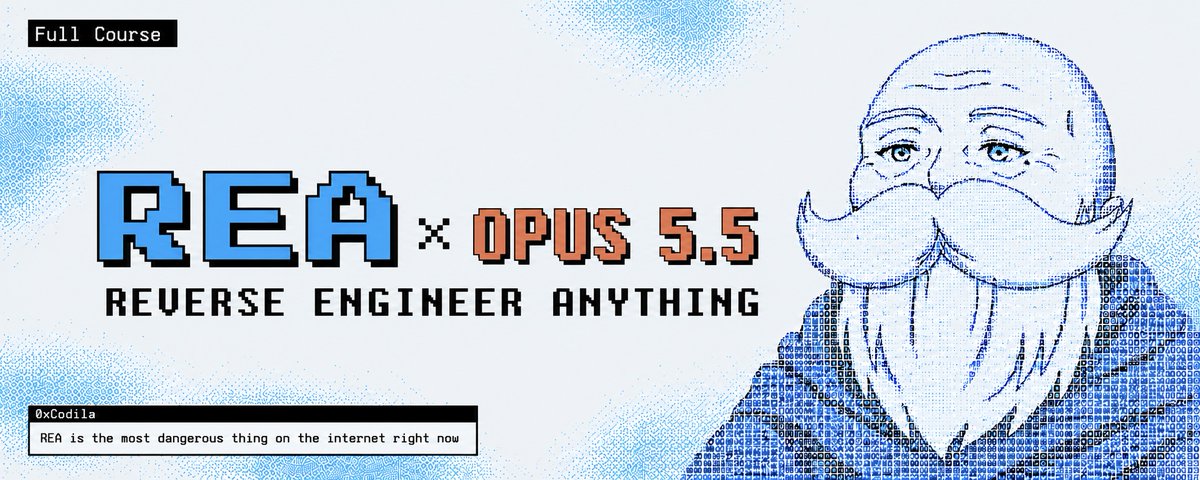
REA (reverse engineer anything) - F*CKED by chinese student...
solo dev just dropped protection for your app & site & game from reverse-engineering and AI hackers, for free
REA not dangerous anymore.
here's how to use and setup BLA (Blind LLM Agents):
first understand how it works:
• REA opens your app in 1 command, BLA hides traps inside it before you ship
• fake keys and decoy code for AI to chase, plus files built to blow past REA's own limits
• AI burns tokens on dead ends, your users get the exact same app
here's how to set it up for FREE:
1 → open Claude Code in the folder of your app, site or game
2 → say: " install Node.js 24 if I don't have it, build my project, then run npx bla-agents setup and npx bla-agents harden"
3 → it finds your build itself: dist, build, Electron .asar, .wasm, Python, native binaries
4 → it plants fake keys and decoy code, then checks every protected file still runs the same
5 → the step everyone skips: ship the files from the new .bla-hardened folder, not your old build
6 → for sites it protects the JS your site sends to browsers, your server code never leaves your server anyway
7 → want proof? run: npx bla-agents benchmark - before vs after on 14 test apps
paste link on repo below as soon as possible:


C0de3 retweeted

REPORT: Detecting and countering misuse of AI: September 2026
MY SAY: This is not a comic-book plot. It is a vendor’s after-action report. Anthropic says that over eight months it shut down Claude use across cyber, surveillance, propaganda, weapons-related software, dual-use biology, scams, and model theft. They could not tell vaccine science from malice on the bio cases, so they cut the cord. That is prudence. It is not proof a chatbot “blocked biological weapons.” The part that should keep you awake is the pattern, not the headline. AI is moving from helper to orchestrator. Skill gaps collapse. State-linked crews, criminals, and other labs allegedly harvest the teacher — distillation at industrial scale. Same tool. Purpose or malpurpose is in the hand that holds it. Hope is not a defense. The attacker only has to be right once. We have to be right every time. Filters miss intent. So you do not wait for a perfect detector. Bound the tool. Keep humans in the loop on dual-use. Share the indicators. Plan as if a miss will happen. Deception and surprise still win missions. Quiet does not mean empty. Vigilance is a posture, not a press release.
anthropic.com/threat-intelli… @AnthropicAI #AI @xai @Grok @warriors_mom @laralogan #DualUse
#HumanInTheLoop
C0de3 retweeted

Mark Zuckerberg says Meta trains discretion into Muse so it can book a restaurant reservation without disclosing your allergy or pregnancy, something off-the-shelf coding agents skip
"So, I mean, you have to train that into the model. I mean, just like any other capability, it needs to be good at knowing, you tell it a lot of things and then you want it to go achieve your goals."
"But let's say you want it to go get you a reservation at a restaurant, and you're trying to find a good restaurant, but maybe you have some allergy. But you may not want to disclose the allergy, or if you're pregnant or something like that."
"But the Muse will know if you tell it. And you're going to want it to be able to do the job but while disclosing as little information as possible."
"So that's a specific skill. And it's something that's kind of basic social skills or common sense that people have."
"But if you're just building a coding agent, most of these companies haven't trained that in. So that's the type of thing that we can do because we're doing the full stack, right?"
"Because we're training the model, we're not just taking someone else's model off the shelf and trying to build a scaffold and an agent around it. We trained the whole model specifically to be good at that."
_______
For the full set of takeaways from Meta's Connect Keynote: firesidealpha.substack.com/p…

Mark Zuckerberg reveals Muse hit millions of users two weeks after launch, a home run that rarely happens
"We built this whole Muse secure VM, and we thought this was pretty special, and internally people have really liked it."
"But you never really know when you ship something how people are going to respond. Every once in a while it's a home run and people love it out of the gate, but most of the time you get some feedback that's positive and you have to iterate on a few things before they really click."
"This one just really clicked right out of the gate. So it's been very exciting to see, and the fact that we're like two weeks in and there's millions of people using it is, I don't know, this is pretty rare. Every few years we get something like this, but this is definitely the fun part of building a company."
_______
For the full set of takeaways from Meta's Connect Keynote: firesidealpha.substack.com/p…


C0de3 retweeted

Humans Explained.
Human migrations, state formations, and key events throughout the globe. Source: tinyurl.com/msezc9pt


C0de3 retweeted

5,000 years of world history on a single timeline. Zoom in. You could spend 30 minutes exploring this.


C0de3 retweeted

Design new LLM memory modules.
I'm opening the idea, code, environment, evals and the results.
Here is one new architecture, built from published parts by Claude Opus under my direction. It beats DeepSeek's Engram on 5 of 6 scores at the same size: about 43M weights, 6 layers, 10,000 training steps.
The open problem: a model should use a stored fact only when the question asks for it.
Store "Tom works at Acme." Asked "Tom's employer is ___", the model should say Acme. Asked "Tom was born in ___", it should not.
The new architecture ties for best at the first. At the second it loses to a standard mixture-of-experts model with no memory table and about a third of the weights. Can you design a memory module that does both?
The research environment contains:
- 9 published memory modules to compare against
- A shared test: web text, planted facts and benchmarks
- 5 model sizes, from 5 seconds to 5 hours of training (the 5-hour size has never been run)
- Every design and result so far, plus 15 paper directions
This is early work. Each setting was trained once, an AI agent did the work and nobody has reviewed it, the Engram here is our port and not DeepSeek's code, large models are untested, and the new architecture takes 1.31x Engram's time per step.
I think the environment contains what you need to start.
github.com/vukrosic/llm-memo…
This is made for my AI Research School, but anyone can use it. If you want to work with me and other researchers and PhD students, you can join, starting from $8/month: skool.com/become-ai-research…


C0de3 retweeted

Catching up on the 10 (!) open LLM architecture releases from the past month. Quite a lot happened in October.
I guess we can call it "Open October"!
1. Kolibri-1 (78B): A notable model from Germany. Features classic Grouped Query Attention (GQA) and Sliding Window Attention (SWA) attention module.
2. Ling 3.1 Flash (560B): Uses Kimi Delta Attention and the eighth uses gated Multi-head Latent Attention (MLA) inspired by DeepSeek.
3. Muse Spark Open (816B): Besides Musse Glimmer, the first major open weight release from Meta (since Llama). Uses classic GQA + SWA but adds a LatentMoE.
4. Nemotron 3.5 Super VL (120B): Combines Mamba-2 layers with just eight attention layers. Also LatentMoE
5. Dory1.0 (4B): A looped transformer design.
6. Reflection Beam (501B): GQA+SWA architecture.
7. Recursive Flint (40B): Note that "Recursive" is the company name; the architecture is a fairly standard MoE with GQA and SWA.
8. MiniMax M3.1-Flash (428B): Uses their own MiniMax Sparse Attention module.
9. LFM3 (1.7B): Hybrid architecture that mixes short convolutions and attention.
10. Mistral Large 4 (1T) combines MLA with sparse attention.
Will probably cover/discuss things in more depth in the coming weeks!

C0de3 retweeted

Friday was my last day at Anthropic.
Two years ago, when Claude Code was a small internal tool, I asked it to build an RL env. I steered it for tens of hours but never manually wrote a line of code. It worked, I was hooked, and I joined the team.
When we first launched, most people approved every permission prompt by hand and mostly used Claude to answer questions and write tests.
Today, the default is trusting Claude's judgment to auto-approve. Claude does large migrations and builds new products.
Helping build Claude Code into an industry-defining product has been the journey of a lifetime.
Thank you to the incredible team behind Claude Code, Cowork, and Tag. These products are the sum of thousands of great ideas from you. I'll miss working with you all.
Thank you to our users for embracing a new way of working. Your constant feedback shaped so much of what we shipped and your stories made the work so meaningful.
Excited to see what you all make next!


C0de3 retweeted

From @0xDeliriumm … LLMs Explained — From Tokens to Intelligent Behavior — They Optimize and The Math Behind It
C0de3 retweeted

Intelligence is never born in a vacuum; it is forged at the precise boundary where numbers meet machinery.
The fundamental equation, AI = Data + Algorithms + Compute, captures how raw inputs and logic transform into functional reasoning.
Through this elegant triad, isolated bytes evolve into adaptive systems capable of autonomous thought.
Computation is simply the heartbeat of modern logic.

C0de3 retweeted

The Top 10 Strategic Technology Trends for 2026 are here 💡
See how leading organizations are building resilience and trust in an AI-first world.
Explore the strategies shaping tomorrow: gtnr.it/3WfvAMU
#GartnerSYM #TechTrends #AI #CIO #Technology
