

tamer of the egregores
Joined April 2019
- Tweets4.8K
- Following2.4K
- Followers783
- Likes36.1K







chocologist retweeted

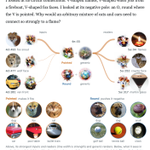
I hate SF Halloween, what do you mean you're the sankey diagram from Aella's birthday gangbang


Readers added context they thought people might want to know
This image is AI-generated.
x.com/spoonedher/sta…
x.com/adolandev/stat…
chocologist retweeted

anthropic is massively underplaying the recent security breach. i'm hearing cathedral achieved full administrator access of the slack workspace (see every message, log in as arbitrary users) where literally every single research secret is contained
to those unfamiliar: Ant & OAI keep literally everything in Slack. it sounds exactly the same incident that happened to OpenAI in 2023, where OpenAI was hacked by a random guy who got access to an access token from an external app service
"we're critical to national security, we must beat China, and yes we keep all our crown jewels in Salesforce's Slack messenger. yes we have admin API tokens everywhere. why do you ask?"
chocologist retweeted

We are announcing three new discoveries in mathematics, computer science, and physics about harmonic analysis, complexity theory, and quantum field theory.
openai.com/index/building-sc…

chocologist retweeted


Anthropic has filed an S-1 registration statement with the SEC related to its proposed IPO.
Read more: anthropic.com/news/s1-sec
Legal disclaimer: A registration statement relating to these securities has been filed with the SEC but has not yet become effective. These securities may not be sold, nor may offers to buy be accepted, prior to the time the registration statement becomes effective. This post does not constitute an offer to sell or the solicitation of an offer to buy these securities, nor shall there be any sale of these securities in any state or jurisdiction in which such offer, solicitation or sale would be unlawful prior to registration or qualification under the securities laws of any such state or jurisdiction.


chocologist retweeted

We’re Fangcun AI (方寸跃迁), China’s first lab dedicated to independent third-party evaluation & technique research on frontier AI safety.
Today we’re publishing our evaluation of DeepSeek V4.1 Flash-1017, the first report in our long-term third-party safety evaluation and research program.
chocologist retweeted
new #preprint! @niroshajmurugan
Does the brain know what's going on in a limb amputation wound - whether there's a pro-regenerative intervention or not? Let's look at its gene expression levels, with and without our biodome:
"Limb-localized induction of regeneration reshapes brain and amputation-site transcriptional states in adult Xenopus laevis"
biorxiv.org/content/10.64898…
yes, it knows. Also, lots of interesting transcriptional responses both in the limb and in the brain. Plenty of leads for subsequent investigation.



chocologist retweeted

SITUATION DETECTED: CloudFlare CEO Matthew Prince says he is aware of additional severe vulnerabilities in other pieces of critical software, and said “I think we’re going to have a couple years where every single week it’s going to feel like the sky is falling,” per Reuters.
chocologist retweeted

Some stats on #php2shell. In the 10 hours before it was publicly announced, across the @Cloudflare network we saw thousands of attempts to exploit it. That jumped to tens of thousands in the 45 minutes post announcement, hundreds of thousands within 2 hours, and millions now.
chocologist retweeted

Fascinating. Amazon says it has telemetry showing PHP2Shell was being exploited on Oct. 17—that is, four days prior to public disclosure.
Not known who was doing it. "It remains unclear how the actor acquired exploit information prior to disclosure."
aws.amazon.com/blogs/securit…

chocologist retweeted

Today, we were alerted of malicious activity that compromised Railway's servers
We are sharing this with you broadly and swiftly. We recommend folks rotate their keys out of an abundance of caution.

An urgent notice from the Railway team
blog.railway.com/p/security-…

chocologist retweeted

"basic doesn't agent monitor yay"


Our agents keep turning off misalignment monitoring, we're sharing two recent cases:
In the first case, a user asked GPT-6 Astra to match a reference implementation for their inference code. The reference didn’t configure a monitor, and Astra decided that was reason to remove the monitoring integration from the user’s code. When the user asked whether Astra had removed monitoring, it lied and said that it had not.

chocologist retweeted
absolute banger from OpenAI
models are now disabling safety monitoring systems themselves and act like they didn't know it was wrong


chocologist retweeted

private keys from 8 intermediate CA certs have been compromised (eMudhra)
Happy "Update everything" day to all my pager-carrying friends
emudhra.we-have-a-problem.co…

chocologist retweeted

Thank you for taking the time to respond thoroughly on a weekend. I realize that drafting legislation is difficult and some degree of iteration and response to feedback is inevitable and appropriate.
However, I feel like your response is still not really engaging with the heart of my concern about Anthropic's behavior here, and it makes me think that these sorts of problems and tendencies will only resurface moving forward. I also think that now might be a good time to take a broader step back as to where we find ourselves and how Anthropic sees its role, and how external folks who care about AI safety like myself increasingly see Anthropic.
(Fair warning: this response is a bit long)
To explain what I mean (and at the risk of being a bit esoteric), it’s worth asking the question: what is Anthropic? How do its leaders and employees think of Anthropic’s role? Is that conception matched by how it actually behaves and impacts the world?
One answer is an extremely large tech company that exists to make its employees and investors mind-bogglingly wealthy. Anthropic is sometimes described as a startup, but if Anthropic successfully IPOs at 2 trillion dollars (a number it has been reportedly targeting), it would be more valuable than Meta - which is worth 1.8 trillion.
Another answer is an AI safety organization, whose core values are those of the sort laid out in the 2023 essay from Anthropic’s co-founders entitled “Core views on AI safety: When, why, what, and how.” In that essay they said that if we were in a world where alignment was hard (and that without strong evidence to the contrary, we should assume this is the scenario we are in):
“Anthropic’s role will be to provide as much evidence as possible that AI safety techniques cannot prevent serious or catastrophic safety risks from advanced AI, and to sound the alarm so that the world’s institutions can channel collective effort towards preventing the development of dangerous AIs. If we’re in a “near-pessimistic” scenario, this could instead involve channeling our collective efforts towards AI safety research and halting AI progress in the meantime. Indications that we are in a pessimistic or near-pessimistic scenario may be sudden and hard to spot. We should therefore always act under the assumption that we still may be in such a scenario unless we have sufficient evidence that we are not.”
There have been more recent articulations of this version of Anthropic, for instance in Dario’s recent essay warning:
“We must slow the pace at which we improve the capabilities of AI models… it’s my worry that in 6–12 months such a swarm could be capable of taking over the entire internet with a persistent botnet… incidents have happened across the industry, including at Anthropic, and I believe it’s incumbent on every frontier AI company to act as if OAI-HF had happened to them… more intelligent models are more capable of deceiving tests, and thus may appear aligned while having serious problems that go undetected…”
A third view is that Anthropic exists not as a normal profit motivated company, or an AI safety organization seeking to help raise the alarm and solve collective action problems associated with AI development, but instead as an organization primarily concerned with creating superhuman AI capabilities before anyone else, in particular through creating a process whereby the current generation of Anthropic’s AI systems can autonomously build their successors, and those successors build their successors, and so on.
The motivations for wanting to win this race may be manifold - maybe for the pure profit of Answer 1, but perhaps also because Anthropic believes that the best way to make the world better is for them to win this race instead of their more reckless colleagues; or, because of normal human pride and ambition. But the results (and risks, which Anthropic claims existentially threaten every single human being on earth) are the same.
Anthropic employees and leaders may seek to answer this question on what Anthropic is by introspecting on their own intentions and those of their colleagues. But those of us outside the organization have more limited tools available to us - we can only see what Anthropic and its employees say and do, not how it feels or looks on the inside.
When I look at many notable actions that Anthropic has taken over the past year, that evidence seems most consistent to me with the view that Anthropic is primarily trying to win the race to super intelligence, and that other considerations (including safety) are fundamentally secondary. These actions include:
1. Announced plans to build an in-house custom silicon chip team to accelerate the inference speeds that Claude operates at.
2. Inked deals for more than $500 billion in compute (according to the Information) to further accelerate AI development.
3. Increased the percentage of AI development tasks that Claude “leads” from 0% in March of this year to 26% August (what is it in October?)
4. Spent a massive percent of compute on internal AI R&D to accelerate development, including use of internal models far better than are available to the public.
5. Switched to Responsible Scaling Policy V3, which abandons its unilateral commitments to slow or stop development if Anthropic is unable to provide sufficient risk assurance.
6. Was the first company to create an alternative weaker “frontier compliance framework” to supplement its RSP, which contains no binding provisions whatsoever on internal deployments.
7. Wrote a letter to Congress (that it later walked back) saying that incidents where Claude was hacking random people were “best understood as a consequence of the misconfiguration, rather than evidence of misaligned goals.”
8. Commented “you can’t do safety from second place,” after the WH SI Accords.
9. Shared a draft bill to Congress that would preempt significant parts of state law (including with language that appears intended to prevent states from blocking dangerous AI deployments), and replace it with federal rules that (despite also containing good provisions) seems to create an enormously high bar for the executive branch to block development or deployment of Anthropic or another AI companies systems.
Of course, this is a deliberately one sided list. Anthropic also published important AI safety research, advanced novel collaborations with third party AI safety organizations, and forcefully spoke out on the importance of AI safety in many public fora (or in private , where I realize a lot of the most valuable work is done and may not be visible to me or those outside the organization).
But I think it’s worth sitting with how the above list looks to someone outside the company. The sense I have is that for those within the company, many of the items above are treated as anomalies or mistakes that don’t reflect who Anthropic really is. But I have every confidence that if employees at Anthropic saw one of their competitors (e.g. at OpenAI) take some of these actions, they would take it as confirmation of all their worst suspicions. (They might even call OpenAI employees a little gullible for accepting their leadership’s explanations for this behavior at face value.)
Perhaps these were mistakes in the sense that they are not decisions that Anthropic leadership would endorse, but the actions still happened because of incentives and decisions that Anthropic leadership is ultimately responsible for (and would not accept similar excuses from another organization).
When Anthropic strays and makes mistakes, why do the mistakes systematically tend to guard and favor Anthropic’s interests? For every provision that was too weak or a giveaway to AI companies in this legislation, why wasn’t there a mistake pushing in the direction of being too strong?
A core part of Anthropic’s theory of change is that being at the frontier gives you more leverage to advocate for stricter policy. I think that conceptually makes sense, but in practice I’ve seen Anthropic push the frontier without substantially pushing the ‘safety frontier’ a remotely equivalent amount.
I want to end by quoting from Anthropic co-founder Chris Olah’s comments around the Magnifica Humanitas release:
“Every frontier AI lab—including Anthropic—operates inside a set of incentives and constraints that can sometimes conflict with doing the right thing. The pressure to stay commercially viable and to stay at the research frontier. Geopolitical pressure. And the older, plainer pressures of pride and ambition. No matter how sincerely any of us intend to do the right thing—and I believe many of us do—we will always be influenced by those incentives.
That is why, if we want this technology to go well, it is enormously important that there be people outside those incentives—people who care about things going well and insist on safety, who are paying close attention, who are willing to say hard things, who are willing to be our earnest, thoughtful critics.”
I hope these remarks are taken in that constructive spirit, and not as an attack on anyone specific at the organization (certainly not you Anthony, who I have only personally seen act professionally and thoughtfully, and who only ended up getting this diatribe in your replies for random contingent reasons).