Is Climate Change a Bust?
Joined December 2021
- Tweets3.8K
- Following49
- Followers252
- Likes3.5K





The CDC reports that for this season, the flu vaccine includes:
H1N1,
H3N2, and
Influenza B
These strains all infect the UPPER respiratory tract where little if any IgG is found.
There is no guarantee on which strains will spread.
cdc.gov/flu/season/2026-2027…

Reminder:
Even if carbon dioxide had remained constant at pre-industrial levels, we would expect the last quarter century temperatures to be the highest on record. Why?
Estimates of radiation the sun is emitting are near the all time high (2024).
Estimates of albedo (earth's "shininess") are near the all time low (2023).
Put these two factors together and the amount of energy earth has been absorbing has increased at a rate more than twice the rate of greenhouse gasses.
This does NOT preclude the effects of greenhouse gasses and one could also say that we would expect record temperatures from ghgs regardless of if solar absorbance remained constant.
But sunshine remains important to watch.
Will solar revert to the mean?
remain at these levels?
increase even further?

ALT https://www.ncei.noaa.gov/metadata/geoportal/rest/metadata/item/gov.noaa.ncdc:C01721/html https://ceres-tool.larc.nasa.gov/ord-tool/jsp/EBAFTOA421Selection.jsp

ALT https://ceres-tool.larc.nasa.gov/ord-tool/jsp/EBAFTOA421Selection.jsp
Climate Observer retweeted

especially if it was a massive bedrock failure that took a glacier with it...
Read more at: theweek.in/news/world/2026/0…

Record Low Temperatures
Over The Central Arctic Ocean?
This year, 2026, will likely represent the coldest summer over the Central Arctic Ocean (poleward of 80°N) for the period of record which began with the International Geophysical Year (1958). This measure is not of the entire Arctic, and perhaps represents only half the area of Arctic sea ice, but is a consistent measure of the Central Arctic Ocean.
ocean.dmi.dk/arctic/meant80n…
At the same time, and perhaps explaining the low temperatures, sea ice thickness for much of the Arctic in March was anomalously high compared with the average of the past fifteen years.
metoffice.gov.uk/research/ap…
This new thicker ice appears to have persisted for through the summer and the increase of ice thickness appears to have occurred over most of the Arctic Ocean.
alaskaclimate.substack.com/p…
Much of Arctic sea ice state is determined by advection which is modulated by shifts between the Arctic Gyre and the Transpolar drift. The shape of the anomalies ( increases toward the Bering Strait, decreases toward the Fram Strait ) are consistent with such a shift.
nature.com/articles/s41586-0…


Climate Observer retweeted
Radiative forcing from 2 X CO₂: ~3.7W/m².
Melt season RF during inter-glacials: ~50W/m².
6000 years of solar RF didn't remove Greenland ice.
100 years of CO₂ RF will not remove Greenland ice.
Higher terrain of Greenland accumulates MORE ice when temperatures are higher.


Climate Observer retweeted
A. Model from Manabe of dramatic increases of CO2.
B. For clarity, I erased the cases of decreased CO2.
C. GFDL CMIP runs for increased CO2.
Climate is not modeled to change!

Climate Observer retweeted
Why isn't climate modeled to change with increasing CO2?
Because global average temperature is not a term in the equations of motion.
Most of the factors of climate
(gravity, spheroidal earth, orbital parameters, geography, et al.)
won't change, regardless of CO2:

Climate Observer retweeted
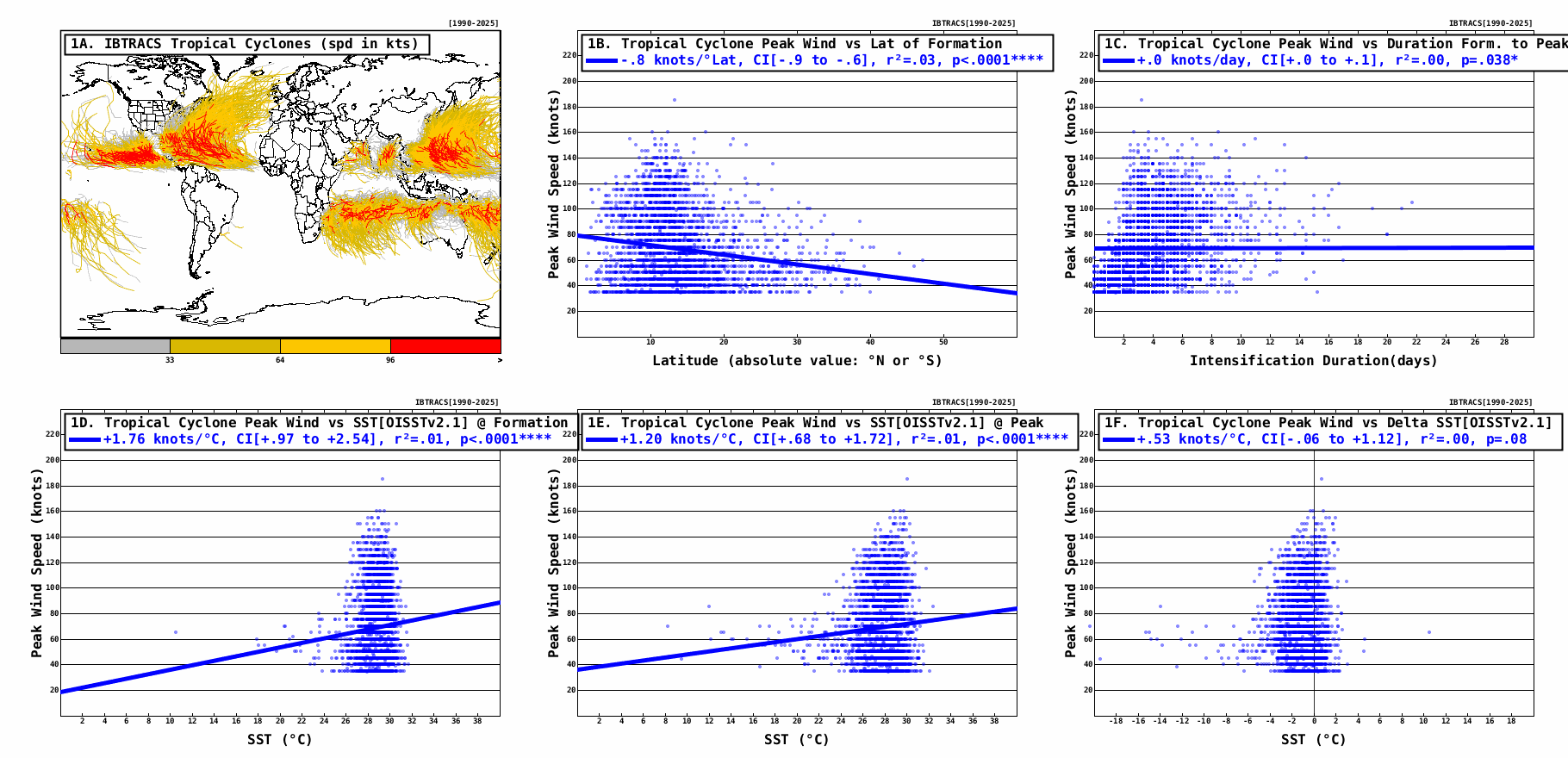
I took a look at this using IBTRACs, OISST and ERA5 for shear and assessing the ITCZ location.
In figure 1E, there is a relationship between tropical cyclone peak intensity and sea surface temperature at peak,
-HOWEVER-, this relationship is extremely weak (r²=.01, 1% of variance explained)
-and- the slope is also weak (~1 knot per °C).
Further, this relationship may be because SST and wind shear co-vary.
SST tends to be highest closer to the equator and decrease poleward, figures 2.
-Average- wind shear (not instantaneous, which is more significant) is complicated but also tends to exhibit increase poleward during peak seasons in the various basins.
Across basins and across seasons (figures 5),
seasons occur when the ITCZ (providing the low level convergence kernels of circulation) wanders into the basin, the average shear is low, and the average SST is high. Is it the high SST or the low shear?
1. When categorized (figures 6), storms which reach major hurricane status tend to do so at slightly higher SSTs.
2. That may be because storms which reach major hurricane status tend to do so forming AND peaking at lower latitudes where SSTs are higher (6D & 6E ).
3. Also, forming at lower latitudes means these storms intensify for a longer period ( maybe because the "Beta-plane" effect is reduced ).
4. Another aspect is in Figure 6C, MOST storms reach peak intensity over waters with SST LOWER than those over which they formed.