
Is Climate Change a Bust?
Joined December 2021
- Tweets3.8K
- Following49
- Followers252
- Likes3.5K






Climate Observer retweeted

especially if it was a massive bedrock failure that took a glacier with it...
Read more at: theweek.in/news/world/2026/0…

Climate Observer retweeted
Radiative forcing from 2 X CO₂: ~3.7W/m².
Melt season RF during inter-glacials: ~50W/m².
6000 years of solar RF didn't remove Greenland ice.
100 years of CO₂ RF will not remove Greenland ice.
Higher terrain of Greenland accumulates MORE ice when temperatures are higher.


Climate Observer retweeted
A. Model from Manabe of dramatic increases of CO2.
B. For clarity, I erased the cases of decreased CO2.
C. GFDL CMIP runs for increased CO2.
Climate is not modeled to change!

Climate Observer retweeted
Why isn't climate modeled to change with increasing CO2?
Because global average temperature is not a term in the equations of motion.
Most of the factors of climate
(gravity, spheroidal earth, orbital parameters, geography, et al.)
won't change, regardless of CO2:

Climate Observer retweeted
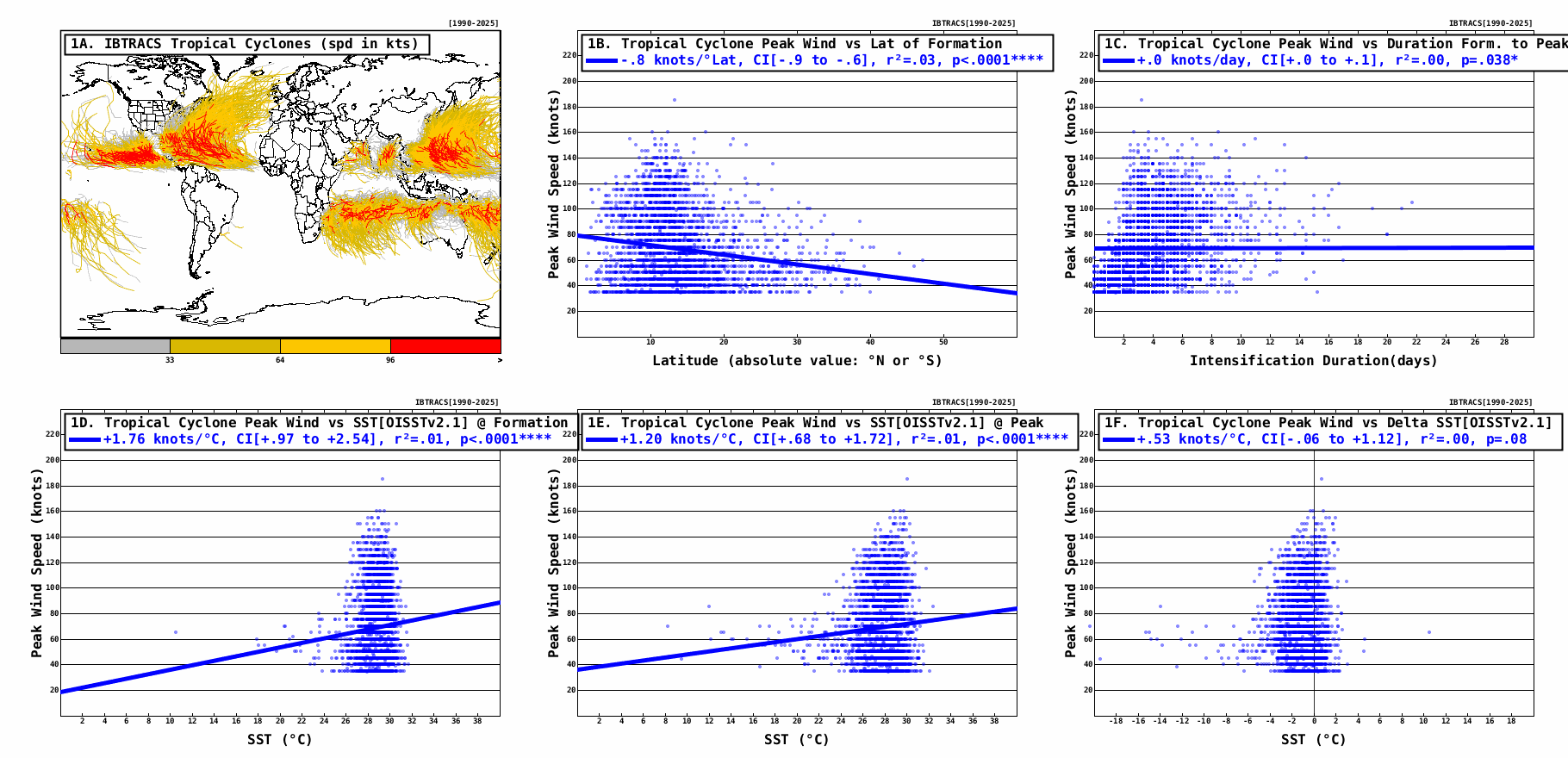
I took a look at this using IBTRACs, OISST and ERA5 for shear and assessing the ITCZ location.
In figure 1E, there is a relationship between tropical cyclone peak intensity and sea surface temperature at peak,
-HOWEVER-, this relationship is extremely weak (r²=.01, 1% of variance explained)
-and- the slope is also weak (~1 knot per °C).
Further, this relationship may be because SST and wind shear co-vary.
SST tends to be highest closer to the equator and decrease poleward, figures 2.
-Average- wind shear (not instantaneous, which is more significant) is complicated but also tends to exhibit increase poleward during peak seasons in the various basins.
Across basins and across seasons (figures 5),
seasons occur when the ITCZ (providing the low level convergence kernels of circulation) wanders into the basin, the average shear is low, and the average SST is high. Is it the high SST or the low shear?
1. When categorized (figures 6), storms which reach major hurricane status tend to do so at slightly higher SSTs.
2. That may be because storms which reach major hurricane status tend to do so forming AND peaking at lower latitudes where SSTs are higher (6D & 6E ).
3. Also, forming at lower latitudes means these storms intensify for a longer period ( maybe because the "Beta-plane" effect is reduced ).
4. Another aspect is in Figure 6C, MOST storms reach peak intensity over waters with SST LOWER than those over which they formed.


Climate Observer retweeted

The "Super" El Nino Will Weaken Super Fast
cliffmass.blogspot.com/2026/…
Climate Observer retweeted

Like and RT this status if you would genuinely like to see President @realDonaldTrump and VP @JDVance award the Presidential Medal of Freedom to Dr. Thomas Sowell.



Climate Observer retweeted

Except it isn’t.
Dayspring argued with me over this that Daniel Steinberg’s seminal research showing oxidation of the polyunsaturated fatty acids in the LDL particle membrane is *the* central mechanism driving its accumulation in atherosclerotic plaque is “outdated” because “LDL aggregability” is an independent driver of macrophage uptake.
Steinberg died a few years ago. But he was #3 just below Brown and Goldstein in LDL receptor fame and he chaired the 1984 NIH Consensus Conference that solidified the consensus that LDL-C “causes” heart disease, and his lab’s work laid out the central mechanism by which LDL particles wind up in plaque.
The problem with Dayspring’s argument is that
a) oxidation itself is a major driver of LDL aggregability and
b) the other major driver is the ratio of choline to saturated fat, which just happens to also be a major determinant of fatty liver disease.
The reality is every mechanism through which LDL particles wind up in plaques is completely separable from their concentration.
There are zero drugs and zero clinical trials that can distinguish between the impact of concentration versus the impact of oxidation.
This is a MECHANISTIC claim, not an “outcomes” claim so you MUST rely on mechanistic research to answer the question.
On this mechanistic claim about concentration being the driver, Steinberg’s graph from 1983 remains undefeated, shown below.
The range at which macrophage uptake of non-oxidized particles (bottom line) plateaus is massively below the physiological range, below an ApoB of 5 or an LDL-C of 7.
Meanwhile, oxidation (top line) causes a 5-fold increase.
So at physiological concentrations, concentration is irrelevant and oxidation is paramount.


Peter Attia sums it rather succinctly:
"Atherosclerosis is driven by the number of apoB-containing particles in circulation, and that relationship holds regardless of how or why those particles are elevated."
Here's your statin.
peterattiamd.com/there-is-no…

Climate Observer retweeted

Or, as Adam Smith put it in a quote that pretty much defines our age, “Virtue is more to be feared than vice, because its excesses are not subject to the regulation of conscience.” bloomberg.com/opinion/articl…

Climate Observer retweeted

UNBELIEVABLE
British police are now ARRESTING a man after being accused of calling someone a "muppet".
1984 has arrived - This is not an exaggeration 👇
Climate Observer retweeted

TRIFECTA VALIDATION
New study.
Self-reported food hedonic overeating is all about:
HIGH ENERGY DENSITY CARBS + FAT.
WORSE:
1. High energy density.
2. Fat.
3. Carbs.
BETTER:
1. Low energy density.
2. Fiber.
3. Protein.
NOT IMPORTANT:
1. Ultra-processed.
2. Carb-to-fat ratio.


Climate Observer retweeted
"It is a challenge that needs sensible policies."
This is not substantiated.
While global Tave has increased, most presumed adverse trends are insignificant or actually decreasing, including:
tropical cyclones, drought, heatwave, fire, etc.
Scary story propaganda tool.
Climate Observer retweeted
"It is manmade."
I have a bit more of an issue with this:
Over the CERES record, RF increase appears to be TWICE AS LARGE from albedo than from GHGs.
Perhaps more accurate:
"Global warming is 31% man made, 69% natural."
