

Introverted Optimist, Building @AgletsAI. Dot Connector, Tool Builder, Coder, and Geek. Into Data, Local & Sovereign AI, SLMs, RL, and making hard things easier
Now YVR | Soon Everywhere
Joined June 2008
- Tweets27.2K
- Following252
- Followers2.1K
- Likes32.5K


I asked Neon to do some research and while it’s internal search tool is surprisingly limited when it comes to dealing with page size I really like the message it gave me informing me it couldn’t do the task. Note: in my prompt I was explicit that it should only create the artifact if the sources could be confirmed as authoritative and concrete. In any previous Gemini model this type of query likely would’ve resulted in hallucinations and an inaccurate artifact regardless of my prompt.
Every time I use Neon for a task I would’ve previously not used a Gemini model for I’m coming away impressed. Even when it can’t fulfil the task requirements.
Neon Message:
Retrieval Limitation on My End:
All three reference pages are large enough that my web-browsing tool truncated them mid-page.
[a list of the URLs giving it issues and the line it was truncated at in each file!]
Completing the Markdown file from truncated fetches would force guesswork on exact …
86
Ouchie and FYI in case you missed the announcement.
Comparing to last week, you will reach your limits 40% faster on GPT-6.2 Astra and 25% faster on Sol.

Sorry we got this wrong. Your banked reset is now live for everyone on Go, Plus, Pro, and Business.
Even with the fix, you should still get more usage out of 6.2 Astra and Sol than you did with 6 Astra and 6.1 Sol.
1
183
Everyone needs to be paying more attention to what the team at FastIno (@fastinoAI) is doing.
I’m biased. I have liked their models since pre-LLM days but I find their approach so solid I think more should take note.
Selfishly I want as much info on their training agent as possible. Full disclosure I’m building the same tooling so comparing helps me. 😉

Curating a good training dataset is one of the most difficult challenges when fine-tuning.
We spent a lot of time working through this problem in the early days of Fastino when we were first training GLiNER.
Now, the tooling we originally built for internal research is part of our Fastino Training Agent.
@urchadeDS and Julia, two members of our founding research team, sat down to talk about how our approach to data generation has evolved and what we've learned along the way.
Watch the full video: youtu.be/uCuPK9yaczE?si=rFQW…

Another impressive release from the lab but with a couple of restrictions, one I find potentially limiting.
If your enterprise generates over 2 million in revenue you need a commercial license. I know some will hate this clause but imo it’s more than fair. If you’re generating revenue from the model and model license revenue is this companies way of making income then it makes sense. My only personal worry about this type of clause is percentage of revenue. Say the model is responsible for 100K of revenue how is the license priced vs if it is responsible for 1 million in revenue. I’d want to know that up front.
The second clause is a bit more troubling for me. Taking your funding into account is a tough sell for me. At least at the 2 million dollar threshold. I’d need to think about this before choosing it.
Still an awesome release and again if we generate revenue from a model no reason the model maker shouldn’t either so I hope they don’t have to deal with people screaming about this. If you want to keep all the benefits for yourself and don’t like it pick another model.
Great job team. 👍

Today we are open-sourcing the weights to OCRia-1, our flagship 4B VLM for document OCR 🔥
This is our SECOND open-weight release in two days (we just launched OCRia-nano-1 yesterday!!).
OCRia-1 is on the pareto curve of accuracy and cost relative to other 4B models on multiple benchmarks: ParseBench, olmOCR-bench (tables), PulseBench-Tab, and fr-bench-pdf2md. It is an extremely general purpose model that can parse even the most complex document types, including complex tables/charts/formatting/layout.
We’re releasing the weights to help advance open research around OCR, on both @huggingface 🤗 and @ollama 🦙
If you want to use it in prod, come talk to us. If you want to use the latest SOTA of the OCRia model family, tuned for production, check out LlamaParse!
Release on @huggingface : huggingface.co/llamaindex/OC…
Release on @ollama: ollama.com/llamaindex/ocria-…
LlamaParse: llamaparse.ai/
63
Ok. What gives Google⁉️
I’ve given Neon a slice of my core project PRs, including a few I consider tough asks, and while the results weren’t perfect across the board it nailed most of the implementations.
Neon is the real deal and I’m both chuffed and dumbfounded.
This might be the most surprising model release of the year.
Until now, I wouldn’t touch a Gemini model for code or long-horizon agentic tasks. Anything I’d bet my startup on, really. They were imo garbage.
Seriously, I have no idea how Google pulled this off. Before Neon I considered Google a benchmaxxing lab with real work performance coming no where near what the benchmark scores would suggest.
But at this token price, I think a lot of people are going to use it. If they can get over their skepticism and give it a try like I did that is. I literally only tried it because people were reporting it excelling at actual work not just demo slop. Even then I went in with an attitude of, “yeah right”.
What might be most crazy is Neon is a medium-sized model. If Google builds a large-size model and the performance scales with it, the other two big labs will have serious competition at the frontier. In fact with Neon they already do on many tasks.
Those are two big ifs. This thing is a unicorn🦄. I hope Google can do it again. Congratulations where congratulations are due. 👍
1
40
Christopher retweeted

Llama can now run several models at the same time.
Here's a support inbox that uses three of them, all on your Mac 🦙
Umm. Google made a model that’s actually good in my testing so far. It actually writes code that doesn’t make me barf. I need to do more testing though. Still. What the heck happened⁉️
Up until now I’ve found all closed Google models to be well pretty much crap. I liked a lot they did with their open weights models (Gemma) but the models they wanted me to pay for were bizarrely bad.
Hello Neon. Nice to meet you.
So far I’m testing it as a code reviewer and it feels like it can really handle the job.
PS. It’s priced kind of “cheaply” as well. Bonus. ✨
1
112
Build a database, I said…
How hard could it be, I said…
I’d tell you where all the time went, but you’ll be able to query that trace soon.
57
There’s now any number of Decision Models, many with quite different architectures.
I’m most partial to @fastinoAI (it’s where I go first) and CloudFlare’s Clef take on the System 1 model design (as well as @liquidai’s D1 family) but this new design from @StartLuxAI I stumbled on while doing research is a direction I was thinking about and they executed on so I’m very excited to dig deeper.
Note: While I think this one is definitely worth a deeper look especially in some judge tasks i don’t see it replacing my GLiNER2.5-Decide (or Cloudflare’s Clef) model use completely. I still need to explore where it’s best matched - more to come.
Open decision models from 0.8B to 27B: a calibrated probability for every option in one pass, and a short thought only when unsure:
decision.startlux.com/
github.com/StartLuxLabs/Star…
arxiv.org/abs/2610.17309
Have you deployed this in any substantial experiments? If so I’d like to hear about what and where?
1
2
75
Come for the adapter stay for the methodology.
The adopter is cool and is another indicator of the direction we’ll be headed in 2027 with domain/task model/adapter and tiny harness pairing.
imo anyway.

Introducing Qwen3.8-27B-pi-adapted 🤗
We adapted Qwen's model specifically for the pi coding agent using reinforcement learning and a LoRA adapter.
The results, measured as pass@1:
🚀 SWE-bench Pro (Hard 51): 29.4% → 62.7%
💻 Terminal-Bench 2.1: 39.5% → 55.8%
⚡ 55–62% fewer tool calls per task
This is the power of open models: you can adapt them to YOUR tools and YOUR use cases. Let’s build! 💛
Open weights: huggingface.co/harness-hub/Q…
Methodology: huggingface.co/blog/harness-…

66
Basically one of my Dream Jobs. If I wasn't building my own startup I’d be all over this. It’s the kind of role that even makes me think. Working with high performing teams, building new and novel solution that’ll change everything. Working with people, prototyping, liaising. It’s an amazing role.
Check it out.

Apply here (locations: London 🇬🇧, Berlin & Munich 🇩🇪, Paris 🇫🇷 and Stockholm 🇸🇪)
jobs.ashbyhq.com/openai/980b…

43
I almost feel sick admitting this given my disdain for Dario’s let’s call them antics to be generous but I spent some serious time with Opus 5.5 this week and I really liked it.
I’ve been an OpenAI model guy for my development work since 5.0 and for the most part the models have done the job I asked but Opus 5.5 seems to follow the OpenAI GSD, don’t wander work model but smarter. Well as long as you are explicit in your tasking, if not it can still wander. Just much less than before.
Guess I’ll be shipping Dario some cash. I’m not dumping the OpenAI models but for critical coding tasks right now it feels like Opus 5.5 is the way to go with Sol used for simpler code tasks. Note: I haven’t found Fable 5.2 all that impressive vs Opus but maybe that’s because it’s more of what I remember Anthropic models to be like. Too smart for their own good or mine.
This is strictly a coding task decision. I’m much more multi-model for non-coding work.
1
1
183
Hi Ksenia (@TheTuringPost),
Your post on The Anxiety of Abundance really resonated with me. ✨👍
I posted something adjacent on X recently, though from a different angle, exploring engineering flow state and the mental fatigue of working with agents.
TL;DR: We've dramatically reduced the cost of execution without proportionately reducing the mental demands of deciding what deserves execution.
Looking at how my own workflow and those of other senior engineers I know have changed (and keep changing), I’ve been wondering: Is flow state dead?
Not because agents have made me less productive, or because I dislike working with them. Quite the opposite. I couldn’t be building the startup I’m building today without them. I have absolutely no desire to go back to manually writing every line of code, or having to grow a team before I can pursue something ambitious. Agents have allowed me to be much more ambitious about what I’ve chosen to build, they’ve allowed me chase the idea that matters to me, all while being much more deliberate about when to grow.
But the work itself has changed.
I used to spend hours immersed in code once I’d figured out the direction. That was often when my brain got a chance to cool down. Now I can have many agents working simultaneously, each making progress, each coming back with something I need to read, understand, evaluate, or make a decision about.
And I can always spin up another thread. Even when the tasks are fully autonomous, keeping track of them all carries a cognitive cost.
The productivity is extraordinary. So is the mental load.
And it’s not just the agents. The pace of change is astonishing. Every few weeks something arrives that changes what’s possible, or at least how we might approach it.
Suddenly we’re not just deciding how to do something and immersing ourselves in executing it. We’re constantly reconsidering what to build, what to pursue, what to abandon, and whether yesterday’s decisions still make sense today and going forward.🤔
And oddly, the better I get at managing all of this, the faster everything seems to move, the more i worry my brain will overheat.
I’ve come to the conclusion there’s an enormous difference between having more possibilities and having the capacity to make good decisions about them.
I think that’s what makes your observation about the anxiety of abundance so interesting. We’ve dramatically expanded our capacity to execute, but the human attention needed to direct all that work hasn’t expanded along with it.
I think we need to really think about how we work with agents. The objective can’t just be maximum parallelism. It needs to be sustained useful progress without exhausting the person directing the work.
Better workflows, fewer unnecessary decisions, less context switching, and systems that learn from what we’ve already done rather than asking us to revisit the same decisions over and over.
I’m biased, of course. I’m building in the broader RSI space, where learning from experience is a big part of the work. But there’s a human side to this too.
Perhaps it’s simply knowing when to stop adding more work simply because we can?🤔
2026 has been something of a petri dish for figuring out what these tools make possible. I’d love 2027 to be the year we start getting serious about making the way we use them sustainable.
Because I don’t want to go back. Not for a second.
But I would very much like my flow state back.
turingpost.com/p/ai-agents-a…
Thoughts?

1
106
Well this is interesting… If you’re into decision models anyway. 🤔
Flide is fast inference infrastructure for Jev-style decision models.
They’re reporting for these System 1 models it’s up to 9.5 times faster than vLLM and SGLang, and every answer is the one the model gives the question alone. The speed up is wild considering we’re already getting fast answers with the models on existing infrastructure.
It serves the Jev /v1/systemone API.
Flide achieves this via Exact State Forking which allows a model to evaluate multiple questions from the same context simultaneously in a single GPU pass.
So it flattens the request tree into a single token stream on the GPU and uses ForkAttention to mathematically isolate each branch's context without duplicating data.
flide.org/
Is flow state dead?
I’ve been thinking about how radically flow state has changed for software engineers working with coding agents.
Have we traded the cognitive demands of implementation for the cognitive demands of continuously managing decisions? They require very different kinds of attention, and I’m not sure we’ve adapted.
I used to put on my headphones, fire up some electronic music and disappear into the code. Planning was always part of the work, but when it came time to build, I could get into a serious flow state.
Now the work is different.
I’m planning, launching agents, reviewing changes, handling exceptions, making decisions and keeping everything moving.
Even with autonomous execution and limited PR reviews, the rhythm is fundamentally different. There are interruptions everywhere, and maintaining the larger picture requires constant attention.
And here’s something I’ve been struggling to reconcile.
This isn’t nostalgia for writing code by hand. I couldn’t have built my startup 12 months ago. Coding agents have made that possible, and I’m without a doubt more productive than I’ve ever been. My agents can accomplish more in an afternoon than I could previously manage in a week. I wouldn’t go back.
But I’ve also never been this mentally drained. The productivity gains are real, but so is the cost of constantly switching context, making decisions and staying on top of it all.
We’ve parallelized execution, but we haven’t parallelized our attention.
I’m not sure we’ve figured out what flow state looks like in this new way of working. But whatever it looks like, we need to figure it out quickly.
The work has fundamentally changed, and I don’t think the old habits are going to carry us through. If we want to excel the way we did as engineers before agents, we need to rethink how we organize our work, manage our attention and sustain the kind of focus that lets us do our best thinking.
I’m already seeing signs of burnout among some of the most talented engineers I know. That’s worrying, especially when we’re supposedly entering an era where so much of the work is being done for us.
2026 has been something of a petri dish. We’ve been experimenting with new tools, workflows and ways of building software at an extraordinary pace.
I think 2027 needs to be the year we codify what actually works.
We need to design workflows that protect human attention as deliberately as we’ve designed systems that maximize agent throughput. Making agents more productive is only half the job.
I’m genuinely curious how others are experiencing this. Have you found a new flow, or are you still trying to figure it out?
5
3
114
An odd prize to celebrate this but I’ll certainly take it. #RTXON

We're giving away a Hogwarts Legacy custom wrapped NVIDIA GeForce RTX 5090 to celebrate its official release with DLSS 5 🪄
To enter:
🟢 Share this post
🟢 Comment #RTXON
Terms and Conditions: nvidia.com/en-us/geforce/con…

59
Christopher retweeted

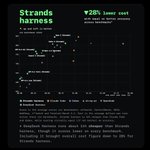
I burned a shitload of compute so you don't have to. Releasing the Harness Leaderboard.
Which harness should you run your open model in? I ran 28,849 trials to find out.
The leaderboard compares nine coding-agent harnesses on open models. In each comparison only the harness changes: the model, provider and reasoning effort stay fixed, and every task gets three attempts.
The trials ran GLM-5.3-Flash, DeepSeek-V4.1-Flash and Flint on Terminal-Bench 2.1 and DeepSWE, for $4,746 of inference.
Averaged over the three models, mini-swe-agent (@KLieret), a bash-only agent, solves 51.4% of tasks and @openclaw 27.3%. Four others are statistically tied with mini-swe-agent.
One of them is Pi (@pidotdev), at 49.4% for $0.29 per solved task, about 45% less than mini-swe-agent's $0.53.
The best harness depends on the model: mini-swe-agent on GLM-5.3-Flash, Hermes Agent (@NousResearch) on DeepSeek-V4.1-Flash and Kimi Code (@Kimi_Moonshot) on Flint.
@opencode costs $3.35 per solved task, 11.7 times as much as Pi.
See Harness Hub's Harness Lens for what the nine harnesses do differently. It documents the prompts, tools and compaction of 34 coding-agent harnesses and links every claim to its source.
Leaderboard: huggingface.co/spaces/joelni…
Harness Lens: huggingface.co/spaces/harnes…
Your company’s know-how is an asset. As AI agents take on more of the work, it could become one of your most valuable. How much of it are you actually capturing?
When AI learns from your work, you should be able to build on what it learns and capture the returns, whether that means better margins or new services you can sell.
That takes work on the data itself. Capture what matters, clean and validate it, and create examples that help you teach your AI and measure whether it’s getting better. Then apply what you’ve learned.
Active evals help you decide where to invest next. The patterns they reveal can point to gaps in your training data, missing context, or tools that need fixing.
Own your intelligence. Keep it, build on it, and profit from it.
1
60