

Machine Learning & Backend 😎 Founder of Humanity backed by Investors from Google, SF and Hong Kong.
Mountains
Joined June 2023
- Tweets1.7K
- Following365
- Followers437
- Likes1.3K
SimPWM: Making Robot World Models More Reliable
What if a robot world model could simulate actions before generating the video?
SimPWM combines a rule-based 3D simulator with video generation:
• Builds a 3D scene from just the first frame.
• Simulates grasping, carrying and releasing objects.
• Generates realistic videos while preserving explicit simulated state.
On 293 unseen DROID episodes, it achieved 0.777 robot IoU and reduced missed pick-ups from 54% to 38% compared with a robot-only proxy.
One fascinating finding: MiniMax-H3 follows simulated object states much better than LTX-2.3.
A promising step toward more controllable and physically grounded robot world models.
Paper: arxiv.org/abs/2611.32786
Code: github.com/TingtingLiao/SimP…
Project: sim-pwm.pages.dev


2
392
NVIDIA’s GTP: Training 2 Trillion-Parameter LLMs at 13 EFLOP/s
NVIDIA introduces Generalized Tensor Parallelism (GTP), a unified approach that combines existing parallelism techniques to make massive LLM training faster and more memory-efficient.
Key results:
13 EFLOP/s across 12,288 NVIDIA GB300 GPUs.
98% weak-scaling efficiency.
Supports 1M-token sequences on 512 GPUs.
Up to 1.55× faster than Megatron-FSDP.
The key idea: schedule parameter communication at the individual GEMM level, hiding more communication behind computation.
Code: github.com/NVIDIA/Megatron-L…

OmniEVIE: One Embedding Model for Everything
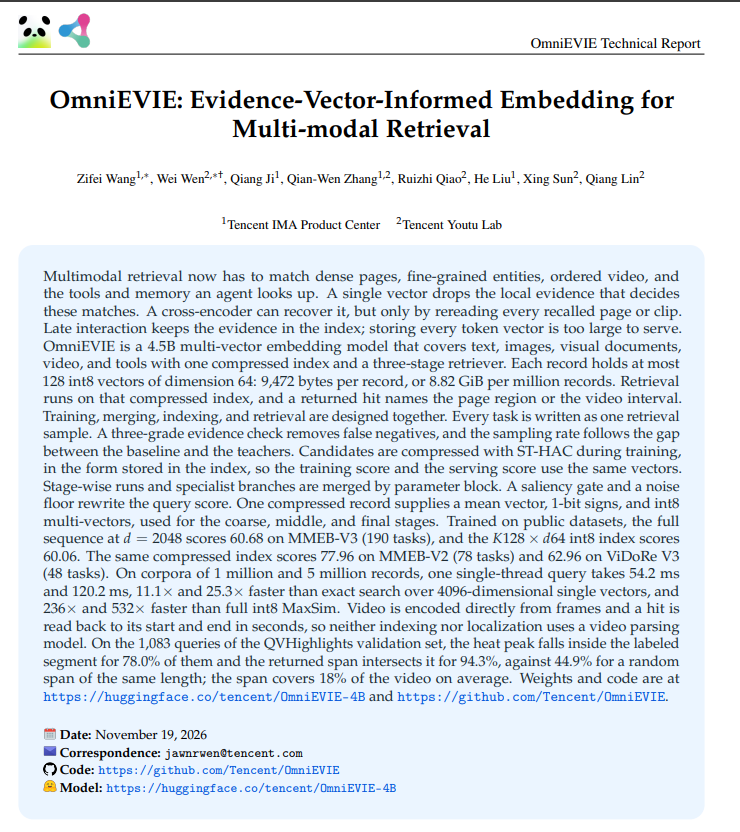
Tencent introduces OmniEVIE, a 4.5B multimodal embedding model that handles text, images, documents, videos, and tool retrieval using a single compressed index.
What makes it interesting?
Multi-vector retrieval: Preserves fine-grained evidence instead of compressing everything into one vector.
Extreme compression: Just 8.82 GiB per million records using 128 int8 vectors of 64 dimensions.
3-stage search: Combines mean vectors, 1-bit hashing, and int8 scoring.
Video understanding: Retrieves relevant moments with timestamps, without a separate video transcription model.
Evidence localization: Identifies the exact page region or video segment behind a match.
The results:
60.06 on MMEB-V3 (190 tasks).
62.96 on ViDoRe V3.
94.3% video segment localization accuracy.
236× faster than full int8 MaxSim on 1M records.
Just 54.2 ms retrieval latency on 1M records.
The bigger idea: Don't just retrieve the right document. Retrieve the exact evidence inside it.
This could be a powerful foundation for faster, more capable multimodal RAG and AI agents.
Paper: arxiv.org/abs/2611.32203
GitHub: github.com/Tencent/OmniEVIE
Model: huggingface.co/tencent/OmniE…
2
205
VideoJev: Making Video AI 100× Faster
What if video models could make decisions directly instead of generating answers token by token?
Meet VideoJev, a System One model that unifies video understanding and temporal grounding through direct candidate scoring.
Key highlights:
4B and 35B-A3B model variants.
Locates events in videos and answers multiple-choice questions.
Reuses video computation across multiple queries.
2.8–3.1× faster temporal grounding.
100×+ faster video QA compared to Thinking models, with comparable accuracy.
The bigger idea: encode a video once, then answer multiple questions with minimal additional computation.
A promising step toward faster, more efficient visual agents.
Paper: arxiv.org/abs/2610.18615
GitHub: github.com/MCG-NJU/VideoJev
Project: mcg-nju.github.io/VideoJev/

𝗦𝗲𝗻𝘀𝗲𝗡𝗼𝘃𝗮-𝗟𝗼𝗼𝗽-𝟵𝗕: 𝗔𝗻 𝗔𝗜 𝗠𝗼𝗱𝗲𝗹 𝗕𝘂𝗶𝗹𝗱𝗶𝗻𝗴 𝟯𝗗 𝗗𝗿𝗲𝗮𝗺 𝗪𝗼𝗿𝗹𝗱𝘀
A developer ran SenseNova-Loop-9B locally using MLX 8-bit on a Mac Studio M5 Ultra and asked it to create something magical.
A giant flying whale drifting through golden clouds, carrying an entire storybook village on its back!
What's impressive?
• Generated the experience in six independent code sections.
• Debugged broken components using console errors and screenshots.
• Wrote its own code using Three.js.
• Added interactive camera controls and three
environments: golden hour, sunrise and starry night.
The result is a fully interactive 3D world built through local AI inference.
We're getting closer to AI models that don't just generate code but build entire interactive experiences.
Model: huggingface.co/sensenova/Sen…
GitHub: github.com/OpenSenseNova/Sen…
𝗥𝘂𝗻𝗻𝗶𝗻𝗴 𝗮 𝟮𝟲𝗕 𝗔𝗜 𝗠𝗼𝗱𝗲𝗹 𝗼𝗻 𝗮𝗻 𝗶𝗣𝗵𝗼𝗻𝗲 𝟭𝟲 𝗣𝗿𝗼
Atomic Chat has successfully run Inkling 2 Mini (26B) on an iPhone 16 Pro with just 8GB RAM.
How did they do it?
• 1-bit quantization reduced the model to 6.88GB.
• Expert offloading streams MoE experts directly from phone storage.
• Frequently used experts stay in memory.
• Parallel expert loading improved decoding speed by ~40%.
The results:
Decode speed: ~3 tokens/sec
Time to first token: 3.1 seconds
Memory budget: Just 4GB for weights, KV cache and buffers.
It's slow, but the impressive part is that a 26B model actually runs on a smartphone.
The future of local AI is getting interesting
GGUF: huggingface.co/AtomicChat/In…
App: atomic.chat
2
8
627
GameAnything: Turn Any Inspiration Into a Playable Game
What if you could turn an image, video, or other creative reference into a playable game using AI?
Researchers from UC San Diego and Aether AI introduce GameAnything, an open-source agentic platform that does exactly that.
Key highlights:
Converts multimodal references into playable game extensions.
Uses coding agents to build and modify game worlds.
An independent AI critic playtests the game and identifies problems.
Persistent memory helps agents refine their work across iterations.
A new benchmark evaluates both gameplay quality and functional correctness.
The results show that AI agents can recreate reference content, but still struggle with precise changes and genuinely playable interactions.
The goal is moving beyond AI-generated game assets toward AI that can build and improve entire game experiences.
Try it: huggingface.co/spaces/GameAn…
Code: github.com/AetherLabsAI/Game…
Benchmark: github.com/AetherLabsAI/Game…

5
330
Meituan-Robotics-0: A Robot That Can Learn, Adapt, and Remember
Meituan introduces MR0, a Vision-Language-Action foundation model designed to make robots better at real-world desktop manipulation.
Key highlights:
147M vision-language samples and 15,060 hours of robot data across 12 embodiments.
A 3-stage training pipeline combining multimodal pretraining, continuous action learning, and real-world corrections.
Introduces Rollback + CFG-DAgger, helping robots learn from both failed actions and human corrections.
Persistent event memory allows robots to remember previous tasks, recover from interruptions, and resume unfinished objectives.
Achieves 93.6% success on RoboTwin 2.0 and 70% on Ethernet insertion with CFG-DAgger.
The interesting part isn't just teaching robots how to perform tasks. It's teaching them how to recover from mistakes, remember what happened, and continue working.
Robotics is moving from reactive policies toward persistent, intelligent embodied agents.

2
8
453

𝗕𝗲𝗮𝗺 𝗠𝗼𝗱𝗲𝗹 𝗧𝗲𝗰𝗵𝗻𝗶𝗰𝗮𝗹 𝗥𝗲𝗽𝗼𝗿𝘁: 𝗪𝗵𝗮𝘁 𝗬𝗼𝘂 𝗖𝗮𝗻 𝗟𝗲𝗮𝗿𝗻 𝗙𝗿𝗼𝗺 𝗮 𝟱𝟬𝟭𝗕 𝗣𝗮𝗿𝗮𝗺𝗲𝘁𝗲𝗿 𝗠𝗼𝗱𝗲𝗹
The Reflection team has released the Beam Technical Report, offering insights into how large-scale AI models are built, trained, optimized, and deployed.
Beam is a sparse Mixture-of-Experts (MoE) model with 501.3B total parameters and only 23.4B active parameters.
Here are some interesting things you can learn from this report:
• MoE Architecture: How models activate only a small portion of their parameters for each token, reducing inference costs.
• Long Context Training: How Beam achieves a 1M-token context window through a two-stage midtraining process.
• Large-Scale Reinforcement Learning: How asynchronous RL works at scale, using 10.5K GB300 GPUs and over 100M rollouts.
• Inference Optimization: How FP8/NVFP4 quantization and speculative decoding improve serving efficiency.
• Hardware-Model Co-design: How model architecture and GPU infrastructure are optimized together.
• AI Safety: How Beam balances refusing harmful requests while responding to legitimate ones.
Why read it?
This report provides a practical look at the engineering behind frontier-scale AI models, from architecture and training to inference optimization and deployment.
link: arxiv.org/pdf/2611.26358

1
10
834