

Postdoc at Liam Holt at NYU Langone studying the Physics of Aging
New York, USA
Joined December 2010
- Tweets61
- Following255
- Followers55
- Likes40



David C. Duran-Chaparro retweeted

NEW PREPRINT: Scientists may have found direct evidence that aging is driven by the loss of cellular information, not just the accumulation of damage
For decades we've focused on what aging cells accumulate. This paper focuses on what they lose: Information.
Using a new technology called SeqTag, researchers measured gene expression, chromatin accessibility, and histone modifications in the same aging cells.
What they found was striking: the regulatory systems that tell cells who they are become increasingly out of sync with age. The authors call this "molecular asynchrony."
As cells age, chromatin structure, histone marks, and gene expression begin drifting apart. Regulatory entropy rises. Repressive chromatin erodes. Cells become less certain of their identity and more likely to drift toward alternative fates.
This is what the Information Theory of Aging (ITOA) states: that aging occurs when cells lose epigenetic information, the instructions that tell the genome how to maintain youthful function. DNA may remain largely unchanged, but the system that reads it gradually loses fidelity.
What's remarkable is that this paper doesn't just describe this phenomenon. It quantifies it. The authors measure increasing regulatory entropy, loss of H3K27me3-mediated repression, erosion of heterochromatin, weakening lineage fidelity, and increased cell-fate drift during aging. In progenitor cells, the barriers that normally preserve cellular identity become progressively weaker with age.
Mechanistically, the study argues that aging is associated with increasing molecular asynchrony between chromatin accessibility, H3K27ac/H3K27me3 remodeling, and transcriptional state.
This decoupling is accompanied by increased regulatory entropy, loss of repressive chromatin architecture, and weakening of lineage constraints. Genes affected are those involved in chromatin organization, DNA damage, and Wnt signaling, consistent with ITOA.
Importantly, the authors provide quantitative evidence that age-related heterochromatin erosion lowers the energetic barriers that maintain cell identity, offering a potential mechanistic link between epigenetic information loss, cell-fate drift, and late-life disease susceptibility 👏

David C. Duran-Chaparro retweeted
After 25 years of brave & brilliant work by hundreds of scientists in my lab to understand then safely reverse aging for the first time, it was moving to witness the first human dose being delivered 🥹 nature.com/articles/d41586-0…

We're excited to share Version 2 of our 50nm-GEMs paper!
This update includes new mammalian cell data and simulations that help us better understand the behavior of these particles. If you're interested in GEMs, we'd love to hear what you think.
Paper: biorxiv.org/content/10.1101/…

1
25
Deeply honored to be a co-author on this paper published today in Nature.
Congratulations to @wang_shunzhi, David Baker, and the entire team on this achievement. Grateful to have been part of the work.
Check it out:
nature.com/articles/s41586-0…
1
35
David C. Duran-Chaparro retweeted
New! What if aging is a symptom of cells losing the ability to read their genome - and there’s a reset switch?
That’s the idea behind the Information Theory of Aging (ITOA)
A new paper @NatureComms by Cohen et al provides strong support for the model & its reversibility 🧵👇

David C. Duran-Chaparro retweeted
Thank you for all your support!
Early access to Season 2 @ lifespan.com
🤖 Made with AI

David C. Duran-Chaparro retweeted
Interesting to see such positive media coverage of my lab & spin-out companies. We’ve seen this before:
1997 - 2009 Positive
2010 - 2014 Negative
2015 - 2021 Positive
2022 - 2024 Negative
2025 - now Positive
Our science is at least consistent 🙏
nypost.com/2026/04/18/scienc…


David C. Duran-Chaparro retweeted
More evidence for:
1. The Information Theory of Aging (ITOA)
2. The Observer, ie backup copy of youthful gene expression
3. Age reversal by OSK being an embryonic reset

Genome-wide association study of proteomic aging reveals shared genetic architectures with longevity, early life development, and age-related diseases
medrxiv.org/content/10.64898…

David C. Duran-Chaparro retweeted
Modeling across seven nations shows that swapping meat and sweets for beans, nuts, and whole grains could add a decade to life expectancy ajcn.nutrition.org/article/S…

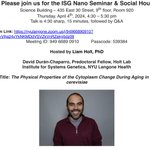
This month we are hosting an amazing team from Europe doing some cool experiment on our cells! They are presenting their work today at our nano seminar!
lnkd.in/eBJBv6Mr

32
David C. Duran-Chaparro retweeted
Statistically, you should not exist:
– Life-friendly universe: 1/10⁶⁰
– Earth + moon: 1/10⁹
– Multicellular life: 1/10⁴
– Intelligence & civilization: 1/10⁹
– Your genome: 1/70 trillion
You’ve already won the lottery 10 times in a row. Ignore small people & enjoy!
David C. Duran-Chaparro retweeted
On October 1903, @nytimes boldly declared it would take humans 1–10 million years to invent a flying machine. The Wright brothers proved them wrong just 69 days later

David C. Duran-Chaparro retweeted
A new study of 3720 people finds that low quality diets (e.g. refined grains, sodium, solid fats, added sugar & alcohol) associate with a faster pace of aging than healthy diets (e.g. whole fruits, greens, beans, dairy & whole grains) 🧵...

David C. Duran-Chaparro retweeted

New Jersey was ranked the third best state to live in by @wallethub — leading the nation across safety, education, health, and quality of life.
From investing in education to expanding access to health care, we are proud to live in the Garden State.


Congratulations @MassGov, @idahogov, @NJGov, @WiStateJournal & @MNSecofState for being 2025’s best states to live in:
wallethub.com/edu/best-state…

David C. Duran-Chaparro retweeted
Time-restricted eating improves insulin sensitivity and lowers blood pressure, even without weight loss.
—Cell Metabolism, 2018
🔬 Excited to present my work this Thursday, July 17 at 12 PM at Liam Holt’s lab (NYU ISG)!
🧠 "Aging cells die not just from damage—but from a breakdown in communication."
Join us on Zoom: lnkd.in/eDqZ25i2
#Aging #SystemsBiology #Yeast #CellBiology #NYU #CGSB

1
36