

GlobalCitizen|Rotarian|Singer|Speaker|Writer|Artist|Student@Life|RT isn’t Endorsement|Views-R-Personal
Joined April 2009
- Tweets28.1K
- Following4.5K
- Followers3.9K
- Likes2.5K






Pinned Tweet
People in the decision making position, be it in government, judiciary or any private organisation should better remember that the universe does not carry debts. It always returns back to you what you gave it. #Karma
The meaning of karma is in the intention. The intention behind action is what matters.
Before you act, you have freedom, but after you act, the effect of that action will follow you whether you want it to or not. That is the law of karma.
“Too big to replace” is not a leadership badge of honor—it is a corporate governance failure.
When a Board reverses its own definitive decision within eleven days—reinstating a CEO while an independent investigation into conduct, compliance, and export-control exposure is still ongoing—it raises a fundamental question for every boardroom: Where does institutional governance end, and "founder indispensability" begin?
NVIDIA’s decision to bring Jensen Huang back as President, CEO, and Board Director, just days after stating it had no plans to do so and while independent counsel continues its review, is a textbook case study in high-stakes corporate governance.
Beyond the immediate stock rally, what message does this rapid U-turn send?
1. To the Markets:
Short-term market relief is not the same as long-term governance confidence. Reinstating an executive before an independent probe concludes signals that market capitalization and product velocity can override due process. It also exposes a glaring succession vulnerability—an over-reliance on a single individual that turns every personal lapse into a systemic valuation risk.
2. To the Industry:
It reinforces a dangerous double standard in corporate leadership: governance guardrails are rigid for professional managers, yet negotiable for iconic founders. When external lobbying and political assurances appear to accelerate a boardroom reversal, it blurs the line between independent fiduciary oversight and reactive crisis management.
3. To Employees:
Nothing erodes internal culture faster than perceived asymmetry in accountability. Every organization preaches zero-tolerance compliance, ethical conduct, and conflict-of-interest policies. When rank-and-file employees face immediate, irreversible consequences for policy breaches, while the top seat is restored mid-investigation, trust in institutional fairness takes a quiet but lasting hit.
Establishing a new National Security Oversight Committee:
True governance is tested not by the committees a board forms, but by whether it allows its own due process to run its full course before acting.
In the long run, no company is stronger than the integrity of its governance.
Core Risks:
- Erosion of Board Independence & Credibility: Reversing a unanimous stance within days—especially after external pressure from investors or peers—signals that the Board can be swayed, weakening its authority in future crises and inviting shareholder activism or derivative lawsuits.
- Compromised Due Process
- Key-Person & Succession Paralysis
Two-Tier Accountability & Cultural Cynicism: Creating visible exceptions for top performers breeds compliance fatigue, weakens whistleblower confidence, and exposes the company to legal claims of inconsistent disciplinary enforcement.
- Heightened Regulatory & Geopolitical
#CorporateGovernance #BoardOfDirectors #ExecutiveLeadership #SuccessionPlanning #RiskManagement #NVIDIA #EthicsInBusiness #Leadership

24
Elon Musk’s warning about a 2027 AI "cash crunch" is making the rounds—and stripped of the sensational headlines, his actual point is one every tech leader should pay attention to.
He isn’t saying AI demand is collapsing. He’s highlighting a working-capital timing mismatch: hyperscalers are spending over $700B+ in 2026 on GPUs and infrastructure months before those clusters can be powered, cooled, and brought online to earn revenue. When power grids, transformers, and liquid-cooling supply chains bottleneck globally, capital gets trapped in uncommissioned hardware.
So what does a global AI capex crunch mean for India’s Data Center industry and Indian IT professionals in 2027?
1. India’s Data Center Boom: Insulated by Demand, Tested by Execution
India generates ~20% of the world's data while hosting under 3% of global data center capacity. With ~1.8 GW operational and nearly 3.9 GW in the pipeline, domestic demand isn't slowing down—backed by DPDP Act localisation mandates and the Union Budget’s 20-year tax holiday for foreign cloud providers.
The shift: Global capital will get more selective. Operators with secured renewable PPAs, submarine cable access (Mumbai/Chennai), and high-density liquid cooling readiness will thrive. Leveraged players facing grid-connection delays will feel the financing squeeze.
2. Indian IT Professionals: From "AI Hype" to "ROI & Implementation"
According to Gartner’s latest forecast, overall IT spending in India will grow 10.6% in 2027 to ₹16.9 trillion—led by a 40.3% surge in IaaS and 28.4% growth in data center systems, while traditional IT services grow at a more measured 6.2%.
The shift: As global enterprises scrutinize their AI budgets, clients won't pay for endless Proof-of-Concepts (PoCs). They will pay for cost optimization (FinOps), AI-to-cloud integration, workflow orchestration, and measurable ROI. Routine maintenance roles face margin pressure, while engineers who can make AI deployments leaner, faster, and production-ready will be in peak demand.
The takeaway: 2027 won't be the end of the AI wave—it will be the year discipline returns to AI economics. For India, that’s less of a crisis and more of a competitive advantage, provided we execute on power and upskilling.
How are you seeing AI budgets shift for 2027—tighter scrutiny or faster deployment?
#ArtificialIntelligence #DataCenters #IndianIT #CloudComputing #TechTrends2027 #FinOps #DigitalIndia

2
31
Job hunting across multiple portals in India might soon get a lot simpler.
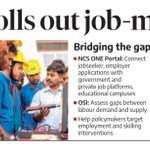
The Ministry of Labour & Employment has rolled out NCS ONE (Open Network for Employment)—a new platform built to connect jobseekers, employers, state portals, educational campuses, and private job boards onto a single integrated network.
Key highlights from the launch:
Unified Access: Connects government, campus, and private recruitment platforms in one place, supported by AI voice and chat bots.
Occupational Shortage Index (OSI): Identifies skill and talent shortages across sectors to guide career choices and targeted skilling.
Expanded Offline Reach: 8 Career Lounges launched, with 200 more planned across Tier-II and Tier-III cities.
A big step toward making hiring and career discovery more transparent and accessible across the country.
#JobsInIndia #CareerGrowth #Hiring #NCSONE #DigitalPublicInfrastructure #Employment

1
20

Innovation doesn’t always require cutting-edge tech—sometimes it requires looking closely at an everyday problem and designing for real human value.
A familiar example is Squatty Potty. After a doctor advised Judy Edwards to raise her knees while using a standard toilet to help with chronic constipation, her son built a simple wooden footstool to recreate a more angled posture.
They pitched it on Shark Tank in 2014, raised $350,000 from Lori Greiner, and grew the business to a ~$31M+ acquisition in 2021.
For people in India, raising the knees during bowel movements isn’t a foreign concept—squatting posture is widely practiced in traditional Indian toilets, and posture research (such as Dov Sikirov’s 2003 study) has explored how posture affects emptying time and straining.
At the same time, real-world design has to balance physiology with everyday practicality: squatting puts more strain on knees and joints, which is why Western commodes remain essential for accessibility, seniors, and joint health—and why a simple footstool became a practical middle ground rather than a universal replacement.
Two takeaways for anyone building products or businesses:
- Solve a real friction point simply: You don’t need complex engineering when a clear insight and usable design solve a daily problem.
- Design with context and trade-offs: What works well in one setting or age group may create friction in another—great product thinking accounts for both.
Where have you seen a simple, low-tech idea win because it focused on practical value over complexity?
#Innovation #ProductThinking #BusinessValue #DesignThinking #Entrepreneurship
69
The Quiet Light That Shapes Greatness
Greatness rarely begins in grand palaces or spotlights. Often, it starts beside a flickering kerosene lamp in the quiet hills—where a mother works from dawn till dusk, tends the fields and cattle, and sits with her children so their minds can grow brighter than their surroundings.
In that simple, disciplined life in the hills, young Ajay walked through sal forests every day to reach his school, absorbing quiet resilience, humility, and focus.
When he later stepped into the Nath tradition in 1994 as Yogi Adityanath, and returned years later in 1998 to Panchur to receive his first alms from his mother, Savitri Devi offered far more than fruit, rice, and coins. Through tears and unspoken grace, she gave him a blessing of selfless surrender: you now belong to everyone.
How Those Roots Shaped Who He Is Today
Grounded in Simplicity: Growing up amid hill labor, forest paths, and modest means fosters a direct connection to everyday hardships and practical discipline—traits that remain central to Yogi Adityanath’s public persona and austere lifestyle.
Shaped by Duty Over Comfort: Renunciation in the Nath tradition demands detachment from personal gain, while a mother’s blessing reorients that detachment toward broader public service—shaping his decisive, mission-driven approach to leadership.
Anchored in Cultural Memory: Drawing strength from ancestral values, spiritual lineage, and selfless sacrifice gives his leadership a sense of continuity—turning private devotion into public responsibility for millions.
A mother’s quiet sacrifice does not end with time; it lives on in the character, courage, and purpose of the life she helped form.
Om Shanti🙏🏻
33
History was made on Wall Street yesterday, yet the market’s reaction tells a far more nuanced story than the headlines suggest.
Anthropic just completed the largest IPO in history—raising ~$81.3 billion in public offering proceeds (surpassing SpaceX’s $75B record earlier this year) alongside another $26 billion in private corporate placements, bringing the total capital haul to over $107 billion.
By the closing bell, shares jumped 17% to $97, cementing a $1.3 trillion basic market cap ($1.75 trillion fully diluted, after briefly touching $2 trillion intraday).
As a board leader and longtime observer of technology cycles, this milestone leaves me asking three critical questions:
1. What is the actual product underneath a $1.75T valuation?
Strip away the hype, and Anthropic’s core offerings—Claude models, enterprise APIs, and coding tools like Claude Code—are built on Large Language Models. By design, LLMs are probabilistic engines, not deterministic ones.
While revenue growth has been staggering (hitting $33.2 billion in the first nine months of 2026 alone), enterprises are paying massive premiums for systems that still require human guardrails, verification, and governance to prevent hallucinations in mission-critical workflows.
2. Can unit economics catch up to compute commitments?
Behind the record valuation lies a $104 billion net loss in the first nine months of 2026 and nearly $900 billion in future compute commitments. Public markets are notoriously less patient than venture capital. Sustaining a trillion-dollar multiple requires transitioning from top-line experimentation revenue to durable, high-margin enterprise profitability.
3. Is this the peak before a 2027 correction?
Notice the paradox of yesterday’s trading session: even as Anthropic soared, broader US tech indexes and chipmakers slumped, and Asian markets followed with sharp declines today. With the AI index already down nearly 20% from its October highs and mounting warnings of an AI equity correction in 2027, institutional investors are clearly questioning how long massive data-center capex can outpace real-world corporate ROI.
Record capital raises validate the ambition of frontier AI, but they do not guarantee invulnerability. As we move into 2027, the winners won't just be those who build the largest probabilistic models—they will be the enterprises that figure out how to govern them, integrate them with human judgment, and generate measurable bottom-line value.
Are we witnessing the birth of the next trillion-dollar tech titan, or the classic crescendo of a market bubble? Would love to hear your perspective.
#ArtificialIntelligence #Anthropic #IPO #CorporateGovernance #TechLeadership #FutureOfWork #CapitalMarkets #AIStrategy

47
What if one evening could transform the way you command a room?
Have you ever held back a game-changing idea because you weren't quite sure how to voice it?
Have you ever walked away from a conversation wishing you had spoken with more clarity, poise, or conviction?
Great communicators aren’t born—they are built in spaces where curiosity is encouraged, missteps are treated as stepping stones, and every voice is heard.
# WELCOME TO THE ELOQUENT ELITES TOASTMASTERS CLUB OPEN HOUSE
Forget dry lectures and theoretical advice. Join us for an interactive, high-energy experience where you will witness communication and leadership in action.
Step inside to discover how you can:
- Speak with conviction: Transform nervous energy into clarity, charisma, and executive presence.
- Think on your feet: Master the art of articulating your thoughts effortlessly, even when put on the spot.
- Lead through action: Build real-world leadership skills by taking the wheel in a supportive environment.
- Grow faster: Experience the power of constructive, encouraging feedback that turns good speakers into unforgettable ones.
🎤 FEATURED KEYNOTE
Be inspired by Christopher Almeida, DTM, as he shares a powerful session on:
“One Meeting Can Change Your Life”
A quick reminder before you hesitate:
You don’t have to be a great speaker to join Toastmasters—you join Toastmasters to become one. No prior experience is needed, and you won’t be put on the spot to deliver a prepared speech. Simply bring an open mind and a willingness to see what you’re truly capable of.
📅 Date: Sunday, November 22, 2026
⏰ Time: 9:00 PM – 11:00 PM IST (GMT +5:30)
💻 Venue: Online via Zoom —
Click here to join:
tinyurl.com/2e2c2e57
Meeting ID: 824 2325 1385 | Passcode: elites26
One evening. Fresh perspectives. A bold step toward a more confident YOU.
Don’t let self-doubt cost you the opportunity you never gave yourself.
🌐 Real People. Real Growth. Together.
Come as a guest. Leave with possibilities.
Warm regards,
Hursh Valecha
VP – Education, Eloquent Elites Toastmasters Club

34
Big relief for retirement planning—and career transitions.
The EPFO Board has approved key updates aimed at making Provident Fund access more flexible, predictable, and practical for members:
- Post-retirement installments (SWP): Withdraw PF funds monthly, quarterly, or half-yearly—completely voluntary, while continuing to earn interest on the remaining balance.
- Phased rollout: In the first phase, 6.32 lakh members aged 55+ stand to benefit.
- Lower minimum balance requirement: Reduced from 25% to 10%.
- Faster full withdrawal after leaving a job: Waiting period cut from 12 months to 2 months.
For employees, this means smoother cash flow in retirement and less friction during job transitions. For HR and finance teams, clearer, faster settlement timelines mean fewer routine employee queries and better support during offboarding and retirement planning.
How do you see flexible post-retirement withdrawals and shorter waiting periods changing retirement and career planning for the workforce?
Stakeholder Value & Broader Impact
Retirees & Senior Members (55+)
- Allows structured income (monthly, quarterly, or half-yearly) via SWP while keeping remaining funds earning interest. Reduces the pressure of managing a single lump sum all at once and helps sustain retirement cash flow.
Working Professionals/Job Switchers
- Cuts the waiting period for full PF withdrawal after leaving a job from 12 months to 2 months, and lowers the minimum balance rule from 25% to 10%. Improves liquidity during career breaks, relocations, or job transitions without locking up funds unnecessarily.
HR & People Teams
- Creates more straightforward, faster exit and retirement touchpoints for employees. Lowers repetitive support questions around lock-in timelines and helps HR frame more modern retirement-readiness conversations.
Employers & Payroll/Finance Teams:
Aligns employee lifecycle milestones with clearer withdrawal timelines. Smooths administrative coordination around separations and retirements, though teams should still ensure employees understand voluntary vs. mandatory rules and tax/financial implications.
Broader Financial Ecosystem:
- Encourages phased drawdown and continued compounding on balances left in the system. | Supports more disciplined post-retirement spending habits and keeps long-term savings working for members longer.
#EPFO #RetirementPlanning #PersonalFinance #HR #EmployeeBenefits #India

16
We dedicate 24 hours to Men’s Day, 24 hours to Women’s Day, and 24 hours to Children’s Day.
We flood timelines with appreciation posts, hand out cupcakes in offices, and share heartfelt quotes. Then, the clock strikes midnight, and for the remaining 362 days of the year, we go right back to taking each other for granted.
It is an uncomfortable truth, perhaps even a bitter one, that calendar-driven appreciation often acts as a convenient conscience-clearer. It lets us pat ourselves on the back for one day while ignoring the silent, everyday weight the people around us carry.
Consider the reality behind closed doors:
- The quiet burden of the provider: Think of the man sitting in his car for ten minutes in the driveway before walking inside. He isn't scrolling on his phone; he is simply trying to transition from the stress of office politics and EMIs to being a patient father, a present husband, and a dutiful son—all without letting the strain show.
- The invisible load of the caregiver: Think of the woman who leads a team meeting at 10:00 AM, remembers her in-laws' medication schedule at 2:00 PM, and mentally plans the week's groceries while putting her child to sleep. She doesn't want a bouquet once a year; she wants someone to share the mental load without having to ask.
- The unspoken pressure on the child: Think of the teenager navigating academic expectations and social anxiety, being told "you have no real responsibilities" by adults who forgot how heavy the world feels when you are still figuring out who you are.
When we silo appreciation into specific dates, we miss the point of partnership.
A healthy home—and a healthy workplace—isn't built on grand, annual gestures. It is built on shared empathy. It happens when a spouse notices the exhaustion behind a partner's silence instead of asking, "Why have you changed?" It happens when siblings share responsibilities rather than leaving them to one "reliable" person. It happens when leaders respect boundaries on a random Tuesday, not just during an annual wellness seminar.
Real respect isn't an event; it is a daily habit.
Let’s stop waiting for the calendar to tell us when to be grateful. Check in on the strong friend who never complains. Thank the colleague who quietly holds the team together.
Share the weight at home before someone breaks under it. Because when everyone steps up as an equal partner in empathy, we don't need a special day to celebrate each other—every day becomes worth celebrating.
How do you practice everyday appreciation in your personal or professional life?
#Leadership #Empathy #WorkLifeBalance #Relationships #Culture #PersonalGrowth #Gratitude

58
An 18-month-old AI startup is joining Palo Alto Networks in a $4.5 billion all-stock deal.
Founded in May 2025 by former OpenAI researchers Yash Patil, Rhythm Garg, and Linden Li, Applied Compute focuses on helping organizations train, customize, and deploy open-weight and proprietary models on their own data—across public clouds and sovereign environments.
Following the expected close in fiscal Q3 2027, Yash Patil is slated to join Palo Alto Networks as Co-Chief AI Officer alongside the Applied Compute team.
A few takeaways worth reflecting on for leaders, builders, and talent teams:
Proprietary data + trust is the enterprise moat: Generic AI capabilities are widely accessible, but enterprises guard their core data closely.
Pairing custom model post-training and inference with an established security and governance backbone directly addresses enterprise trust hurdles.
Speed and technical depth compress timelines: Scaling from a 2025 founding to crossing $100M+ in revenue, landing major enterprise names, and commanding a $4.5B acquisition offer shows how fast specialized AI teams can move when product-market pull aligns with clear architecture.
Security and AI are converging at the leadership level: Elevating AI leadership into the C-suite alongside cybersecurity reflects a reality every board and executive team faces—AI adoption scales only as fast as trust, safety, and resilience.
For those advising boards, scaling ventures, or preparing early-career engineers for high-velocity tech environments: what matters most when an early-stage company crosses from promising tech into mission-critical enterprise trust?
#EnterpriseAI #Cybersecurity #Leadership #AIAdoption #Startups #FutureOfWork
33
In 1999, the world panicked over the Y2K bug.
Having spent over 25 years leading HR and people strategy across Indian and global technology firms, I witnessed that turning point from the inside. To the outside world, India’s IT sector looked like an overnight sensation. Inside the industry, we knew the truth: that "overnight" breakthrough was built on nearly two decades of quiet, grueling preparation.
Watching Think School’s recent breakdown of how seven founders built Infosys from a ₹10,000 seed fund in a 1BHK Pune apartment brought back vivid memories of what it actually took to build world-class tech companies out of India—and why those lessons matter more than ever to today’s founders and aspiring entrepreneurs.
What every early-stage leader should take to heart:
1. Reputation is your first currency.
Before Infosys had computers, venture capital, or even an office, Narayana Murthy had credibility earned at Patni Computer Systems.
That trust unlocked their very first US client. In my experience hiring and advising leaders, no pitch deck replaces a track record of reliability. When you have zero brand equity, your personal integrity is your strongest asset.
2. Frugality and grit buy you runway.
Between 1981 and 1983, the founders didn't own a computer. They wrote code on paper in India, took turns flying to the US to run it on client mainframes, lived in cramped apartments, and ate dal khichdi and bread-jam to conserve cash. Having seen early Indian IT teams operate with lean budgets and immense pride, I can tell you: early discipline keeps you alive long enough to catch your break.
3. Don't just cold-sell—partner with trusted intermediaries.
After making 50 trips to Delhi just to secure a license to import one computer, Infosys unlocked scale by partnering with Kurt Salmon Associates (KSA). Instead of knocking on closed corporate doors alone, they leveraged KSA's trusted advisory relationships—starting with Reebok—to enter global boardrooms. Ecosystem partnerships beat solo cold-calling every single time.
4. Stay in the game long enough to catch the wave.
For ten years, the License Raj and steep tax slabs kept growth modest. Had they quit in year eight or nine, they would have missed the 1991 economic liberalization—and the 1999 Y2K inflection point that propelled them from ₹8.6 crore in 1992 to ₹500 crore by 1999, and eventually into a global powerhouse.
Today’s founders have cloud infrastructure, AI, and global capital at their fingertips—luxuries unimaginable in 1981. Yet the human fundamentals of building an enduring company haven't changed.
Build trust before scale. Protect your runway. Choose the right partners. And stay consistent long enough for the market to meet your preparation.
For the founders and builders in my network—which of these lessons hits closest to home for you right now?
#IndianIT #Startups #Entrepreneurship #Infosys #Leadership #Bootstrapping #FoundersJourney #BusinessStrategy

33
Excited to be moderating a session on this today: “The Next HR Stack: Suite vs Best-of-Breed vs AI-Native.”
Three competing visions. One critical question: What should the next HR technology stack actually look like?
We’re going to challenge the assumptions behind all three approaches, surface the real trade-offs, and look at what architecture HR leaders should bet on over the next five years.
The goal isn’t forced consensus—it’s clarity:
- What each approach gets right
- Where each one breaks down in practice
- What you’re actually betting against when you choose one path over the others
Looking forward to a sharp, honest conversation today. If you’re attending, come ready with your toughest stack questions—and if you aren’t, which approach do you think holds up best over the next five years?
#HRTech #FutureOfWork #PeopleStrategy #EnterpriseArchitecture #AIinHR


33
In The World Ahead 2027:
The Economist frames the global economic outlook around a stark warning: "Something, somewhere, will have to give."
The magazine highlights two interlocking financial fault lines—sovereign bond markets and debt-fueled AI spending—alongside supply-side shocks that could test global market resilience in 2027.
1. Sovereign Bond-Market Pressure ("Something Has to Break")
Rich economies living beyond their means: The Economist warns that many advanced economies are running unsustainable fiscal deficits, pushing government borrowing costs sharply higher.
The French flashpoint: France is singled out as an acute risk. A incoming presidential election could rattle European unity and trigger a sharp sell-off in European bond markets and spill over into currencies and equities globally.
2. The AI Investment Cycle & Debt-Fueled Crash Risk
Shift from cash to complex debt: The Economist notes that the primary risk in artificial intelligence for 2027 isn't whether the technology works, but how its massive infrastructure buildout is being financed. Cloud giants are projected to issue roughly $420 billion in debt in 2027 (up about 60% from 2026), increasingly relying on complex, opaque, and circular financing deals where firms act simultaneously as investors, vendors, and customers for one another.
Bubble and correction danger: The Economist cautions uncertain near-term returns raises the danger of an AI market correction or crash.
Contrarian take on AI fears: At the same time, the publication argues that two popular anxieties—widespread immediate job destruction and catastrophic data-center power and water consumption—are overstated relative to the actual data. Instead, it points to cybersecurity vulnerabilities from open-weight models and political backlash against Big Tech as the more immediate operational threats.
3. Inflation, Food & Energy Shocks ("The Grocery-Bill Effect")
Iran conflict aftershocks: Iran conflict continues to disrupt Middle Eastern energy flows and choke global fertilizer supplies.
Super El Niño & food inflation: Combined with forecasts for a "super El Niño" and record global heat in 2027, fertilizer shortages threaten global crop yields and food security—translating geopolitical friction directly into higher grocery prices and sticky inflation that could keep central banks from cutting interest rates aggressively.
4. Sector-Specific Shifts & Bright Spots
The "Ozempic effect" on consumer spending: As GLP-1 weight-loss drugs become more accessible globally, The Economist tracks a structural shift in household wallets—away from calorie-dense food and alcohol and toward apparel, cosmetics, fitness, and longevity-focused healthcare.
Commercial space & renewables: Falling launch costs (led by SpaceX’s Starship) are opening the door to private space stations and early commercial work on orbital data centers, while volatile fossil-fuel geopolitics continue to accelerate global investment in renewable energy.

47
Transitioning from executive leadership to the boardroom is one of the most rewarding shifts a business leader can make. It moves your focus from operational execution to strategic foresight, governance, and sustainable value creation.
Three years ago, I completed my certification as an Independent Director with the Institute of Directors (IOD), India. That milestone opened a deeply fulfilling chapter of learning, perspective, and boardroom contribution.
This December, I am looking forward to attending the IOD Hyderabad Regional Conclave on the Role of Independent Directors.
With corporate governance evolving rapidly, the theme—"Strengthening Board Leadership & Governance: Navigating D&O Liability & Emerging Risks"—could not be more timely.
Today’s boards need voices that bring both seasoned business judgment and sharp awareness of emerging risk landscapes.
If you are a senior leader or C-suite executive aspiring to step into an Independent Director role, I strongly encourage you to explore this space.
Serving on a board is not just a career milestone; it is an opportunity to mentor leadership teams, strengthen governance frameworks, and contribute meaningfully to an organization's long-term growth.
Event Details:
- Date: Saturday, December 19, 2026
- Venue: Radisson Blu Plaza Hotel, Banjara Hills, Hyderabad
More Info & Registration: iodglobal.com
Link is given in the comments section below.
For those in and around Hyderabad—or traveling in for the conclave—let’s connect! I would love to catch up, exchange notes on board readiness, and discuss how we can elevate governance standards together.
#CorporateGovernance #IndependentDirector #BoardLeadership #InstituteOfDirectors #IODIndia #Hyderabad #ExecutiveLeadership #BoardOfDirectors #RiskManagement #LeadershipGrowth

13
"If your UPI PIN was used, it must have been your fault."
For years, banks have used this exact logic to reject fraud claims and leave victims stranded.
A landmark ruling by the Telangana State Consumer Disputes Redressal Commission just challenged that narrative—and every digital banking user in India needs to know about it.
What happened:
A 44-year-old woman lost ₹55,000 from her SBI account via an unauthorized UPI transaction. She hadn't shared her credentials or approved the payment. When the matter reached the consumer commission, the bank was ordered to:
- Refund the entire ₹55,000
- Pay an additional ₹30,000 in compensation and litigation costs (₹85,000 total)
The key takeaway for consumers:
The Commission explicitly observed that the mere use of a UPI PIN or authentication mechanism does not automatically prove the customer authorized the transaction.
Banks cannot simply point to technical logs, claim "PIN was entered," and wash their hands of liability when a customer disputes a fraudulent debit.
If you ever face an unauthorized UPI transaction, remember your rights:
Report immediately: Call the national cybercrime helpline (1930) and notify your bank right away. Under RBI guidelines, zero-liability protection applies when unauthorized transactions are reported promptly (within 3 working days).
Don't accept a generic rejection: If your bank closes your ticket citing "PIN/OTP used," escalate the complaint to the RBI Integrated Ombudsman or the Consumer Commission.
Document everything: Keep screenshots of your immediate complaint emails, SMS alerts, and cybercrime acknowledgments—they serve as crucial proof that you acted in good faith.
Digital convenience shouldn't mean zero accountability. Know your rights, stay vigilant, and share this so more people know they don't have to accept unfair claim rejections.
#ConsumerRights #UPIFraud #DigitalBanking #CyberSecurity #FinancialLiteracy #India #BankingAwareness

36
प्रणाम… मैं हिंदू हूँ! | Akshat Gupta youtube.com/shorts/_1e8R8bwL… via @YouTube
16
Incredible dedication leads to history! 🇮🇳✨
Huge congratulations to Maharashtra’s own Shrishti Dharmendra Sharma for shattering the Guinness World Record in limbo skating by blazing through 50 metres in just 6.86 seconds!
Balancing rigorous medical studies as an MBBS student at Indira Gandhi Government Medical College in Nagpur with elite-level sports training, Shrishti proves that passion, discipline, and grit can take you to the global stage.
Breaking records isn't just about speed—it's about the relentless pursuit of excellence and pushing the boundaries of what is possible.
Here’s to celebrating youth icon power and Indian excellence!
#GuinnessWorldRecord #LimboSkating #Inspiration #IndianAthletes #HardWork #Excellence #motivational

48
"LinkedIn Thought-Leader" Parody
Really love to see when the architects of AI get humbled by their own creations.
Billions of dollars in R&D, trillions in market cap, and limitless compute power… all leading to the ultimate pinnacle of human-AI synergy:
An AI-generated Jensen Huang doing a K-pop dance routine while Elon, Zuck, Sundar, Sam Altman, and a literal RTX graphics card cheer from the front row.
Karma never forgets to revisit. We built gods in the machine, and the machine chose comedy.
What an AI-generated Jensen Huang dancing in a leather jacket taught me about B2B SaaS and synergistic leadership:
1️⃣ Embrace disruption: Even when you’re the one disrupting the dance floor.
2️⃣ Know your audience: Whether it's Elon, Zuck, Sundar, Sam, or a sentient GPU in a suit—keep them clapping.
3️⃣ Stay humble: You can build the chips that power the AI revolution, and the internet will still use them to put you in a K-pop routine.
Karma never forgets to revisit.
#Leadership #Innovation #AI #TechTrends #Disruption #Satire
#AI #Nvidia #TechSatire #Deepfake #SiliconValley
154