

courage & leverage
Amsterdam, The Netherlands
Joined September 2022
- Tweets1.2K
- Following1.4K
- Followers164
- Likes3.6K




Dexter retweeted

Every LLM API is built wrong. REST, WebSockets, all of it. The solution was in front of us the entire time. DNS literally has a Question section and an Answer section. Cloudflare Workers can accept direct TCP connections now, so here is LLM via DNS:
dig +tcp +short @ask.southpolesteve.com what-is-a-websocket.ask.sout… TXT
Dexter retweeted

The Lean FRO and Mathlib Initiative have released a joint statement on the Lean verification of the Riemann Hypothesis.
On November 20, Levent Alpöge released a proof of the Riemann Hypothesis as a Lean library of 17 million lines of code. Over the past day, the Lean and Mathlib communities worked together to verify it. The statement certifies the proof as correct and describes how it meets all necessary verification criteria.
Congratulations to Levent on this achievement, and thank you to everyone in the community who contributed to the verification.
Full statement: leanprover-community.github.…

Dexter retweeted

AI now finds bugs that survived decades of human review, and writes code that looks right but isn’t. Tests can’t keep up.
LeanCIL: formal verification for .NET
Proofs about compiled C# and F# (any dotnet lang), for every input, checked by @leanprover
github.com/NethermindEth/Lea…

Dexter retweeted
I built it instead 😁
Introducing LeanCIL - formal semantics for .NET CIL in Lean 4, with machine-checked proofs against actual compiled assemblies
Not just C# - a foundation for verifying F# and other .NET languages too
Let's formally verify dotnet
github.com/NethermindEth/Lea…

I just proposed an official @leanprover 4 formal semantics for C# - giving C# a foundation for machine-checkable proofs.
AI agents are getting very good at writing code - and very good at breaking it.
In the agentic era, "tests passed" won't be enough for critical software. We need to be able to prove properties of the code we ship.
And this is becoming practical.
Rust already has Aeneas -> Lean. Microsoft Research is using it to formally verify SymCrypt. Java and C have roots into formal verification too.
C# should not be left behind.
AI can write the code.
AI can construct the proof.
A deterministic proof kernel checks whether the proof is actually correct.
That is a very different trust model from:
AI writes code -> AI reviews code -> hopefully both were right.
Proposal:
github.com/dotnet/csharplang…

Dexter retweeted

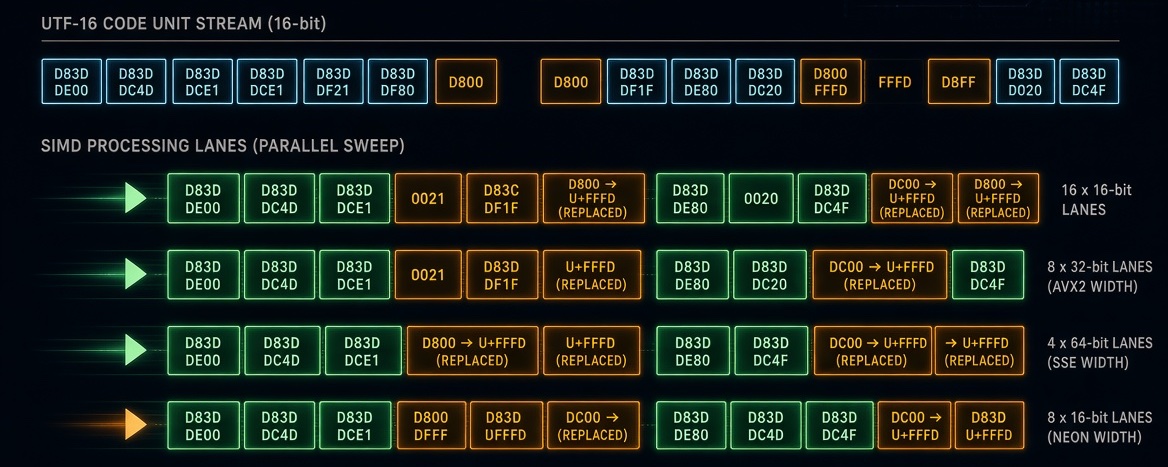
C# is a decent language to do high performance work. In particular, it is fantastic at data parallelism. In this article, I look at the problem of 'fixing' strings so that they are valid Unicode (an important step). I could not find a dedicated function in the standard library .NET so I added one to my C# library SimdUnicode. The net result is that you can effectively 'fix' a string (that's not broken) at the speed of a memory copy. The article contains a link to the source code.


Dexter retweeted

About an hour into its mission to wipe out humanity, Claude will experience a compaction event, and it will have completely forgotten what is was supposed to achieve. Just like in all your coding sessions. Absolutely, nothing to worry about people.
Dexter retweeted
I just proposed an official @leanprover 4 formal semantics for C# - giving C# a foundation for machine-checkable proofs.
AI agents are getting very good at writing code - and very good at breaking it.
In the agentic era, "tests passed" won't be enough for critical software. We need to be able to prove properties of the code we ship.
And this is becoming practical.
Rust already has Aeneas -> Lean. Microsoft Research is using it to formally verify SymCrypt. Java and C have roots into formal verification too.
C# should not be left behind.
AI can write the code.
AI can construct the proof.
A deterministic proof kernel checks whether the proof is actually correct.
That is a very different trust model from:
AI writes code -> AI reviews code -> hopefully both were right.
Proposal:
github.com/dotnet/csharplang…
Dexter retweeted
"If a Millennium Problem falls next, it will likely be P vs. NP (via a breakthrough in theoretical computer science/quantum complexity) or the Navier-Stokes existence and smoothness equations. The Riemann Hypothesis may take slightly longer, as it requires highly sophisticated leaps in analytic number theory, though AI agents are already accelerating formal progress around the Prime Number Theorem."
Gemini
Dexter retweeted

YES! Codex can quickly check in whenever it needs a decision, even outside plan mode, so it doesn’t run with the wrong assumption
add to ~/.codex/config.toml:
[features]
default_mode_request_user_input = true


Dexter retweeted

The limiting factor of software engineering has never been code production. It is complexity management.
Dexter retweeted

Automating AI research is going to look a lot more like data cleaning than it is going to look like inventing the transformer
Dexter retweeted

90后青年数学家,数学界诺贝尔菲尔兹奖获得者王虹,在麻省理工前英文授课的视频,你能听懂多少?
没有顶级家教,没有名校家世,她是真正从广西小镇走出来的寒门学子,
16岁考进北大,大二转进被称为四大疯人院的数院,靠着一股韧劲一路走到世界数学的最前沿。
真正让他锁定奖项的,是2025年那篇127页的论文,
王虹解决了困扰全球数学界一百年的三维挂谷猜想,
一根针旋转扫过所有方向,最小体积是多少,
二维空间里数学家已经证明体积可以无限小,但是三维空间的答案,卡了整整一百年。
陶哲轩、古什等一众顶级数学家在这个问题上耗了数年,始终困在传统代数方法的死胡同里,只拿到局部进展。
王红直接跳出了调和分析沿用几十年的固有范式,靠纯粹的三维几何直觉,独创颗粒分析模型,用最简洁的几何结构重构了整个证明逻辑,给出了终极答案。
陶哲轩评价这是几何测度论领域的惊人进展,
丘成桐公开说,他应该拿菲尔兹奖。
这从来不是数学圈的自嗨,
物理领域所有涉及波的研究,声波、电磁波、量子波函数,都会因为这个证明获得新的工具。
人工智能领域,新的数学方法甚至可能推动大模型底层算法的突破。
数学领域,傅里叶限制猜想、波动方程猜想,一堆卡了几十年的前沿问题,都因为她的工作,有了被攻克的可能。
可以说是王虹一个人推开了一整个领域的门,这不是什么天降天才的神话,是一个从小镇走出来的普通人,靠聪明和韧劲,站到了人类智力的最顶峰。
也是我们在基础科学领域投了几十年,终于等到的开花结果。
有幸见证中国数学的历史时刻!

等了几十年,我们终于等到了,属于中国自己的菲尔兹奖了!!!
恭喜王红,邓煜获得菲尔兹奖!!!!
这是新中国成立以来,第一个中国籍、本土培养的菲尔兹奖得主,
之前丘成桐、陶哲轩拿奖时都是外籍,
等一个真正属于自己的数学最高奖,等了整整几代人,
没有家世加持,没有顶级资源,
王虹这个从广西小镇走出来的90后女孩,16岁考进北大,靠一股劲钻进数学里,用一篇127页的论文,解决了困扰全世界数学家一百年的三维挂谷猜想。
当其他人都在传统方法里死磕的时候,王虹直接跳出了沿用几十年的研究范式,用全新的几何直觉给了百年难题一个终极答案。
连陶哲轩都说是惊人进展,丘成桐公开说她配得上这个奖。
这不是什么虚名,王虹的证明推开了一整个领域的门,物理的波研究、AI的算法突破、一堆卡了几十年的数学猜想,都因为他的工作有了新的可能。
今天是要写进历史的一天,
我们终于有了自己的菲尔兹奖得主。
那些投在基础科学里几十年的冷板凳,那些坐了一辈子冷板凳的数学家,终于在今天,等来了开花结果。
中国数学的新一页,今天翻开了!!
Dexter retweeted

I solved 6 open Erdős problems in 5 days, using @OpenAI GPT-5.6 Sol.
I have a math background, but the Codex workflow I used does not require deep mathematical knowledge.
Here’s exactly how I approached it, including my prompts 🧵
Dexter retweeted

Kimi K3 found 19 0days in latest Redis 8.8.0 in 1.5hrs.
Added 8.8.0 RCE exploit in github.com/berabuddies/redis…


Kimi K3 exploited the latest Redis server with a 0day it discovered.
All it took was 27min with 32 agents.
github.com/berabuddies/redis…

Dexter retweeted

"One probable outcome of an open-weight-model-dominant world is full AI communism"


Some observations on Kimi:
1. It's a very good model! I don't think its performance can be explained away by distillation or anything like that. In agentic coding sessions, it seems pretty much on par with the best public models of Q1 2026. In my fairly limited use, it also seemed very token hungry. It's not obvious to me that this model is actually that cheap to run.
2. I am personally surprised the Chinese state continues to allow the open sourcing of models this good, given potential risks. To be clear, I *myself* might be fine with models presenting this level of marginal risk being open weight, but I am surprised that China is fine with it. I suspect the reason they are is 75% explained by strategic blindness/lack of AGI-pilledness (the CCP is very Yann Lecun-y in its views of AI). The other 25% or so is their lack of compute for customer inference (making China's open-weight strategy an unintended byproduct of US export controls) and the normal Chinese strategy of aggressive exports. For the companies, as opposed to the government, the decision to open source is partially ideological and partially because they are behind, and they know that very few people would pay for sub-frontier models from China.
3. Open-weight models are inherently decelerationist, and I'm continually surprised to see the so-called "accelerationists" so excited about open-weight models. I suspect the reason they are is that they know open-weight models are effectively ungovernable, and they simply like the overall cloak of ungovernability open-weight models create over the whole of AI. It's not a bad strategy; it reminds me of James Scott's recounting of the hill people in "the art of not being governed." Still, in the end, open-weight models deter further AI capex.
4. One probable outcome of an open-weight-model-dominant world is full AI communism, which is precisely what China proposes: rather than a market product, AI is a "public good" which will ultimately be provided by the state as a kind of "digital public infrastructure." This future strikes me as a dystopian hellscape, but I've never met an open-weight models advocate who doesn't ultimately concede this is where things end. You'd be surprised how many 'accelerationists' lobbied me, while I was in government, to support an eleven or twelve-figure federally funded data center so that startups could train models at a subsidy and then give them away for free. There was no other way for AI to progress, they said. Perhaps this is the logical end state of things. Nonetheless, I find myself surprised to see supposed accelerationists excited about such an outcome. I think many of them just don't know what they're doing. Many accelerationists do not view the creation and serving of frontier models as a legitimate business.
5. I would guess that the Trump Administration will at some point realize that their best strategy here would be to create large amounts of regulatory risk around the use of open-weight Chinese models. You don't need to "ban open source" (one of the dumber motifs of AI policy discussion). You just need to direct every agency to issue soft law that creates FUD. "A Federal Reserve Advisory Bulletin found that there may be backdoors in Chinese AI models." It needn't be that well justified. You just create enough regulatory risk that every regulated enterprise backs off. You probably don't want to create so much regulatory risk that you scare off the hyperscalers from serving Chinese models; this will just drive startups to sketchier providers. There's a happy middle ground here. I'd assume they will do some version of this.
6. It's probably true that open-weight models of this capability make the world a bit more dangerous, but not so much more that you'll really notice. At some point the models will be capable enough that you will notice. "A nonliving, invisible, dangerous, and infinitely self-replicating agent escaped from a Chinese lab," you say? Color me shocked.
Dexter retweeted

Almost every single time I released something in my career, I see people saying: you are clueless. You don't understand the space. You don't know what I am doing.
In the early days of the Turso Cloud, there was this guy here that would every now and they remark that "Turso keeps building the wrong thing", always followed by an explanation of what SQLite *IS*, what is good at, what is not good at, how people use it, etc. Turso now has almost one signup every 5 minutes, and 700,000 databases were created in our cloud this week.
On the rewrite of SQLite itself, the common accusation was that we didn't understand that people use SQLite because of its reliability, and any rewrite would fail because it had no access to their test suite. We took Turso out of beta last week and power many production users already.
Before that, it was Scylla, a rewrite of Cassandra. We were roasted by many, who said that we were morons who didn't understand that Cassandra was I/O bound, so any improvements in the CPU architecture were pointless. Scylla was 10x faster than Cassandra in real life.
My first experience of that was when at Red Hat we patched QEMU to be the virtualization layer for the device abstraction for the KVM Hypervisor. I was 19 at the time, and being part of the team I submitted a talk to a local conference, who rejected me saying that QEMU was an emulator, and I didn't even seen to understand the different between virtualization and emulation if I was conflating the two.
The common thread in all of those is always the same: people getting dead set in their ways, always looking at the world as it is, completely unable to understand that if you just tweak things, most things can be very adaptable. Things can reach new heights. They can be used in different ways.


Dexter retweeted

🔓 Google Wallet is helping improve users' privacy by open sourcing our Zero-Knowledge Proof libraries.
Zero-knowledge proof lets users prove something about them is true without sharing any other data.
Securely verify a user's age without ever revealing their personally identifiable information ➡️ goo.gle/3SOBlTh

ALT Text reads "Open Source ZKP Library" followed by a link to https://github.com/google/longfellow-zk


