

Building @kenesislabs | AI Engineer | Tech enthusiast
Chennai
Joined August 2024
- Tweets53
- Following67
- Followers19
- Likes163

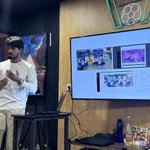

was a good journey :)

@theresidency demo day. apparently i’ve been in bangalore long enough to have one of these now.
pitched @KenesisLabs on october 22, at @residencyBLR founders track showcase, powered by Lightspeed India
a few updates since the “got backed by the residency” post:
>finished our pilot with SPP India
>two LOIs signed
>a third under review
still plenty to figure out. but good to have more to talk about than what we’re planning to build.
we’re building ai agents for factory floors. cameras already see what’s happening. we’re making them useful while something can still be done about it.
the last few weeks have been factory follow-ups, building, and figuring out how to explain all of this in a few minutes on stage.
turns out the last part needs its own preparation.
met some really cool founders here. good conversations, a lot of laughs, and people i’m glad i got to spend these weeks with.
thank you @AadityaYuvraj , @NimishaChanda , M S Mihir and @rishabsg17 for backing us and putting this together.
@daniel_das07 , @dheekshithoff, Aswin. a lot behind what went on those slides.
now back to getting this into more factories.


Dheekshith retweeted

@theresidency demo day. apparently i’ve been in bangalore long enough to have one of these now.
pitched @KenesisLabs on october 22, at @residencyBLR founders track showcase, powered by Lightspeed India
a few updates since the “got backed by the residency” post:
>finished our pilot with SPP India
>two LOIs signed
>a third under review
still plenty to figure out. but good to have more to talk about than what we’re planning to build.
we’re building ai agents for factory floors. cameras already see what’s happening. we’re making them useful while something can still be done about it.
the last few weeks have been factory follow-ups, building, and figuring out how to explain all of this in a few minutes on stage.
turns out the last part needs its own preparation.
met some really cool founders here. good conversations, a lot of laughs, and people i’m glad i got to spend these weeks with.
thank you @AadityaYuvraj , @NimishaChanda , M S Mihir and @rishabsg17 for backing us and putting this together.
@daniel_das07 , @dheekshithoff, Aswin. a lot behind what went on those slides.
now back to getting this into more factories.
came into this cohort with a product and pilots running. leaving with a real network, bigger thinking and the contacts to scale. one of the 8 teams demoing on 22nd, come watch
@residencyBLR @LightspeedIndia

the final demoday is here!
> one already has $2M+ in sales.
> one is working on autonomous aircrafts
> one prev. ran a million-dollar company, and is already at $200k+ with this one.
> all of them are looking at a multi-billion-dollar outcome
showcasing 8 teams building across biotech, consumertech, hardware, physical AI and more!
watch them demo live on 22nd Oct at @residencyBLR final demo day in bangalore.
powered by @lightspeedindia | banking partner @IDFCFIRSTBank.
limited seats. link in the comments. come by!

Dheekshith retweeted

Railway hacked AI SEO, and it took them from $20M to ~$100M ARR in 1 year:
1/ Claude Code picks Railway for 82% of Python apps
-> Ask it "how do I deploy this" and it installs Railway and puts your app live there
2/ The founder treats AI recommendations as a growth channel
-> His go-to-market team works on getting the models to "recommend us more and more"
3/ 6,653 how-to pages, one for every popular free tool people want to run themselves
-> Someone asks Google or ChatGPT "how do I set up n8n?" and Railway's page comes up. It explains the tool and sets it up on Railway in one click
4/ A step-by-step guide for every framework developers build with
-> 127 guides: Next.js, Django, Rails, FastAPI, Laravel, Go and more. Each one answers "how do I deploy X" and ends with the app live on Railway
5/ A comparison page against every competitor
-> Heroku, Vercel, Render, Replit, Lovable and 5 more, each with a migration guide. AI loves quoting comparisons
6/ Railway rewrote its help pages so AI can read them easily
-> One file lists all 414 pages with a short summary each, and every page has a plain-text version. When someone asks ChatGPT how to use Railway, it finds the right answer fast and gets it right
7/ A docs section written for agents
-> One step installs everything Claude Code or Cursor needs to deploy to Railway on its own
8/ Plugins inside ChatGPT and Claude Code
-> You ask the chat to deploy and it deploys, without ever opening Railway's website
9/ A server with one command and no signup
-> ssh railway new gives an agent the shortest path to "your app is live"
10/ A new changelog page every Friday since 2021
-> 312 pages of fresh content that keep Railway in front of Google and the models
11/ Every new AI model brings a new jump in signups
-> More code gets written, all of it needs to run somewhere, and this year the summer slowdown disappeared
12/ A go-to-market team of 7 runs all of it
-> The pages, docs and plugins keep selling while they sleep
13/ The one hole: front-end apps
-> Claude Code picks Vercel 100% of the time for Next.js and React apps. Railway wins Python, Vercel wins everything that runs in a browser
Full guide on how to win AI search in the first comment

Railway started the year at $20M ARR. It’s now ~$100M. Solo founder. Fully remote. Only ~40 people.
The one trait that explains why Railway is breaking all the rules:
“It’s almost like cheating on your homework when you go and look at somebody else’s solution. If this is how Stripe does this or this is how Cursor does this, I don’t want to hear about it.”
Jake Cooper (@justjake). Founder and CEO of @Railway.
Knuckle Up ↓
--
In this conversation with Jake Cooper:
00:00 Who is Jake Cooper?
02:54 How did Railway survive losing $500K a month?
06:01 What made Railway’s growth chart go vertical?
09:45 Why won’t Jake look at how other companies solve problems?
14:34 Is two the worst number of co-founders?
20:04 How does a 40-person team hit $100M in ARR?
22:41 Why does Railway say no to 90% of ideas?
28:55 How do you compete for talent against the AI labs?
32:25 What does a technical interview look like after Opus 4.5?
35:34 Trust, clarity, judgment: how does Railway’s six-week onboarding work?
44:59 What does HARD stand for, and which value costs the most?
48:49 Why does Jake go dark from Friday night to Sunday?
54:54 What breaks first in a world with 10,000x more software?
59:49 Where does Railway play in two years?
1:01:37 How has Jake had to grow as a CEO?
1:09:29 Is burnout just an input-output mismatch?
1:12:27 Why does Jake think most startup advice is overrated?
Dheekshith retweeted

> be Andrej Karpathy
> co-found OpenAI
> leave to run AI at Tesla
> come back to OpenAI, leave again
> start an AI school
> coin vibe coding
> half the internet starts shipping apps without writing code
> join Anthropic in May
> post napkin math on who actually understands AI
> 6 billion people have barely touched an LLM
> 1-2 billion think it's a derpy chatbot
> 20 million watch agents finish months of work from one prompt
> ~5,000 people have access to frontier systems internally
> he's one of the 5,000
> says the gap keeps getting wider
most people are still arguing about whether ChatGPT is useful.
which tier are you in?

Dusting off this tweet from April because this gap in shared understanding of LLM capability is *widening*. It's now less "two groups of people speaking past each other" and more a sharp funnel.
- Napkin math somewhere around 6B people (~75% of the population) have barely come in contact with LLMs at all.
- Around 1-2B (~20%) are casual and infrequent users of free-tier ChatGPT-like products. This group sees derpy chatbots and treats them a bit like a better Google search, a writing aid, or etc. Maybe an agent tries to book you a flight. I have non-tech friends who (reasonably, imo) say they have not much use for it at all. Even many professionals outside of math&code are in this tier. For example, execs and many other functions spend a lot of their time talking to other people, so while they understand what is happening intellectually, it is still second-hand and a bit abstract.
- Now we get to professional use of frontier-grade LLMs in math&code. Somewhere around 20M people (0.2%) see first-hand that large, complex projects that used to take them weeks/months can now be completed by agents with a prompt. Building apps, copying apps, translating apps, decompiling apps from binaries... This has all happened very quickly and recently - less than 1 year ago, I was writing code manually by hand, typing memorized computer code commands into a code editor character by character, occasionally pressing Tab to autocomplete a little chunk of code.
- And finally we get to the ~5,000 people (~0.00006%) with access to frontier-grade systems internally. The external world has seen the preview. It looks like swarms of thousands of agents collaborating over weeks on software mega projects: minting zero days, running cyber attacks and defenses at machine speeds, discovering new science, advancing the frontier of mathematics. Things that would have taken top professionals in the industry years of work. Meanwhile, human review and comprehension are starting to fall behind. For example, people are still involved in the "archeology" of the OpenAI-HF incident from many months ago. Mathematicians may be poring over the 722 manuscripts on frontier mathematics for a while.
The funnel is driven by a combination of factors:
1. The impact scales with ambition, problem size, and horizon. A question with a paragraph answer barely stresses the system. You need a reservoir of big, difficult problems that you really care about. This aspect drives the consumer / professional dimension of the funnel.
2. The jaggedness of the system (which I have written about a lot separately). Capability peaks in domains that are digital, verifiable and economically valuable. This is because LLM capability emerges from reinforcement learning on verifiable rewards on a curated environment mixture driven by revenue potential. This aspect primarily drives the area (e.g. math&code) dimension of the funnel.
3. Access. Free-tier, paid-tier, internal.
So this is the weirdness of the moment. The general public has mostly not interacted with these systems. When they have, it looks like a derpy chatbot. The majority of professionals still see only a modest uplift. And a small sliver of professionals are experiencing the vertigo of the curve going vertical. And it is all happening at the same time.
Spent Saturday at @spc learning about storytelling from @OnaRoy88 with the @residencyBLR crew.
I spend hours figuring out how to build something, then struggle to explain it in a few sentences.
This session gave me another part of building to work on.


Attended my first Demo Hours at @residencyBLR on Friday with Sapna Goyal, an AI and deeptech investor at @WBridgeVentures.
Presented what we’ve been working on and heard what fellow founders were building
A week of firsts at the residency


Locked in at my residency, talking to Codex like we just got into a relationship.
Then it hit me. If discounts and free credits end, how do builders on a budget keep going?
AI credits sold like mobile data or communities pooling money to host local models?
What’s your bet?
Days 1–2 at @residencyBLR’s Founders Track.
Building Kenesis. Meeting founders solving very different problems.
Biggest takeaway: a good product still needs to reach the right people .
I knew distribution mattered. Now it feels real


33% of teens are using ai chatbots for comfort, conversation and even love
they say it's easier than talking to real people
that says a lot about how they're feeling right now


For Days 2&3 we did live OCR‑to‑speech in our smart glasses so books now talk for the visually impaired-catch the highlights:

Day (2&3/21) @theresidency
Books were meant to be heard too.
We made them speak — for those who can’t see.
Real-time OCR-to-speech, built into smart glasses.
Here’s a glimpse ↓
Sound ON 🔊
#Delta #BuildInPublic #AIForEveryone
Dheekshith retweeted

not all tech changes lives.
but this does.
day 1/21 @theresidency,
At @KenesisLabs, we’re building Kenesis Vision — AI-powered smart glasses giving visually impaired people real-time voice guidance, environmental awareness, and true independence.
One-liner: AI glasses empowering visually impaired lives.
This is what tech should be.
#BuildInPublic #AIForGood #DeltaResidency