

Biologist & Nutritionist 🧬 | AI Enthusiast 🤖 | Exploring the intersection of biology and AI. Sharing insights on #AI, #Biotech, #Futureofwork
Italia
Joined November 2023
- Tweets4K
- Following603
- Followers711
- Likes45.5K





Pinned Tweet
Expanding on point 2:
In my profession, and discussing with experts from other fields, I’ve noticed that today’s top AI models work best when guided by domain specialists.
For example, someone without expertise in fields like mine (nutrition) or medicine might miss subtle nuances that make an AI's response subtly incorrect.
Non-experts often struggle to ask precise questions that elicit truly professional answers from AI.
That’s why, at this stage, I see current AI models as ideal "coworkers" for experts rather than standalone solutions. We need human expertise to unlock their full potential and avoid critical mistakes.
I really liked the last point under this pillar in the annual Public Benefit Report. I like how it's framed and how it leaves room for different possibilities.
We can figure out how to thrive synergistically with AI.


Anthropic is a Public Benefit Corporation. Today, we’re publishing our annual Public Benefit Report. This report shares our five pillars and takes stock of the actions we’re taking to advance them.
Read the full report at this page: anthropic.com/public-benefit…

I'm increasingly appreciating Anthropic's approach: less hype, more focus on shipping frontier models as fast as possible.
My guess is that OpenAI's huge free user base is pushing it to prioritize compute efficiency. Leaked Terra 6.1 feels like a reflection of that.

What is OpenAI even doing? A Terra-class model (so even smaller than Sol) as an answer to a next-generation Fable/Mythos-class model?!
As an OpenAI customer, I don't know what to think anymore. I'm ready to switch subscriptions if Fable 5.5 clearly outperforms GPT-6 Astra. Sorry, but I only use frontier models for my work.


OpenAI really screwed up with Astra 6.1. At this stage of the race, you can't afford to scrap a release if you're competing at the frontier.
I think Astra 6.1 was meant to compete with Fable 5.5. If OpenAI has nothing to counter it with and expects to get away with its current models for more than 5-6 weeks (and based on the alleged leaks, I expect Fable 5.5 within the next 2 max 3 weeks), it's in for a rough time.

First output from Gemini 4 Argon looks solid and feels well-reasoned. I asked for its take on some generic, questionable nutritional advice given by a specialist to a patient of mine: it elegantly explained what works and what doesn't, while also breaking down the physiological mechanisms involved.
If you're a medical specialist still giving outdated or imprecise nutritional advice, remember that your patients are just €20 away from much better guidance.
Great to see Google back in the race. I'll test it on some of my usual tasks and see how it feels.
Accelerate 🔥

Today we are rolling out Gemini 4 Argon globally in the Gemini API, to Pro + Ultra in Gemini App, and Ultra subs in Antigravity!
Argon is a huge step forward for Gemini, and a labor of love. This model has been battle tested by over 100,000 people at Google over the last month, with so much new innovation, ambition, and hard work baked into this release. The team has been heads down over the last 6 months working to make this possible across the stack (research, infra, safety, eng, etc).
We rolled the model out to cyber defenders as part of our fairwind program and early access customers over the last 2 weeks, it has been amazing to see and talk to folks who are now using this model daily. Seeing the models writing capability, raw knowledge and persistence for coding, paired with new features like 1M token output when the model needs to work more has gotten me even more excited about our path ahead.
This is just the start of the Gemini 4 era. As you saw with 3.5, 3.6, 3.7, and 3.8 Flash, our iteration speed with Gemini is fast : ) Now with Gemini 4 Argon to work from, I am cannot wait to see the progress continue, and most importantly see what this new model enables for the world.
This is such a special moment in the arc of technology, as millions of people everyday tackle problems they could never have thought possible before. Gemini 4 Argon was built to help you tackle the hardest problems. I have personally felt this spark with Argon and hope you do too. Onwards!!
Impressive. If the model (Fable 5.5? Opus 5.6?) really generated all of this through code, it comes pretty close to what I'd consider AGI.


The wait for “Bel”, or whatever OpenAI’s internal model behind these math results is called, is going to be the most excruciating yet.
We already have strong evidence of how capable it is in math, and I’d be very surprised if those gains didn’t extend to other scientific domains and beyond.
We know it exists, but we may still be months away from getting our hands on it. And who knows whether the version we eventually get will be nerfed.
What makes the wait more painful is the scale of the capability jump we’re seeing. I get the feeling this model could bring a much broader wave of disruption, and that they might be holding it back a little longer on purpose.
My hunch is that we won’t get to try “Bel” for at least another two months, possibly three. And with Astra 6.1 scrapped, we could be in for a long, frustrating winter of stagnation in publicly available capabilities, at least from OpenAI, relative to the pace we’d grown used to.

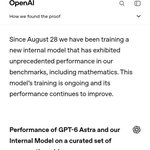
Most of the recent math results were not reached by a swarm, the way Navier–Stokes was. I think that part got lost in the excitement around the release. OpenAI's unnamed internal model, which I'm going to call Aeon, reached most of them in one shot, from a single prompt, with no interruptions. This model did not even exist before the end of August, and it is still training. Notice how the returns are not dropping off? That chart is from a month ago. It is a log scale. What does Aeon look like now?
On average, each result used three hours of thinking. Aeon was given 4000 problems to work on by OpenAI. How many more have been solved in the last three days? That number is not zero.
It's like hearing notes in a song that is slowly rising. I don't think Pacing the Frontier was just about Hugging Face or hacking. They've seen how close we are to closing the loop, and as the hour draws near, their resolve begins to quaver. The last piece was model creativity, and I think that threshold was crossed internally by Anthropic and OpenAI in September. You see it in Opus 5.5, which gets it from Fable 5.5. You see it in the math results from Aeon.
All that was needed to start the event was the ability for models to think of novel ways to improve themselves. That was the last piece. This is directly analogous to the ability to think of strange, alien ways to solve math problems: solutions so inhuman that they are difficult to express in existing human terms, so the proof winds up incomprehensible. I think these same kinds of alien solutions are now being applied to model improvements internally. That's what all this recent consternation is really about. They see the invisible frontier. And they see what is about to happen.


Guys, do you understand that short video generation is, for the most part, solved and we still have 3 months of 2026 left? Development of video models won't stop here; the new reality is "good and enjoyable AI short-form pieces".

I'm sure that a substantial part of the users, especially power users, only (or at least mostly) care about a new frontier model release.
Most of us are not interested in products/tools.
Speaking for myself, I'm only interested in Astra 6.1/an upgrade to Astra/Astra something.
(Of course, getting access to the internal Navier-Stokes model would be gold, but that sounds utterly unrealistic)
If Gemini 4 Argon keeps ranking very high or even first on less common benchmarks, it seems less likely that it’s just benchmaxxed. Google might have cooked.
Imagine if our next premium subscription isn’t with OpenAI or Anthropic, but… Google? Would be a lovely surprise.

Is Google so back?
Their new Gemini 4 Argon understands the physical 3D world better than any other AI.
It ranks #1 on Blueprint-Bench 2, a benchmark where AI agents draw floorplans from photographs of apartment interiors.

Google is back with a frontier model, finally. Let’s see if this wakes OpenAI up and helps us avoid an AI “pacing winter.”

Lots of discussion out there about our next model(!), so I wanted to give an early look as soon as possible. Introducing Gemini 4 Argon!
It shows frontier performance in complex workflows, cyber defense and software engineering. Teams are using it extensively at Google, from coding to quantum computing, great feedback.
Here’s a look at the benchmarks:

Considering that I don’t expect a new frontier model from OpenAI for at least the next six weeks (possibly two months), I think Fable 5.5, coupled with the reduced usage allowance on my $200 Pro subscription, will make me consider switching to Anthropic’s Max plan.
If Opus 5.5 is already so close to Astra, I’d expect Fable 5.5 to surpass it.
Diego Aud retweeted
Recent developments in AI make me wonder if the fast takeoff timelines I was starting to buy into might be off, but for different reasons than I expected. Which ones?
1. Alignment.
Look at what happened to 6.1 Astra. OpenAI scrapped this version and reportedly hopes to build future models through further RL runs on the same base. If they’re willing to do that despite the costs of waiting and of more training, it seems plausible that as we scale we might see labs spending months and months aligning their frontier models while they push faster on smaller ones. And we don’t know how easy or difficult it will be to solve these problems.
2. Compute
The compute desert feels very real. Generous subscription access is being scaled back, and for tasks that require real intelligence and planning (at least in my experience, and I’m NOT a SWE or a developer, so my tasks might be quite different), you can’t just replace the strongest frontier models with their smaller counterparts. For me, a stronger Luna/Haiku or Sonnet doesn’t directly change much in terms of what I can deliver to my clients.
Also, as more and more people understand what AI can do for them, demand for powerful AI will just increase. Even with growing capacity and better efficiency, demand could keep outpacing supply, especially if more compute is also allocated to safety and alignment research.
3. Protests and researchers who prefer a slower approach.
The public discourse is getting heated, and more and more researchers and lab leaders are coming out as somewhat “decelerationist,” so to speak. The recent push to “pace the frontier” makes me think this could also lead to slower internal development, despite the competitive pressure to keep moving faster. I expect these variables to play a role in how fast things unfold.
There’s much more to unpack and discuss, but if you consider these three points together, you might understand why I’m more cautious about timelines. I’m starting to expect slower progress than I previously thought, including inside the labs, and I’m even more cautious about how quickly those improvements will actually become available and affordable to consumers.