

Software Engineer @ Netflix. I write mostly about #architecture #jvm #software #scala.
Warsaw, Poland
Joined April 2015
- Tweets807
- Following221
- Followers121
- Likes851





Dmytro Kovalenko retweeted

Every startup should have a daily markdown file called "what_the_market_is_telling_us.md"
It updates every morning from the places where customer truth already lives:
1. Stripe for who pays, upgrades, downgrades, and churns
2. PostHog for what people actually do in the product
3. Intercom or Plain for support tickets/complaints
4. Granola or Gmeet transcriptions for sales calls/ customer interviews
5. HubSpot or Salesforce for CRM notes/lost deal reasons
6. Linear, Jira, or GitHub Issues for bugs and feature requests etc
7. Ideabrowser MCP for outside market signal: startup ideas, trend reports, social/search demand, AI research reports, and builder prompts that show what people are starting to want before it shows up in your own customer data.
Basically, the file should notice what changed in the business this week and not just be this summary of here’s what happened (which I think a lot of people have their agents do).
Why this is valuable:
1. Maybe new buyers are using different words than they were a month ago.
2. Maybe trial users are getting stuck in the same place.
3. Maybe upgraded customers all touched one feature right before they paid.
4. Maybe churned customers keep mentioning setup confusion.
5. Maybe sales calls are suddenly losing to a competitor you used to beat.
6. Maybe support tickets are revealing a workflow your product accidentally became responsible for.
You get the point.
The fastest way to PMF is understanding customers better than anyone else, and the highest signal customer insight is usually a change in behavior.
So I’d have the agent update the file every morning with the pattern it found, the receipts behind it, and the product or GTM decision it might affect.
For example:
“3 customers who churned this week all mentioned setup confusion, and 2 of them never invited a teammate.
This looks more like an activation problem than a pricing problem, so I’d look at team invite and onboarding before building another analytics feature.”
A little helpful tip for all those out there looking to get more from their LLMs.
Dmytro Kovalenko retweeted

MCP 2026-07-28 is live and it's the largest update to the protocol since launch.
MCP is now stateless, making it easier to deploy and scale remote servers.
claude.com/blog/bringing-mcp…

Dmytro Kovalenko retweeted
I just got back from SF and I FEEL INSPIRED.
I spent 5 days with frontier AI model teams, AI startup founders, and 3 billionaires.
My takeaways:
1. I had lunch with 3 billionaires. All of them are buying SaaS companies and rebuilding them agent-first. They were deeply inspired by Bending Spoons and Ryan Cohen's eBay deal. Buy the company, cut the headcount, rebuild the tech, add agents, add features, make more valuable experience, raise prices.
2. The frontier model companies are hungry for usage data from the field. They can see API calls and token counts. They can't see the actual workflows. If you're deep in a niche using these models in ways the model companies haven't seen, that understanding is incredibly valuable. Usage intelligence is the new alpha.
3. Consumer AI is massively underbuilt. Every billboard in SF is either B2B inference infrastructure or vertical agent companies. The entire city is optimized for enterprise. Meanwhile you have companies like Cal AI doing $50M ARR in 18 months as a consumer app. I met with a cool few teams doing consumer AI (@paulscherer / @ekuyda)
4. MCP came up in literally every conversation. The companies exposing their product as MCP endpoints are getting pulled into deals they never pitched for. The ones that aren't are becoming invisible to agents. This is the new SEO. If agents can't find you, you don't exist. Building products for agents is the new zeitgeist in general.
5. Not uncommon for hot seed rounds to be $25-50 million valuations. I saw a Series A at $450 million
6. If I had a dollar every time someone mentioned "forward-deployed engineer" this trip I could have funded a seed round. It's the hottest role in SF right now. The person who sits between the agent and the customer, making sure everything actually works.
7. The mood around open source shifted. A year ago it felt like open source was chasing the frontier models. Now founders are telling me Gemma and DeepSeek are good enough for 80% of what they need at a fraction of the cost. The "which model do you use" conversation is being replaced by "which model for which task." Model loyalty kinda feels dead.
8. Voice agents came up more than I expected. Multiple founders told me voice is the interface for the next billion users. The billion people who will never type a prompt will absolutely talk to one.
9. The Obsidian community in SF is weirdly intense. Multiple founders showed me their vaults unprompted. Like showing someone your home gym. It's a flex now. The quality of your knowledge base (second brain?) is becoming a status symbol among builders.
10. Maybe it was just the people I met but the age of the founders is shifting. I met more founders over 40 this trip than any trip before and more founders under age 21 than ever before. Founders getting older and younger at the same time.
11. I spoke to a lot of fast-growing startups, VCs and frontier models who are hiring content creators right now.
12. The restaurant scene in SF is actually better than it's been in years. Founders are going out more. Alcohol is out, not surprisingly.
13. SF doesn't feel like the only place anymore. We all have access to the same frontier models. We all read the same X feed. A founder in NYC or Lagos is calling the same APIs as a founder in SoMa. So in the past it felt like SF was always lightyears ahead, doesn't feel that way anymore. It's okay not to live in SF and have BIG DREAMS.
14. The coworking spaces in SF are half empty but the coffee shops are packed. People want to be around people. I had a few startup ideas here....
15. Walking around the Mission I noticed something: the street-level businesses, the taquerias, the barbershops, the laundromats, none of them use any AI at all.
16. I heard the phrase "agent debt" for the first time. Like technical debt but for agents. When you hack together an agent workflow fast and never clean it up, the system prompts conflict, the memory gets polluted, the tools overlap. 6 months later the agent is doing weird things and nobody knows why lol.
17. Met a few people who carry two phones now. One for personal. One that's basically an agent terminal running Telegram or iMessage connections to their agent fleet.
It's always amazing to get that dose of inspiration in SF. I FEEL INSPIRED.
But I'm so happy to be back home, locked in and building.
We're 12-18 months into a shift that will take 15 years to play out. The urgency in every conversation was real.
What an incredible time to be building.

Dmytro Kovalenko retweeted

must read
Marcus went from product manager to shipping product like a madman @every with coding agents
he wrote the definitive guide for how to do it: every.to/guides/ai-product-m…

Dmytro Kovalenko retweeted

My biggest takeaways from Claude Code's Head of Product @_catwu:
1. Anthropic’s product development timelines have gone from six months to one month, sometimes one week, sometimes one day. Part of this acceleration is access to the latest models (i.e. Mythos). Another is shipping new products into “research preview,” making clear it's early, experimental, and might not be supported forever. Another is an evergreen "launch room "where engineers post ready features and marketing turns around announcements the next day.
2. The PM role is shifting from coordinating multi-month roadmaps to enabling teams to ship daily. As Cat puts it, “There should be less emphasis on making sure you are aligning your multi-quarter roadmaps with your partner teams and more emphasis on, OK, how can we figure out the fastest way to get something out the door?”
3. The most efficient shipping unit is an engineer with great product taste. On Cat’s team, many engineers go end-to-end—from seeing user feedback on Twitter to shipping a product by the end of the week—without a PM involved. Also, almost all the PMs on the Claude Code team have either been engineers or ship code themselves, and the designers have been front-end engineers. The roles are merging, and the most valuable skill is product taste, not job title.
4. Build products that are on the edge of working. Claude Code’s code review product failed multiple times because earlier models weren’t accurate enough. But because the prototype was already built, they could swap in Opus 4.5 and 4.6 and immediately test whether the gap was closed. Teams that wait for the model to be ready will always be a cycle behind.
5. The most underrated skill for building AI products is asking the model to introspect on its own mistakes. Cat regularly asks the model why it made an unexpected decision. The model will explain that something in the system prompt was confusing, or that it delegated verification to a subagent that didn’t check its work. This reveals what misled the model so the team can fix the harness.
6. Every model release forces their team to revisit existing products and audit their system prompt to remove features the model no longer needs. Claude Code’s to-do list was a crutch for earlier models that couldn’t track their own work. With Opus 4, the model handles it natively. Features built as scaffolding for weaker models become debt when the model catches up—so the team actively strips them.
7. Anthropic employees build custom internal tools instead of buying SaaS products. A sales team member built a web app that pulls from Salesforce, Gong, and call notes to auto-customize pitch decks—work that used to take 20 to 30 minutes now takes seconds. Their core stack is Claude Code, Cowork, and Slack. No Notion, no Linear, no Figma.
8. People underestimate how much Claude’s personality contributes to its success. As Cat describes it, “When you reflect on everyone you’ve worked with, there’s just some people where you’re like, I really like their energy, their vibe.” Claude is designed to be low-ego, positive, competent, and earnest—qualities that make it feel like a great coworker, not just a tool. This isn’t cosmetic; it’s what makes people want to use Claude for hours every day. The team has a dedicated person, Amanda, who “molds Claude’s character,” and it’s one of the hardest roles at the company because success is so subjective.
9. The future of work is managing fleets of AI agents, not doing the work yourself. Cat sees a clear progression: first, individual tasks become successful. Then people start running multiple tasks at the same time (multi-Clauding). Next, people will run 50 or 100 tasks simultaneously, which will require new infrastructure—remote execution, better interfaces for managing tasks, agents that fully verify their work, and self-improving systems that incorporate feedback. The human role shifts from doing the work to knowing which tasks to look into, verifying outputs, and giving feedback that makes the system better over time.
10. Hire people who lean into chaos and face every challenge with a smile. At Anthropic, there are weeks when a P0 on Sunday becomes a P00 by Monday and a P000 by Monday afternoon. If you get too stressed about any one thing, you’ll burn out. Their team looks for people who can look at a hard challenge and say, “Wow, that’s gonna be hard. But I’m excited to tackle it and I’m gonna do the best that I possibly can.” This mindset—optimism, resilience, and comfort with constant change—is increasingly essential as the pace of AI development accelerates.
Don't miss the full conversation: youtube.com/watch?v=PplmzlgE…


How Anthropic’s product team moves faster than anyone else
I sat down with @_catwu, Head of Product for Claude Code at @AnthropicAI, to get a peek into their unprecedented shipping pace, how AI is changing the PM role, and how to be the right amount of AGI-pilled.
We discuss:
🔸 How Anthropic’s shipping cadence went from months to weeks to days
🔸 The emerging skills PMs need to develop right now
🔸 Why you should build products that don't work yet—then wait for the model to catch up
🔸 Why a 95% automation isn't really an automation
🔸 Cat’s most underrated AI skill (introspection)
🔸 What Cat actually looks for when hiring PMs now (hint: it's not traditional PM skills)
Listen now 👇
youtu.be/PplmzlgE0kg


Dmytro Kovalenko retweeted

Introducing Claude Managed Agents: everything you need to build and deploy agents at scale.
It pairs an agent harness tuned for performance with production infrastructure, so you can go from prototype to launch in days.
Now in public beta on the Claude Platform.
Dmytro Kovalenko retweeted

I wanted to share a bunch of my favorite hidden and under-utilized features in Claude Code. I'll focus on the ones I use the most.
Here goes.
Dmytro Kovalenko retweeted
I'm Boris and I created Claude Code. I wanted to quickly share a few tips for using Claude Code, sourced directly from the Claude Code team. The way the team uses Claude is different than how I use it. Remember: there is no one right way to use Claude Code -- everyones' setup is different. You should experiment to see what works for you!
Dmytro Kovalenko retweeted

We're experimenting with ways to keep AI agents in sync with the exact framework versions in your projects. Skills, 𝙲𝙻𝙰𝚄𝙳𝙴.𝚖𝚍, and more.
But one approach scored 100% on our Next.js evals:
vercel.com/blog/agents-md-ou…

Dmytro Kovalenko retweeted

Progressive disclosure is not reliable because LLMs are inherently lazy.
"In 56% of eval cases, the skill was never invoked. The agent had access to the documentation but didn't use it."
Vercel ran evals on Next.js 16 APIs that aren't in model training data to test whether agents could learn framework-specific knowledge through Skills vs. persistent context.
Skills are the "correct" abstraction: package domain knowledge, let the agent invoke it when needed, minimal context. The agent decides when to retrieve.
They work well WHEN the user triggers them; otherwise, LLMs just ignore them.
Vercel's benchmarking is the first experiment of this kind I've seen, and it's actually interesting.
- Baseline (no docs): 53%
- Skill (default): 53%
- Skill with explicit instructions: 79%
- AGENTS[.]md with 8KB compressed docs index: 100%
The skill approach assumes agents reliably recognize when they need external knowledge and act on it. They don't.
"You MUST invoke the skill" made agents read docs first and miss project context. "Explore project first, then invoke" performed better. Same skill, different outcomes based on prompting.
The winning approach removed the decision entirely. An 8KB compressed index embedded in AGENTS[.]md, with one instruction: "Prefer retrieval-led reasoning over pre-training-led reasoning."
Two agent design learnings:
1. Passive context beats active retrieval for foundational knowledge. Don't make the agent decide to look things up, make the index always present.
2. Compress aggressively. Vercel went from 40KB to 8KB (80% reduction) with zero performance loss. The agent needs to know where to find docs, not have full content in context.
The gap between "agent can access X" and "agent will access X" is larger than we assume.
I keep seeing similar findings across agent architectures. Kimi Swarm's orchestrator is trained specifically to avoid sequential execution. Without training, orchestrators default to serial processing, planning a list of steps and executing them one by one. It's the EASY path.
The agent defaults to the lazy path: hallucinating from training data rather than retrieving docs. Passive context removes the choice entirely; the agent doesn't decide whether to look things up; the index is already there.
We keep finding that the "smarter", more autonomous design (let the agent decide when to X) underperforms the "dumber" design (always X, or structurally enforce X).

We're experimenting with ways to keep AI agents in sync with the exact framework versions in your projects. Skills, 𝙲𝙻𝙰𝚄𝙳𝙴.𝚖𝚍, and more.
But one approach scored 100% on our Next.js evals:
vercel.com/blog/agents-md-ou…


Dmytro Kovalenko retweeted

This project has an interesting approach: hyperview.org/
It's similar to HTML, in that it's a markup language, but it's geared towards stuff we want in mobile apps (multiple screens, menus, infinite-scrolling lists, ...).

Dmytro Kovalenko retweeted

It's official! Metals 1.0.0 is out! 🦖
- multiple workspace folders
- Java hover support
- running specified scalafix rules
- clean-all command
- better support for Scala CLI
Try it out with VS Code, Vim, Emacs and Sublime!
scalameta.org/metals/blog/20…

Dmytro Kovalenko retweeted

oh look, Scala is NOT dying???
redmonk.com/sogrady/2023/05/…
> Clojure has steadily lost ground in these rankings, as have most of its counterparts with the exception of Scala.

Dmytro Kovalenko retweeted

Today, the zio-kafka maintainers are super proud to bring you a new version of zio-kafka!
The new version mainly improves a lot the Consumer performances, to get closer to the native Java kafka-clients Consumer ones
🔥🚀❤️
Details:
github.com/zio/zio-kafka/rel… – at Saint-Pierre, La Réunion

Dmytro Kovalenko retweeted

For those curious about Martin @Odersky's talk given at the @scalarconf
Here are the slides: github.com/lampepfl/async/bl…

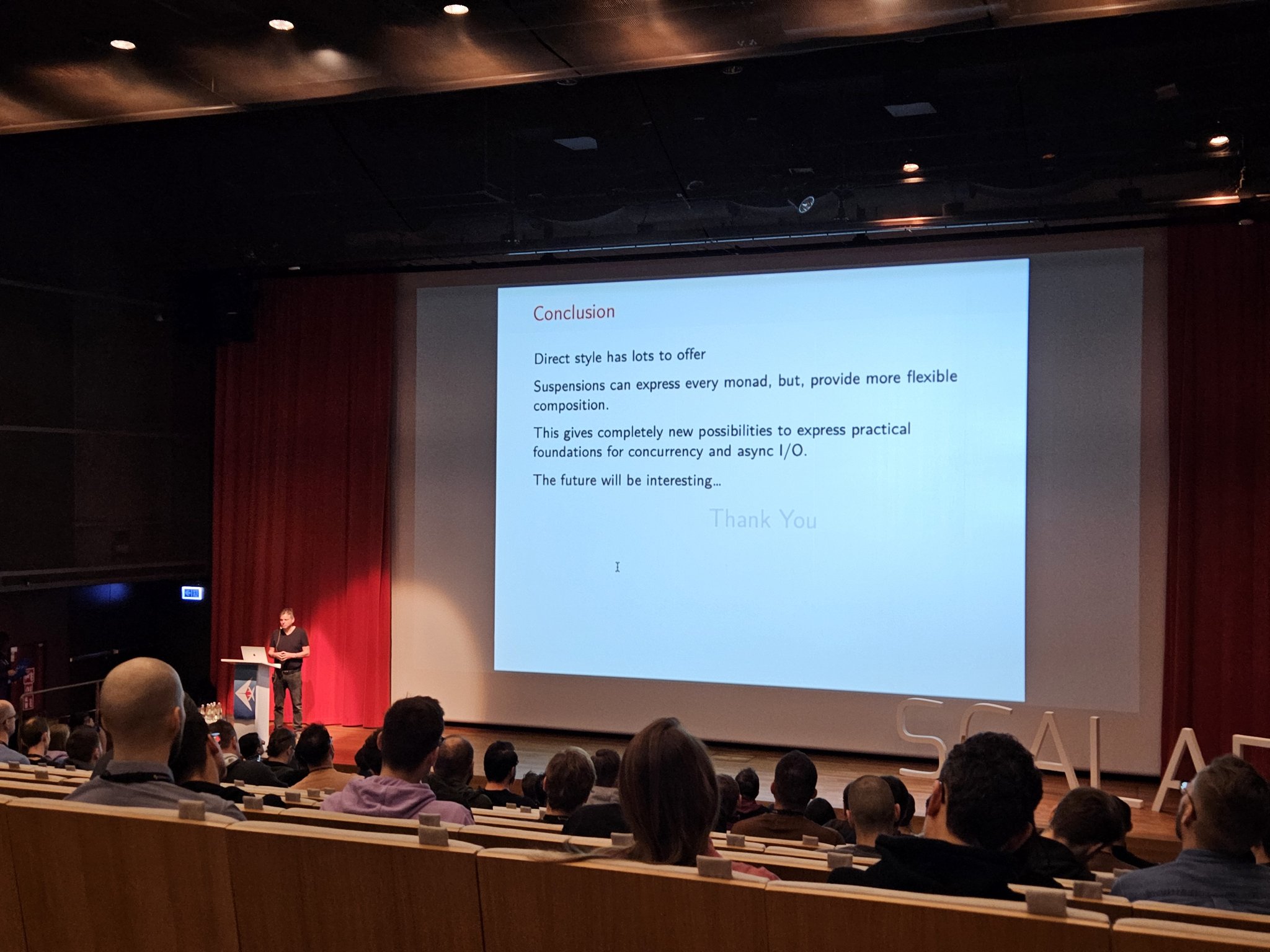
Today's @scalarconf keynote by @odersky showed how tomorrow's Scala would change.
It's hard to summarize all the information we got. Let's leave it as "the future will be interesting".
Dmytro Kovalenko retweeted

Hello #Scala friends! You probably don't know me, but I've been using Scala a long time and I have a crazy idea: Let's make Scala easier for newcomers.
If you think it's just crazy enough, join in at the GitHub discussions linked at the end
scala.works/
Dmytro Kovalenko retweeted

Senior Engineers understand that the highest value of code reviews isn't about ensuring high-quality code.
They know that code review is about teaching & learning how to do better engineering.