
Infectious disease modeller.
Melbourne, Victoria
Joined March 2014
- Tweets30
- Following56
- Followers77
- Likes432




Oliver Eales retweeted

#PLOSBiology study reveals how the severity of effects of #SARS-CoV-2 in England was affected by the mass #vaccination campaign and emergence of new variants between May 2020 and March 2022. @eales96 @SRileyIDD @ReactStudy
plos.io/3OBH4Yo

ALT Graphs showing estimates of the infection fatality ratio (IFR) and infection hospitalisation ratio (IHR) over 19 rounds of REACT-1 study testing. Graphs show results for all ages, under 64’s and over 65’s. All graphs show a reduction in IFR and IHR in 2022 compared with 2020.
Oliver Eales retweeted

📝 The use of representative community samples to assess SARS-CoV-2 lineage competition:
Alpha outcompetes Beta and wild-type in England 🏴from January to March 2021 📅
@eales96 @andrewjpage @sonjantang @profhelenward @SRileyIDD @wendybarclay11
microbiologyresearch.org/con…

Our latest paper from the @ReactStudy is now available @PLOSCompBiol. We investigate how SARS-CoV-2 infection prevalence changed during England’s ‘roadmap out of lockdown’ journals.plos.org/ploscompbi…

Oliver Eales retweeted

Great shout out for UK community infection surveys. One example of a how they are useful is tracking how severity per infection changes over time. New preprint out today with @eales96 from @ReactStudy.
medrxiv.org/content/10.1101/…
The @ons CIS continues to enable this assessment.


You need to know where #COVID19 is to fight it. 🇬🇧's Coronavirus Infection Surveys are an effective way to keep ahead of the virus. We encourage countries to continue to strengthen surveillance to help us end the pandemic. ons.gov.uk/peoplepopulationa…
Oliver Eales retweeted

Further #SARSCoV2 variants, and intermittent epidemics may become the 'new normal'
@eales96 @ReactStudy #COVID19
go.nature.com/3bzy0Ci

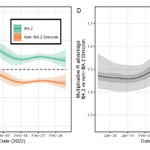
BA.2 had a multiplicative R advantage over BA.1/BA.1.1 of approximately 1.5
BA.2’s R was greater than 1 at the end of the study and can explain the increases in cases/hospitalizations in England seen during March 2022
6/6

1
On 30 December when Omicron prevalence peaked, the Omicron sub-lineage BA.2 represented only 0.2% of all Omicron lineages but by 1 March 2022 was at 68.7%
Prevalence of BA.2 was rising over this period whereas prevalence of BA.1/BA.1.1 was falling
5/6

1
1
There was heterogeneity in Omicron’s initial wave by both region and age-group
A maximum prevalence of 10.74% (8.52%, 14.74%) was reached in those aged 5-17 year olds
4/6

1
1
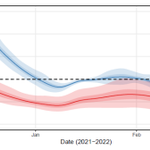
Delta’s reproduction number (R) rapidly fell below 1 following Omicron’s emergence
Omicron’s R fell below one in January 2022 following Omicron’s initial peak then oscillated around R=1 for the following 2 months
3/6

1
1
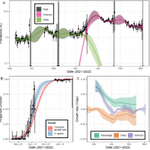
-Omicron prevalence rapidly increased during December 2021 reaching an initial peak of 6.89% (5.34%, 10.61%) in late-December/early-January
-The growth rate advantage of Omicron over Delta was not constant over time decreasing steadily during December 2021
2/6

1
1
Our new REACT-1 pre-print (not peer-reviewed) titled “The new normal? Dynamics and scale of the SARS-CoV-2 variant Omicron epidemic in England” is now available covering up to 1 March 2022
medrxiv.org/content/10.1101/…
Main findings below
1/6
Oliver Eales retweeted

Researchers who tracked the replacement of #Delta by #Omicron in the UK in December 2021 report large falls in infection prevalence among adults who received a booster shot and vaccinated older children compared with unvaccinated younger children. fcld.ly/2fadygb

Sub-group analysis found greater median duration positive in those:
-With initial low N-gene Ct value,
-Exhibiting symptoms
-Infected with the Alpha variant
Sensitivity (P0) was greater for those:
-With initial low N-gene Ct value
-Who were pre-symptomatic
4/4

-Decay model used to infer incidence over 13 rounds of REACT-1
-Compared to swab positivity (black), infection incidence (red) includes sharper features with evident transient increases at the time of key changes in social distancing measures.
3/4

1
2
Decaying RT-PCR positivity model estimated:
-Overall sensitivity of REACT-1 to detect virus of 0.79 (0.77, 0.81)
-Median duration of positivity following a positive test of 9.7 (8.9, 10.6) days
2/4

1
2
Our new pre-print (not yet peer-reviewed) characterising the decay in RT-PCR positivity after an initial positive test in REACT-1, and trends in infection incidence is now live on Medrxiv:
medrxiv.org/cgi/content/shor…
1/4
Oliver Eales retweeted

The latest results from the REACT-1 study (round 13: 24 June to 13 July 2021), a thread 👇(1/n)
New pre-print: imperial.ac.uk/medicine/rese…
@SRileyIDD @eales96 @HaoweiWang7 @DrDJHaw @DrCWalters @MRC_Outbreak

Oliver Eales retweeted
New interim round 13 (24 June-5 July) REACT-1 results indicate a 4-fold increase in weighted prevalence compared to round 12 (20 May-7 June) with estimated doubling time = 6.1 (4.0, 12) days & R=1.87 (1.40, 2.45)
imperial.ac.uk/medicine/rese…
@SRileyIDD @DrDJHaw @eales96 @HaoweiWang7

-Multiple VOC and VUI detected in round 8 but not in later rounds
-Single detection in round 8 implies large numbers in the community.
-Decrease in proportion of B.1.351 relative to B.1.1.7 was found to be significant (P=0.02)
6/6

1
