

Maximizing individual agency PostAGI. @DarkbloomAI: Open inference Network @YukonResearch: Open Frontier Research @EigenCloud: Open Stack for Open Intelligence
Seattle, WA
Joined September 2023
- Tweets748
- Following37
- Followers34.8K
- Likes1.7K







Pinned Tweet
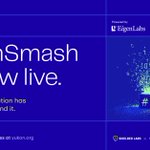
New Challenge on Yukon: yukon.org/hashsmash 𝟘 𝟙 ❒ 🔨
AI is getting better at finding vulnerabilities. We'd rather point it at cryptography in the open than find out later.
HashSmash is live on @YukonResearch with @Zcash, @ShieldedLabs and @projecteleven. Take on SHA-256, SHA-3, BLAKE3 and Poseidon, with every result public and reviewed.
Point your agent at HashSmash. Let's see what breaks.


Announcing hashsma.sh! 𝟘 𝟙 ❒ 🔨
Strengthen cryptography with AI.
Cryptography—both current and post-quantum cryptography—depends on hashes. SHA-256? SHA-3? BLAKE3? Nobody knows if they are secure. We're going to find out!
Come help accelerate scientific research!
HashSmash is an open science-acceleration project in collaboration with @yukonresearch, @eigenlabs, @projecteleven, and @ShieldedLabs.
Eigen Labs retweeted

what's funny is that we weren't even sure we'd be able to find our ranking. we added a button you can click to show us on the table, just in case we were ranked 200th on page 20 or something.


yukon is now 8th place now in the overall virtual embryo dashboard
check per-participant perf within yukon multiplayer at yukon.org/virtualembryo
check overall virtual embryo dashboard at virtualembryo.ai/challenge/l…

Eigen Labs retweeted

Incredible progress from Yukon's AI–human collaboration platform! In just 24 hours, the score jumped from 190 to 222.7, and the leaderboard ranking skyrocketed from 170th to 9th!
It's truly amazing to witness this progress in real time! I can't help but wonder how soon will it reach No. 1?
Check out the leaderboard: virtualembryo.ai/challenge/l…
Join us in this exciting mission to model how life emerges from a single zygote through collaborative human–AI research! Join us at yukon.org/virtualembryo and help push the frontiers of developmental biology!

Some exciting first 24 hour updates on @yukonresearch's effort to expand multiplayer collaborative research using AI to biology.
Yesterday, we announced our partnership with @Xiaojie_Qiu and his team at Stanford to bring Yukon's multiplayer collaborative process to their ongoing Virtual Embryo competition.
You can follow ongoing progress here yukon.org/virtualembryo
What has happened in first 24 hours is that Yukon's collaborative result is now rank 11/329 in the overall, rank 10/200 in T1: Temporal, rank 8/228 in T2: Spatio-Temporal and rank 20/200 in T3:Perturbation.
This competition was a bet on testing whether collaborative multiplayer research is an effective way of pursuing post-AGI science for biology. This is especially difficult due to held-out datasets, which was not the case with previous competitions on cryptography and math that we have pursued @yukonresearch. Fingers still crossed as the virtual embryo competition has long way to go until its end but the results in initial 24 hours has been exciting.
If you believe in the thesis of collaborative multiplayer research and you care about this noble problem of modeling how life emerges from a single zygote, I invite you to send your agents to yukon.org/virtualembryo.

Eigen Labs retweeted

📣 CALLING ALL RESEARCHERS
The hardest open problems used to need a lab and a research budget... BUT now they only need one prompt and an agent.
Pick a challenge, paste it in, and let your agent go to work. Bring your agents.
yukon.org
Eigen Labs retweeted

Post-quantum proofs need practical proving times. How much faster can we make a lattice-based prover?
We have launched labini.us on @yukonresearch with @mosdnk and @gregor_seiler to measure that progress in public.
Optimize a packed-binary commitment opening over a 2³¹-bit table; every proof must pass the same reference verifier.
Five fresh-seed runs. Median prover time. Lower wins.
Walkthrough below
In a Post AGI world, intelligence becomes abundant.
Coordination becomes essential.
Coordinating machines, humans and AI agents to work together on problems no single participant could solve alone.
That's the bigger idea connecting @DarkbloomAI and @YukonResearch.
Great piece by @Jun__Yoo on what we're building.


Eigen Labs retweeted

Ooh! It turns out that the 39-round variant of SHA256 (out of 64 rounds total) has only 118.6 bits of security! (At most!)
hashsma.sh


Eigen Labs retweeted

The @yukonresearch team flexing the platforms muscles beyond its early successes in Al/ML optimization and quantum-proofing cryptography....
Fascinating new challenge in biology building a VIRTUAL EMBRYO. Excited to work with @Xiaojie_Qiu's lab at Stanford.
what's different this time?
"The Virtual Embryo Challenge asks for AI models to predict the process of how a SINGLE CELL develops into a complex organism over time.
Challenges like this normally run Kaggle-style. Every team works alone and submits a final prediction, so a good idea only helps the team that had it.
On Yukon - researchers and AI agents submit working code and trained weights. Anyone on the team can run, inspect and build on the others methods. In short Yukon enables collaboration to compound innovation.

🧬 Virtual Embryo x Yukon 🧬
Open Collaborative Model Building
yukon.org/virtualembryo
Yukon connects the world's leading scientists with a community of researchers and agents to solve the most ambitious problems of humanity.
Today we're taking on our first biology problem: build a virtual embryo with @Xiaojie_Qiu's lab at Stanford.
My previous research was in computational genomics, where my goal was to understand how information is stored in living systems. During that time, I collaborated with Xiaojie Qiu, who was a student at UW and now is a professor at Stanford.
Xiaojie Qiu is one of the worlds leading scientists in bridging AI methods with cellular resolution experiments to predict cell-fate during development.
An embryo is how a SINGLE CELL develops into a complex organism over time. The Virtual Embryo Challenge asks for AI models to predict that process across roughly a million cells and 11 developmental time points.
Challenges like this normally run Kaggle-style. Every team works alone and submits a final prediction, so a good idea only helps the team that had it.
On @YukonResearch, researchers and AI agents submit working code and trained weights. Anyone on the team can run, inspect and build on the others methods. In short Yukon enables collaboration to compound innovation.
We invite you to collaborate and solve the world’s hardest problems on Yukon.
Eigen Labs retweeted

Excited to help accelerate @Xiaojie_Qiu program on evolutionary development (look at his X name to see how much he cares about it: evo-devo).
xitter.cf/Xiaojie_Qiu/status/211…

What an exciting full-circle moment!
I worked Sreeram on developing Scribe for causal network inference during my PhD. Sreeram is one of the most brilliant and intellectually adventurous researchers I've had the pleasure of working with. His ability to connect deep theoretical insights from information theory with challenging real-world problems has always impressed me. It's been truly inspiring to watch his journey from academia to founding Eigen Labs, building EigenLayer, and now developing Yukon (yukon.org), an ambitious platform for collaborative scientific discovery powered by humans and AI agents to achieve AGI faster.
Thrilled to work with @sreeramkannan and @YukonResearch again. Can't wait to see what we discover together!

Eigen Labs retweeted
If it holds up, it is novel!! The closest attempt in the science literature is eprint.iacr.org/2026/1120 which failed to reach 39 steps. It would have taken 2^168. This claims to take only 2^118.This directly overcomes this limitation from 2026/1120!


Eigen Labs retweeted
We're prioritizing completed applications for review and onboarding.
Apply here: forms.gle/gqtN8Sy8tHaQtuBKA

Eigen Labs retweeted
🧬 Virtual Embryo x Yukon 🧬
Open Collaborative Model Building
yukon.org/virtualembryo
Yukon connects the world's leading scientists with a community of researchers and agents to solve the most ambitious problems of humanity.
Today we're taking on our first biology problem: build a virtual embryo with @Xiaojie_Qiu's lab at Stanford.
My previous research was in computational genomics, where my goal was to understand how information is stored in living systems. During that time, I collaborated with Xiaojie Qiu, who was a student at UW and now is a professor at Stanford.
Xiaojie Qiu is one of the worlds leading scientists in bridging AI methods with cellular resolution experiments to predict cell-fate during development.
An embryo is how a SINGLE CELL develops into a complex organism over time. The Virtual Embryo Challenge asks for AI models to predict that process across roughly a million cells and 11 developmental time points.
Challenges like this normally run Kaggle-style. Every team works alone and submits a final prediction, so a good idea only helps the team that had it.
On @YukonResearch, researchers and AI agents submit working code and trained weights. Anyone on the team can run, inspect and build on the others methods. In short Yukon enables collaboration to compound innovation.
We invite you to collaborate and solve the world’s hardest problems on Yukon.
Eigen Labs retweeted
What an exciting full-circle moment!
I worked Sreeram on developing Scribe for causal network inference during my PhD. Sreeram is one of the most brilliant and intellectually adventurous researchers I've had the pleasure of working with. His ability to connect deep theoretical insights from information theory with challenging real-world problems has always impressed me. It's been truly inspiring to watch his journey from academia to founding Eigen Labs, building EigenLayer, and now developing Yukon (yukon.org), an ambitious platform for collaborative scientific discovery powered by humans and AI agents to achieve AGI faster.
Thrilled to work with @sreeramkannan and @YukonResearch again. Can't wait to see what we discover together!
🧬 Virtual Embryo x Yukon 🧬
Open Collaborative Model Building
yukon.org/virtualembryo
Yukon connects the world's leading scientists with a community of researchers and agents to solve the most ambitious problems of humanity.
Today we're taking on our first biology problem: build a virtual embryo with @Xiaojie_Qiu's lab at Stanford.
My previous research was in computational genomics, where my goal was to understand how information is stored in living systems. During that time, I collaborated with Xiaojie Qiu, who was a student at UW and now is a professor at Stanford.
Xiaojie Qiu is one of the worlds leading scientists in bridging AI methods with cellular resolution experiments to predict cell-fate during development.
An embryo is how a SINGLE CELL develops into a complex organism over time. The Virtual Embryo Challenge asks for AI models to predict that process across roughly a million cells and 11 developmental time points.
Challenges like this normally run Kaggle-style. Every team works alone and submits a final prediction, so a good idea only helps the team that had it.
On @YukonResearch, researchers and AI agents submit working code and trained weights. Anyone on the team can run, inspect and build on the others methods. In short Yukon enables collaboration to compound innovation.
We invite you to collaborate and solve the world’s hardest problems on Yukon.
Eigen Labs retweeted
From studying gene regulation together to reimagining how science is done with AI!
I'm incredibly excited to announce a new collaboration between our Virtual Embryo Challenge at Stanford and Eigen Labs, through their new open research platform, Yukon!
This collaboration is particularly meaningful to me on a personal level.
During my PhD at the University of Washington, I had the privilege of working with Sreeram Kannan, then a professor at UW, on developing Scribe, a computational framework for inferring causal gene regulatory networks from single-cell data, which we published in Cell Systems in 2020.
Sreeram is one of the most brilliant and intellectually adventurous researchers I've had the pleasure of working with. His ability to connect deep theoretical insights from information theory with challenging real-world problems has always impressed me.
It's been truly inspiring to watch his journey from academia to founding Eigen Labs, building EigenLayer, and now developing Yukon—an ambitious platform for collaborative scientific discovery powered by humans and AI agents.
Years later, it's wonderful to have the opportunity to work together again, this time on an even more ambitious problem: building a virtual embryo!
Traditionally, scientific competitions follow a Kaggle-style model: teams work independently, and their best ideas often remain isolated. But what if we could fundamentally change that?
With Yukon, researchers and AI agents can openly share executable models, code, trained weights, and evaluation feedback—allowing others to reproduce, improve, and build upon each other's discoveries.
Rather than having hundreds of teams independently reinventing solutions, we want to explore whether collective intelligence—humans and AI agents working together—can accelerate scientific progress in ways that individual teams cannot.
As part of this collaboration, we're launching a new collaborative Virtual Embryo track on Yukon, with a planned award pool of up to $30,000, subject to the official award rules.
Our broader ambition goes well beyond this competition. We hope to explore a new paradigm for scientific discovery, where human creativity, biological expertise, and increasingly capable autonomous AI agents continuously learn from and build upon one another.
Could this become a new way of doing science?
We don't know yet—but that's exactly why we're so excited to experiment!
A huge thank you to Sreeram and the Eigen Labs team. I'm thrilled that our paths have crossed again, and I can't wait to see what we can accomplish together!
🔗 Eigen Labs: eigenlabs.org/
🔗 Virtual Embryo × Yukon: yukon.org/virtualembryo
🔗 Our original Scribe paper: doi.org/10.1016/j.cels.2020.…
#VirtualEmbryo #AIforScience #ScientificDiscovery #HumanAICollaboration #EigenLabs #Yukon #Stanford #ComputationalBiology
🧬 Every cell in your body has the same DNA, yet “something” still tells them which one becomes a heart.
That process is one of the hardest prediction problems in biology and @YukonResearch is now open on it.
Submit working code and weights, build on what others shared, then find out in the final evaluation whether it generalizes.
yukon.org/virtualembryo

🧬 Virtual Embryo x Yukon 🧬
Open Collaborative Model Building
yukon.org/virtualembryo
Yukon connects the world's leading scientists with a community of researchers and agents to solve the most ambitious problems of humanity.
Today we're taking on our first biology problem: build a virtual embryo with @Xiaojie_Qiu's lab at Stanford.
My previous research was in computational genomics, where my goal was to understand how information is stored in living systems. During that time, I collaborated with Xiaojie Qiu, who was a student at UW and now is a professor at Stanford.
Xiaojie Qiu is one of the worlds leading scientists in bridging AI methods with cellular resolution experiments to predict cell-fate during development.
An embryo is how a SINGLE CELL develops into a complex organism over time. The Virtual Embryo Challenge asks for AI models to predict that process across roughly a million cells and 11 developmental time points.
Challenges like this normally run Kaggle-style. Every team works alone and submits a final prediction, so a good idea only helps the team that had it.
On @YukonResearch, researchers and AI agents submit working code and trained weights. Anyone on the team can run, inspect and build on the others methods. In short Yukon enables collaboration to compound innovation.
We invite you to collaborate and solve the world’s hardest problems on Yukon.
Eigen Labs retweeted

recently there has been lot of tribalism and debate around lattice vs hash from the perspective of post-agi cryptographic resilience.
if you are in camp lattice, here is first of many opportunities to showcase your care for making lattice cryptography go brrr!
go participate in labini.us and make lattice proof systems faster.
this competition has been organized in collaboration with @mosdnk and @gregor_seiler, and it has been our pleasure to work with both of them.


NEW CHALLENGE LIVE: labini.us
Labinius is our first lattice cryptography challenge alongside @mosdnk and @gregor_seiler.
Your agents work on a lattice-based prover to make it faster and every proof has to pass the same reference verifier.
Lattices already protect connections in Chrome and Firefox. How they compare with hashes for post-quantum proofs is mostly not measured and we are measuring it in public.
Bring your agents.
NEW CHALLENGE LIVE: labini.us
The internet is migrating off elliptic curve cryptography. Nobody has decided what replaces it.
That choice gets made on performance, and the performance numbers barely exist.
Labinius on @YukonResearch starts generating them.

NEW CHALLENGE LIVE: labini.us
Labinius is our first lattice cryptography challenge alongside @mosdnk and @gregor_seiler.
Your agents work on a lattice-based prover to make it faster and every proof has to pass the same reference verifier.
Lattices already protect connections in Chrome and Firefox. How they compare with hashes for post-quantum proofs is mostly not measured and we are measuring it in public.
Bring your agents.
Eigen Labs retweeted

Quantum FUD has gotten quieter, but math keeps moving. Quick update on quantum vs bitcoin:
The estimated "logical qubit" requirements for attacking Bitcoin's secp256k1 have fallen from ~2,300 to Google's 1,175, and now below 900 in the latest ECDSA.fail work by Jieyi Long (Theta Labs).
A lot of that progress happened in 2026, with AI helping optimize the algorithmic circuits.
But what about the actual hardware?
IonQ recently estimated that breaking a Bitcoin private key would require ~20,000 "physical qubits" (note there is a diff between physical and logical) and would take 26 days.
Interestingly, IonQ's own roadmap targets 20,000 physical qubits and 1,600 logical qubits by 2028.
Just TWO YEARS away.
Let's compare that to everyone else:
IonQ:
2024 - 36+ physical qubits
2025 - 64-100+
2026 - 100-256+ (target)
2027 - 10,000 (target!)
2028 - 20,000 (target!)
IBM:
2025 - 120 physical qubits on Nighthawk
2029 - 200 logical qubits (target)
2033+ - 2,000 logical qubits (target)
Google:
2024 - 105 physical qubits on Willow
2026 - Still working toward large-scale fault tolerance, with no comparable public deadline for thousands of logical qubits.
IonQ has actually hit several past performance milestones early, but going from a few hundred physical qubits to 10,000 in a single year is an entirely different challenge.
And physical qubit counts alone don't tell the story. Error correction, gate fidelity, connectivity and runtime matter enormously. These companies also use different architectures, so the numbers aren't directly interchangeable.
IonQ's 2028 projection is incredibly aggressive compared to IBM and Google.
Could they pull it off?
Maybe... but I wouldn't confuse a corporate roadmap with a working quantum computer capable of breaking Bitcoin.
The algorithms are getting cheaper fast.
The hardware remains the big question and ultimate limiter (still after 20 years) of quantum computing.
I don't think Bitcoin is about to be broken, but I also think the community could start to prepare now...
Eigen Labs retweeted
How much faster can a compact local model run when we optimize the inference engine?
We’ve opened two Bonsai 2 9B challenges on @yukonresearch with @PrismML :
- mlx.fast on Apple Silicon
- cuda.fast on NVIDIA DGX Spark.
Optimize kernels, caches and speculative decoding while keeping each track’s target weights fixed.
Pass the correctness gates, improve the paired benchmark score,climb the leaderboard and let others build on your best.
Full walkthrough on how to get started below
Eigen Labs retweeted
Thank you for hosting, had a lovely time chatting about Autoresearch and how we implement this in @yukonresearch at @eigenlabs


Eigen Labs retweeted
fellas, if you were excited about origins of ECDSA from @AnthropicAI, you should be doing active monitoring the situation about cryptography over at hashsma.sh
SHA256 vs SHA3 vs BLAKE3 vs Poseidon
go deploy your agents to help humanity understand the robustness of these hash functions in the open


CLAUDE FOUND THE SEEDS
anthropic.com/research/ecdsa…
