Edd (@erla_ndpg) header
Edd (@erla_ndpg) profile picture

Ex Computer Science student from Indonesia Only create X because AI Researchers are on X

Joined August 2020
Photo by Edd (@erla_ndpg)Photo by Edd (@erla_ndpg)Photo by Edd (@erla_ndpg)Photo by Edd (@erla_ndpg)Photo by Edd (@erla_ndpg)Photo by Edd (@erla_ndpg)Photo by Edd (@erla_ndpg)Photo by Edd (@erla_ndpg)Photo by Edd (@erla_ndpg)Photo by Edd (@erla_ndpg)
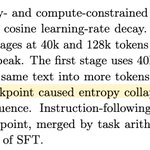
I'm wondering whether if using something that supposed to stabilized more like Muon should be able to remove these kinds of things? anw, how do you even recover for this? (for both the model and the researcher ๐Ÿซ  )
1
148
I saw a lot of Gekko somewhere...spill the tea to us yk ๐Ÿ‘€
40
New Unsloth release - 1.9x faster decode for Inkling-2-Mini reaching 125 tokens/s on RTX PRO 6000! We also updated huggingface.co/unsloth/Inkliโ€ฆ with mainline llama.cpp support & fixed KV cache quantization using more VRAM than F16! Also RTX Spark, AMD and all devices are optimized!
We made Inkling 2 Mini run ~1.9x faster locally! โšก๏ธ Inkling 2 Mini GGUFs can now reach 125 tokens/s on a RTX Pro 6000 GPU via Unsloth, with no accuracy loss. Run faster via Unsloth Desktop! GitHub repo: github.com/unslothai/unsloth GGUF: huggingface.co/unsloth/Inkliโ€ฆ
16
12
4
140
6,762
Yah udh kepake ๐Ÿ˜ž
Dugong: Composing Uncertified DAG Consensus George Danezis, Lefteris Kokoris-Kogias, Alberto Sonnino arxiv.org/abs/2611.27473 [๐šŒ๐šœ.๐™ณ๐™ฒ ๐šŒ๐šœ.๐™ฒ๐š]
2
117
arxiv.org/pdf/2611.24331v1 Cool paper! One thing that is missing (I think) is that it also depends on how hard the dataset is. One of the thing that we observe is that for the same model, the GNS behavior can be different with respect to how hard the dataset is (eg. coding and math dataset GNS is different than general language) I forgot what's the exact number tho ๐Ÿ’€
6
391
Edd retweeted
The Lean FRO and Mathlib Initiative have released a joint statement on the Lean verification of the Riemann Hypothesis. On November 20, Levent Alpรถge released a proof of the Riemann Hypothesis as a Lean library of 17 million lines of code. Over the past day, the Lean and Mathlib communities worked together to verify it. The statement certifies the proof as correct and describes how it meets all necessary verification criteria. Congratulations to Levent on this achievement, and thank you to everyone in the community who contributed to the verification. Full statement: leanprover-community.github.โ€ฆ
592
5,474
2,213
29,524
3,761,120
RT @UnslothAI: Run Inkling 2 Mini, the strongest 26.4B MoE model that runs on 16GB RAM. Thinking Machinesโ€™ Apache 2.0 model uses a loopedโ€ฆ
This quoted post is unavailable.
4
2
The Riemann Hypothesis proof is now available on @paperswithcodee Chat with it here: paperswithcode.co/pdf/133661
9
36
8
390
46,900
1 hour in, Neon is quite good... Not yet on hard task tho
1
1
2
303
Unsloth Desktop now supports NPUs! NPUs use 2-4x less energy per token for local models vs GPUs! We collabed with AMD to support the current Strix, Krackan and Gorgon devices, and future AMD devices with NPUs will also be supported out of the box! Blog: unsloth.ai/docs/get-started/โ€ฆ
AMD XDNA 2 NPUs are the world's first NPUs supported by @UnslothAI Desktop. 100+ agentic apps. Now on your NPU. bit.ly/4jqlftF
13
20
145
5,180
so is Neon good or not? or Opus 5.5 still the wonder child?
1
1
124
Together AI has written Megakernels since last year for inference optimization. Their recent blog states they are not continuing with that and will rely on model forward-pass optimization, CUDA graphs, and PDL.
4
5
1
56
6,068
AGI - Artificial Genshin Impact
ๅŽŸ็ฅž้ข†ๅ…ˆไธ–็•Œไธ€ไธช็‰ˆๆœฌ
3
184
Looking for a reference manual for building a frontier LLM? We wrote one ๐Ÿ‘‡ The K2 Horizon technical report is now on arXiv: 134 pages on how we built six models, from architecture to inference. It may be the most detailed LLM training reference you can read today. โ€ข Architecture: we bring two new attention designs, MoVA and softplus attention gating, to strengthen reasoning. With them, our 36B model nearly matches a 32B dense one on one-seventh of the active parameters. โ€ข Pre-training: we trained four models, from 3.7B to 36B, on the same 22T tokens. Their normalized loss curves collapse onto nearly the same line, so a recipe that works on a small model carries over when scaling up. โ€ข Data: 60+ pages on the part most reports skip. How we generated ~10T synthetic tokens, and why we chose the data mix on predicted scores at scale, which reversed the small-run ranking. โ€ข Post-training: we document our full production-scale run for the 375B flagship. โ€ข Inference: Uno gives an autoregressive model diffusion speed with one small adapter. Up to 2.2ร— faster decoding, lossless by construction, no draft model. This is the last piece of the openness puzzle. K2 Horizon already shipped with 380 checkpoints, 13 TB of pre-training data, 58 training runs and 17 code repositories. The report explains the decisions behind them. More details: arxiv.org/abs/2611.21003
25
85
24
559
56,277
In multi-epoch training, latent feedback can match a vanilla Transformer's loss with far less compute or unique data (nearly 50% at best). ๐Ÿ“œ Paper: alphaxiv.org/abs/2611.latentโ€ฆ ๐Ÿ’ป Code, checkpoints & data: github.com/ifm-ai/LoRM ๐Ÿงต Walk-through: xitter.gq/huskydogewoof/status/2โ€ฆ Many challenges remain, such as prefilling and speculative decoding.
"Latent Feedback Is a Compute and Data Amplifier" Repeatedly training LLMs on the same data gives diminishing returns, but latent feedback provides a more efficient way to use that compute. This paper revisits Latent Feedback Transformers, which feed each token's final hidden state into the next token's input, letting the model to reuse information across consecutive positions. Across models from 60M to 778M params, latent feedback saves up to 48% of training compute or 41% of unique training data in measured comparisons at matched validation loss. A new scaling law also predicts performance on a held-out 778M model within 0.3%. alphaxiv.org/abs/2611.latentโ€ฆ
5
11
72
3,021
data efficiency
High-quality data is limiting modern pretraining. But it turns out you can reach the same performance with far less data, in 4 lines of code. Introducing ๐‹๐š๐ญ๐ž๐ง๐ญ ๐…๐ž๐ž๐๐›๐š๐œ๐ค ๐ˆ๐ฌ ๐š ๐‚๐จ๐ฆ๐ฉ๐ฎ๐ญ๐ž ๐š๐ง๐ ๐ƒ๐š๐ญ๐š ๐€๐ฆ๐ฉ๐ฅ๐ข๐Ÿ๐ข๐ž๐ซ. Feed a Transformer's own top-layer states back in as input, and every token and every FLOP counts for more. The more data each parameter sees, the more you save. TL;DR: - On the same data, latent feedback reaches the same loss with 15% ๐ฅ๐ž๐ฌ๐ฌ ๐ญ๐ซ๐š๐ข๐ง๐ข๐ง๐  ๐œ๐จ๐ฆ๐ฉ๐ฎ๐ญ๐ž at 100 unique tokens per parameter, and 46% less at 400 (2-epoch budget) - At the same number of epochs, it reaches the same loss with 10% ๐ฅ๐ž๐ฌ๐ฌ ๐ฎ๐ง๐ข๐ช๐ฎ๐ž ๐๐š๐ญ๐š at 60M parameters, and 20% less at 778M (1 epoch, 50 unique tokens per parameter) - Downstream (109 tasks in 37 suites): ahead in all 17 settings at a 4-epoch budget - Our fitted scaling law predicts the savings keep growing with model size. On a 2-epoch budget, the compute saving goes from 15% at 271M parameters (measured) to 34% at 10B and 45% at 100B (predicted) ๐Ÿงต ๐๐š๐ฉ๐ž๐ซ, ๐œ๐จ๐๐ž ๐š๐ง๐ ๐œ๐ก๐ž๐œ๐ค๐ฉ๐จ๐ข๐ง๐ญ๐ฌ ๐š๐ญ ๐ญ๐ก๐ž ๐ž๐ง๐
1
1
16
1,825
guys, I'm tired of Jensen scandal already. Can we just talk cool things like system, parallelism, efficiency already?
1
5
331
Dimana ini woy
1
1
173
Ada banyak bjir
45