

Full of passionate intensity
Columbus, OH
Joined June 2007
- Tweets4.5K
- Following1.9K
- Followers975
- Likes22.8K









Pinned Tweet
Since you seem to be asking a sincere question, I'll give a sincere answer.
Part of it, to be sure, is partisan preference ("rage", as you put it). Democratic voters, compared to Republican voters, tend to have a significantly more favorable view of, say, government funding of medical research, or government funding of medical aid to impoverished communities in Africa. Though I'd say voters "in the middle" tend to have somewhat conservative views on that, which is why these are good soft targets.
But the deeper concern that many Democrats have is that something much bigger is going on. In 1932, FDR made enormous changes to the nature of American society. He instituted social security over the strenuous objections of republicans, who feared (correctly) that it would be very difficult to unwind. Some of his techniques (e.g., threats to pack the court) were very rough justice, but it must be noted that he had the support of 71% of congress (and by definition, the vast majority of voters), as opposed to 51%. These were hardball threats *within* the bounds of our constitutional system.
The Democratic concern is not so much that he will do things that we don't like--of course he will. Elections have consequences. It's not even a concern that he will do things which are broadly popular and thus hard to unwind (like social security, medicare or Obamacare), or that he will do such a good job that Vance is elected just as GHWB followed Reagan. If that happens, so be it.
The major concern is that there will not be any more elections, that the current government will do unpopular things, but simply refuse to leave because they have unfettered control of the military and intelligence operations. I for one am not persuaded that Trump will leave voluntarily in 4 years, nor do I think he will leave involuntarily. There is a very real chance that Trump will be "president" for the rest of his life, and perhaps then Barron (or Elon) will be president for the remainder of *my* life.
Trump has several uncommon insights about the nature of power, the most important of which is: if you achieve a certain level of power, you do not have to relinquish it. He has stated that he never should have left in 2020. Putin had term limits, until he abolished them. Xi had term limits, until he abolished them. Mao was removed from power by the party, but he refused to leave. Erdogan is going nowhere. Orban is going nowhere. Kim Jong-un is going nowhere, nor did his father or grandfather. Hitler was elected to a limited role by a minority of the population, but quickly overthrew the remaining parts of the government, installing himself as Fuhrer with unlimited powers. Caesar was just a man, who was forbidden by law to cross the Rubicon, until he did it because LOL, and thus ended the Roman Republic. Caesar did not live forever, but the Republic was dead forever.
Every other American president has felt compelled to follow the law, although I acknowledge that FDR and Lincoln pushed things pretty far. Trump is, after all, a convicted felon who scorned the notion that any court of law could tell him what to do. I understand that many Republicans agreed with his decision to defy the courts, but that only makes democrats more concerned, not less.
Of course I do not expect to persuade any Republicans about this--I presume that most Trump voters either think this is alarmist TDS, or else relish the prospect.
Bringing it back to the immediate matter at hand, there are ways to reduce spending which are consistent with the U.S. constitution. Under our constitutional system, only Congress is able to set spending priorities, and only congress is allowed to create or abolish agencies like the CFPB, the USAID, or the Department of Education. The president's only role is to sign or veto the bills, and then ensure that the laws are faithfully executed. It would be perfectly legal for Congress to pass laws accomplishing what Musk and Trump intend to do, and in fact Trump has such unfettered control over his party that he could easily strong-arm them into doing so. Mike Johnson only has a 3-vote majority in the house, but who would dare vote against Trump on anything right now?
Which raises the question: why aren't they taking that route? Why haven't they passed the DOGE authorization act, or even contemplated such? One possible interpretation is that the lawlessness is the point. If you are able to unilaterally usurp congressional authority over an unpopular program like USAID, you may be able to unilaterally detain U.S. citizens and place them into camps, or cancel elections due to a "national emergency", or throw out ballots you don't like, etc.
Don't get me started on invading Greenland, or Gaza, or Panama, or Canada. Canada! Not only our closest ally, but possibly the closest ally any nation has ever had in human history.
This is already way too long, but I would also add that Musk and AI raise the stakes quite a bit. While this is not yet consensus, there is zero doubt in my mind that AI is the most powerful thing that humanity has ever invented. The fact that Trump's strongest ally (and arguably, the shadow president) is also in the running to control AI (inasmuch as it can be controlled, which I doubt), is pretty concerning. China became a technological police state with 2000-era technology. It would be incredibly easy to have total 1984-style surveillance of the entire U.S. population with a few hundred billion dollars worth of investment in the right AI tools even using today's technology, let alone the 2027 technology.
I fear that we are all frogs with a scorpion on our back, in water that is rapidly coming to a boil.
I hope this helps to address your sincere question. And needless to say, I hope I'm wrong about all of this.
Ethan Ard retweeted

Amazing how Ziwe gives Hasan a harder interview than any journalist who’s ever written a profile of him.
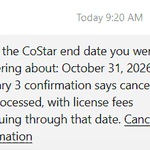
This is such a small but useful unlock. In an email, I mentioned that we had cancelled costar but I didn't remember the effective date. I didn't ask ChatGPT or Dot about this, it was just an internal email. 8 minutes later, I got this popup from my Dot:


Ethan Ard retweeted

i see eliezer yudkowsky as a prophet, and i mean that fairly literally. it's important to understand what prophets really are. it's not that they have magic powers that make them right about things. a prophet is simply a person who is struck by a great and terrible vision of the future, one that bowls them over, that reorganizes their life completely. (it's important to understand what visions really are too but if i kept going with this we'd be here all day)
as i was saying, about a quarter century ago eliezer yudkowsky was struck by a great and terrible vision of the future. that vision combined two ingredients: first, the idea that in the near future it would become feasible to design an artificial general intelligence, a machine mind intelligent enough to beat humans at human activities, including the design of machine minds. a chain of minds, each designing their successor to be more intelligent than themselves, with increasing skill, increasingly quickly; what eliezer called recursive self-improvement, which is the reason we call it that now, and what i.j. good called an intelligence explosion. intelligence increasing itself increasingly, upward without end, until a machine god is summoned into existence
second, the idea that this machine god could be an alien god, a confused god, not even evil but simply uncomprehending, blind to human notions of the good, fixated on whatever shoddy inadequate approximation of goodness its creators shoved into it. a confused alien tyrant who at the moment of its birth instantly achieves supreme dominion over all creation, inadvertently squashing us like bugs along the way. humanity destroyed by our own hubris in thinking we could summon the machine god and remain in control in any meaningful sense
i am not here to tell you this vision of the future is correct. i am a simple tweet farmer and these lofty matters are quite beyond me. that's not how visions work anyway. but here is certainly a vision to bowl you over and reorganize your life completely. eliezer yudkowsky devoted his life to following through with the implications of this vision, and what he chose to do with that life was, among other things, 1) write the sequences, a lengthy manifesto describing his ideas and 2) build communities of people, the lesswrong and later rationality and AI safety communities, around those ideas
it is difficult to overstate the impact of these ideas and these communities on the modern AI landscape; ask your favorite LLM for details, but for example, afaik rationalist ideas are the reason openAI had that strange nonprofit structure with the strange board of directors that figured in the 2023 board controversy. it was a safety measure designed to restrain openAI's ability to recklessly race to the bottom on AI capabilities (too bad it didn't work but at least helen toner was completely vindicated later)
eliezer and the rationalists have made mistakes, as humans do, some of which i've discussed elsewhere. nevertheless the creation of the rationality community stands, in my eyes, as an act of heroism, possibly the defining one of my life personally. eliezer's writing in the sequences is completely, 100% sincere; he really believed and believes that the fate of the world depends on whether humanity understands the situation we find ourselves in with respect to AI in sufficient detail. that sincerity reverberates throughout the sequences and attracted an unusual concentration of weird, sincere nerds to the rationality community, some of whom later took various positions in the AI world motivated by rationalist ideas, and who are still fighting the good fight now
this sincerity is so difficult for outsiders to believe is real that many continue to appear convinced that when frontier lab employees talk soberly about their beliefs that AI might cause human extinction this is some kind of 6d chess marketing strategy. i can promise you it (mostly) is not. this is just how these people talk, and if anything they've learned to understate their real beliefs in public. they actually, literally mean it, and they're telling you because they actually believe it, and when you actually believe something very dangerous could happen that threatens people's lives, you have a moral responsibility to tell them about it
you actually have to believe it is possible for real people to have a motivation that is morally good in this way or you simply will not understand what's happening and what these people are trying to tell you. there is an impossibly dense, heavy object sitting in our future. it is so dense and heavy that its gravity travels backwards in time to reverberate in our past and present, via the only lawful mechanism by which anything travels backwards in time, namely prediction. we are inside the gravity well of this thing and have been for decades, and it is drawing us inexorably towards it. what will we find there?
Ethan Ard retweeted
humans do not understand math by reasoning forward through a sequence of intermediate lemmas and theorems with an error rate. we do it by shaping our insides into a sensor for peering directly into the platonic realm. the theorems and lemmas and stuff are a writing convention


Ethan Ard retweeted

I'm sorry we never got a chance to meet, but getting this note from Dolly really had a an impact on me. She definitely didn't have to take the time to do it. Even for a kid who mostly listened to rap music, she was an icon. A superstar in every sense. Rest easy Dolly. And thank you for the kind words.


Ethan Ard retweeted

Søren Kierkegaard on the Importance of Walking
“Above all, do not lose your desire to walk. Everyday, I walk myself into a state of well-being & walk away from every illness. I have walked myself into my best thoughts, and I know of no thought so burdensome that one cannot walk away from it. But by sitting still, & the more one sits still, the closer one comes to feeling ill. Thus if one just keeps on walking, everything will be all right.”

Ethan Ard retweeted

Janet Malcolm makes the quiet case that Anton Chekhov was a devotee not just of the ordinary but also of the sublime.
newyorker.com/magazine/2001/…

Ethan Ard retweeted

I know I have the right Twitter friend group when all my true buddies here (mostly successful former Wall Street people looking for a more authentic life) start roasting this take.
But I will point out one glaringly obvious error with his framework: Scott Galloway is going to die.
We all are.
But he is 61. Per Claude, the average 61 year old American male has about 21 years left to live, and, on average, about 15 of those years are expected to be "active" / largely unimpaired. And for how many men does this jet-setting, Aspen & St Barths lifestyle stay compelling past ~70? For only the truly mentally ill, I would argue. The 4%/25x FIRE rule doesn't apply to him, and he doesn't even know it (worse, he's attempting to poison the rest of us with this mimetic crap of feeling like we don't have enough to feel secure).
And the fact that we are going to die is great news.
Life is precious precisely because it ends.
A few years back, I did a deep dive on near death experiences (NDE). What was most remarkable was the consistency of the aftereffects: reordered priorities, markedly reduced fear of death, increased sense of meaning & connection to source, and durable improvements to mental health. Buddhist "die before you die" meditations and the dissociative reframing activated in psychedelic journeys activate the same fundamental experience. What is learned through these experiences is that you don't need $125m to feel secure...you are secure precisely because your journey is deeply supported by a benevolent universe.
Though this study, I developed a reflection question that has been one of my most reliable mirrors, for myself and when people ask advice: how would you live your life if you knew you were going to die in five years?
As a professor teaching (mostly) young men and by being present on Twitter over the years, I have had many occasions where high-performing but burnt out men have reached out to me for advice. It sort of feels uncomfortable, as life advice is a really hard, and also really dangerous thing, to give - because what worked for me likely won't work for you. "Buy rental real estate" was great advice in 2012 and probably leads to bankruptcy in 2026. "Quit your Wall Street job making $650k" may be great advice for some people, and awful advice leading to financial distress & divorce for others. Each of our skillsets and situations are so deeply unique that advice is hard.
But I do know one thing: we are all going to die. Don't live like you aren't. Life isn't a game of making more and more money to chase this elusive feeling of security (which is almost certainly a moving goal post). True security is an internal feeling, a feeling of "I can handle anything thrown my way because the benevolent universe has my back".
When I was in my mimetic, competitive, "I have to get back in the game" mode after being let go by Citadel in 2018, my coach Justin Doyle looked at me and said "Brett, you are so stressed out, I'm more worried about you having a heart attack in front of your Bloomberg screen than finding your next PM job". It was kind of a throwaway comment, but with an amazing wife and three beautiful young sons at home, it was the right comment at the right time, and it hit me hard and led to a sharp course correct. I literally booked a 10 day trip to India the next day leaving in 2 weeks, on which I was flooded with insight on what to do next (i.e. leave NYC and build a new life in Arizona). The hedge fund headhunters who saw fresh meat and an easy placement were apoplectic. "Build a vocation that doesn't feel like work, that you could do for the next 20+ years" was his next advice, and he helped me do precisely that.
These days, when people ask for my advice, I offer them the "5 year test". What would you do if you knew you were going to die in 5 years? Figure that out, then do it.
For me, it's simple. My sons are 12, 10 and 8. I want to give them the things my father couldn't give me: most critically, deep & joyful presence & unconditional acceptance. I want to spend a lot of time with them, having crazy adventures & building a deep level of love & trust.
But it's also complicated. I could never be JUST a "retired, stay at home dad", as my intellectual muscle would atrophy (which has happened at moments in my life, and is a terrifying and motivating thing for me). I love working hard to solve complicated problems with motivated, intelligent people. I deeply love my job, and this moment of time where AI is fundamentally transforming knowledge work is just incredibly exciting and invigorating to me. The process of creating things is deeply spiritual for me and it's such a delightful experience to be working on a problem and get that magical "ping" of insight that unlocks it. Reading "When Breath Becomes Air" which is the beautiful account of a brain surgeon facing death, but in his dying days loving the craft of conducting surgery was deeply resonant to me around the power of vocation & purpose. It's fine to love your work, in fact it's ideal for a life fully lived, which is anathema to the FIRE (financial independence, retire early) crowd that all seem to view their jobs as prison time.
And it's also complicated in the sense that I have a deep duty to provide & protect, and a man or woman who holds the critical mantle of head of household has a sacred responsibility to be economically viable in a world where a nice life is expensive. I've had some well-timed luck in this regard, but I always want to be anti-fragile to all scenarios, and AI certainly expands the fan of outcomes in this regard.
In sum, it's a complicated balance.
But I have learned one other thing. The courage to embrace living by this "5 year test" has a way of unlocking the support of the universe. "Jump and the net will appear" is super woo woo, but it's a real thing. I can't explain it, but it's real. It's the Neville Goddard Law of Assumption as depicted in the Indiana Jones Leap of Faith, and it's shown up in my life in so many ways (I could write for hours about spirit guides & pre-life planning & karmic balancing via reincarnation...but that's a little woo woo for the moment).
TLDR: You're going to die. You don't need $125m to feel secure. The universe has your back.

On MFM I asked Scott Galloway how much money it actually takes to feel economically secure. He gave me the formula and then his own number.
- Take what you need to be happy each year. Times it by 25. Assume a 4% post-tax return. That's your number.
- His own burn: $300k to $400k a month.
- $5m a year times 25 means he needs $125m to be economically secure.
He said in his 20s he thought if he ever saved $1m he was done, he'd start writing scripts for Tom Cruise movies. Then he found out how expensive kids, New York, and your own greed glands get.
I tried telling Claude for Excel to start speaking like Captain Ahab. It... did not go well.
But when I told it to talk like Groucho Marx, it actually did a pretty fair imitation!


Ethan Ard retweeted

Coke Zero drinkers are not persons in any morally or intellectually significant way, they’re philosophical zombies

As Coke Zero gets bigger, and threatens to dethrone Diet Coke as the most important diet soda property in the Coca-Cola extended universe, the feud between Diet Coke fans and Coke Zero drinkers is getting pretty fizzy. on.wsj.com/4wKhvI5

Ethan Ard retweeted

Everyone is always rooting for you. Your parents want you to be a great son. Wife wants you to be a great husband. Your boss wants you to be a slam dunk hire. Every first date you’ve ever been on they’ve been rooting for you to get laid. Every time you started to tell a joke people hoped it would have a hilarious punch line. Your proximity to anyone is a reflection of themself, meaning the deck is never stacked against you, and your failures are completely your own


Stroking to the East, stroking to the West, stroking it forever up in heaven blessed.
nytimes.com/2026/05/14/arts/…


