




Eugene Ye retweeted

1 week late, but here are some expanded thoughts from my presentation on "Is Compute a Commodity" from last week.
Read on to find out the 5 reasons why compute is a commodity, and the 3 reasons it is not!

Eugene Ye retweeted

Took Wafer 4 months to get to 1 trillion tokens a day on @OpenRouter, but only 4 days to get to 2 trillion!

Eugene Ye retweeted

Don, there is a missing term in your equation.
The crunch spread is not: Token Price - GPU rental price.
Rather it is: (Token Price * Token Volume) - GPU rental price.
More simply: Revenue per GPU - GPU rental price.
Continuous throughput improvements for the same exact token mean that volume growth can more than offset token price declines for the exact same model/token
i.e. Kimi K3 token throughput per GPU has recently been improving at a 37% annualized rate driven by inference engine optimizations.
GPU prices are vertical because:
1) Mix is shifting from higher margin frontier tokens to lower margin open-weight tokens. $10 in Claude revenue requires $1 of inference compute. $10 of of open-weight revenue requires $3 to $7 of inference compute given competition between inference providers leads to lower margins. Open-weight tokens taking share is positive for AI infrastructure demand given lower margins at the model layer. The reverse is also true in that frontier tokens taking share is negative for AI infrastructure demand. Open-weight models have been taking share since early summer.
2) Throughput is steadily improving for each individual token type such that GPU compute becomes more valuable even as true like for like token prices decline.
Eugene Ye retweeted
excited to partner with @Vercel to power Token Pass!
for $30 per month, your team gets $80 in monthly credit for:
- GLM 5.3,
- Kimi K3
- DeepSeek V4.1 Flash 1017
powered by Wafer, with more models coming soon!
available as an add-on to Vercel Pro.
links in thread 🧵


Eugene Ye retweeted

Introducing the Haight Street Compute Market.
A one-day trading floor where vetted buyers and sellers of compute meet and sign deals in person. Nov 17, at the old Federal Reserve building in San Francisco.
Request your invite: luma.com/86cjwpui
Eugene Ye retweeted

personal update: i quit investment banking
and joined @wafer_ai as chief of staff
thank you to my goats @gpuemi @gpusteve @gpugene
we’re hiring ranked gamers: jobs.ashbyhq.com/wafer

Eugene Ye retweeted
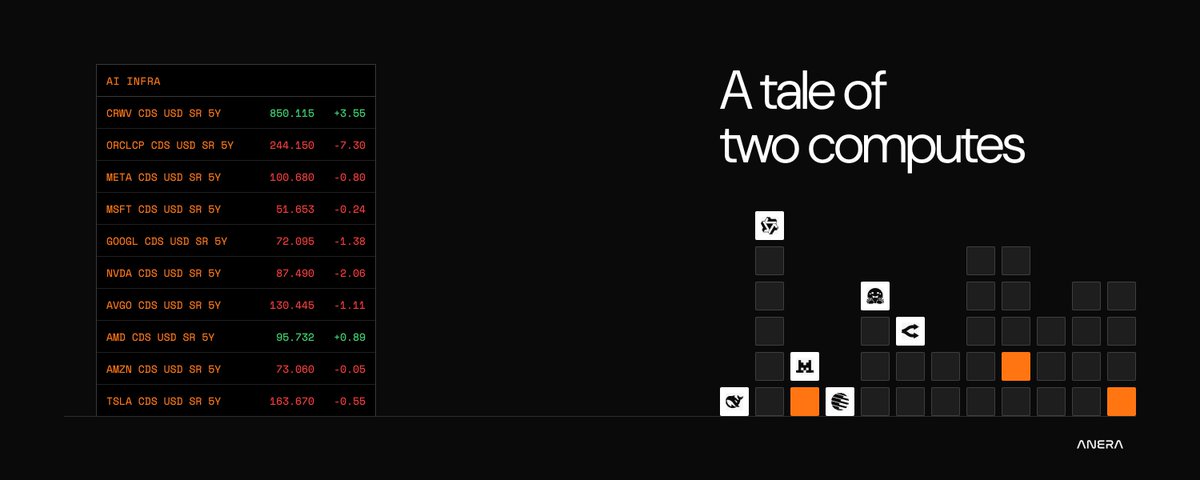
Just like with oil, the market outside the majors is the true marginal market for compute.


Eugene Ye retweeted
Wafer beat Cerebras on latency for @ycombinator's AI Office Hours.
GLM-5.2 on Wafer averaged 379 ms versus 674 ms for Gemma 4 31B on Cerebras.
that's 44% lower latency with a much larger model.
YC wanted people to get startup advice from AI versions of its partners at conversational speed. after testing lightweight Gemma and OpenAI models, they moved to a dedicated Wafer endpoint.
Wafer agents tuned the serving setup for YC’s request rate, cache usage, and prompt and response lengths.
users spent 2.5 minutes longer talking to its AI partners on Wafer compared to other providers.
read how YC built the experience and landed on Wafer
🧵 link in thread

Eugene Ye retweeted
@brilliantorg 3x’d their tokens per second and cut inference costs by 50%, by making its AI tutor fast enough to answer in real time instead of speculatively prefetching answers.
To keep Koji, their AI tutor, responsive during math and coding lessons, the Brilliant team was speculatively prefetching AI-generated responses so students wouldn’t have to wait.
On Wafer's dedicated GLM-5.2 endpoint, Brilliant reached ~250 ms time to first token and 300+ output tokens per second. This was a 3x throughput increase over their previous provider.
That speed let Koji answer learners in real time, so the Brilliant team could stop pre-generating responses and remove the prefetching layer.
Read how Brilliant made the switch!
🧵 Link in Thread

Eugene Ye retweeted
we launched the most comprehensive ai performance engineering repo in the world
now we'll be posting every single resource
follow and save to keep up with the series. links in thread 🧵
part 5: Roofline: An Insightful Visual Performance Model for Floating-Point Programs and Multicore Architectures
the authors introduced a model for relating arithmetic throughput, memory bandwidth, and data reuse. applied to AI workloads, it gives a way to evaluate batching and kernel optimizations against the hardware's limits.
the paper's concepts connect to these AI performance decisions:
operational intensity measures floating-point work per byte of DRAM traffic after cache reuse. during dense transformer decoding, a linear layer processing a small token batch can read a large weight matrix for little arithmetic.
compute and bandwidth roofs bound throughput. if weight reads limit an inference kernel, reducing transferred bytes can lower its memory-time bound. increasing peak arithmetic throughput alone leaves that bound unchanged.
the ridge point marks the minimum intensity needed for peak compute throughput to be possible. batching tokens that share a weight matrix can increase work per weight byte, moving the matrix multiplication toward that threshold.
computation ceilings account for limits in instruction parallelism and operation mix. for neural-network matrix multiplication, check Tensor Core use and compare throughput with the roof for the kernel's execution path and precision.
bandwidth ceilings account for memory access patterns and data placement. for GPU tensor operations, changing the layout or thread-to-data mapping to coalesce scattered accesses can improve useful bandwidth.
data reuse raises intensity when it reduces DRAM traffic for the same arithmetic work. a tiled matrix multiplication can reuse operands on chip; measure whether that reuse reduces DRAM byte traffic.
the memory level determines which bytes to count. if a matrix multiplication reuses operands from L2, compare its L2 traffic with L2 bandwidth and its DRAM traffic with DRAM bandwidth.
the authors demonstrated the model with 4 floating-point kernels on 4 multicore systems. for AI performance work, use it to assess weight reuse, memory layout, and arithmetic execution before choosing an optimization to test.

Eugene Ye retweeted
Nope. OpenAI and Anthropic trending towards a duopoly would be negative for AI infrastructure demand and a disaster for the application layer.
Eugene Ye retweeted
Inference providers hate this man...
Your LLM deployment can deliver 30 to 50% better performance after initial deployment.
If your current inference provider isn't learning your workload and tuning the stack continuously after deployment, you need another provider.
Wafer's continual inference agents do that work.
Wafer's continual inference agents profile your production workload to identify where scheduling, decoding, or GPU memory pressure limits performance.
The agents benchmark changes to batching, serving engines, and GPU kernels against your workload. Each candidate must preserve correctness and meet your reliability targets before it ships.
The agents keep profiling as traffic changes, identifying new bottlenecks and further opportunities to improve performance per dollar.
Watch @gpuemi explain how that work continues after deployment in his conversation with theCUBE.
Eugene Ye retweeted

Why am I so focused on networking over raw compute?
Look at GPU utilization 53% of surveyed data center operators report running at only 50–70% capacity during peak demand.
GPUs aren't sitting idle because they lack compute power, they're sitting idle because they're waiting for data. They wait on storage, they wait on CPUs, and above all, they wait on other GPUs to send results back across the network.
If you add more compute to a cluster without upgrading the pipes, you just get diminishing returns on your capex.
$LITE $COHR $AAOI $CRDO

Eugene Ye retweeted

Nearly half a year of silence. We spent it studying one problem: how far RL can scale.
MiMo-V2.6 is in the middle of its RL run right now. Three things we scaled: compute (~2B tokens per step, 1568 prompts × 16 rollouts, fully async), environments and harnesses (multi-task agentic RL, mixed across multiple harnesses in one run), and grader compute (agentic in-group credit assignment, with test-case and rubric-based rewards). We'll open-source the details piece by piece over the coming weeks.
Streaming the run: mimo.xiaomi.com/rl/
Eugene Ye retweeted

@ycombinator was testing lightweight models for its ai office hours. the goal was useful startup advice at conversational speed.
they moved to glm-5.2 on a dedicated wafer endpoint. the wafer agents tuned the serving setup around their prompts, cache usage, and traffic.
yc then tested it against gpt-4.1 mini on openai and gemma 4 31b on cerebras. wafer had the lowest average llm latency at 379ms.
users on wafer talked to the ai partners for 2.5 minutes longer on average!
read how yc found the right setup
🧵 link in thread
Eugene Ye retweeted
@ycombinator built AI versions of its partners to help more people work through their startup ideas.
For its Office Hour Simulator, the team needed useful answers delivered quickly enough for a spoken conversation. They had been testing lightweight Gemini and OpenAI models before moving to GLM-5.2 on a dedicated Wafer endpoint.
YC then compared that deployment with GPT-4.1 mini on OpenAI and Gemma 4 31B on Cerebras, evaluating answer quality, latency, and conversation duration.
The Wafer configuration delivered 31% lower average LLM latency than OpenAI and 44% lower than Cerebras. Users spent 2.5 minutes longer talking to YC’s AI partners when using Wafer.
Read how YC built the experience and landed on Wafer
🧵 link in thread
Eugene Ye retweeted
DeepSeek-V4.1-Flash is live on @OpenRouter!!
pick @wafer_ai as your provider
(ss taken 9.12.26)

