

An independent, research-driven NGO founded by former Turkish diplomats | global affairs, int. politics & governance https://xitter.cf/t.co/IDjvmvgWHK
Brussels, Belgium
Joined June 2019
- Tweets6.9K
- Following115
- Followers7.6K
- Likes75





Pinned Tweet
📢 New instituDE Report
Turkey’s Human Rights Regression over the Past Decade: How Emergency Measures Became the Rule, from Scapegoats to Everyone 👇
by human rights expert and instituDE member @HKaplankaya
institude.org/report/turkeys…

"The election’s deeper significance lies in whether voters demand greater accountability, more effective governance and a clearer political strategy alongside military strength. A change of leadership may alter Israel’s political tone and diplomatic relationships, but it will not automatically resolve the Palestinian question or end regional instability. Ultimately, the test for Israel’s next government will be whether it can translate military power into sustainable security and a more coherent political future."
institude.org/opinion/israel…
"Lula's victory shows the resilience of his political coalition, but it does nothing to resolve the country's underlying divisions. Just over half the electorate went to Bolsonaro. Conservatives still have a strong presence in Congress and in the states. Lula has won another term, but not a mandate for his entire program."
institude.org/opinion/lulas-…
"The next challenge for South Korea’s missile defense is to prevent North Korea’s inexpensive weapons from weakening critical infrastructure that supports South Korea’s expensive defense system. To address these issues, KAMD and C-UAS should be integrated through coordinated acquisition, operational testing, and sustainable production capability. Cooperation with the United States and Japan would strengthen these efforts and should proceed in a way that enables South Korea’s self-reliant defense, especially when finite allied resources are confronted with competing demands elsewhere."
institude.org/opinion/south-…

"Taking into account the findings of the WGAD and the large number of violation judgments delivered by both UN bodies and the ECtHR, the detention and mass conviction practices targeting individuals associated with the Gülen Movement should be examined through the framework of crimes against humanity."
👇
institude.org/report/turkeys…

"Israel’s Elections: A Referendum on Netanyahu or on Israel’s Future?"
by instituDE member @s_akman_
institude.org/opinion/israel…

"Lula's comeback was a turnout story. His fourth term will be a governing one."
by instituDE member Dr. @imdat_oner
institude.org/opinion/lulas-…

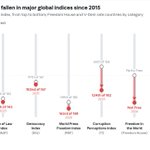
"The scale of the transformation [in Turkey] is recorded by every major international index. Freedom House downgraded Turkey from “Partly Free” to “Not Free” in 2018 and has since placed it among the ten countries with the steepest decline in freedom over the past decade. In the World Justice Project’s Rule of Law Index, Turkey fell from 80th in 2015 to 118th of 143 countries in 2025. The Economist Intelligence Unit classifies it as a “hybrid regime” close to the authoritarian threshold, V-Dem as an electoral autocracy, and Reporters Without Borders ranked it 163rd of 180 for press freedom in 2026. Its score in Transparency International’s Corruption Perceptions Index fell to a record-low 31 in 2025."

"Kritik Seçimler ve Ankara’da Güç Savaşı"
instituDE Dış Politika Analisti @hasimtekines Ankara'da devam eden güç mücadelesini, bölgedeki dengelere etki edecek ABD ara seçimleri ve dünyadaki diğer seçim süreçleriyle birlikte ele aldı👇
youtube.com/watch?v=nQZATTQu…
"South Korea’s Missile Defense Paradox: Protecting an Expensive Shield Against Cheap Drones"
by Dr. Ju Hyung Kim, President at the Security Management Institute
institude.org/opinion/south-…

"Over the past decade, mechanisms introduced [in Turkey] as exceptional responses to a specific security threat became embedded in ordinary governance and were progressively applied to a widening range of actors: from the Gülen Movement to Kurdish political actors, journalists, academics, civil-society organizations, LGBTI activists and other religious communities and, most recently, the main parliamentary opposition. The period has been marked by a durable expansion of executive power and a corresponding weakening of the institutions that ordinarily constrain it: the courts, the media and civil society."
institude.org/report/turkeys…
"This trajectory was neither inevitable nor the work of the government alone. Having long turned a blind eye to the persecution of others, Turkey’s political actors and much of the public simply looked away again when the government turned on the Gülen Movement. They treated its followers as acceptable scapegoats whose rights could be suspended without consequence for anyone else. That indifference proved costly. The extraordinary measures the AKP government deployed against them have become ordinary instruments of rule, used against ever-larger segments of society."
"The lesson reaches beyond Turkey. The rule of law cannot be suspended for one disfavored group without being weakened for all. How far this democratic backsliding will go remains an open question. What is already clear is that those who turn a blind eye to the scapegoats may become the next victims soon."
"France and the wider European community can draw several lessons from the recent unrest. First, legitimate grievances must be addressed before distrust becomes entrenched. Second, democratic rights must be protected even during periods of tension, because criticism is one of the means through which democracy corrects its own failures. Third, violence must never be romanticized as a shortcut to justice. Fourth, governments must combine fair law enforcement with genuine social reform. Finally, education must be treated as a long-term investment in social peace. None of these measures offers an instant solution, and social trust takes time to build. But the absence of an easy solution is no reason to abandon the search for a better one."
institude.org/opinion/when-p…

"The scale of that transformation is recorded by every major international index. Freedom House downgraded Turkey from “Partly Free” to “Not Free” in 2018 and has since placed it among the ten countries with the steepest decline in freedom over the past decade. In the World Justice Project’s Rule of Law Index, Turkey fell from 80th in 2015 to 118th of 143 countries in 2025.5 The Economist Intelligence Unit classifies it as a “hybrid regime” close to the authoritarian threshold, V-Dem as an electoral autocracy, and Reporters Without Borders ranked it 163rd of 180 for press freedom in 2026. Its score in Transparency International’s Corruption Perceptions Index fell to a record-low 31 in 2025."
"These rankings capture the scale of the decline, but not its mechanics. This article argues that the measures first deployed against the Gülen Movement, a group that had been gradually dehumanized over the preceding years, became the template for a far broader authoritarian transformation. It first examines the crackdown on the Gülenists, then the extension of the same methods to Kurdish political actors, journalists, academics and civil-society organizations, other religious groups and, later, the main parliamentary opposition. The account draws on the findings of domestic and international courts, United Nations bodies and independent monitoring organizations."