
God First | Serving Humanity | All worship belongs to God alone.
Joined September 2024
- Tweets1K
- Following55
- Followers5
- Likes2K




Redo retweeted

I had the honour of donating and unveiling a permanent plaque honouring our legendary Igbo ancestor, Olaudah Equiano, the enslaved boy who bought his own freedom right here in Montserrat in 1766, wrote the most powerful slave narrative ever published, and became one of the greatest abolitionists the world has ever known!
Redo retweeted

16-year-old Oluebube Umejiaku wins Player of the Match in the final AND Player of the Tournament at the 2026 FIFA U-17 Women's World Cup in Morocco!
She takes home the adidas Golden Ball with 4 goals and 2 assists, including the winning goal against Japan.
Let's Retweet to celebrate her! 👏

Redo retweeted

1. As a woman I have benefited A LOT from patriarchy eg if I enter a room and there are 5 men and 1 chair, all 5 men will say I should sit. My clients love going to police stations and other law enforcement with me because they know the officers will be nice to me and that invariably means nicer treatment for them. Benefits of patriarchy.
2. Patriarchy is why I can ask a random man to help me reverse my car (🥲🥲don’t judge me, that is the worst part of driving), and he will gladly do it. I have never changed a Tyre in my life why? If I have a flat on the road, I won’t spend up to 5 minutes before a man will pull over and help me fix my spare for free.
3. Because of patriarchy, women like me in male dominated fields are treated like eggs. 10 criminal litigation lawyers, 9 are men, 1 is me. They will say “let the woman go first”, “a beautiful woman should not be stressed, who did you come to bail from cell?” Sharp sharp I don finish dey go. Even male judges joke with you more when you’re for eg the only female in court.
4. Clients pay more because they know a woman will make it easier for them. Client don ever add additional 200k to my fee because we went together when he was invited to SARS and he noticed how everyone was nice and he wasn’t maltreated because of my presence.
Men (patriarchy) are always nice to me (a woman) and I have benefited more from patriarchy than actual men themselves 😂😂
It is women who are liabilities that complain of patriarchy.

Redo retweeted

Yoruba people carry tribe for head
Hausa people carry religion for head
Igbo people carry business for head
Redo retweeted

We can all agree that yorubas are the Indians of Africa? When it comes to having funny foods and low hygiene 😤
Redo retweeted

YORUBA DID NOT INVENR AFA/IFA, THEY LEARNT FROM IGBOS.
When I said that Yoruba learnt Afa/Ifa from Igbos, some people will be crying.
LET THEM COME AND CRY


Yoruba did not invent Ifa. They imported it.
Before you let your emotions take over, calm yourself down. The original name of this system was ʿIlm al-Raml, The Science of Sand. It was developed by Black populations in Aswan and the Nile Valley long before it ever reached West Africa.
The whole framework is pure binary mathematics. It uses a base of 16 figures that multiply out into 256 probabilities. This is what Yoruba people call the 256 Odu.
If you want to know, go and read the historical manuscripts of North African scholars especially that of Shaykh Abdallah al-Zanati.
He documented this binary science centuries ago. Every single one of the 16 primary Odu in Ifa has a direct Arabic mathematical equivalent in Zanati’s records.
The figure the Arabs called Tariq is what the Yoruba call Ogbe. The figure they called Jama'a is what the Yoruba call Oyeku. The mathematical coding is identical. You cannot debate this.
When ancient people migrated from the Nubian corridors and Arab Trans-Saharan trade routes opened up, Islamic scholars and merchants brought this architectural blueprint with them into West Africa.
The Yoruba are genius custodians. They assimilated it brilliantly. They mapped this imported Arab-transmitted science onto their own indigenous cosmology, attributed it to Orunmila, and named it Ifa.
But being a great preserver is not the same as being the originator.
This is why you find the very same system everywhere along those migration routes. The Fon call it Fa. The Ewe call it Afa. In Madagascar it is Sikidy. The medieval Europeans even copied it and translated the Arabic name into Geomancy.
If we have been quiet about this, it does not mean we do not know. History does not care about modern sentiments.
By historical origin and transmission, Ifa is Esin Arabu. The blueprint came from Aswan and arrived through Arab corridors.
Facts don’t lie.
Allah knows best.

Redo retweeted

Ambazonia has secured a significant victory in Norway. Norwegian authorities, who had previously accused and allegedly pursued charges against Ambazonia liberation leader Dr. Cho Ayaba for crimes against humanity and war crimes, have now dropped the charges for lack of evidence. The proceedings were widely viewed as politically and economically motivated, influenced by France, the United Kingdom, and the United States acting through Cameroon.
This outcome is a major win for Ambazonia and for Biafrans, whose leaders have faced similar accusations of alleged crimes in Norway and Finland based on unfounded charges. These leaders are fighting for the liberation of Ambazonia and Biafra—territories regarded as among Africa’s earliest democratic entities before their respective invasions by Cameroon and Nigeria.
Analysts monitoring the situation argue that Norway has tarnished its international image. It cannot credibly claim that Dr. Cho Ayaba committed war crimes without evidence while simultaneously hosting Taliban figures who have been linked to documented war crimes, including the deaths of American and British soldiers. Those individuals have been able to move freely in and out of Norway, and the country even played a role in negotiations to end the 20-year war in Afghanistan. Yet the same Norway arrested an Ambazonia liberation leader on unfounded war-crimes allegations, apparently under pressure from France, Britain, and the United States to help protect neocolonial interests in Ambazonia through Cameroon.
Another analyst noted that in a world where power and national interests often take center stage, justice ultimately prevails for the weak—as seen in the cases of Dr. Ayaba and Simon Ekpa, the Biafra prime minister.

Redo retweeted

Congratulations to the Igbo sons and daughters who won their elections in the United States of America! 🇺🇸
We celebrate:
🇺🇸 Justin Onwenu – Michigan State Senate, District 1
🇺🇸 Junior Ezeonu – Texas House of Representatives, District 101
🇺🇸 Janelle Anyanonu – New Mexico House of Representatives, District 19
🇺🇸 Gabe Okoye – Georgia House of Representatives, District 102
We also celebrate and congratulate all Ndị Igbo who stepped forward to contest for public office. Whether you won or not, your courage, commitment to public service, and willingness to represent your communities deserve recognition.
From Ala Igbo to the world, Igbo excellence continues to shine. 💚

Redo retweeted
Fashion designer Weiz Dhurm Frankly created a dress inspired by the ancient Igbo-Ukwu bronze.
Featured in the Spring/Summer 2027 Ready-to-Wear collection, titled “The Remembering (Ncheta),” the design pays homage to the extraordinary artistry and heritage of ancient Igbo civilisation.

Redo retweeted

This is their principal encouraging his followers to fight, grab, snatch & run with it.
And that was what they did in 2023.
Now, the opposition is saying this time, it's "Rig and Die", they are now afraid, gaslighting us and threatening us.
Hypocrites.
Redo retweeted

We are transforming education in Anambra State for good.
Anambra is fast losing what it has always been known for: academic excellence. But we are determined to restore that legacy.
No child in the South East will be left behind.


Redo retweeted

Hear the latest on Mazi Nnamdi Kanu’s release from the horse’s mouth. Governor Otti is trustworthy. I know.


Redo retweeted

Look at this fake linguistic chart by one "Ikwerre son". This chart was intentionally created to manipulate people by cherry-picking words, ignoring regional dialects, and hiding common Igbo roots. When you translate these words literally instead of using generic English labels, the narrative completely falls apart.
A. FACTS VS CHERRY-PICKING
Let let us tear this propaganda apart using actual facts. Here is the line-by-line truth of what is actually being spoken:
1. Thanks
* Graphic shows: Ikwerre = Imeka | Igbo = Daalu
* The Literal Translation: Imeka literally means "You have done greatly" (from the root verb me = to do, and ka = greater/more). Imela literally means "You have done well."
* The Fraud: Both share the exact same Igbo root verb. Furthermore, Imeka/Meka is the everyday way to say thank you across Owerri, Mbaise (Imo State), and Umuahia (Abia State). It is not exclusive to Ikwerre.
2. Them
* Graphic shows: Ikwerre = Wé | Igbo = Ha
* The Dialect Fact: While Central Igbo uses Ha, Southern Igbo dialects like Ngwa and Ohuhu (Abia State) routinely use Wá or Wé for "them." It's a standard regional variation, not a different language.
3. Chair
* Graphic shows: Ikwerre = Agada | Igbo = Oche
* The Literal Translation: Agada is a universal Igbo word. It literally means a traditional folding wood-and-leather stool or cross-legged chair. Oche is just the generic modern word for any seat. Acting like Agada isn't Igbo is completely fraudulent.
4. Forest
* Graphic shows: Ikwerre = Igbo | Igbo = Ohia
* The Ancestral Truth: In ancient Igboid linguistics, the root word "Igbo" or "Agbọ" natively refers to the ancient, sacred forest and the pristine hinterland. Our ancestors were the undisputed masters of the tropical rainforest, which served as our natural fortress and shield against outside invasions for thousands of years.
* The Fact: As the language evolved over centuries, mainstream Igbo dialects began using the word Ọhịa or Ofia for the wild bush. Meanwhile, the ancient root word Igbo naturally shifted into Úgbó, which we all use today to mean a farm (the ultimate source of life, wealth, and sustenance cleared from the forest). Since the Ikwerre clusters developed on the southern periphery, they preserved the ancient vocabulary intact, keeping Igbo as the word for the forest.
* The Reality: The linguistic connection between Igbo and Úgbó is well-recognized by historical linguists. The creator of this chart tried to use this word to separate us. Instead, they accidentally exposed the deepest, most sacred linguistic treasure possible: Ikwerre preserved the original, ancient root of our collective name.
5. Eat
* Graphic shows: Ikwerre = Rié | Igbo = Rii
* The Literal Translation: The absolute root verb for "eat" across all Igboid language branches is Rí (e.g., Rie nri). The creator just changed an accent marker to make them look different.
6. Offspring
* Graphic shows: Ikwerre = Omu | Igbo = Umu
* The Dialect Fact: This is a basic vowel harmony shift (o vs ụ). Ọmu is widely used in Northern Igbo clusters (Nsukka/Enugu) and Cross River Igbo (Afikpo). In Central Igbo, Ọmụ refers to a fresh palm frond, symbolizing new birth, growth, and offspring.
7. Plate
* Graphic shows: Ikwerre = Ongba | Igbo = Efere
* The Literal Translation: Ongba (often pronounced Ọkba) shares a direct linguistic root with the Igbo word Ọkwa, which is the traditional carved wooden plate or bowl used to serve food and kola nuts in Anambra and Imo states. Efere is a generic word.
8. Go
* Graphic shows: Ikwerre = Dne | Igbo = Ga
* The Dialect Fact: While Central Igbo uses Gá, Eastern dialects like Bende, Ohafia, and Arochukwu (Abia State) natively use Jne or Zne (derived from the root noun Ije, which means to journey or walk).
9. Drink
* Graphic shows: Ikwerre = Wnó | Igbo = Raa
* The Dialect Fact: This is just a soft nasal variation of the Igbo verb Ṅụọ (to drink), common in Owerri and Mbaise where the heavy velar nasal ṅ sound softens into a w or wh.
10. Come
* Graphic shows: Ikwerre = Vá | Igbo = Bia
* The Dialect Fact: This is a well-documented sound mutation where the hard "B" in Bia shifts to a "V" (Vá). You find this exact shift in Ebonyi State dialects (Ikwo/Izzi) and other Rivers State Igboid branches like Ogba and Egbema.
B. THE ACADEMIC & ANTHROPOLOGICAL PROOF
Linguistic science settled this decades ago. Renowned linguist Professor Kay Williamson firmly classified Ikwerre under the Igboid language family due to its identical grammatical structure.
Iconic historical authorities like Professor Adiele E. Afigbo and foundational anthropologist Professor M. Angulu Onwuejeogwu (who mapped out the Nri civilization) thoroughly documented these cultural structures. Onwuejeogwu analyzed how old corporate terms within the language family evolved, proving that the structural mutation from the general root word Igbo/Agbọ (describing the forest geography) into specialized terms like Úgbó (the farm) tracks the deep, unified history of our people. They share the exact same historical DNA.
C. THE SHARED "MOTHER TONGUE" (Proto-Benue-Kwa)
The person who created this chart was maliciously trying to manufacture a separation, but unfortunately for him, from a purely scientific standpoint, his graphic accidentally highlights how Igboid, Edoid (Edo), and Yoruboid languages are all deeply connected sister branches that split from a single ancestral mother tongue thousands of years ago.
Linguists like Joseph Greenberg and Kay Williamson proved that Igbo, Edo, and Yoruba belong to the East Volta-Niger language phylum, originating from a single "Proto-Language" spoken around the Niger-Benue confluence about 4,000 to 6,000 years ago. As populations migrated, it split into sister branches.
Since Ikwerre is a highly conservative cluster, it kept ancient words alive rather than replacing them, preserving striking historical connections to the broader language family tree:
1. Come (Ikwerre: Vá | Central Igbo: Bia): In the Edo language, the word for "come" or "arrive" is Vbá or Vá. The creator thought he was proving Ikwerre isn't Igbo by using Vá, but he actually highlighted the ancient genetic link showing that Proto-Igboid and Edoid ancestors used the exact same root sound before Central Igbo shifted to a "B" sound.
2. Go (Ikwerre: Dne/Jne | Central Igbo: Ga): In Edo (Bini), a journey or movement is heavily tied to the root Ije. While Central Igbo evolved to use Ga, Ikwerre preserved the ancient root Jne/Zne (meaning to journey), which perfectly bridges the gap between Eastern Igbo dialects (Bende/Ohafia) and the Edoid family tree.
3. Them (Ikwerre: Wé | Central Igbo: Ha): Many Edoid and Southern Igboid dialects utilize the "W" consonant base for plural human pronouns (like the Wá and Wé variants). Central Igbo structurally shifted this to Ha over time.
CONCLUSION:
Identity politics cannot erase linguistic science. If you have to skip every major regional dialect in Igboland just to make a chart look different, you are not proving a separation. You are proving a cover-up. Ikwerre remains firmly rooted in the Igboid family tree. Share the actual facts and stop letting internet graphics deceive our people!
Okechukwu Okonjo writes from Ibusa, Enuani.


Redo retweeted

The mere fact that many of you don’t read history books gave birth to the nonsensical narrative many of you churns out daily. Which is very appealing.
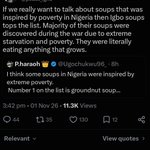
Before colonial rule, Ewgusi had already transcended its role as mere food among different tribes. As a commercially valuable “oil crop” not as means to prepare soup just like the Igbo people do. Originally, the crop belong to the Igbo people, but got traded across regional markets, cross-ethnic networks, and inter-ecological exchange systems.
That’s why no ethnic groups know how to use Egwusi seed to prepare better soup like the Igbo people.
So Egwusi seed, if we call it Igbo soup we are very right as it was originally Igbo crop that was expanded and traded during Aro confederacy reign.

Redo retweeted

Update: Convicted yahoo Oba, Joseph Olugbenga Oloyede; Apetu of Ipetumodu drags Gov. Ademola Adeleke to court to block the appointment of a new Oba, arguing that Osun Government did not give him opportunity to defend himself before dethroning him.
Joseph Oloyede left Ipetumodu for the U.S. in March 2024. This was the last time he was seen or heard from, prompting reports that he was missing.
11 months later, in February 2025, reports emerged that he was in FBI custody over benefit fraud. Two months later, in April 2025, he pleaded guilty, and by August 2025, he was sentenced.
Following his conviction and prolonged absence, the future of the Apetumodu throne became a subject of disagreement among the town’s traditional stakeholders, after kingmakers refused to dethrone him.
This continued until Governor Adeleke signed the deposition, which the disgraced Oba is now challenging in court.
On May 7th 2026, Adeleke signed the deposition order, officially removing him, saying he acted after getting a certified copy of the American court judgment and the king's conviction had brought the throne shame.
The former king and members of the Latimogun Royal Family of the Aribile Ruling House, are asking the court to restrain Adeleke and other government officials from filling the Apetumodu stool until the substantive case is determined.
Oloyede pleaded guilty to 38 fraudulent COVID-19 relief loan applications that secured $4.4 million. He was sentenced to 56 months in prison, three years of supervised release and ordered to repay the $4.4 million (₦5.9bn).
Follow @TrendingEx for dailies..


Redo retweeted

As soon as I saw this account disparaging Ojukwu and leading his/her nepotistic contravenes to do same, I knew straightaway that it had nothing to do with the Igbo nation.
Shame has a new name. Beware.


Redo retweeted

The Igbos & Yorubas of Sierra Leone
🧵
The Igbos and Yorubas are not indigenous to Sierra Leone but they played enormous roles in this country as freed slaves long before the nineteenth century. They were known in Sierra Leone as Ibos (or Ebos) and Akus. The Ibos were Christians while the Akus were principally Muslims.
Today, most of the Ibos and Akus in Sierra Leone have been absorbed into the Sierra Leone Creole people.
Sierra Leone Creole ethnic construction was naturally done by the mingling of the newly freed blacks, Nova Scotians, Jamaican Maroons and Liberated Africans such as the Akan, Bakongo, Igbo and Yoruba – over several generations in the late 18th and early 19th centuries.
Some of this information and history hold several advantages for the Nigerian people. It reveals who we are as a people and how we can have a common ground to forge a new identity without erasing our history. For example, in present-day Agbor, some people who have Igbo names and even practice a very similar culture to the Igbos claim that they are not Igbos, a phenomenon that gained ground after the civil war.
However, history tells us that before the 18th century, the people of Agbor and indeed some parts of the present-day Delta State and Edo State identified as Igbo.
Richard F. Burton and Verney Lovette Cameron, travellers who sojourned West Africa in their book “To The Gold Coast for Gold” published in 1883 noted that Agbor didn’t only identify as Igbo but also was known as the HEADQUARTER of Igboland. The Yoruba people in Sierra Leone were known as Aku.
In volume 2 of To The Gold Coast for Gold, the Igbos of Sierra Leone were described as “Swiss of the community”. Here is what the authors wrote:
“The Ibos, or ‘Eboes’ of American tales, are even more divided (diverse); still they feel and act upon the principle ‘Union is strength.’ This large and savage tribe, whose headquarters are at Abo, about the head of the Nigerian delta, musters strong at Sá Leone; here they are the Swiss of the community; the Kruboys, and further south the Kabenda-men being the ‘Paddies.’
It is popularly said that while the Aku will do anything for money, the Ibo will do anything for revenge. Both races are astute in the
extreme and intelligent enough to work harm. Unhappily, their talents rarely take the other direction. In former days they had faction fights: the second eastern district witnessed the last serious disturbance in
1834.
Now they do battle under the shadow of the law. ‘Aku constables will not, unless in extreme cases, take up their delinquent countrymen, nor will an Ebo constable apprehend an Ebo thief; and so on through all the different tribes,’ says the lady ‘Resident of Sierra Leone.’
If the majority of the jury be Akus, they will unhesitatingly find the worst of Aku criminals innocent, and the most innocent of whites, Ibos, or Timnis guilty. The Government has done its best to weld all those races into one,
and has failed.”
This 1883 revelation by Richard F. Burton and Verney Lovette Cameron also points out that while Igbos weren’t united into one kingdom, they had each other back to the point of safeguarding other Ibos who aren’t innocent of a crime. The same could be said about the Akus and other tribes of Sierra Leone anyway.
To date, the “Union is Strength” philosophy known locally as “Igwe bu ike” has continued to be a major principle of the Igbo people. If anyone can understand this principle better, it should be the Igbos. The Igbo identity was formed by diverse people who shared similar cultures and spoke several dialects of the same language of which some of these dialects aren’t even mutually comprehensible.


