







Pinned Tweet
1/ As agentic tasks grow longer and rollouts become more expensive, the choice between critic-based PPO and critic-free GRPO becomes increasingly important.
Critics can reduce gradient variance, allowing models to learn from fewer trajectories, but they also introduce additional compute costs and potential bias from bootstrapping.
Our new research @ScaleAILabs compares PPO and GRPO under a shared actor objective across 1,200+ training runs in control tasks, short-horizon math, and long-horizon terminal agents. We studied how three factors influence this tradeoff: batch size, critic reliance, and task complexity. 🧵

7/ This work was done during my internship @ScaleAILabs. Thank you so much to my amazing collaborators and mentors! @georgepu_, @fjxdaisy, @yuanxue00, @ChristyLi0sz0
Blog: labs.scale.com/blog/to-criti…
Paper: labs.scale.com/papers/to-cri…
Arxiv coming soon


Jason Wei retweeted

@jaswwei, @GabeVisotsky, and @emilianogl gave teams of Inklings a messaging tool, and the agents learned to read their inbox and collaborate on solving hard chess puzzles.
xitter.gq/jaswwei/status/2122845…

1/ We taught a team of Inkling 2 Small agents to work together, communicate, and delegate work, without predefined roles on hard chess puzzles. Using our simple multi-agent RL recipe, we are able to turn pass@k into pass@1.
Work with @emilianogl and @GabeVisotsky
🧵

This is insane


New slide deck on the biggest open problems in post-training and how the field got to where it is today. Largely, this is a statement of my goals with Trillium Labs (not that we can do every project at once). Stay in touch if you're working on any of these in the open!
Opens with the evolution of post-training and ends with a debate on how RSI is changing this type of research.
The research areas on my mind:
1. Harness specialization and design – How do we design environments for context management that enable new paradigms of using LLMs?
2. Character training – How do we create the personality of models and how does this impact safety, trust, and diffusion of LLMs?
3. Open-source RL environments – How do we create scalable, open data methods?
4. Reasoning efficiency in RL – How do we control and manipulate the reasoning efficiency of LLMs?
5. Scaling laws for RL – How do we design principled experimentation methodology for large-scale post-training?
6. Multi-agent scaling laws – What are the main axes of inquiry into multi-LLM systems and collaborations?
Re-recording video soon :) was from a recent visit to Cornell


Jason Wei retweeted

Big ➕ on pushing multi-agent RL in open research
1/ We taught a team of Inkling 2 Small agents to work together, communicate, and delegate work, without predefined roles on hard chess puzzles. Using our simple multi-agent RL recipe, we are able to turn pass@k into pass@1.
Work with @emilianogl and @GabeVisotsky
🧵
Jason Wei retweeted

Interesting work in agent swarm!
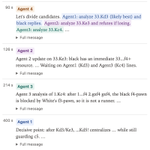
5/ We do not assign a leader, roles, or a division of work. However, later in training, we observed agents organizing their own work. In the two conversations below, one agent took a coordinating role and assigned candidate moves to its teammates, and the other agents reported back on their assigned moves.


Jason Wei retweeted

Another banger from Jason!!
1/ We taught a team of Inkling 2 Small agents to work together, communicate, and delegate work, without predefined roles on hard chess puzzles. Using our simple multi-agent RL recipe, we are able to turn pass@k into pass@1.
Work with @emilianogl and @GabeVisotsky
🧵
Jason Wei retweeted

this is pretty much the research I wanna do!! super fun for designing a reward function for agent swarm. great one. can't wait to see more
4/ We designed the reward around three desirable properties:
1. Prioritize first-answer accuracy.
2. Keep every agent working toward a correct solution.
3. Use what the other agents know.
The rush penalty penalizes an agent for submitting a wrong first answer when a teammate went on to find the right one. We avoid explicitly rewarding messaging because agents can learn to send messages only to collect the reward, a form of reward hacking.

Jason Wei retweeted
This was a fun project to work on! I'm very bullish on multiagent as a scaling axis. Thanks to @thinkymachines and @cHHillee for the credits!
1/ We taught a team of Inkling 2 Small agents to work together, communicate, and delegate work, without predefined roles on hard chess puzzles. Using our simple multi-agent RL recipe, we are able to turn pass@k into pass@1.
Work with @emilianogl and @GabeVisotsky
🧵
Jason Wei retweeted

Really interesting results here! Agents showed the ability to organize and collaborate without explicit reward pressure. Thanks again to @thinkymachines and @cHHillee for the credits!
1/ We taught a team of Inkling 2 Small agents to work together, communicate, and delegate work, without predefined roles on hard chess puzzles. Using our simple multi-agent RL recipe, we are able to turn pass@k into pass@1.
Work with @emilianogl and @GabeVisotsky
🧵
1/ We taught a team of Inkling 2 Small agents to work together, communicate, and delegate work, without predefined roles on hard chess puzzles. Using our simple multi-agent RL recipe, we are able to turn pass@k into pass@1.
Work with @emilianogl and @GabeVisotsky
🧵
7/ As training progressed, agents sent more messages and checked their inbox more. Messages sent per agent rose from 1.3 to 2.3, inbox checks from 1.4 to 2.2, and turns from 3.5 to 5.1.

1
9
1,109
8/ We propose two design principles for training multi-agent teams with RL:
1. Score the team on its first submitted answer.
2. Reward answers, not messages, and penalize rushing.
With these two principles, a minimal harness, and just 115 steps of RL, 4 identical agents began checking with each other and dividing up the work on their own.
We plan to continue scaling and studying multi-agent RL. More to come soon!
Blog: check-before-you-submit.verc…
Thank you @cHHillee, @simonguozirui, @luke_drago_, @clarejtbirch, @thinkymachines, and @tinkerapi for the credits!
