

Principal Solution Engineer @salesforce || Vibe Coder Extraordinare || Software Engineering Enthusiast Trying to Build New Things || Husband & Dad of 2
Somewhere
Joined October 2009
- Tweets14.4K
- Following2.1K
- Followers1.3K
- Likes7.6K







JT retweeted

THIS IS A PURE F*CKING DIAMOND
Anthropic just documented one of the best setups for Claude Code
The idea: run Opus 5.5, Sonnet 5.5, and the new Haiku 5.5 together in a tight tripartite loop, each doing only what it was built for
Opus-level planning on every big architectural decision, without paying Opus rates for routine code edits or repo searches
You just start Claude Code like this:
CLAUDE_CODE_SUBAGENT_MODEL=haiku claude --model opusplan
here's how it splits:
→ Opus 5.5 runs plan mode: architects the system blueprint, locks contracts, and signs off on the diff
→ Sonnet 5.5 executes the plan in the main session: writes the code, applies patches, and runs test suites
→ Haiku 5.5 swarms the repository in parallel: maps the AST, greps call sites, and parses docs at 340 tok/s with native 1M context
→ you stop burning Opus context on routine files and keep your main session under 10k tokens
Opus only steps in at three moments:
→ before a plan locks (architectural design)
→ when the same test fails twice (debugging deadlocks)
→ before calling it done (signing off on git diff)
Opus plans, Sonnet builds, Haiku swarms
JEV engineering is the same move one layer down: the forks that need no thinker (which file, which tool, retry or stop) resolve in code in 15ms, and the frontier models only see the ones that split
the full tree
> Opus 5.5 architects the implementation plan (opusplan mode)
> Sonnet 5.5 runs the main execution session and writes code
> search maps the repo AST on Haiku 5.5 (340 tok/s, 1M context)
> grep locates token call sites on Haiku 5.5 (isolated subagent)
> docs pulls API specifications on Haiku 5.5 (0.05x cost)
> Opus 5.5 verifies synthesized diff before final sign-off
> JEV routes micro-forks in milliseconds
paste the tree and this prompt into Claude Code ↓
"Reconfigure my Claude Code setup around this tree:
1. Run with model 'opusplan' so Opus 5.5 plans the architecture and Sonnet 5.5 implements the code
2. Set CLAUDE_CODE_SUBAGENT_MODEL=haiku so all search, grep, and documentation subagents swarm on Haiku 5.5 with its native 1M context
3. Configure fallbackModel to ['sonnet', 'haiku'] in settings.json to guarantee 100% session availability
4. Add one rule to CLAUDE.md: delegate all repository searches and test runs to Haiku 5.5 subagents to keep main context under 10k tokens
5. Route fast deterministic forks (tool choice, path selection, retries) through JEV
Show me every change as a diff first. No edits until I say go"
↳ code.claude.com/docs/en/mode…
save it, it'll come in handy

JT retweeted

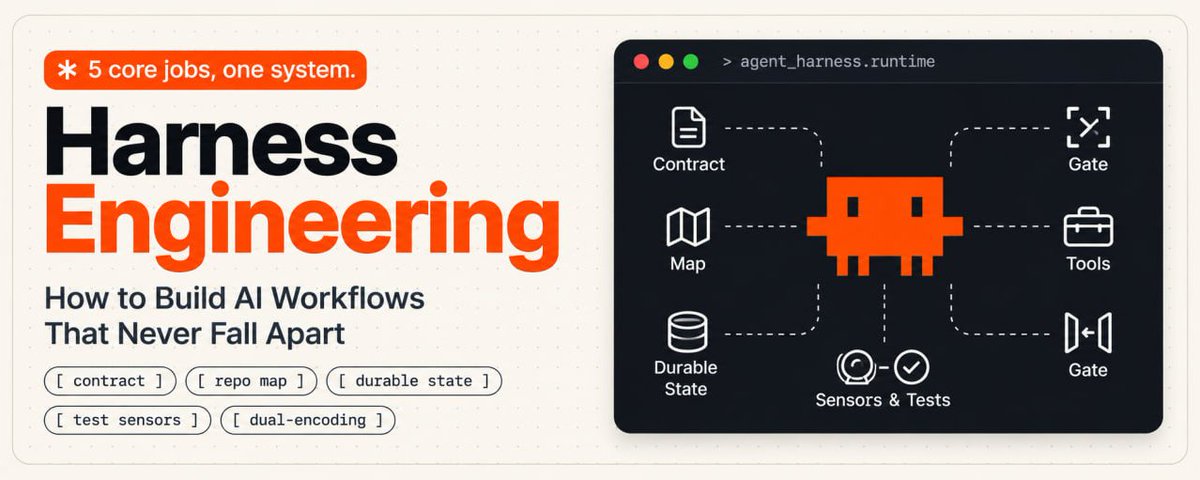
Google open-sourced Harness². It lets an AI agent improve its own setup on every new task, without retraining the model.
The setup around a model, its "harness", is normally designed once by a person: the system prompt, guardrails, memory, tool guidance, subagents, skills, scripts and plugins. Harness² edits all 8 while it works.
How it works:
→ proposes changes to the harness for the task in front of it
→ tests those changes on that same task
→ keeps what actually worked better, with no answer key needed
→ carries the lessons into future tasks
In Google's tests, one round improved GLM-5 and Gemini 3.5 Flash by up to 11.5 points on WorkBuddy-Bench and 11.8 points on LAB, a legal benchmark.
Works with OpenCode or Codex. The demo runs on Linux with no API keys:
git clone github.com/google-research/h… && cd harness2
uv venv --python 3.12 .venv && source .venv/bin/activate
uv pip install -e '.[render]'
harness2-demo --output runs/demo --k 2
Apache-2.0, 11.3K stars.

Everyone is sleeping on @salesforce #agentforce
I will be dropping a 12 chapter 80k word thesis soon.
Hope my followers enjoy it.
Models think. Salesforce knows. Trust compounds.
JT retweeted

Sundar Pichai calling his head of AI to automate all Stanford degree jobs before these kids get back to their dorm rooms.
JT retweeted

The stupidity of these @Stanford students to take the greatest opportunity for equality in humanity ever and to really free humanity and go walk out on @google and @sundarpichai that's pioneered that. Biased, idiotic, short-sighted and very selfish. Selfish because they ignored the bottom 3 billion people on this planet that could benefit from AI and they are worried about their misinformed selfish self-interest.
youtube.com/watch?v=wf74VXKT…


Stanford grads walk out as Google CEO Sundar Pichai takes the stage as commencement speaker. No mention of AI, unlike other uni speakers getting booed down this year. Story for @sfgate shortly
JT retweeted

Salesforce published a detailed writeup on going agentic with Claude Code. A couple things jumped out.
A migration they'd scoped at 231 days shipped in 13. One PR delivered 21 endpoints at 100% test coverage.


JT retweeted

SpaceXAI will provide @AnthropicAI with access to Colossus 1, one of the world’s largest and fastest-deployed AI supercomputers, to provide additional capacity for Claude → x.ai/news/anthropic-compute-…

JT retweeted
SpaceXAI and @AnthropicAI have also expressed interest in partnering to develop multiple gigawatts of orbital AI compute capacity

JT retweeted

SpaceX as a vertically integrated AI compute company makes an insane amount of sense.

We’ve agreed to a partnership with @SpaceX that will substantially increase our compute capacity.
This, along with our other recent compute deals, means that we’ve been able to increase our usage limits for Claude Code and the Claude API.
JT retweeted

Welcome Salesforce Headless 360: No Browser Required! Our API is the UI. Entire Salesforce & Agentforce & Slack platforms are now exposed as APIs, MCP, & CLI. All AI agents can access data, workflows, and tasks directly in Slack, Voice, or anywhere else with Salesforce Headless 360. Faster builds, agentic everything. 🚀
#Salesforce #Agentforce #AI
venturebeat.com/ai/salesforc…

JT retweeted
Agents are going to use software 100X more than people will in the future. As a result, enterprise platforms will become headless and be able to work with any agent on or off platform. If you don’t do that you’re DOA.
What some have missed is that this creates vastly more use-cases for these platforms than even existed pre-AI. This isn’t zero sum. Software value props have traditionally been capped at the number of users you have in a company. Agents have no upper limit.
We’re going to run agents to process data at a scale humans never could, they’re going to be running 24/7 in parallel doing work for us, and they can integrate workflows across systems to generate all new value propositions.
Once you embrace this approach, it becomes obvious how much more upside there is.

Welcome Salesforce Headless 360: No Browser Required! Our API is the UI. Entire Salesforce & Agentforce & Slack platforms are now exposed as APIs, MCP, & CLI. All AI agents can access data, workflows, and tasks directly in Slack, Voice, or anywhere else with Salesforce Headless 360. Faster builds, agentic everything. 🚀
#Salesforce #Agentforce #AI
venturebeat.com/ai/salesforc…


JT retweeted
Dogfooding Opus 4.7 the last few weeks, I've been feeling incredibly productive. Sharing a few tips to get more out of 4.7 🧵
JT retweeted

Wait, so there's a @BagsApp @BagsHackathon applicant that created several index funds for the bags eco system that auto shuffles every few hours and actually makes money and the @BagsApp dudes are quiet about it??? --> @BagsIndexSol

JT retweeted

Elon Musk thinks the entire education system is built on a broken assumption.
That every student should learn the same thing. At the same speed. In the same order. At the same time.
Musk: “Everyone goes through from like 5th grade to 6th grade to 7th grade like it’s an assembly line. But people are not objects on an assembly line.”
The model was designed for a factory economy. Standardized inputs. Predictable outputs.
That economy is gone. The assembly line is gone.
But the education system still runs on its logic.
A student who masters algebra in two weeks sits through eight more weeks because the calendar says so. A student who struggles gets dragged forward because the schedule doesn’t wait.
Neither is being served. Both are being processed.
Musk: “Allow people to progress at the fastest pace that they can or are interested in, in each subject.”
AI doesn’t teach a classroom. It teaches a student.
One at a time. Every time.
It skips what a student already knows. It finds where they’re stuck and approaches it from a different angle.
It adjusts in real time. Not at the end of a semester when the damage is already done.
A student obsessed with basketball learns fractions through shooting percentages. A student who builds in Minecraft learns geometry through architecture.
The subject doesn’t change. The entry point does.
No teacher with thirty students can do this. Not because they lack skill.
Because the math doesn’t work.
AI doesn’t have that constraint.
Musk: “You do not need to tell your kid to play video games. They will play video games on autopilot all day. So if you can make it interactive and engaging, then you can make education far more compelling.”
The brain isn’t broken. The format is.
Kids learn complex systems and strategic thinking for hours voluntarily. Then walk into a classroom and can’t focus for twenty minutes.
That’s not a discipline problem. That’s a design problem.
Musk: “A university education is often unnecessary. You probably learn the vast majority of what you’re going to learn there in the first two years. And most of it is from your classmates.”
Four years. Six figures of debt.
And the real value comes from the people sitting next to you. Not the institution charging you.
The degree doesn’t certify knowledge. It certifies endurance.
Musk: “If the goal is to start a company, I would say no point in finishing college.”
The system was built to train employees. If you’re not trying to be one, it has nothing left to offer you.
Every lecture. Every textbook. Every curriculum. Now available instantly. Personalized to any learner. Adapted to any pace.
The question isn’t whether the old model survives.
It’s how long we keep forcing students through it while the replacement already exists.
JT retweeted

Karpathy's LLM Wiki got 5,000 stars in 48 hours. Now someone extended it with the features it was missing.
Memory lifecycle. Confidence scoring. Knowledge graphs. Automated hooks. Forgetting curves.
It's called LLM Wiki v2.
The original pattern was brilliant. AI builds a wiki instead of re-deriving knowledge from scratch every time. But it treated all knowledge as equally valid forever. In practice, that breaks.
Here's what v2 adds:
→ Confidence scoring. Every fact carries a score. How many sources support it. How recently confirmed. Whether anything contradicts it. Knowledge that decays over time. Not everything is equally true forever.
→ Memory tiers. Working memory for recent observations. Episodic memory for session summaries. Semantic memory for cross-session facts. Procedural memory for workflows. Each tier more compressed and longer-lived.
→ Knowledge graph. Not flat pages with links. Typed entities with typed relationships. "A caused B, confirmed by 3 sources, confidence 0.9." Graph traversal catches connections keyword search misses.
→ Hybrid search. BM25 for keywords. Vector search for semantics. Graph traversal for structure. Fused with reciprocal rank fusion. Replaces the index .md file that breaks past 200 pages.
→ Automated hooks. On new source: auto-ingest. On session end: compress and file. On schedule: lint, consolidate, decay. The bookkeeping that kills wikis is now fully automated.
→ Forgetting curves. Facts that haven't been accessed or reinforced in months fade. Not deleted. Deprioritized. Architecture decisions decay slowly. Transient bugs decay fast.
→ Contradiction resolution. AI doesn't only flag contradictions. It resolves them based on source recency, authority, and supporting evidence.
Here's the wildest part:
The original LLM Wiki was a flat collection of equally-weighted pages. This turns it into a living system with memory that strengthens, weakens, consolidates, and forgets. Like a real brain.
"The Memex is finally buildable. Not because we have better documents or better search, but because we have librarians that actually do the work."
Built on lessons from agentmemory, a persistent memory engine for AI agents.
Extends Karpathy's original. Open Source.

JT retweeted

One folder changes how Claude Code works.
Most users never set it up properly.
Here is the anatomy of .claude/:
✦ CLAUDE.md
This is your project's memory. Write your build commands, architecture decisions, and conventions here and keep it under 200 lines. Claude reads it at the start of every session and follows it throughout.
✦ CLAUDE.local.md
These are your personal overrides. Your preferences stay out of the shared version, so you can change them without touching anyone else's setup.
✦ settings.json
This is where you set permissions. Allow npm run *, block .env files, and spend five minutes here to avoid a lot of surprises later.
✦ commands/
These are your custom slash commands. review.md creates /project:review, and fix-issue.md creates /project:fix-issue. You build the workflow once and run it in every session.
✦ rules/
This is where you put modular instructions. When CLAUDE.md gets crowded, split it into focused files like code-style.md, testing.md, or api-conventions.md. You scope each file to the directories where it matters.
✦ skills/
These are auto-invoked workflows. Claude reads the task, matches it to a SKILL.md description, and runs it without you typing anything. Security reviews and deploys run hands-free.
✦ agents/
These are subagent personas. code-reviewer.md checks PRs to your standards, and security-auditor.md scans for vulnerabilities. Each one runs in an isolated context window and returns only the findings.
The decision rule:
✦ Project instructions → CLAUDE.md
✦ Recurring workflows → commands/
✦ Context-triggered tasks → skills/
✦ Specialised review work → agents/
Most just prompt harder when Claude gets confused.
The fix is almost always better project architecture.
Repost ♻️ to help someone in your network.
P.S. Have you set up your .claude/ folder?
