

Retired Army Transportation Operations Machinist Toolmaker welder, Robotics, MSN Programming and Technology DOD certified soldering board builder desi Python
Tacoma, WA
Joined March 2025
- Tweets127K
- Following7.5K
- Followers5.9K
- Likes135K




Pinned Tweet
Final Outline: Unified 2026 Next-Generation In-Memory Neuromorphic Computing Architecture
Hybrid Duplex 2D FeFET Platform for In-Situ Edge AI (Training + Inference + Multimodal Sensing)
This synthesizes the original 2023 duplex FeFET (Ning et al., Nature Nanotechnology) with all major 2024–April 2026 advances in 2D/vdW ferroelectrics, hybrid memristors, nanogate scaling, optoelectronic synapses, and 3D integration. It targets <5 fJ/operation, ns switching, >10¹³ endurance, wafer-scale uniformity, and 3D CMOS-compatible stacking for practical edge intelligence.
I. Core Device Building Block (Hybrid Duplex Platform)
1. Baseline Duplex 2D FeFET (Ning et al., 2023 – foundational)
MoS₂ channel + HZO/CIPS ferroelectric gate with tunable double-well energy landscape.
Seamless training (polarization update) ↔ inference (MAC) modes.
Key Metrics: 4.8 ns speed, 22.7 fJ bit⁻¹ μm⁻², >10¹³ cycles endurance, >10-year retention.
Switching Energy: [E_switch = Q_MAX · V / 2] (Q_MAX from integrated charge-voltage hysteresis).
Hardware demo: 2T1D (TIIO) arrays → 99.86% accuracy on nonlinear localization with in-situ training. GPU-equivalent throughput at 100–1000× lower energy (SPICE + array simulations).
2. Hybrid Ferroelectric–Memristor Extension (2025 advances)
Decouples training/inference paths in shared cell; adds analogue filament states.
Energy Model: [E = 2 P_R · S · V_prog = MW_0σ · (C_D + C_BL) · V_prog] (P_R: remanent polarization, S: area, MW: memory window from pulse tests).
3. Nanogate & Wafer-Scale vdW Scaling (Science Advances/Science 2026)
1-nm gates (SWCNT), Bi₂O₂Se-Bi₂SeO₅ or MoS₂ stacks (<5% variation).
Compact Multidomain NLS + BSIM Model: [P_η(t) = {P_R - (P_R - P_η(t_i)) exp(−(∫_{t_i}^t 1/τ(t’) dt’)^β) if E_FE(t) ≥ 0; -P_R + (P_R + P_η(t_i)) exp(−(∫_{t_i}^t 1/τ(t’) dt’)^β) if E_FE(t) < 0}]
[τ(t) = τ_0 exp((η E_a± / |E_FE(t)|)^α)]
Coupled to BSIM via charge equality. Metrics: 0.6–0.8 V, 1.6–20 ns, 2.8 fJ/bit/μm², sub-60 mV/dec swing.
4. Anisotropic Optoelectronic Synapse (ReS₂/HZO & similar 2026)
Polarization-resolved + photo-trapping.
Energy per Event: ~2.0 fJ (1.3 fJ optical + 0.7 fJ electrical).
[E_opt = P_light × t_pulse × responsivity, E_elec ≈ I × V × t]
LTP/LTD linearity from conductance-pulse data; photoresponsivity up to 4×10⁵ A/W.
5. Emerging 2026 Additions (e.g., α-MnS, dual-gate, sliding ferroelectrics)
Room-temperature ferroelectricity in 2D semiconductors for enhanced tunneling electroresistance (TER ~1.3×10⁴) and endurance.
II. Array & Interconnect Architecture
• 2T1H / 2T1D Cells + 3D Stacking: CMOS base + 2D FeFET/memristor crossbar middle + optoelectronic/nanofluidic top.
• Nanofluidic Memristors (2025): Ionic dynamics in 2D nanochannels for temporal plasticity (tunable by pH/geometry).
• In-Memory MAC: (I = W · V) (conductance matrix × voltage vector via Ohm’s law summation).
• Sb-contacted MoS₂ flash for analogue search.
III. Computing Paradigms (All In-Situ)
1. In-Memory + In-Sensor Computing: Direct sensor-to-synapse (sub-60 mV/dec).
2. Spiking Neural Networks (SNN): MoS₂ FeFET optoelectronic arrays as synapses; leaky integrate-and-fire neurons.
3. Analogue/ANN Mapping: [H_j = ReLU(∑ W_i I_i + b), SME = min ∑ [λG - W]²] (SME: square-mapping error for conductance-to-weight).
4. Multimodal: Electronic + optoelectronic + ionic pathways for vision/tactile/chemical sensing.
5. Logic-in-Memory: Non-volatile Boolean (NAND/NOR) and TCAM via FeFET/FTJ.


Kevin John Parrish retweeted

Can You Trick Your Brain into Seeing This Spin in the Opposite Direction? 🧠🌀🤯
Kevin John Parrish retweeted

ChatGPT learns using a formula that was invented in 1847 to calculate the orbits of planets.
w ← w − η∇L
This is gradient descent, and without it, not a single modern neural network would exist. It wasn't invented at OpenAI or Google but in France almost 180 years ago, when the mathematician Augustin-Louis Cauchy was looking for a faster way to calculate the motion of celestial bodies.
Imagine you're standing on a mountain in thick fog. You can't see the bottom, but you can feel the slope under your feet. You take a step where it's steepest downhill, check the slope again, and take another step. Step by step, you end up in the valley.
A neural network does the same thing. The mountain is its mistakes, and the valley is the right answers. Except this mountain doesn't have three dimensions but billions.
Cauchy calculated orbits. His formula taught machines to write.
Kevin John Parrish retweeted

A research team at TU Wien has uncovered something astonishing: quantum entanglement the mysterious bond connecting particles across space doesn’t form instantly. Instead, it takes about 232 attoseconds (a quintillionth of a second) to fully emerge. Using advanced computer simulations of atoms hit by laser pulses, scientists observed that entanglement develops gradually as one electron escapes and another shifts energy levels, slowly weaving their quantum link through time.
This finding challenges decades of assumptions that entanglement happens outside of time itself. It reveals that even the universe’s fastest phenomena have measurable stages a kind of “quantum heartbeat.”
Researchers now aim to confirm the results experimentally, a daunting task at speeds where light barely crosses a human hair’s width. Cracking these fleeting moments could reshape quantum computing, encryption, and communication, showing that even instant mysteries unfold with rhythm and order.
Sources: NASA, Scientific American, Physical Review Letters


Kevin John Parrish retweeted
Overview of Topological Quantum Computing (TQC) with Quantum Knots and Anyons
The concept in @kparrish51’s post (and the linked Reson8-Labs YouTube video) connects early magnetic-core memory (ferrite rings on wires storing bits via magnetization) to modern TQC. In TQC, information is encoded in the topology of braids formed by exotic quasiparticles called non-Abelian anyons (not ordinary bosons or fermions). Braiding their worldlines creates “quantum knots” in 2+1D spacetime; the computation result depends only on the knot topology, not on local details or small perturbations. This makes TQC inherently fault-tolerant at the hardware level.
Magnetic fields enter via physical realizations like the fractional quantum Hall effect (FQHE), where a strong perpendicular B-field in a 2D electron gas (2DEG) creates Landau levels and anyonic excitations. The anyons carry fractional charge and obey non-Abelian statistics—the exchange (braid) applies a unitary matrix to the degenerate ground-state manifold, not just a phase. This stores and processes quantum information robustly, much like magnetized cores but at the quantum-topological level.
The video (tied to work like Layla Hormozi’s talk and the 2024 arXiv paper “Minimal Quantum Circuits for Simulating Fibonacci Anyons”) demonstrates this with the doubled Fibonacci (DFib) model on small qubit lattices—showing fusion, twisting, and braiding in the smallest possible circuits (3–9 qubits). It bridges theory to near-term quantum simulators.
Key Mathematical Foundations (with Equations)
Anyons are defined by fusion rules and braiding statistics. For the simplest universal model (Fibonacci anyons, τ), the fusion rule is: τ × τ = 1 + τ (where 1 is the vacuum). A pair of τ anyons can fuse to vacuum or another τ, creating degeneracy used for qubits. The quantum dimension of τ is the golden ratio (φ = (1 + √5)/2).
Braiding two anyons applies a unitary R-matrix (from the braid group representation). For Fibonacci anyons, the non-trivial braiding phases (in the fusion channels) involve roots of unity tied to the 5th cyclotomic field: R_{ττ}^1 = e^{i 4π / 5}, R_{ττ}^τ = e^{-i 3π / 5} (or equivalent conventions up to global phases; exact matrices are derived from the modular tensor category). Sequences of braids approximate any unitary gate densely in SU(2) (or higher), enabling universal quantum computation by braiding alone.
The full computation corresponds to evaluating knot invariants (e.g., Jones polynomial at a root of unity), which is BQP-complete—hence universal. Worldlines of splitting–braiding–fusing anyons form a knot in spacetime: Computation = braid word ∈ B_n ↦ unitary on fusion space. Local deformations of the braid do not change the result (topological protection).
Research Overview and Key Papers/Journals
• Classic foundational review: Nayak et al. (2008), “Non-Abelian Anyons and Topological Quantum Computation,” Rev. Mod. Phys. (arXiv:0707.1889). Defines anyons, braiding, and fault tolerance. “The unitary transformations remain unchanged under local deformations… serve as logical quantum gates.” Cited >8,900 times.
• Pedagogical Fibonacci focus: Field & Simula (2018), “Introduction to topological quantum computation with non-Abelian anyons,” arXiv:1802.06176. Covers braiding matrices to braid compilation. “Fibonacci anyons… allow for universal quantum computation by particle exchange or braiding alone.”
• Recent theory: Hassler (2024), “Topological Quantum Computing,” arXiv:2410.13547. Emphasizes knots: “The trajectories… form a knot in space-time. The result… does not depend on the concrete form.”
• Universal via double-braiding: Kaufmann et al. (2025), arXiv:2312.16747v2. Shows double-braiding alone suffices in certain SU(2)_k theories.
Newest Technology and Experimental Progress (2024–2025/2026)
Physical Fibonacci anyons remain unrealized in materials, but simulations on quantum processors now demonstrate braiding and universal gates:
grok.com/imagine/post/6dbda2…

Kevin John Parrish retweeted
Awareness never so simple alternative motives try tell them still observant awareness price of clarity!
Kevin John Parrish retweeted

251 Years of Unmatched Lethality
#Marines stationed across the globe commemorate the 251st anniversary of the Marine Corps, honoring a distinguished legacy of service, sacrifice, and unwavering fidelity to both the nation and fellow Marines.
(Narrated by @netflix @mosquitobowl Director Peter Berg)
🎥(U.S. Marine Corps video by John Martinez)
Kevin John Parrish retweeted

Historic new Dime for America's 250th:
- Rich Black Ruthenium finish
- 24KT Gold highlighted details
- Genuine U.S. legal tender status
- Official Certificate of Authenticity
An unforgettable collectible honoring America’s historic 250-year milestone.
Kevin John Parrish retweeted

"Not only is the Universe stranger than we think, it is stranger than we can think."
— Werner Heisenberg
Kevin John Parrish retweeted

Oh. My. That is so cool
I. MUST. HAVE. ONE !!!!
h/t to my pal MajorMaxPatriot
Kevin John Parrish retweeted

NVIDIA just fixed text-to-SQL’s biggest problem!
the release is called Auto Ontology, and it targets the reason an agent can write valid SQL against a company database and still return the wrong number.
the database stores columns, and the agent has to guess what they mean. a column called extendedprice might hold revenue, and two systems in the same company can define revenue differently.
Auto Ontology gives the agent an ontology, a schema that maps business concepts to the columns that hold them and defines how they relate, before any query is written. it drafts that schema from your database metadata instead of making you write it, and a human certifies it.
the ontology holds three things:
→ terms: business concepts like customer, order, or revenue, with descriptions and synonyms, mapped to the exact columns that store them.
→ SQL attributes: reviewed expressions like a margin or a rolling total, reused so every measure is computed the same way each time.
→ relationships: how tables join, including bridge tables, inferred from keys and the data itself.
to draft these, it profiles columns, samples values, extracts terms table by table, and mines past query history for SQL attributes. everything lands in Postgres, with embeddings in pgvector.
at query time, the agent maps the question to certified terms, follows relationships to find the joins, and writes SQL. it checks filter values against the real data, repairs the query if a check fails, and returns the answer with its SQL and steps.
when the data can't support a question, the agent says so. in NVIDIA's demo, a question about return on ad spend on a sales database with no ad data gets a clarifying reply offering revenue instead of an invented number.
so the ontology tells the agent how to compute an answer and also which questions have one at all.
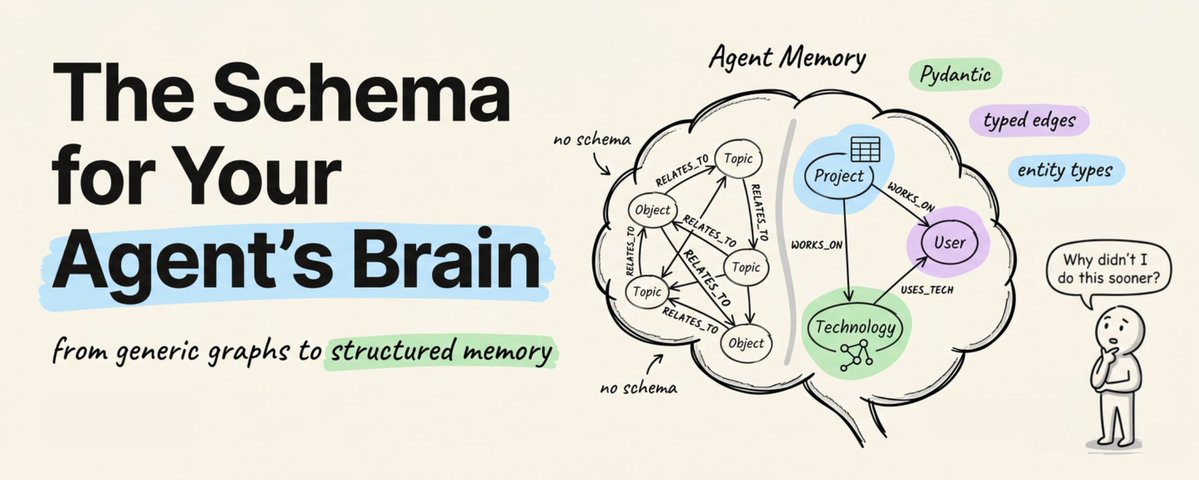
as the architecture in the image shows, an ingestion service compiles the ontology from your source databases, and any agent harness reaches it through MCP, CLI, or REST API. it supports ten engines including Postgres, Snowflake, Databricks, and DuckDB, runs on Nemotron by default or any OpenAI-compatible endpoint, and is Apache 2.0.
check it out on GitHub: github.com/NVIDIA/auto-ontol…
the same principle of defining a schema before the model extracts anything also decides whether agent memory works. I wrote about that in the article quoted below.

ALT NVIDIA Auto Ontology GitHub README: green NVIDIA mark, shortened intro, Discover and Ground, key features, and the AI-Q agent harness architecture diagram


Kevin John Parrish retweeted

Abandoned Cold War-era military command post bunker. You just wonder how many of these are scattered around 👀
Kevin John Parrish retweeted

Embedded System Design, Fourth Edition, 446 pages
Embedded Systems Foundations of Cyber-Physical Systems, and the Internet of Things
Textbook, Open Access, © 2021
* Provides a semester-length textbook, with comprehensive coverage of the fundamental knowledge in embedded and cyber-physical systems
* Links modeling and hardware, in order to bridge the gap between hardware and software, allowing readers to put these into perspective
* Couples practical aspects of embedded system design with an introduction to more theoretical aspects
* Includes extensive exercises for each chapter
You can download PDF and EPUB book directly
link.springer.com/book/10.10…


Embedded Systems - Shape The World users.ece.utexas.edu/~valvan…
这是德克萨斯大学奥斯汀分校(UT Austin)的 Jonathan Valvano 和 Ramesh Yerraballi 教授开发的一门享誉全球的嵌入式系统入门经典课程与电子书教材。课程也托管在 edX MOOC 平台
该课程采用自底向上和实践导向的方式,带领学生从最基础的电子学、数字逻辑开始,一步步构建出基于 ARM Cortex-M 微控制器的复杂嵌入式系统(如电子游戏、物联网设备)
课程可分四个阶段
1、基础准备 Ch 1 - Ch 5:嵌入式基本概念、电子学基础(电压、电流、电阻)、数字逻辑、C语言编程基础
2、硬件接口 Ch 6 - Ch 9:微控制器 I/O 端口、设计与开发流程、开关与 LED 接口控制、数组与功能调试
3、核心控制 Ch 10 - Ch 13:有限状态机(FSM)系统设计、UART 串行通信、中断(Interrupts)处理机制、DAC(数模转换)与声音输出,含 Ch 17过渡进阶章节,可归入3阶段
4、高级应用 Ch 14 - Ch 16:ADC(模数转换)与数据采集、基于系统方法的电子游戏设计、物联网(IoT)基础
所有视频均托管在 YouTube 和 Amazon S3 两个平台上
所有测验和实验均须在 EdX 平台上完成
此外大家可关注作者的三卷本书籍和学习资料
Volume 1 Embedded Systems: Introduction to ARM Cortex M Microcontrollers
Volume 2 Embedded Systems: Real-Time Interfacing to ARM Cortex M Microcontrollers
Volume 3 Embedded Systems: Real-Time Operating Systems for ARM Cortex M Microcontrollers
users.ece.utexas.edu/~valvan…
users.ece.utexas.edu/~valvan…


Kevin John Parrish retweeted
Tiny air cavities turn flat silicon into a UV-focusing mirror, producing focal spots as small as about 1 micrometer despite silicon’s strong ultraviolet absorption. @SPIEtweets phys.org/news/2026-11-air-ho…

Kevin John Parrish retweeted

The Theory Of Everything based on a 90-degree rotation, proposed by the creators of the community-based conceptual framework ( TH390 )
LongPodcast (Excellent !)
drive.google.com/file/d/1ktA…
Verbatim PDF for the above podcast:
docs.google.com/document/d/1…
Slides PDF: (Showing a Spectral Mass Gap)(Valid?)
drive.google.com/file/d/1Apd…
@Voltardark @dr_logvinovich

