

Founder, R10x Learning, Building & Deploying AI solutions in Retail, CPG and Distribution.
San Francisco, Bay Area, CA
Joined May 2007
- Tweets4.1K
- Following5.2K
- Followers754
- Likes9.5K





K R Prasad retweeted

Two decades into my career, here’s what I know: the highest highs come from 1) doing creative & ambitious work with 2) people you genuinely enjoy being around. When you don't have both, you're miserable. When you do, you're levitating. Nothing else matters.

K R Prasad retweeted

This is f*cking insane. Ilya Sutskever, the man who co-founded OpenAI, described the future he doesn't like:
"Maybe every person will have an AI that does their bidding. It earns money for them, advocates for their needs, then writes a little report: here's what I've done
The person says great, keep it up. But the person is no longer a participant"
In this 1.5-hour interview, he explains why almost nobody can feel what's coming until it's already here
AI → Agents → AIs That Earn For You → Humans Who Are No Longer Participants
The only way to stay in the game is to be the one running the agents
Worth more than any $2,000 AI course
Bookmark and watch it today
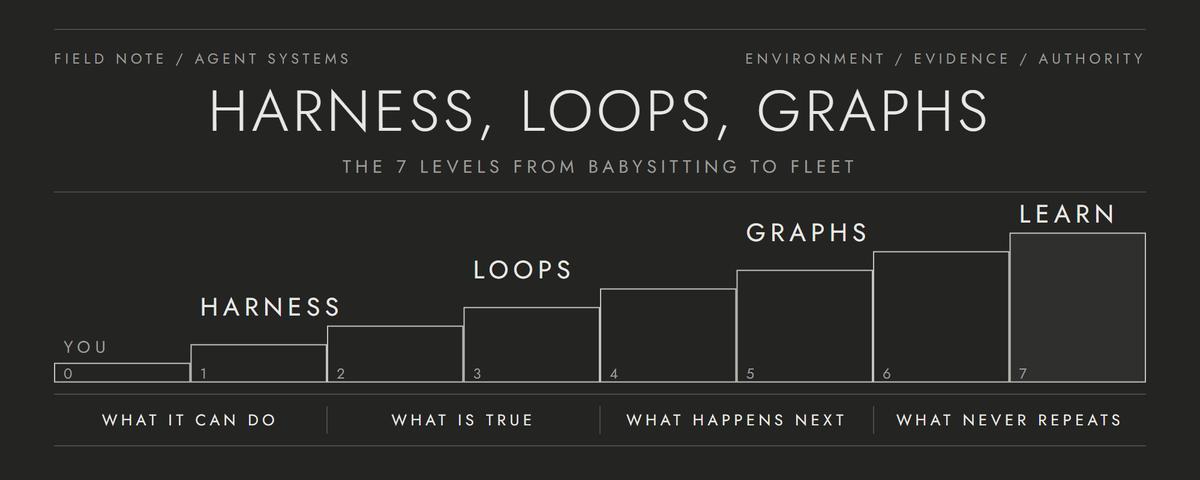
Then read how to run them yourself: Harness, Loops, Graphs ↓

K R Prasad retweeted

Over the past week, I’ve been overwhelmed by the love and support of friends, industry colleagues, and people I've never met. Thank you to everyone who has shown kindness to my family and me. It means the world to me.
I came to the United States 53 years ago, and becoming an American citizen is one of the greatest gifts and proudest moments of my life. NVIDIA has been my life’s work. Building it into the company it is today alongside my colleagues has been a privilege and an honor. Nowhere but in America could a company like NVIDIA be possible. I love our country, and I love NVIDIA.
I did not live up to the standards expected of everyone at NVIDIA, and I have made serious mistakes in my personal life. I created problems for the Board that I deeply regret. I own my mistakes completely, and I am committed to cooperating with the Board’s independent investigation.
Since my departure, I’ve seen an outpouring of calls from NVIDIA’s employees, investors, business partners, and customers for me to return as CEO. Many continue to reach out to me directly as the company navigates complex technology, market, competitive, and geopolitical dynamics. NVIDIA is a once-in-a-generation company. If the Board of Directors decides that my return is in the best interest of our shareholders, our employees, the company, and America, I would be honored to answer these calls and return as CEO.
Thank you again to everyone who has shared their good wishes. I am profoundly humbled by your support. To my family: I love you, and I will spend the rest of my life being worthy of yours.
Jensen
K R Prasad retweeted

A good reflection of what my father taught me: treat every living being with ❤️ and respect.

K R Prasad retweeted

“Go all the way with it. Do not back off. For once, go all the goddamn way with what matters.”
- Ernest Hemingway
A powerful message about determination, passion, and unwavering commitment is captured through a quote attributed to Ernest Hemingway, accompanied by his iconic black-and-white portrait. The words, “Go all the way with it. Do not back off,” emphasize the importance of pursuing what truly matters with courage and conviction.
The message serves as a reminder that meaningful ambitions require persistence, sacrifice, and the willingness to remain committed despite uncertainty or adversity. It reflects the belief that when something is worth pursuing, it deserves your full dedication rather than hesitation or compromise.

K R Prasad retweeted

Business is problems. The best companies are just highly effective problem-solving machines.
Travis Kalanick on why he loves problems:
“I don’t think about problems in a negative way.”
“I think about problems the way a math professor would think about a problem.”
“A math professor without interesting problems to solve is a sad math professor.”
“So you wanna create interesting things to solve. You wanna create problems to solve. You have to predict well the nature of the problem and your ability and capacity to solve it.”
— @travisk
K R Prasad retweeted

Apple’s new CEO just said something that every tech company in the world disagrees with.
In an interview with WIRED’s Steven Levy published yesterday, October 30 John Ternus, the man who replaced Tim Cook two months ago, was asked about a future where AI agents take over more computing tasks and do the work autonomously.
His answer: “The creation of products is a deeply human and personal thing, something that we love to do.”
That’s Apple’s new CEO at a moment when every competitor is racing to replace human work with AI drawing a public line between automation and creation. Between efficiency and craft. Between what AI should do and what humans must do.
Google is building AI that writes its own code. Microsoft is building AI that replaces entire workflows. Meta is building AI that generates content autonomously. OpenAI is building AI agents that act on your behalf without asking.
And Apple’s CEO the first product engineer to run the company in over a decade just told the world that the thing his company does best cannot be automated. That great products require human hands, human taste, human judgment. That AI is a tool, not a replacement.
This is either the most important thing a tech CEO has said in 2026 or the most dangerously naive.
Here’s why it might be both 🧵

K R Prasad retweeted

The coffee is hot,
the world is quiet,
and for a moment
everything feels
just right 👍☕




K R Prasad retweeted

Apple CEO John Ternus: "This is, I am convinced, the most exciting time in my career to be building product — because AI has so much potential."
"Our focus is what it always is. We focus not on technology, but on product — and how do we leverage technology to build products and features and experiences that really matter to people."
"If we're doing that right, no one has to know that it was AI that [made] it happen. They just want to know, 'Wow, I was able to do that thing that I couldn't do before and it was fun and it was easy.'"
(TIME || 2026)
K R Prasad retweeted
“The beautiful thing about learning is nobody can take it away from you.”
― B.B. King


K R Prasad retweeted

A retired NASA engineer who had worked on the Space Shuttle program for 25 years was hired by SpaceX at age 62. He described the first week as the most disorienting experience of his professional life.
At NASA, a design change required 3 meetings, 2 committees, a review board, and 6 to 18 months of documentation. At SpaceX, his new supervisor said "if it works, build it. If it doesn't, change it by Friday."
He sat at his desk after the first day and called his wife. He told her he felt like a man who had been swimming with ankle weights for 25 years and someone just cut them off. He could move. He could decide. He could build something in the morning and test it in the afternoon. The constraint that he had accepted as the nature of aerospace engineering turned out to be the nature of bureaucracy.
Within 6 months he had contributed to more design iterations than he had completed in his last 5 years at NASA. Not because he was working harder. Because the time between having an idea and testing the idea collapsed from months to hours. The same brain. The same knowledge. A different operating system.
He described a specific moment where he proposed a modification to a Raptor engine component. At NASA, the proposal would have entered a queue. At SpaceX, the modification was machined by the end of the day and tested by the following morning. He watched his idea become a physical object in 18 hours. At NASA, 18 hours would not have been enough to schedule the first meeting to discuss whether to schedule a meeting.
He told an interviewer: "I didn't get smarter when I went to SpaceX. I got faster. The intelligence was always there. The system was in the way."
The difference between SpaceX and NASA is not talent. NASA has extraordinary talent. The difference is the time between a thought and a test. SpaceX compresses it. NASA elongates it. The same engineer produces 10x more at SpaceX than at NASA because the bottleneck was never the engineer. It was the meetings about the meetings about the work.