Working on the https://xitter.cf/t.co/FFJdrfbujm 🛜
Joined December 2008
- Tweets12.9K
- Following7.5K
- Followers1.5K
- Likes9.5K


Mark Foster retweeted

This week's episode of the Doha Debates Podcast asks: Who controls your money?
Featuring @saifedean, @jasonhickel and @ptcherneva
0:00 Intro
1:41 What is money?
12:23 “Issuing money is theft, and a more precise way of putting it is slavery.”
16:21 “In the modern world, money is actually debt.”
24:55 Are economists gaslighting the public?
29:30 Is capitalism undemocratic?
37:39 Does private finance, not government, drive instability?
1:08:04 “We live in effectively fake democracies.”
01:18:24 Is bitcoin the answer to existing power imbalances?
1:26:44 Did fiat money pay for the Iraq War?
1:35:41 “Bitcoin takes away from [money printers] the ability to loot you.”
01:43:47 How capitalism drives war
01:56:39 What China's industrial policy gets right and wrong
02:14:10 Can the global south escape the dollar?
02:24:09 Experts' final take: What is one thing you wish you had known about money when you were younger?
Mark Foster retweeted

Boost your Altium Designer efficiency by 50% with these 10 hidden gems ⚡
As PCB designers, we all know the feeling: hours lost navigating menus and repeating manual steps. The real productivity leap doesn’t come from clicking faster — it comes from knowing the right shortcuts.
After years of refining my workflow, here are 10 Altium hacks that made the biggest difference:
Find Similar Objects (FSO) – Right‑click → Find Similar → batch‑edit 100 components in seconds.
Smart Alignment – Use A shortcuts (AL, AT, AD) to snap components into place instantly.
Single Layer Mode (Shift+S) – Eliminate visual clutter and focus only on the layer you’re working on.
Routing Modes (Shift+R) – Switch between Push and Walkaround mid‑trace without restarting.
Quick Via / Layer Switch – Use + / - on the numpad while routing to auto‑place vias.
Length Tuning (TR) – Create accordion traces like a pro; hit Tab to tweak settings on the fly.
3D Navigation – 3 to enter 3D view, Shift+Right‑click to rotate, 0 to reset.
Mirroring (X / Y) – Flip components instantly while dragging.
Selection Filter – Lock onto Polygons or Text so you only grab what you need.
Paste Special (E+A) – Duplicate complex layouts while preserving net connectivity.
Which of these do you already use — and what’s your #1 Altium time‑saver? Let me know in the comments 👇
#PCBDesign #AltiumDesigner #EngineeringProductivity #AltiumTips


Mark Foster retweeted

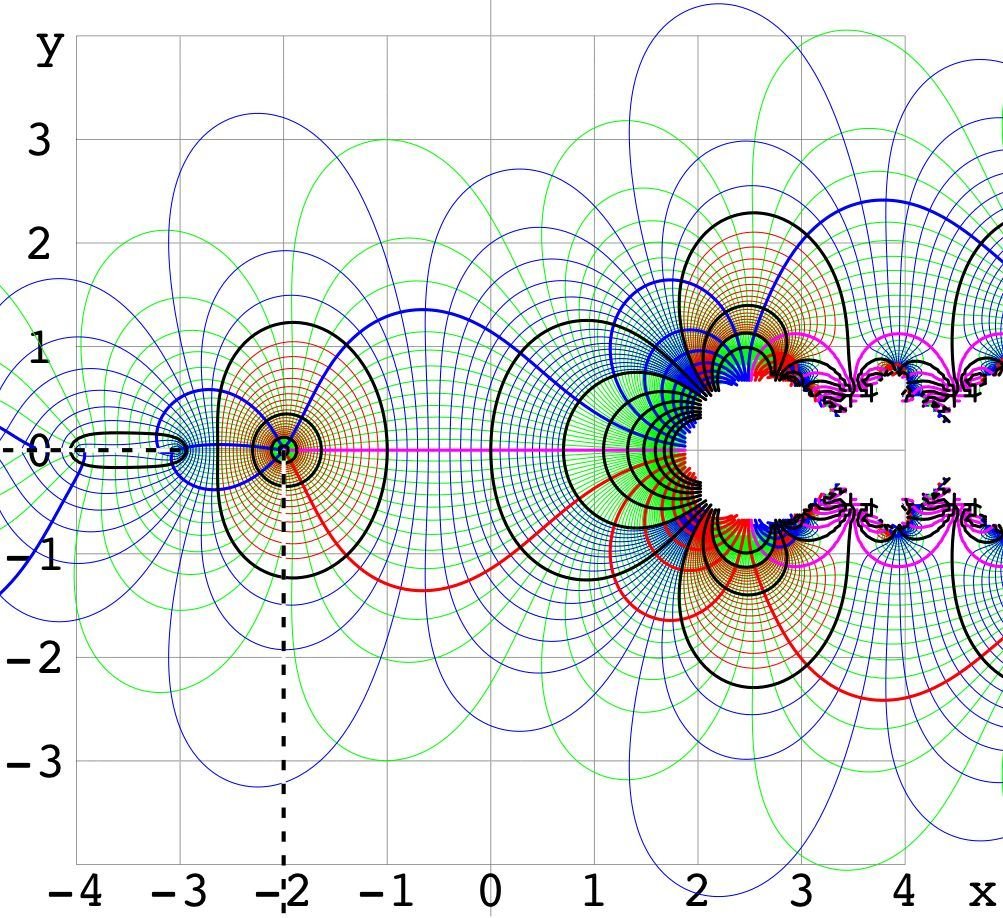
z ↦ z² + c.
Most starting values are driven to infinity by repeated application of this map; a smaller set of starting values remains forever bounded. The boundary separating the two is the Julia set, a fractal curve whose local geometry repeats at every scale.
The white disk is the filled Julia set, the open region of bounded orbits. The nested colored curves surrounding it are equipotentials of the Green’s function, level sets of the escape rate that remain smooth far from the set and grow increasingly intricate as they approach its boundary.
When the orbit of the critical point 0 stays bounded the Julia set is connected; otherwise it dissolves into Cantor dust. Gaston Julia and Pierre Fatou traced the first examples of these sets by hand in 1918.


Mark Foster retweeted

Interestingly, Sinatra didn't want to collaborate at all. He didn't believe the partnership would work because their musical styles were too different. But it turned out great!!! 🔥The way Elvis moves his hand, his neck, it's just so charismatic. So fresh. Nobody compares.
Mark Foster retweeted

We have proven a theorem in complexity theory establishing a deterministic space bound strictly lower than the 50-year-old Savitch bound.
Beyond pure theory, we used these proof constructions to build an inference engine that speeds up LLM generation on local models, especially on Apple Silicon.
We show that on any graph, one can validate whether two points are connected in the few-path regime without a prior promise. While a quantum computer can validate this in logarithmic space, we prove that a classical computer can solve it in polynomial time and sub-Savitch deterministic space (O(log^2 M / log log M)).

Mark Foster retweeted

it's always cool to see real money secured by miniscript in the wild!
this ~61.8 BTC input could be spent by either two signatures from a set of three keys, plus 3 from a another set of six keys,
or a separate 2-of-3 quorum after ~36 days worth of blocks have elapsed.

Mark Foster retweeted

You can generate an exceptionally strong Bitcoin passphrase without touching a computer.
All you need is five dice, a pen and the EFF Large Wordlist.
Each combination of five dice rolls selects one of 7,776 words. Repeat the process to build a passphrase with measurable entropy, using ordinary words that are practical to memorise, back up and recover.
I've put together a demonstration explaining how it works, why I favour this particular wordlist, and the details worth getting right.
Have a look. 👇

Mark Foster retweeted
Voltage Regulator Quick Reference: AMS1117 & LM2596S 🔧
Whether you're troubleshooting a repair or selecting a part for your next project, this quick guide breaks down two of the most common voltage regulator families—their output variants and pin configurations.
🔹 AMS1117 Linear Regulators
Common fixed-output variants:
• AMS1117-5.0 → 5.0V
• AMS1117-3.3 → 3.3V
• AMS1117-1.8 → 1.8V
• AMS1117-1.5 → 1.5V
• AMS1117-1.2 → 1.2V
Pinout (1–3): GND · OUT · IN
🔹 LM2596S Switching Regulators
Fixed-output variants:
• LM2596S-3.3 → 3.3V
• LM2596S-5.0 → 5.0V
• LM2596S-12 → 12V
Pin labels:
V-IN
V-OUT
GND
Feedback
ON/OFF
Keep this handy when identifying regulator markings or reviewing pin labels on the bench.
⚠️ Always verify the exact package pinout against the manufacturer's datasheet before making circuit connections.
Created or enhanced with AI tools for creative and educational purposes.
#VoltageRegulator #Electronics #SMD #IC #Tech #Engineering