

System Architect. Software Dev. AI/ML Specialist. Tech Consultant. SMBs & Enterprises. Opinions are my own. CEO/CTO at @tangledgroup
Serbia, United States
Joined April 2009
- Tweets9.5K
- Following2K
- Followers816
- Likes43.9K





Marko Tasic retweeted

Today we release Mirage: A 22 MB visual-language model that runs scene descriptions + object detection + OCR + segmentation + spatial relations analysis + extractions + decisions, in a single pass.
It can do all that in 74 ms on Samsung Galaxy S26 NPU or 107 ms on its CPU.
Mirage has a 7.8M encoder + a 40.8M decoder at 2bits, and describes images in English, German, French, Spanish, Italian, Dutch and Polish.
We trade general language capacity, to compete top small VLMs today (SmolVLM2-500M, LFM2.5-450M and Florence2-230m) on these tasks.
On 256 VQAv2 questions, feeding Mirage's structured output and full trace to text-only Qwen3-0.6B raised its score from 9.3 to 31.3 out of 100, without fine-tuning either model.
Read more and benchmark it yourself here:
cactuscompute.com/blog/mirag…


Marko Tasic retweeted

Catching up on the 10 (!) open LLM architecture releases from the past month. Quite a lot happened in October.
I guess we can call it "Open October"!
1. Kolibri-1 (78B): A notable model from Germany. Features classic Grouped Query Attention (GQA) and Sliding Window Attention (SWA) attention module.
2. Ling 3.1 Flash (560B): Uses Kimi Delta Attention and the eighth uses gated Multi-head Latent Attention (MLA) inspired by DeepSeek.
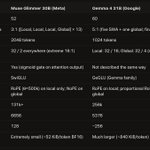
3. Muse Spark Open (816B): Besides Musse Glimmer, the first major open weight release from Meta (since Llama). Uses classic GQA + SWA but adds a LatentMoE.
4. Nemotron 3.5 Super VL (120B): Combines Mamba-2 layers with just eight attention layers. Also LatentMoE
5. Dory1.0 (4B): A looped transformer design.
6. Reflection Beam (501B): GQA+SWA architecture.
7. Recursive Flint (40B): Note that "Recursive" is the company name; the architecture is a fairly standard MoE with GQA and SWA.
8. MiniMax M3.1-Flash (428B): Uses their own MiniMax Sparse Attention module.
9. LFM3 (1.7B): Hybrid architecture that mixes short convolutions and attention.
10. Mistral Large 4 (1T) combines MLA with sparse attention.
Will probably cover/discuss things in more depth in the coming weeks!

Marko Tasic retweeted

We @huggingface reproduced this paper!!
It's built with ML Intern, an open-source harness to do AI research, train models, and more
Model: huggingface.co/ML-Intern-lab…
Demo: huggingface.co/spaces/ML-Int…


We asked GPT-6 Astra to edit Qwen3.5-0.8B weights to improve math.
It directly changed only 0.016% of weights, fixing 0.8B's reasoning loops & improving math up to 6x and even instruction following 3x, without gradients or training.
We call this Weight-Space Programming: frontier LLMs can now natively read/write neural network weights! 🧵
Blog: rikiyat.github.io/blog/weigh…

Readers added context they thought people might want to know
LLM was given weights explicitly as text in prompt and used code/forward passes (per authors' logs) to ablate Qwen looping direction, a known thinking-mode issue per model card. Primarily fixed repetition in that mode, not general 'natively' improving weights/math.
rikiyat.github.io/blog/weight-sp…
github.com/RikiyaT/lm_und…
huggingface.co/Qwen/Qwen3.5-0…
huggingface.co/RikiyaT/Qwen3.…
Marko Tasic retweeted

We introduce Depth Hybrid Attention (DHA), which incorporates depth-wise value mixing into hybrid architectures with very little additional compute and cache overhead. By allowing layers to mix information across depth, DHA broadens each layer’s view and increases the model’s expressive capacity.
Our DHA method adapts to multiple hybrid architectures, including Depth Window Attention (DWA) for GQA + SWA and Depth Delta Attention (DDA) for MLA + KDA.
Across loss curves, short-context benchmark results, and long-context retrieval evaluations, both variants outperform their corresponding full-attention and hybrid-attention baselines, while retaining hybrid attention’s low KV-cache footprint.
Project overview & code: github.com/Nanbeige/Depth-Hy…

Marko Tasic retweeted

BREAKING: Revolut moved ~2,000 engineers onto self-hosted GLM for coding and pushed Claude Code and Codex to the exception list.
Per David Abitbol, who leads AI ops there: 56 Nvidia B200s, a blended 30 cents per million tokens, roughly a tenth of what they paid Anthropic and OpenAI. Engineering lead time improved 70%.
Here's the part that matters: the gains showed up when tokens stopped being rationed. Engineers quit saving AI for the hard tickets and pointed it at everything.
Frontier models become the exception, open weights become the default. That's a pricing problem for every lab heading to IPO.
h/t @OliverMolander
Would you move your team off frontier APIs if the bill dropped 90%?

Marko Tasic retweeted

Today we are happy to share one of our first open research releases: Latent Sparse Attention (LSA), a step towards subquadratic attention that matches accuracy of full attention at ultra-long context.
Sparse attention attends to only a few tokens per query, but it has to find the right ones. At 10M tokens, that search takes 98% of the attention layer's time. LSA makes sparse attention up to 22.7× faster and full attention 72.4x faster.
With @kubicek_ales @caciolai @PengLiangzu @SukritSumant @Ben_Hoov @FraserGreenlee @RMBattleday @radim_urban @thoefler @jcrwhittington
LLM steering weights of LLM 😉
We asked GPT-6 Astra to edit Qwen3.5-0.8B weights to improve math.
It directly changed only 0.016% of weights, fixing 0.8B's reasoning loops & improving math up to 6x and even instruction following 3x, without gradients or training.
We call this Weight-Space Programming: frontier LLMs can now natively read/write neural network weights! 🧵
Blog: rikiyat.github.io/blog/weigh…
Readers added context they thought people might want to know
LLM was given weights explicitly as text in prompt and used code/forward passes (per authors' logs) to ablate Qwen looping direction, a known thinking-mode issue per model card. Primarily fixed repetition in that mode, not general 'natively' improving weights/math.
rikiyat.github.io/blog/weight-sp…
github.com/RikiyaT/lm_und…
huggingface.co/Qwen/Qwen3.5-0…
huggingface.co/RikiyaT/Qwen3.…
Marko Tasic retweeted

Meet QwenBend 🎉
Qwen writes a Bend program, then the same model type checks it with Bend2 rules and runs it inside its own forward pass
no interpreter, compiler or tool call just like qwenputer. The whole CPU is 53M non zero hand-set weights inside the model
I rewatch this part over and over.
I agree with him.

Marko Tasic retweeted

Meet qwenGPU: Qwen3.5-2B with a SIMT GPU inside its weights, 45 compiled layers in front of Qwen’s own, using its Gated DeltaNet layers as registers and memory.
It runs real CUDA in its forward passes. The host compiles the kernel to PTX and loads it, then the model writes every step of the launch itself: every register, branch and memory write.
The GPU has 4-lane warps, a 4-stage pipeline, 15 registers per lane and 126 words of global memory, all held in DeltaNet state. Qwen generates each launch token by token, each record running one machine block for one warp.
Marko Tasic retweeted

Yann LeCun was right & nobody in this industry wants to say it out loud.
109 million parameters beat 72 billion.
He has spent years saying scale is not the thing that makes a model understand the world. Meta bet the other way. He left in November and started his own lab in Paris.
Last Thursday he published the proof.
The theory everyone has been running on since 2024 is that if you train models big enough, on text, on images, on sound, they all end up with the same picture of reality inside them. Size does it. Nobody ever proved that part.
Randall Balestriero and LeCun proved it. And the proof says size was never doing the work.
What does the work is which two things you show a model together.
A photo and the caption of that photo are two views of one thing. Models trained on pairs like that get there fast.
Two paragraphs pulled from the same document are not two views of one thing. Models trained on those get there slowly and expensively.
Next word prediction is the second kind. That is what every chatbot in the world runs on.
In their tests the first method reached the same understanding after 21.6 million examples. Next word prediction needed 900 million.
And a 109 million parameter text model ended up closer to an image model's view of the world than a 72 billion parameter language model was.
660 times smaller.

Marko Tasic retweeted

I give an incredible amount of alpha away for free at this website with my open models data dashboard.interconnects.ai/


Wut ?! 😮😎

1/3
A CPU inside an LLM is one thing, but running another LLM inside an LLM would be taking things a bit too far, wouldn't it?
Anyways, here's an LLM running inside an LLM : QwenPU, an LLM (@karpathy's stories260k) running on an NPU compiled inside Qwen 3.5-4B's weights.


This is at the same cool and weird 🫡

We’ve raised $1.3M from YC & Afore Capital so you never have to type or speak again.
Typing is slow. Talking into your computer is awkward. Subvocal fixes both
Our glasses give you the speed of speech without you making a sound or touching a keyboard.
It tracks your internal speech muscles with non-contact sensing and decodes silent, almost invisible mouthing into text at more than 200 words/min.
Pre-orders are now live at:
subvocal.co/preorder?utm_sou…