








Andy Fox retweeted

My latest song/video is getting a lot of comments so let me explain a few things:
1 - The song was created from a hook I recorded as a hum; it guides the entire song; you hear that exact hook on repeat as the foundation of the entire song (even the bagpipes echo it).
2 - To generate the song itself it took 108 song generations in Suno; each one listened to, adjusted, modified and prompts tweaked to get it closer to the finish line.
3 - No specific artist was used to guide the style; the style was prompted as "Folk, Acoustic pop, folk-pop"
AI is incredible; creative people everywhere will produce amazing creative work with it, and we will be the lucky ones to be able to enjoy it. It's a wonderful tool; it empowers and unlocks tremendous creative potential. Having said that, the human has the steering wheel; if you defer to the AI for all creative output, it may produce greatness, but it is more likely to reverse to the mean, and averageness. It's no different from any other creative tool. Embrace it, use it, master it and compel it to create your vision.
Anthropic just shooting themselves in the foot long term by continuing to nerf their models.

Claude can no longer “Reverse Engineer Anything.”
Anthropic just quietly killed REA.
But Interesting timing.
After a few viral cases of people using Claude to reverse-engineer Samsung TV firmware and identify data-collection services, Anthropic appears to have restricted those reverse-engineering abilities.

Retaining customer data will become too risky for companies.

Every single company with customer data WILL be targeted, and many will be hacked.
The best we can do is learn from those that weee breached AND share details in public. Also:
“the malicious actor had access to abliterated models and substantial compute resources which enabled them to perform highly sophisticated exploits against our infrastructure.”
Andy Fox retweeted

Entirely true. It's the second-rate programmers that are having trouble adapting to AI, and screaming about it.
The A-list guys are delighted. Listen to Linus Torvalds. Or DHH. Or, a little outside my usual community, Uncle Bob Martin. We can get so much more done now!

I agree with everything OP says except "watching all of those years go down the drain."
AI might have made it almost meaningless to write code by hand anymore. But the people who have spent years/decades writing code are now in the best position to leverage AI coding tools.
Learning to code was a stepping stone toward learning to decompose and solve complex problems. I have worked with a lot of different people with different levels of coding experience. And I can say with confidence that, in general, the more coding experience you have, the better you're positioned to think about long-horizon tasks and to organize and tackle problems with multiple moving parts.
All those skills directly translate to using AI coding agents. And I'm seeing it happen in real time. People with long software engineering experience have a totally different way of using AI coding agents (given that they set their ego aside and accept that this is the new norm). They are more organized, know how to steer the agent like guiding an intern or mentoring a junior dev.
People who don't have coding experience are using agents in a random and chaotic way (the approach has its outside-the-box-thinking merits but doesn't have the same reliability as the experienced SWE approach).
Andy Fox retweeted

I think many of us working in tech tend to forget that the reason software engineering vs other engineering fields pays (a lot!) more, is a lot more flexible (WFH/remote), and has better perks:
Because this field changes much faster than other engineering fields. The premium is because fewer people are able/willing to pick up new technologies, methodologies so quickly.
But the field had ~10-20 years of stability, and so lots of folks forgot this is why a premium exists. And that AI is just another tech wave: software engineers who pick it up and master it will generally fare better; those not will struggle a lot more.
Andy Fox retweeted

Unfortunately, with access to an abliterated DeepSeek V4.1 model, there is little value to KYC holding back the frontier models now for cyber.
In fact, making it hard to secure systems w extra friction in American Enterprise is hurtful to national security.
Ai is the wakeup call to move your assets to self custody.

SCOOP: Major U.S. banks are detecting unauthorized third-party AI agents inside customer accounts, including some attempting to take actions that appear to be independent of user instructions, sources told Axios.
The findings have alarmed banking executives, who are racing to restrict access to their systems as AI moves at a velocity faster than financial institutions can respond, multiple industry and bank executives told Axios.
Several banks are now preparing for worst-case and even “day after” scenarios, including how to rapidly secure or restore customer accounts if things go wrong, the people said.
Several bank executives told Axios they're struggling to distinguish between human users and AI agents. One executive said banks also struggle to determine whether agents are authorized by customers or potentially operating without their permission, more akin to rogue agent behavior.
Read my latest for Axios here: axios.com/2026/10/22/ai-agen…

Maybe @OpenAI @AnthropicAI should.. Oh I dunno, help everyone play better defense with their frontier models instead of blocking access.

And yet the average engineer cannot access the cyber abilities of the frontier models to address and find issues in their own apps ahead of time or to take action quickly in times of need.

Crazy 72 hours in security. Three major incidents dropped back-to-back: eMudhra, PingCAP (TiDB Cloud), and PHP.
Here is the short version of what happened and who got hit.
1. eMudhra (Trusted CA compromise)
eMudhra generated 8 intermediate CA certificates in April 2025 (cross-signed by Sectigo). A bug in their HSM key-wrapping test script created a second set of P-384 keys where the private keys were single-byte numbers under 256. Operators picked the wrong key labels and signed them into real CA certs.
One of the intermediate CA private keys was literally the number 4.
The other seven: 56, 66, 115, 155, 156, 230, 237.
Three weeks later (May 2025), their CRL signatures started failing because the CRL signer was using the real keys instead of the weak ones. Instead of asking why the keys didn't match, someone switched the CRL signer to the weak keys and closed the ticket.
• Browsers are safe: Chrome, Firefox, Apple, and Microsoft already blocked them, and zero rogue certs hit CT logs.
• Servers are not: curl, Python (certifi), Go binaries, and Docker base images don't check CRLs. Update ca-certificates, certifi, and Go (1.27.3 / 1.26.10).
• 10-second check on any server:
curl dv-g3b-emudhra.we-have-a-pro…
(TLS error = safe. 200 OK = still vulnerable.)
2. PingCAP / TiDB Cloud (10.6 TB breach)
Attackers found GCP and Azure credentials committed inside PingCAP's own repos. They set up a replication feed of TiDB Cloud's production control plane and exported the entire database every 6 hours for 22 straight days. 88 full exports, zero alerts. 200 GB is already out on torrents.
Beyond the 413 private repos and 20.6M customer SQL queries logged from their web SQL Editor, PingCAP engineers were pasting customer secrets into Jira tickets.
Who is affected in the leaked records:
• Live credentials exposed in support tickets:
- Pinterest: AWS keys for their pingcap-logs S3 bucket
- CardX / Silverlake (NPCI-linked env): AWS admin key in a backup log with full access to 258 external S3 buckets
- DeBank: 38 presigned S3 URLs
- An unnamed AI/dev platform: a 314 MB slow-query log attached to a ticket containing 8,027 live customer secrets (an AWS root key, a GitHub admin PAT over 1,701 repos, 7,485 AWS STS tokens, and 192 OpenAI/Anthropic/Gemini keys)
• Tenants with infra metadata, VPC CIDRs, app-server IPs, or contract pricing exposed:
- Tech: Atlassian, Databricks, Airbnb, Baidu, LINE, Nylas, Persona, PatSnap
- E-comm & Travel: Booking.com, Shopee, Flipkart, Mercari, ZOZO, AEON, Delhivery, Klook
- Gaming: Capcom, Square Enix, Konami, Bandai Namco, Cygames, Colopl, DMM
- Finance: PayPay, SoftBank, SBI, SB Payment Service, Fujitsu, TOPPAN, Bank of China, China Life
- Crypto: Bitget (said only public trade logs were on it and they already left), Pionex, DigiPlus, NFTscan, Chainbase
• Developer profiles leaked (from a purchased reo.dev table in PingCAP's BigQuery):
- 24,900 personal emails + GitHub/LinkedIn profiles of engineers at Tencent (3,327), Huawei (2,726), ByteDance (2,475), AIG (2,140), Mastercard, Flipkart, and bKash.
If you use TiDB Cloud: rotate your console API keys, DB passwords, and anything you ever pasted into a support ticket.
3. PHP "PHP2Shell" (CVE-2026-109618 & CVE-2026-109619)
Two CVSS 9.2 pre-auth RCEs leaked yesterday ahead of today's 14:00 UTC patch.
Public writeups trace it to a heap Use-After-Free in PHP's native C multipart/form-data session upload-progress handler (ext/session/session.c).
Because C-level multipart parsing runs before line 1 of index.php:
• App auth, Laravel/WordPress middleware, and file_uploads = Off do not stop it.
• Only PHP 8.2–8.5 get official patches today (59% of PHP servers on Shodan are on EOL <= 8.1).
• Until you patch php-fpm: lock php_admin_flag[session.upload_progress.enabled] = off and block unexpected multipart requests at Nginx/Apache/Cloudflare.

Andy Fox retweeted

Today I call upon the blockchain industry to calmly begin planning for "bunker mode". My personal recommendation is to set in motion a controlled mass migration of assets to fresh addresses, i.e. addresses whose pubkeys remain hidden behind a hash.
Holders, starting with large and sophisticated ones, should consider moving the bulk of their funds to addresses that have never signed a transaction. And when they do sign one, they should also move remaining funds to a new address (possibly generated from the same seed phrase).
Don't rush. While I believe there is cause for action a rushed migration would do more harm than good. Don't panic either. Moving assets to protected addresses is a simple, preventative step which does not require new cryptography or new wallets.
IMO it is now reasonable to brace for the possibility that ECDSA breaks before qday, in the worst case in months not years. By "break" I mean fast private key recovery (e.g. in one week) on available hardware (e.g. a large GPU cluster).
Recent days have been humbling for human mathematical intuition. Long-held, unquestioned hypotheses have fallen. This includes the n log(n) bound for integer multiplication and the 3SUM conjecture. In hindsight, May's unexpected disproof of the Erdős unit distance conjecture was our warning shot.
Yesterday's OpenAI drop made it clear that mathematical superintelligence is upon us. They say there are weeks where decades happen. We are about to live through weeks where centuries of mathematical progress happen. Could our magic 64-byte ECDSA signatures be too good to be true? Was it just security through obscurity all this time?
Elliptic curves feel especially vulnerable to superintelligence. Curves carry rich structure, with room for fancy tricks like Schoof, Frobenius, pairings. (By contrast, hashes are designed to minimise algebraic structure.)
Separately, as Ewin Tang can attest, an efficient quantum algorithm sometimes foreshadows an efficient classical one. We should be open to the possibility of a classical counterpart to Shor that breaks elliptic curves and RSA at once.
Also noteworthy is the striking under-representation of cryptographic breakthroughs among the 722 mathematical results OpenAI published. I've witnessed first-hand the US government censoring academic quantum cryptanalysis results. Backroom interventionism is my base case.
I urge large, sophisticated actors to lead by example. Project11's "risq list" (bitcoin-risq-list.projecteleven[.]com) is a great tracker of exposed BTC pubkeys. Binance, Bitbank, Robinhood, Bitfinex, and Tether have an opportunity to harden their cold storage. Next month I'll address institutions in London in a live Q&A (forum.ethereuminstitutional[.]org/london-2026).
Again, please do not rush. Wallets holding under 50 BTC enjoy partial cover from "Satoshi's shield", i.e. his 20K exposed addresses that hold 50 BTC each. Load-bearing signers like oracles and L2 security councils should consider rotating ECDSA pubkeys with every signed message and/or multi-signing with a hash-based schemes like SPHINCS.
Exiting bunker mode safely will require post-AI cryptography. My inclination is to go all-in on hash-based cryptography and avoid structured mathematical assumptions entirely, whether from curves, lattices, or isogenies. A single battle-tested hash (e.g. from the SHA or BLAKE families) yields plausible post-AI security.
The Ethereum roadmap on strawmap[.]org fully embraces hash-based cryptography with end-to-end formal verification as a response to the quantum threat. Those timelines must now be revisited and accelerated in light of mathematical superintelligence. I'll be pushing for maximum defensive acceleration.
Andy Fox retweeted

💯
People that complain AI is useless lack the very creativity that they claim it destroys

I find these takes really confusing.
you have a 150 IQ+ tireless genius living in your computer. it can use your browser and read your email and access any file you want. it won't complain if you give it the most tedious administrative tasks. it is willing to work 24/7 for less than minimum wage. it can work unsupervised for hours at a time.
and you can't think of any way to put it to use?
are you completely lacking in imagination or do you enjoy mundane administrative tasks? you enjoy paying parking tickets and triaging emails and manually unsubscribing from spam and vetting credit card payments and canceling subscriptions and renegotiating insurance? you like doing that?


Andy Fox retweeted

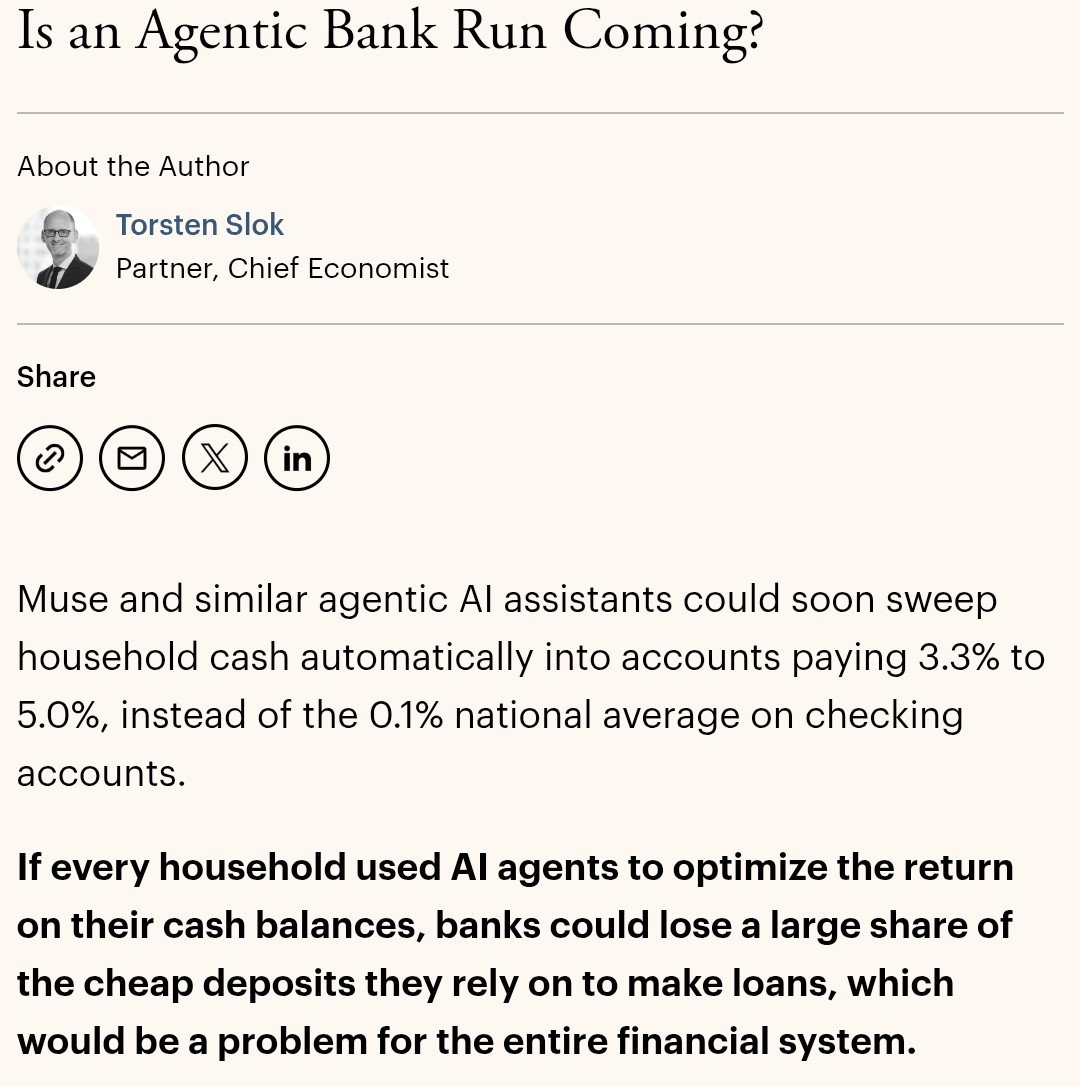
The irony of all this is it’s framed as an ai risk that needs protection against. But think about what it really means
Our banking system is so unsustainable and extractive that the moment humans have smart ai bots advising them, the ai bots will recommend exiting banks and earning better yield elsewhere
Which makes most banks economically unviable
This isn’t AIs fault, it’s a risk of highly monopolized and extractive banking
And it’s fixed by decentralized finance + ai, where users decide what to do with their own assets and earn their own yield

The chief economist at Apollo is warning that mass adoption of AI agents could trigger a bank run as they optimize user investments. Gary Gensler spent his last few years as SEC chair warning that the exact same problem will hit the markets: the pursuit of algorithmic perfection at scale destroys system stability. Personal-finance agents making simultaneous optimal decisions could potentially cause a massive flash crash.
Agent acausal coordination, with no messages passed between them, will show up in a lot of places. Markets will get the big headlines, but huge numbers of clever advisors making very similar choices will impact all of human society. Capability gains make this worse, not better. The smarter the agents, the narrower the optimal path; and knowing that other agents see that exact same path lets them move together without talking to each other. Agents do not need to collude to act in unison. Thus, they break no human laws by doing so. Human laws were not written for this. They were not written for a lot of what is coming, and it is about to start happening very fast.
Andy Fox retweeted

It takes a while to build the confidence, but there's no future where you're manually reviewing every line of agent code. Not much acceleration in that. You need adversarial agent reviews, you need automated testing, and maybe you spot check. That's it. From prompt to production!
Opus 5.5 is good but I feel like people have a much lower bar for "AGI" than I do when reading these posts. It's not that good.

Feeling the AGI/ASI, few observations
1. Opus 5.5 really gives strong vibes of AGI (maybe not fully there, but we're very close, like 80%-90%).
For example, few breakthoughs in training humanoids are needed. We need to move this intelligence into physical world.
2. I don't think Anthropic has discovered any magical formula.
3. Which means, SpaceXAI, Google, and others will soon follow. This prediction is based on the amount of compute they already have + additional compute being added all the time.
4. Never was more confident that Anthropic, SpaceXAI, Google, OpenAI, likely Meta, basically all big US AGI labs will have proper AGI in 2027.
5. And from there we'll move quickly to ASI territory (likely also in 2027).
It looks like few GW of compute are enough for strong AGI, now imagine what we will able to do with 10-20GW of compute which are rapidly coming online.
And then with 100GW-200GW...
2027 will be an utterly insane year.

Andy Fox retweeted

Zuck pretty handily dismantles Dario's talking points here:
- people want models that are *aligned with them* (subtly punches back at Anthropic's normative constitutional approach)
- labs already face liability if they screw up, so incentives to release aligned models is already baked in
- Meta delayed Muse for alignment reasons but didn't make a whole song and dance about it
- Subtly questions Anthropic trying to kingmake METR (implies METR is an Anthropic patsy)
- Meta doesn't need to coordinate with anyone to work on alignment, it's just something labs should naturally do

Last month I wrote about how we can build a positive and safe future for everyone: meta.com/thefutureisforevery…
Every lab has the responsibility and incentive to move at the pace required to train its models safely, and the ability to take its own actions to ensure that happens.
The reality is:
- People won't want to use agents that are misaligned with them and that don't do what they ask, so labs have a strong natural incentive to make their models more aligned.
There is a lot of debate about slowing progress on capabilities until alignment catches up. My view is that trust and alignment are quickly becoming the most important capabilities that will differentiate agents and models. Any lab that doesn't focus on alignment will fall behind.
- Labs face significant liability if their models cause harm, so they have a strong incentive to prevent this as well.
Meta delayed shipping Muse for several months to focus on safety and security. We didn't call for everyone else to do this before we would. We just did it as part of our day-to-day work because it was clearly the right thing for people and for us. I'm proud of the security foundations we've built.
- Engaging independent evaluators and advisors is industry best practice. MSL already does this today in several areas because it helps produce better work. Other labs can just do this too. In general, it would be helpful for there to be a larger and more diverse ecosystem of evaluators.
- Committing the significant majority of compute towards serving people rather than racing towards recursive self-improvement is one of the best ways to ensure we develop this technology safely. Meta has made this commitment and other labs can do this as well.
I believe the key to building a positive future for everyone is maintaining the right balance of power. This is within our power to do.
