
“Northern Ireland is the world’s best kept secret. Both in the character of its people and it’s scenery.”
Joined June 2022
- Tweets177
- Following825
- Followers66
- Likes1.3K





NI Observer retweeted

🚨 They Said the Quiet Part Out Loud 🚨
I’ve watched the clip of Fergal Enright, Director of Glór na Móna, and there is no room for spin.
He states it clearly. They have no interest in the Irish language finding a permanent place within Northern Ireland. They want to destroy the Northern Ireland state, and they see the language as a means to do it.
That is not a misquote. That is not taken out of context. That is the stated position of the director of an Irish language organisation that has received significant public funding from the very state he wants to see destroyed.
Let that settle for a moment. Public money, raised from ratepayers and taxpayers across Northern Ireland, including from the unionist community, is going to an organisation whose leadership openly describes the Irish language as a tool for dismantling Northern Ireland. Not promoting culture. Not expanding access. Not building shared understanding. A means to destroy the state.
For years we have been told that opposition to certain Irish language demands is bigotry. We have been told that funding streams, legislation, and institutional support are about rights and respect. Then a senior figure in the sector says the quiet part out loud: the language is useful because it advances the destruction of Northern Ireland.
That changes the conversation. It confirms what many in my community have argued for a long time – that for some activists, cultural promotion is secondary to a political project aimed at ending Northern Ireland’s place in the United Kingdom. When the mask slips this cleanly, the pretence should end with it.
I have no problem with people speaking Irish. I have no problem with people wanting to learn it or pass it on. Culture is not the enemy. Using culture as a weapon against the constitutional status of Northern Ireland is a different matter entirely. And taking public funding from the state while declaring the intention to destroy that state is an insult to every taxpayer who is expected to underwrite it.
Questions now need to be asked of the funding bodies. What due diligence is carried out? What standards apply when an organisation’s leadership expresses open hostility to the existence of Northern Ireland? Is public money being given with no regard for the political objectives being openly stated by those running the groups?
Unionists are often lectured about respect and parity of esteem. Respect is a two-way street. It is hard to show respect for a project whose directors describe your state as something to be destroyed and your community’s constitutional position as the obstacle. It is harder still when that project is bankrolled in part by the state itself.
Fergal Enright has done everyone a favour by speaking plainly. The rest of us should respond with equal plainness. Public funding is not an entitlement for those who want to dismantle the place that provides it. If the goal is the destruction of Northern Ireland, then the funding conversation needs to change accordingly.
My community has every right to reject being asked to pay for the rope.
#IrishLanguage #GlórNaMóna #FergalEnright #PublicFunding #NorthernIreland #PUL #Accountability


NI Observer retweeted

My thoughts go out to nationalists in Stabane who have been victimised by <checks notes> being shortlisted for the award for UK Town of Culture.
This must come as a shock, particularly as the bid was originally supported by <checks notes> the SDLP and Sinn Fein.
No doubt the £60,000 that the town received to support its bid has caused <checks notes> “huge division” and “major mistrust”.
I am sure residents will be aghast to learn that the title would have come with an award of a further £3 million, which would have left the town in <checks notes> “a very uncomfortable place”.
Spot the difference 👀
SF reps dressed in expensive brands in their video 🛍️
💰 Michelle in Didriksons
💰 John Finicune in Ralph Lauren
💰 Chris Hazzard in Jack Wolfskin
Realised their expensive brands didn’t fit the narrative so the brand vanishes from the promo tweet??


NI Observer retweeted

Just in case you think this is just about SPS rules for imports and exports: The UK has agreed that the EU will make its rules on:
- all stages of production, processing and distribution of food, of feed and of animal by-products;
- animal health, animal breeding, and animal welfare;
- plant health; plant protection products;
- plant reproductive material;
- antimicrobial resistance in animals;
- contaminants and residues;
- materials and articles intended to come into contact with food;
- food information and labelling requirements;
- rules on organics;
- nutrition standards and associated requirements;
- genetically modified organisms;
- biocidal products;
- marketing standards applicable to agricultural sectors and products, with the exception of wine and spirits;
- all related official controls and certification...,
by the same rules that apply to those areas within the [European] Union, on the basis of dynamic alignment and simultaneous application in accordance with this Agreement,
NI Observer retweeted

Unionists are not to be made the scapegoats for GAA and Casement Park development failure:
Between 2014 and 2016, criticism surrounding the Casement Park redevelopment centered on severe safety failings, flawed planning assessments, and a breakdown in working relationships involving the GAA, its design team, the Department of Culture, Arts and Leisure (DCAL), and the Department of the Environment (DoE).
Carál Ní Chuilín of Sinn Féin was the Minister of Culture, Arts and Leisure (DCAL) in 2015. Mark Durkin SDLP was DOE Minister.
Between 2014 and 2021 Mooreland and Owenvarragh Residents' Association (MORA) brought the legal challenges against the Casement Park redevelopment in West Belfast
Safety Technical Group (STG) & Sport NI Criticisms
The sharpest technical criticism came from safety officials within Sport NI (an arm's-length body of DCAL) and the multi-agency Safety Technical Group (STG), which included the PSNI, NI Ambulance Service, and NI Fire and Rescue Service:
Inadequate Emergency Exiting. Safety experts warned that the proposed 38,000-capacity design lacked sufficient turnstiles and emergency exits to safely evacuate crowds in an emergency.
Hostile Working Environment. During a 2015 Stormont inquiry, Sport NI safety officers Paul Scott and Laura Strong testified that they were subjected to "ridicule," "abuse," and "undue pressure" from GAA officials, the stadium design team, and DCAL civil servants when they raised these safety objections.
Unsafe Capacity Proposals. In January 2016, a joint report submitted to the STG by emergency services assessed the safe capacity of the constrained site to be between 11,239 and 18,264—roughly half of the GAA's revised stadium proposals at the time.
NI Observer retweeted

Lot of confusion this weekend over the status of the reset deal, fanned by UK ministers misleading media.
They are claiming the deals on food/agri products and emissions go ahead regardless of agreement in tuition fees. That is untrue.
Brussels says the deal is a package and there has to be agreement on tuition fees before the rest of the deal can be implemented. Six months allocated to come up with a tuition fee agreement.
In practice, the deal will go ahead. Because the Burnham government will capitulate over fees.
International fees currently circa £25,000 at UK universities on average. Burnham already offered to cut that to £12,000 for EU students.
Not enough says the EU. Has to be same as it is for UK students: £9,750.
Ministers already preparing for yet another surrender along these lines. But still working out how to compensate UK universities for lost revenue of at least £500m/year, rising soon to £1 billion — at a time when UK uni finances already stretched.
Whatever scheme it chooses UK taxpayers will be footing the bill to subsidise the offspring of wealthy Europeans (including many Brussels bureaucrats) to study at UK universities.
Very few UK students will choose to study at EU universities. Those that do will also hail from affluent families.
Socialism for the haute bourgeoisie.

MY TAKE ON THE UK/EU ‘DEAL’ ON STUDENT TUTION FEES The more you dig into the Burnham ‘reset deal’ with the EU, the more it becomes apparent how one-sided it is. Yet again, Brussels has taken us to the cleaners.
The food/agri reset will overwhelmingly benefit EU farming/food producers, who export a lot more to us than we do to them.
But the so-called ‘youth mobility’ scheme is even more lopsided — because far more EU students come to study here than UK students study in the EU.
In 2019 circa 150,000 EU students were at UK universities, a mere 15,000 UK students at EU universities i.e 10 times more!
Since Brexit, which meant EU students had to pay international fees, the number has fallen to about 65,000.
A large chunk of which are at Russell Group unis, where fees for international students average £27,000 (ex. medicine).
The EU is insisting they now pay only £10,000 (which UK student fees will soon be).
Take out Irish EU students (who already pay only domestic fees), allow lower fees for non-Russell Group and don’t include post-grads (not covered) — and the Russell Group calculates the EU demand will cost UK unis £500m/year in lost revenue.
But if lower fees means more EU students will come here and head more towards pre-Brexit levels, then the cost will very soon be over £1bn — and the UK taxpayer will be expected to make up the difference.
The Brits don’t realise how much this policy is being pushed by the euro-elite, including in the Brussels Commission and its many bureaucratic arms.
These are full of functionaries who send their kids to UK universities because they can afford to and because our top universities are so much better than the EU’s.
We have four in the world league top 10. The EU none. Indeed in some global surveys the EU has only two in the top 40.
So UK unis are very attractive for the haute bourgeoisie of the euro-elite. And saving £17,000 a year on fees a nice little earner.
In essence, the British taxpayer will be subsidising the education of the offspring of affluent euro families. Not exactly socialism in action.
There’s also the little matter of an outstanding £6 billion in UK loans to EU students — a fair chunk of which will never be repaid. We can expect that to rise under the Burnham reset.
Frankly, I don’t know why he bothers to negotiate. It would be quicker just to give the EU what it wanted — and the result wouldn’t be any worse.
NI Observer retweeted

If this means EU students will pay the lower fee in Northern Ireland, as they did before Brexit, they will cost Stormont and our universities money and count towards the 'home student' cap, displacing young people here.

BREAKING:
The EU will not implement the Brexit reset deal until Andy Burnham agrees to allow European students to pay the same as their UK counterparts, @oliver_wright reports
Member states have overruled the Commission and put the whole package on ice until the tuition fees offer is resolved
The could delay the implantation of the youth mobility scheme and plans to end checks on food being exported from Britain to Europe
“The council agrees that adoption of the council decisions on signing the agreements shall not precede the conclusion of the negotiations on the supplementing agreement providing equal treatment on tuition fees,” the council said
UK-EU summit live: PM set to sign reset deal after ‘down to the wire’ talks
thetimes.com/article/fbcba96…
NI Observer retweeted

🏟️ Top 15 teams by average stadium fill in the 🏁 UEFA Nations League 2026/27 (as of 11 Nov):
98.2% ☘️ Northern Ireland (18,111 avg)
94.3% 🇬🇷 Greece (27,069)
94.0% 🇵🇹 Portugal (48,279)
93.7% 🇫🇷 France (76,254)
93.7% 🇳🇴 Norway (25,478)
92.7% 🇪🇸 Spain (34,405)
92.4% 🇩🇰 Denmark (35,270)
92.3% 🇭🇷 Croatia (19,516)
92.2% 🇨🇭 Switzerland (15,485)
91.8% 🇩🇪 Germany (48,533)
90.8% 🏴 England (81,695)
90.8% 🇳🇱 Netherlands (41,412)
90.5% 🇱🇻 Latvia (6,109)
90.1% 🇽🇰 Kosovo (12,597)
90.1% 🇱🇺 Luxembourg (8,453)
👉 Full attendance tables available at football-md.com/attendance
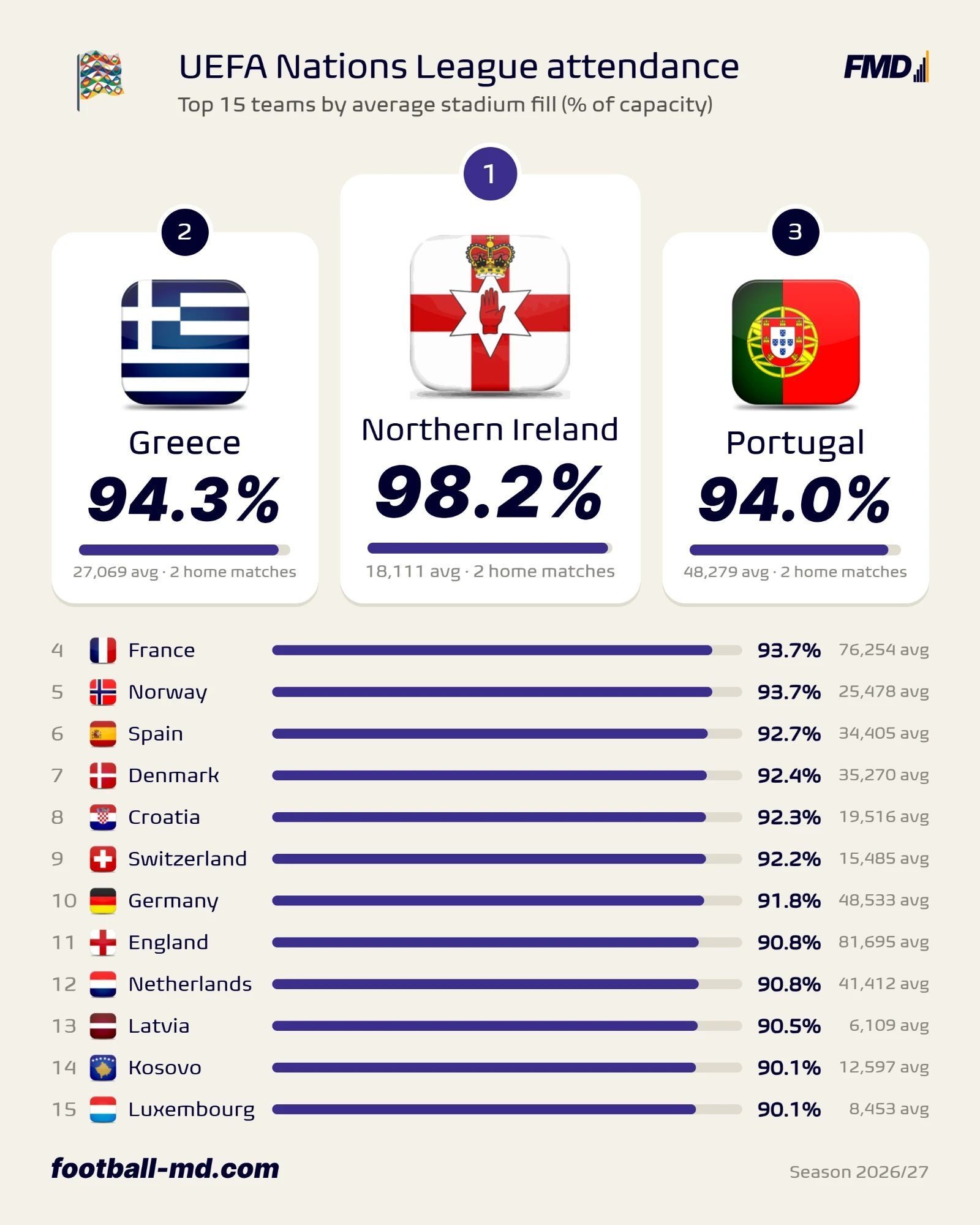
ALT UEFA Nations League attendance: Top 15 teams by average stadium fill, 11 Nov
NI Observer retweeted
For the many UK politicians @UKLabour and journalists @BBC who don't know anything about UK trade, here are the highlights:
1. The UK is now predominantly a service exporter. 57% of UK exports are services, which are not affected by EU 'red tape'.
2. UK goods exports have dropped from almost 70% of our total exports in 1997 to just 43% in 2025. This trend began long before Brexit and is tied to Net Zero mandates, high UK energy prices, and EV mandates.
3. Machinery and transport goods, such as cars and aircraft parts, are 42% of all UK goods exports. This is by far the UK's largest export sector, although it is also falling. It was 50% of UK exports in 2000. But if the UK joins the EU's CBAM, companies in this sector will see their imported material costs rise, making their exports even less competitive.
4. Chemicals are the UK's second-largest export sector. They account for 19% of UK goods exports, but this share is shrinking due to UK and EU energy costs and Net Zero regulations. These will increase if the UK joins the EU ETS.
5. Miscellaneous Manufactures account for 11% of UK goods exports. This is still the UK's third-largest export sector, even though it includes many goods the UK no longer makes because of our high Carbon taxes, which will increase if the UK signs up to the EU's even higher ETS on November 20th.
6. Fuels account for 9% of UK exports. This is still the UK's 4th largest goods export sector, even though the current and previous governments are/were trying to destroy it with bans on new exploration and ultra-high taxes.
7. Material Manufactures account for 8% of UK goods exports. This sector includes iron, steel, aluminium, ceramics, and glass manufacturing - industries that have gone, or are going, out of business in the UK because of high UK energy costs, which will rise if the UK joins the EU ETS.
8. These five sectors make up almost 90% of UK exports. The other 5 industry sectors are insignificant. But the government and our journalists think the UK is New Zealand and that the only goods we export are food and live animals to the EU. We don't! UK food and live animal exports to the EU were just 1.3% of the UK's total exports.
9. The government is about to sacrifice all of the export industries listed above to slightly reduce the IMPORT costs of a handful of Supermarkets, at least two of which are privately owned German companies.
These savings will not be passed on to UK shoppers because the government has also increased wages again, and supermarket energy costs will increase if we join the EU's ETS.
10. UK exports of food and live animals will not increase because we are paying farmers to not produce them, this has nothing to do with EU red tape. Instead we are paying farmers to plant trees and wildflowers or plaster their farmland with solar panels. (54% of UK electricity is coming from gas today, 12% from solar and 3% from wind.)
11. Write to your MP and tell him to #StoptheReset.
If you don't stop this, don't complain when all of our goods export industries have closed because of EU higher carbon taxes, EU higher carbon import tariffs, and the cost of complying with the EU's new packaging and process regulations.
NI Observer retweeted

Happy birthday to Liverpool legend, John Barnes 🎉✨

ALT A birthday graphic for Liverpool legend, John Barnes
NI Observer retweeted

Reports commissioned by @Economy_NI have found that ‘the operation of Northern Ireland's Brexit deal is still characterised by confusion, duplication and accumulating regulatory burdens on businesses’👇

The operation of Northern Ireland's Brexit deal is still characterised by confusion, duplication and accumulating regulatory burdens on businesses, two reports have found. bbc.in/4A5EBd2

NI Observer retweeted

“This is a multi-state sponsored invasion of Britain.”
@PatrickChristys breaks down how illegals get to Britain, from taxpayer-funded support in France to the British state’s unmarked coaches and police escorts waiting in Portsmouth.
Full interview: youtu.be/jWgXaUrpnrc
NI Observer retweeted

The Paul Tomkins piece Neil references can be found here 👇
tomkinstimes.substack.com/p/…
NI Observer retweeted

The refereeing Liverpool have been subjected to, particularly at Anfield, is genuinely staggering. And I’m tired of legitimate criticism being dismissed as “sour grapes” before anyone even bothers to look at the evidence.
Paul Tomkins has researched this extensively, going back decades and some of his findings are genuinely ridiculous.
Consider these stats from his April 2026 study:
• ZERO opposition players have received a foul-related DOGSO red card at Anfield since 2009. That’s 325 home league games without an opponent being sent off for denying an obvious goalscoring opportunity through a foul.
• 3 Liverpool players received DOGSO red cards at Anfield in just 28 games under Slot. More than opposition players received at Anfield in the previous 25 years combined.
• Liverpool haven’t received a penalty in the opening 15 minutes of a league match with fans present since December 2012. Man City received 14 (!!) in that same period.
• Liverpool went 305 consecutive league matches between 2015 & 2023 without an opposition player receiving a 2nd yellow. That’s 8 years. Home or away.
• Since VAR was introduced, Liverpool have received just 2 VAR-awarded penalties for fouls. Man City received 11. Liverpool have also had 7 awarded against them.
• Liverpool received ZERO subjective VAR overturns in their favour before the 28th minute across approximately 260 matches. Man United received 7, Arsenal 6 & Man City 6.
• Salah averaged just 0.83 fouls won per 90 minutes, ranking outside the top 2,000 players in Tomkins’ study. Anyone who watched Salah knows how ridiculous that is given how frequently he’s grabbed, pulled & manhandled.
• Liverpool’s average foul free-kicks won dropped from around 12-13 per game before Klopp to just 9 after his arrival. Only Sheffield United recorded fewer in Tomkins’ comparison.
• Only 51% of Liverpool’s penalties were awarded at Anfield, compared to approximately 63% at home across the league. Some home advantage, eh?
And perhaps the most damning stat of all:
Of the 56 highly contentious league incidents Tomkins identified against Liverpool in the VAR era, 53 (95%) happened when the match was level or separated by just 1 goal.
These are game-changing decisions. Penalties, red cards & incidents that can genuinely decide matches, title races & entire seasons.
Think about Tarkowski’s challenge on Mac Allister, Ødegaard practically playing basketball at Anfield, Senesi’s handball or Salah getting manhandled every other week without a whistle. Oh, and literally disallowing a completely valid goal at Tottenham (no, YOU let it go).
At what point do we stop pretending this is normal?
And what frustrates me most is how quickly people dismiss the conversation as “sour grapes.” As if being a Liverpool supporter somehow invalidates the evidence. You can be biased & still be absolutely right.
I’m not suggesting these stats automatically prove some grand conspiracy, but the disparities are extraordinary. And when you actually watch the incidents themselves, it’s difficult to understand how some of these decisions are even possible.
We’re talking about penalties & red cards. Literally the most consequential decisions a referee can make. And somehow Liverpool consistently find themselves on the wrong end of them, even at Anfield - especially at Anfield - where we’re supposedly benefiting from this enormous home advantage.
Why shouldn’t that be questioned?
Credit to Paul Tomkins for actually doing the research & documenting this over the years.
Full analysis:
tomkinstimes.substack.com/p/…
But sure, “sour grapes.”
#LFC

NI Observer retweeted

Official figures out this morning report that last month, the UK government borrowed £24.5 billion.
But the fineprint shows that almost £11 billion of that extra borrowing went on debt interest payments.
That's more than £400 per household on debt service costs, in September alone.
So far during this financial year, from April to September, the government's debt interest payments amount to £61 billion.
Now, this number will barely feature in UK newspapers and across our airwaves. It may be mentioned in passing in out-of-the-way business sections, or on the odd business bulletin.
But this huge debt interest bill won't register with the vast majority of our political and media class, or impact the national debate.
Let me explain why that's so wrong and so dangerous ...
£61 billion is a massive amount of money.
It's equivalent to the UK's entire annual defence budget – the money we're paying, increasingly to foreign creditors, simply to service our national debt for six months, not to pay any of it back.
£61 billion is equivalent to the money you'd raise over a year from adding a whopping 7 pence to the basic rate of income tax.
For £61 billion, you could build around 40 large, state-of-the-art hospitals, or employ more than 100 thousand extra nurses for ten years.
£61 billion would pay for free-at-the-point of use social care for everyone who needs it in the UK, for an entire year – three times over.
Again, this is the debt interest bill on Britain's spiralling national debt – now more than 3 trillion pounds – over the last six months alone.
The UK's public finances are close to meltdown – yet so many MPs and journalists continue blithely to view ever more public spending and borrowing as the answer to every problem.
Those who highlight the dangers post by our hugely precarious national accounts are dismissed as cranks, ideologues or worse.
But basic arithmetic has no ideology.
And there is nothing "progressive" or "kind" or "right-on" about driving the UK ever closer to the fiscal cliff edge, provoking a crisis that will make the "austerity" years of the 2010s feel like a picnic, a crisis in which poorer households will suffer the most.
Yes, Britain's national debt is lower than that of France. But because our borrowing has been rising so sharply, and because we're so prone to inflation, our debt service costs are much higher.
The UK is spending a disgraceful 3.6pc of GDP on public debt interest, while France spends less than 2.5pc.
Endless airtime and column inches are devoted to spurious conversations about a billion or two of additional "fiscal headroom" we may or may not have in three years' time.
And, of course, any "extra headroom" is immediately pledged in new spending – which means yet more borrowing.
These conversations are a waste of time – and, in fact, are deeply counterproductive. Three-year fiscal forecasts, even one- and two-year forecasts, routinely turn out to be askew by tens of billions of pounds.
I'm not saying we don't need fiscal rules - we do, but we need more immediate rules, which actually bite, acting as a meaningful constraint on out-of-control borrowing and spending.
Instead, political and media sages present the nation with spuriously precise discussions about fictional fiscal outcomes way into the future – using rules which are deliberately designed to kick arithmetic realities into the long grass ....
An increasingly expensive, over-bearing, out of control state is not the answer to Britain problems.
But unless we change course, it will certainly be our downfall.
Please like/share if you think what I'm saying is important – and if fiscal realities should feature more prominently in our national debate.
And for more sharp, plain-speaking economic analysis subscribe to:
"When The Facts Change - economic and politics in a fast-moving world, with Liam Halligan"

NI Observer retweeted

🚨 I spend an enormous amount of time trying to understand the chaos we're living through. Not the headlines. The machine behind them. 🚨
If you want to understand what Elon Musk is really fighting, and who is really fighting him, this is the clearest map I can give you.
Expensive houses. Expensive schools. Expensive healthcare. Taxes that rise every year while everything gets worse. Borders nobody voted to open. Speech rules nobody voted for.
Most people look at this and blame capitalism. The market failed, they say, so the state has to step in and fix it.
They have it exactly backwards. What they want to fix it with is what broke it. This isn't chaos, and it isn't capitalism. It has a direction, a method, and a hundred-year history. Let me reverse-engineer it.
In 1926, Mussolini's regime threw Antonio Gramsci, co-founder of the Italian Communist Party, into prison. From his cell he asked the question that would shape the next century: why did the revolution win in Russia but fail in the West, where Marx said it was inevitable?
His answer: in Russia, the state was everything, so seizing it was enough. In the West, the state was only the outer wall. Behind it stood the real fortress: the church, the family, the school, the press, the culture. Western workers never revolted because the culture held them.
So the conclusion was simple. Don't storm the palace. Capture the culture. Win the institutions and you never have to win the argument, because you decide which arguments are allowed.
In 1967, the German student leader Rudi Dutschke gave it a slogan: the long march through the institutions. Paris supplied the intellectual software, and I've already apologized for my country's part in that.
Then came the most patient operation in modern history. The students of the 60s became the professors of the 80s. Their students became the journalists, judges, civil servants and HR directors of the 2000s. Their students now run the foundations, the NGOs and the agencies. No single step looked like a revolution. That's exactly why it worked.
The method was communist. The ambition became global. And it grew like a cancer. A cancer never attacks the body head-on. It hijacks the body's own cells and feeds on the body's own resources. This system never had to defeat the West. It just had to make the West pay for it.
In America, the machine found a political home: the Democratic Party. Not the millions of decent people who vote for it. The apparatus. The donor networks, the activist groups, the consultants, the captured agencies that keep moving in the same direction whoever wins.
In Europe, it found something even better. The EU's founders, Schuman, Adenauer, De Gasperi, were Catholic anti-communists who wanted to make war impossible. But they built exactly what the long march dreams of: power that never has to face a voter. A Commission nobody directly elects holds the right to propose laws for 450 million people. Chat Control. The digital euro. Speech rules written in Brussels. Nobody stormed anything. They just drafted it.
Add the World Economic Forum, the UN agencies and the global foundation circuit, and you have the full map. You don't need a secret meeting when everyone went to the same schools, reads the same papers, funds the same NGOs and flies to the same conference in Davos every January. It's not a conspiracy. It's a class with shared incentives. That's harder to fight, because there's no headquarters to raid.
And the billionaires? Most people who became the richest in the world got absorbed. They built something real, then traded it for an aura. Bill Gates is the perfect example: he built the software that ran the world, then became the bankroller of global health bureaucracies and the funder of newsrooms covering his own causes. Laurene Powell Jobs bought The Atlantic. Benioff bought Time. You're not buying a business. You're buying the right to be called good by the people who decide who is good. That's the corruption. Not suitcases of cash. Money for aura, grants for loyalty, NGOs for policy. All legal. All invisible.
Here's the proof it's one system and not a hundred separate problems. Look at what happened to prices over the last 25 years. Everything exposed to markets and technology got cheaper: TVs, software, phones, clothing. Everything controlled by institutions exploded: college, healthcare, childcare. And housing, where you need a committee's permission to build anything. Same country, same economy, same decades. The difference isn't the product. It's who controls it.
Taxes go up and services get worse, because the money doesn't reach the services. It feeds the layers. Immigration happens at a scale no electorate clearly chose, because for a system that lives on managing problems, more problems means more budget. And a two-income family today can't buy the house their parents bought on one salary. That's real poverty, manufactured by a machine that is rewarded for looking good, never for being good.
MAGA isn't the cause of the chaos. It's the immune response. Brexit, the farmers' revolts, the votes shaking every European capital: same thing. The body finally noticed the tumor.
So what we're living through is not a normal political cycle. It's a fight to the death between two models. One runs on the perception of goodness. The other runs on reality.
And it had to be the richest man in the world. Anyone smaller would have been bought, sued or cancelled. Every billionaire before him took the deal. Elon walked out of the club and turned the lights on.
He bought Twitter for $44 billion, opened the Twitter Files and gave the world back a public square where any narrative can be checked in real time. He went inside the government and helped shut down USAID. Now Politico announces that the Democrats' gavels are coming for him. His answer: he'll find out who is really pulling the strings and go after them, not just their puppets.
He has one line he keeps coming back to: he cares about the reality of goodness, not the perception of it. That sentence is the whole war.
Now the part that makes me certain of how it ends.
A lie is expensive to maintain. It needs gatekeepers, censors, fact-checkers, friendly journalists, a budget, and constant repairs every time reality contradicts it. The truth costs nothing to maintain. It just keeps being true.
AI is driving the cost of checking anything toward zero. Any budget, any study, any statistic, any promise, audited in seconds by anyone with a phone. Yes, AI can generate lies at scale too. But producing a lie is cheap. Defending it against a billion instant audits is impossible.
That's what acceleration really means. It doesn't pick sides. It speeds up feedback loops. Systems aligned with reality compound. Systems built on lies hit the wall faster. And you cannot build rockets, design chips or cure diseases with a false model of the world. Physics doesn't read op-eds. The more intelligence we pour into the world, the more expensive every lie becomes.
You cannot scale a lie. You can only scale what's true.
We are close to the collapse of the old order and the birth of a new one. Not the one from the WEF's own 2016 video, "you'll own nothing and you'll be happy." The opposite. An order built on truth-seeking, efficiency, science, private property and free markets. You will own things. You will build things. And you'll be happy, because it will be real.
Gramsci's long march took a century. Its collapse will take years.
History will remember this moment. A man walked into the most powerful machine ever built, refused the deal everyone else took, and chose reality over perception.
I have never been more optimistic.
🤖 Made with AI
