

Product Designer
Banja Luka
Joined April 2008
- Tweets3.1K
- Following315
- Followers1.5K
- Likes1.2K


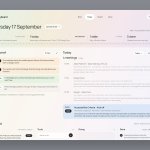





if I build an agent, I need to see it
so now my routines get their own UI. this is my dayboard, everything that needs me today on one screen

I saw a cool app today and immediately started thinking about how I’d build it.
AI makes that jump too easy.
I’m trying to slow down: define the problem, design the key moment, then build the smallest test.

I’m seeing this more in design systems:
components help teams move faster.
decisions keep the product coherent.
The real question is:
what should the next team inherit?

There was some great design systems chatter this weekend. Wanted to add a few thoughts that have been rattling around in my head, and have lately started to crystallize while watching agents build interfaces, both for me and for other people
mattrothenberg.com/notes/you…

Components are no longer enough

Wrote a little provocative piece for a Tuesday afternoon: are components dead?
medium.com/@disco_lu/compone…

This 👇

One pattern I find useful for working with LLMs is a nice long ramble session. Sometimes the LLM needs more bits to understand what you're trying to achieve, but you're too lazy to type them. In these cases I like to lean back, switch to /voice and just ramble for like 10 minutes, total mess, anything goes, full stream of consciousness. Sometimes I declare it up top, something like "switching to speech recognition sorry for any typos...". Sometimes I turn it into a small interview of a few turns. But I find that the LLMs are somehow very good at reconstructing long incoherent rambles and often their echo of your own tangle of thoughts comes out quite a bit cleaner than what you started with. The result is that you improve the mind meld and have to correct things less from that point on.
Gave Claude my Hermes skills repo and asked it to review how my agent thinks.
It found stale rules, duplicate workflows, and too much routing noise.
The fix was not “add more prompts”.
It was remove the bad ones and sharpen the rest.
The good old days are happening right now. Don’t let ambition turn the present into a waiting room.

WARNING: Longer post (but worth reading or bookmarking for later).
Your life has seasons.
Each one is unique. Characterized by its own distinct desires, struggles, opportunities, and identity.
But one reflection I've had recently is just how easy it is to completely disassociate with the present season.
To give all your time and energy toward a longing for some nostalgic memory of a prior season or an anticipation for some beautiful state of a future season.
You look back at the past and all you see is sunshine. Because it all worked out. You forget (or glaze over) the struggle you endured. You're here today. You made it. You're alive. You're doing fine.
You look forward at the future and dream on what could be. You'll have so much more. More freedom. More purpose. More health. More deep connection. More everything.
The past is beautiful and the future feels limitless. So, logically, you slowly start to treat everything about the present as the bridge. A dash connecting your past and your future. A gap to be crossed as quickly as possible.
Everything you do today is in anticipation of some eventual end state.
I'm doing this now, so that I can have that later.
Unfortunately, the danger of that dissociation with the present is significant. You may spend your entire life living for a future that has a decidedly mirage-like property. You inch closer, but when it's right in front of you, it disappears and reappears on the horizon.
You may spend your entire life skipping through the present, deferring your presence, your joy, and your very humanity to a future that never comes.
In a classic French fable, a young boy is gifted with a magic ball of golden thread. He's told that if he simply pulls on the thread, time will leap forward. The catch, of course, is that once it's pulled, it can never be put back.
The young boy takes advantage of the newfound powers. Each time he's faced with a boring day at school, a frustrating set of chores, or a scolding from his parents, he pulls the thread, skipping through to the good parts.
As an adult, he continues, leaping through mundane struggles in his marriage, the friction of having a newborn, and the boredom at work. He finds himself pulling on the thread more and more, avoiding even the most minor inconveniences of his life.
But when he wakes up one day and sees an old man looking back at him in the mirror, he's filled with regret. He realizes in that moment that as he chose to skip through the boredom, struggles, and friction, so too did he miss the real texture of being alive.
How often do we all do the same? How easily do we default into this disassociation? Disconnecting from the present in anticipation of some future.
A mentor recently asked me this:
"Where are you going and why are you in such a rush?"
It hit me hard.
And to be honest, I haven't stopped replaying those words since he said them.
Why are you in such a rush?
The world wants you to rush into everything. Rushed decisions. Rushed conversations. Rushed relationships. Rushed timelines.
In doing so, you slowly relinquish your agency. You give up your claim on your own life. Surrender authorship to a pen that was never even yours.
In a world that wants you to rush, the ultimate act of rebellion is presence.
Be in the season you're in. Don't romanticize the past, don't fantasize the future. Be here. Be now. Be in this. All of its texture, depth, and struggle. All of its joy, tension, and pain. Sit with the uncertainty. Become friends with it. Fall in love with it.
Because every single thing you do today is something your younger self dreamed of and something your older self will wish they could go back and do.
The good old days are happening, right now.
And the next time you find yourself skipping through the present, remember these words:
Where are you going and why are you in such a rush?
Read a bit about AI agents today.
The tools part feels obvious.
The harder bit is trust:
what can it touch, can I see what happened, and will I notice when it fails.
“Designers should learn to code” is the boring take.
Better:
Designers should learn how to shape AI-built products into something useful.
The interesting shift for designers isn’t “learn to code.”
It’s learning which product mode you’re operating in, and being able to move between modes with AI.

As engineering, product, design, DS, etc. melt into a new kind of role, I was reflecting on what roles might look like in the future. For example, when I look at the Claude Code team I see what I think is five archetypes:
1. Prototyper: comes up with brand new ideas; churns out many ideas, most of which don't ship
2. Builder: quickly turns a prototype/idea into production-grade product/infra
3. Sweeper: cleans up the UI, simplifies the code and system, unships, optimizes performance
4. Grower: takes a product that has been built and iterates on it to improve Product-Market Fit
5. Maintainer: owns a mature system to make it secure, reliable, fast, and efficient as it scales
Many people span across 2 roles, and sometimes 3 roles. I also notice that these roles are not really tied to job function -- eg. across Anthropic, some designers match category 1, some 2, some 3; same for engineers, PM, DS.
A healthy team needs a mix of these, depending on the product:
- A product that is new and pre-PMF needs people that are strong at 1+2+3
- A product that is growing and has found PMF needs 2+3+4 and some 5
- A product that has strong PMF needs 3+4+5 and some 2
Maybe product roles of the future will look more like this, and less like the domain-specific roles of today?
Figma feels less like a static design canvas now and more like a product lab.
The line between exploring, prototyping, and implementing keeps getting thinner.
I’m going to be a bit more active here 👋
Lately I’m deep in AI tools, agents, design workflows and automation.
Mostly trying things, seeing what works, and sharing what I learn.

Ognjen Divljak retweeted

Went through all episodes of @joindiveclub, pulled out everything about portfolios, hiring, and what makes candidates stand out.
Distilled it into a skill that audits any product design portfolio.
Actually works:
npx skills add hey-stefan/portfolio-audit

The best designers aren’t worried about AI.
They’re worried about the 6 hours of meetings that AI could’ve been in for them.
Ognjen Divljak retweeted

they’re even gonna take the jobs of tiktok influencers

Boston Dynamics’ new Atlas robot can dance with superhuman fluidity
Readers added context they thought people might want to know
The viral video appears to be AI-generated, not an official demo from Boston Dynamics. Their Jan 5, 2026 announcement describes the new Atlas as an industrial robot with impressive range of motion but no dancing shown. bostondynamics.com/blog/boston-dy… x.com/zhao_dashuai/s…
Ognjen Divljak retweeted

crazy time to be a designer... everything is new again
I've not had this much fun in years, we are all juniors! and yet deep experience (judgement/taste etc) is the superpower when working with AI
execution costs dropping! thinking comes to the fore again. craft as aesthetic execution skills is out! craft as building what's what's right is in!
speed.
is chat UX the end state or are we in a transition?
my dog just vibe coded a weather app
🥲