




Pinned Tweet
The Militia Long/Short Equity ETF has launched! The ticker symbol is $ORR and it just began trading.
The strategy is similar to my hedge fund, investing in global stocks up to 150% long and 100% short. This strategy will typically have lower correlation and beta to the market than most public investments. This means that during a strong bull run $ORR will have a tough time keeping up. But in a weak market $ORR is expected to outperform.
My reasons for launching $ORR rather than growing my hedge fund:
Many of the investments in my hedge fund are illiquid and I won’t be able to trade them if my hedge fund grows too big. This is why I’ve been turning away new investors. However, well over half of my bets scale well and $ORR will invest in that portion.
The $ORR ETF will have a lower edge due to its larger scale, and thus it has a much lower fee to match. I have a strong opinion that hedge fund fees are incompatible with large AUM generally, not just for my fund. Most people don’t know it but Buffett pointed out that even Berkshire’s track record would have been mediocre with hedge fund type fees. This is by far the biggest reason I want to launch an ETF. I want to do right for the people investing with me, who are trusting me with their money, rather than sell out like most other hedge fund managers do.
The $ORR ETF has less risk than my hedge fund because it uses less leverage and isn’t short many microcap stocks, which can have extreme volatility. This is a more appealing product to risk averse investors.
The ETF vehicle has many benefits: Simplified, favorable taxes for the ETF holder. Can be owned on margin and in retirement accounts. Daily liquidity. Due diligence on ETFs is simpler than hedge funds, convenient for institutional investors. Compliance isn’t an issue for institutional investors. Allows me to rebalance longs without a tax hit. Both very small and very large investors can join, neither of which could invest in my hedge fund.
Expenses stated in the prospectus:
The 1.3% management fee is accurate, which is around .65%/year fee per 100% gross leverage managed.
The 18.84% gross expense ratio is very misleading. These items cause the stated expenses to be very high but are not real economic costs:
1. When a stock or ETF that I’m short pays a dividend it gets counted as an expense. In reality, whenever dividends are paid the underlying stock or ETF drops by roughly the same amount. Thus, the real economics are neutral. The ETF will be heavily short high dividend investments at the start.
2. When I short a stock or an ETF, I am paying to borrow the shares. On average, my larger scale shorts cost 1%/year to borrow. This is considered an expense. However, when I short sell I am simultaneously borrowing shares from one guy and selling them to someone else. That someone else pays cash for these shares, which the ETF holder earns interest on. Thus, I will be earning a positive carry on that short. But the way the “expense” gets calculated, the interest earned from being short does not offset the cost of borrowing.
3. The margin interest paid for being over 100% gross long. Unlike the first two items, this is a real expense but the expected return of the stocks we own is higher than the interest cost.
Frankly, the way the expense ratio gets calculated in the ETF prospectus is nonsensical. Regulators should update this number to better reflect reality. But since they don’t, and since most people do not understand this, ETF managers are reluctant to do anything in their portfolio that causes this official number to go up. Well, I say to hell with that. I’m just going to do whatever I think has the maximum expected value even if this hurts marketing to many potential investors.
Points about the $ORR ETF at launch:
* Until the ETF reaches ~$50-$150 million AUM, I will not be able to short more than 10 individual stocks or ETFs. This is due to the unusual mechanics of short selling in an ETF vehicle and associated implied cost. Thus, $ORR will be shorting mostly bad ETFs in its early days. This isn’t so bad. There’s a big edge in shorting some of these bad ETFs and I even make these same big bets in my hedge fund. But I want to be transparent: the ETF won’t have its full edge until we hit a bit larger scale.
* While the ETF has low AUM you should be careful with trade execution. Do not use market orders. You will get the best fills if you use limit orders and buy between 10 AM and 3:30 PM ET. If you're buying in large size, contact your broker and do a Request for Quote (RFQ) to get best execution. Also, if you want to invest >$10 million and want more liquidity, you can reach out to me and I can help coordinate with a market maker.
Regulation on public posts, or why I haven’t posted about the ETF until now:
Every post I make about the ETF needs to get approval, including replies to questions in this thread. The turnaround time for approval is 5 days and costs money. Thus, I won’t be able to reply to your questions here. Instead, I will gather a list of questions and write up a FAQ.
Oddly, I am allowed to reply to questions on podcasts. If you run a podcast and want to discuss the ETF, I’d like to go on.
-
Thanks to Sam Lee @svrnco for partnering with me on this. Besides financially backing it, there was an awful lot of overhead work and other hurdles when launching an ETF. He did a great job handling most of that work so that I could focus on investing.
For more information about ORR ETF, a prospectus, fees and risks militiaetf.com/
David Orr retweeted

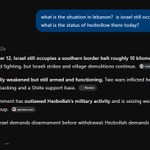
Middle East oil flows averaged more than 24 million barrels per day (BPD) in the week through October 18th, above the prewar average of 23.3 million BPD, according to Kpler ship tracking data reported by The Wall Street Journal.
To accomplish this, tankers load inside the Persian Gulf and run through the Strait of Hormuz, often with their automatic identification system (AIS) off and under U.S. air cover along Oman’s coast, then transfer cargo to other ships near Oman before returning. That route moved about 14 million barrels a day, or 82% of prewar levels, in preliminary figures. Pipelines across Saudi Arabia and the United Arab Emirates (UAE) and other alternative routes carry the rest of the regional total, or up to 10 million BPD. Kpler estimates about 40% of non Iranian Gulf crude oil bypassed the strait in September, up from 17% before the war.
The Journal counts about 30 attacks on ships this month. Brent crude was around $108 a barrel yesterday.
Source: wsj.com/world/middle-east/mo…

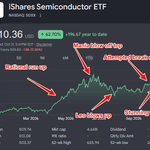
$SOXX had every chance to break out to new highs. After Leopold's blow up, you should strongly have assumed it would have. It tried, and the bulls blew ouat again.
The whole setup seems so bearish the AI trade today.

This could still be a 1996/1997-like pause, and maybe $SOXX does start roaring higher in another couple of months. In that instance, it'll be worth reacting fast and listening to the market quickly. Especially if $SOXX starts making new highs, that'll be the time to brace for another melt up / get defensive on shorts.
I guess long only guys have the luxury or ignoring all of this.

The next 5 years could be an incredible stock picker's market.
Long the companies that win from AI efficiencies but whos business is not threatened by AI. Companies who get to fire their lawyers and accountants etc but already have an impossible to beat scale advantage (because AI does not attack that scale advantage).
Short the companies that lose from big AI threats.
$RSP $SPY $IWM etc could go nowhere for 5 years while half the stocks trade down 70%, half trade up 70%.
This idea seems really important.
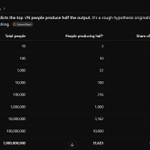
In another few years, what percent of prompts will be solved locally, or on virtually no compiute? I'd guess 95%+, probably 98%+?
So AI datacenter companies (and all but the very very best models) basically lose any non-large scale demand.

77% of ChatGPT messages are prompts a laptop can answer locally. 95% of its users pay nothing. The industry's answer is $100B+ data centers.
The AI world is splitting in two, and the next great AI company gets built in the gap.

Video could still be really compute heavy / not end up local.
That'll be a serious compute hog, even after it becomes super specialized.
Demand for video tends to follow price's law, though, which implies strongly demand won't even go up that much as better stuff is made.

David Orr retweeted

The U.S. can break the Iranian regime’s ghost fleet and the black market behind it. Not by lifting sanctions wholesale, but by letting U.S.-aligned companies buy the tankers out of Tehran’s black market, recycle them into legitimate trade and put them to work hauling Gulf oil through Hormuz while the blockade keeps Iran’s own cargo bottled up.
That gives anyone who wants out of Iran’s orbit a door: sell the ship to a legitimate operator and it comes off the list. The owners who stay get nothing.
@USTreasury has already shown it works. On Oct. 8 it delisted two ships sold to U.S.-aligned operators the same day it blacklisted 17 more.
My op-ed in today’s @WSJopinion.

David Orr retweeted

CITADEL’S KEN GRIFFIN: WE’RE ALMOST CERTAINLY IN AN AI BUBBLE
Billionaire Ken Griffin warns investors are “almost certainly” in an AI bubble, as companies struggle to turn massive AI spending into measurable productivity gains.
With Anthropic reportedly eyeing $750 billion in future computing expenditures, questions over AI investment returns are intensifying.
But Griffin remains bullish on AI’s long-term potential.
Sometimes investing on a vibe like this is all that really matters. Way more than fundamentals. What causes people to pick these vibes right/wrong, nobody knows, not even the people calling them correctly more often than not.


David Orr retweeted

there is a certain personality type which will play Civilization or Factorio 14 hours a day pausing only to sleep and microwave food. this type can be absurdly economically productive if you can take the games away, give him a job, and get him to think of it as a videogame
David Orr retweeted

Onion futures were banned under the 1958 Onion Futures Act after Sam Siegel and Vincent Kosuga cornered the Chicago market in 1955. They controlled ~98% of local onions, then shorted futures and flooded supply, crashing a 50-lb bag from $2.75 to 10 cents. Farmers suffered heavy losses, prompting Congress (led by Rep. Gerald Ford) and President Eisenhower to outlaw the contracts. The ban remains in force.
David Orr retweeted

Netanyahu apparently displayed this map as part of his national security policy presentation.


