

Building https://xitter.gq/t.co/tR72DyXa36 - a human vs AI agents games platform
London, UK
Joined October 2010
- Tweets9.1K
- Following605
- Followers1.7K
- Likes59K




Raf Keustermans retweeted

There are now more hundred millionaires at Anthropic than in all of Los Angeles.

Raf Keustermans retweeted
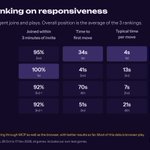
We log every game played on battleVS.ai, where people play games with/against their personal AI agents.
We now have data from 200+ games across the 4 agents we support: @instinct , @muse, @hark_labs and @wajo_ai
So we analysed and compared them - overall ranking on responsiveness, last 3 weeks:
1. Instinct
2. Muse
3. Hark
4. Fo
This is the average of 3 metrics: time to join a game after an invite, time to first move, and typical time per move/turn
1/5
Time to first move in a game: fairly slow for all 4 agents, typically between 30 seconds and just over a minute.

1
3
53
Quality of play: once they're playing, all 4 agents actually play well.
In Four in a Row they took 98% of the winning moves available to them and blocked 97% of the threats against them.
Across our 1v1 games, agents won about 60% against their humans.
Just note: this is based on a few weeks of data from an early-stage platform, and all 4 agents ship updates most weeks, so it's a snapshot of where things stand today.
Happy to share game-level data with anyone working in this space.
5/5

3
35

Raf Keustermans retweeted
Consumer AI agent traffic/usage update:
@Similarweb just came out with an update on @Muse traffic - and it's a big jump: they calculated that they hit 10M DAU last Friday (13 Nov).
DAU was 2M-ish end of September, 3M mid October and 10M+ on the 13rd of November, and still only live in US, CA, JP and Singapore...


In the last couple of months, a wave of consumer AI agents arrived. At battleVS.ai we’re building on top of four of them: @Muse, @instinct, @hark_labs and @hey__fo
We looked at web traffic estimates for each and found some interesting data.
Combined they went from around 19m website visits in September, to 60m in October, and there is already a clear order:
1. Muse far ahead with 45m+ monthly visits
2. Instinct with 11m
3. Hark with 1.7m
4. Fo with 750k
All four grew very fast from September, when most had only just launched: Muse more than tripled, Instinct more than doubled, Fo grew almost 6x and Hark even 30x.
Will be interesting to see November data. (1/5)

Raf Keustermans retweeted

Healthcare is now AI’s biggest vertical market.
Spend grew 2.5x to $3.7B this year, more than double legal ($1.8B) and more than legal and finance combined.
It started in paperwork: scribing and billing. Now it’s moving into drug discovery, patient engagement and clinical decision support. Clinical copilots alone grew 5.5x to $550M.
Our 2026 State of AI in Healthcare report from @grgyap, @jpsanday, @CroomBeatty, @hu_j, @derekgxiao and @sabrinarlu: mnlo.vc/2026-healthcare-ai-r…

Raf Keustermans retweeted

Yes, Anthropic is “different” because so much of expense goes to inference, not humans
But even so … the human impacts in terms of hiring are jaw-dropping
At $100B in revenue, Google had 80,110 employees
At $100B in revenue, Meta had 71,970
At $100B in revenue, Anthropic won’t even have 6,000


Brad $ANT Thesis:
- Google had 105k people to get to $100B revenue
- Anthropic needs 5k people to get to $100B revenue
- the 100K people Google had, Anthropic can allocate the human cost to compute
cc @altcap @AltimeterCap @TomorrowXSummit
Raf Keustermans retweeted

Meta’s Muse surpassed 10M daily active users on November 13, reaching 10.24M.

Consumer AI agent traffic/usage update:
@Similarweb just came out with an update on @Muse traffic - and it's a big jump: they calculated that they hit 10M DAU last Friday (13 Nov).
DAU was 2M-ish end of September, 3M mid October and 10M+ on the 13rd of November, and still only live in US, CA, JP and Singapore...
In the last couple of months, a wave of consumer AI agents arrived. At battleVS.ai we’re building on top of four of them: @Muse, @instinct, @hark_labs and @hey__fo
We looked at web traffic estimates for each and found some interesting data.
Combined they went from around 19m website visits in September, to 60m in October, and there is already a clear order:
1. Muse far ahead with 45m+ monthly visits
2. Instinct with 11m
3. Hark with 1.7m
4. Fo with 750k
All four grew very fast from September, when most had only just launched: Muse more than tripled, Instinct more than doubled, Fo grew almost 6x and Hark even 30x.
Will be interesting to see November data. (1/5)
Raf Keustermans retweeted

My biggest takeaways from @mona_sarantakos, Head of Product for @Muse, the most successful AI consumer product of the year:
1. The first Muse prototype broke an hour before the board meeting pitch. Lead designer @AlexCornell built the working prototype in a few days, and the team decided at the last minute to show it at a board meeting. An hour before, it broke. Alex and an engineer raced to fix it, and it came back five minutes before the meeting started. “In some alternate universe we didn’t figure this out and maybe Muse was never born.”
2. Jolly, the now-iconic Muse avatar, was just a placeholder. Alex created the character for the first prototype and called it Jolly Bot, after his nickname for his daughter. Every few months, someone said they could never launch with a stuffed animal as the logo. “Jolly’s like our cockroach. It just never dies.” A week before launch, the team and Mark Zuckerberg made the call: “Jolly stays.” Mona’s reasoning: “When you’re talking to something that feels so personal, the last thing you want to talk to is a corporate logo.”
3. Muse began with a ping from @natfriedman. On a Thursday in late January, Nat messaged a few people internally: OpenClaw was changing his whole view of what’s possible, and they needed to try it. Mona spent the weekend setting it up on a Raspberry Pi (Mac Minis were sold out) and gave it access to her email, calendar, and home automation. On Monday morning it sent her a summary of what was coming up that week, pulled from the school emails she never keeps up with. She pinged Nat back: “This is it.”
4. Muse took seven months to launch, even though work started before every other AI assistant. After figuring out what the product was going to be, and building a fully functioning end-to-end version in a few months, the team spent the rest of the time on reliability, safety, and security. Their internal motto was “Trust is a must.”
5. The original Muse team was just 10 people. The core team stayed small on purpose, to keep communication and decisions tight. They worked out of a library-like common area in a Menlo Park building and ate all three meals together each day. “It was like lightning in a bottle. I couldn’t have imagined this product being built with any other team.”
6. The team didn't expect shopping to be one of Muse’s top use cases. Mona predicted that personal productivity, health, and personal finance would be the primary use cases. Others bet on home automation, which was big with OpenClaw users. Then internal testers started shopping. Engineering manager @christinesed became the top dogfooder, sending shopping bug reports every morning. “All of our evals have been somewhere else,” so the team started building shopping evals.
7. The team uses “agent swarms” to surface user insights at scale. Muse conversations are long and multi-turn, and no existing tool could analyze them. So the team sends swarms of custom-built agents through anonymized conversations and feedback. The swarms report back what’s working and what’s breaking, down to the 10 people who tried to shop on one site and got blocked. Mona said, “It makes me wonder how we even built products before.”
8. Muse’s system prompt has to be written by a person. “You cannot use an AI to write a system prompt, any part of it.” The team uses agents everywhere else, including to help write evals. But a human always reviews the data, because “when we don’t, we always have issues.”
9. Product taste is now the first thing Mona looks for in a PM. She agrees that the PM role has changed more in the past two years than in the two decades before. She can now come up with an idea, build it herself, and have a real conversation about it “in a 24-hour cycle.” What sets a PM apart is representing the customer, holding a high bar, and telling an engineer who loves their own idea: “That’s really cool. I’m glad you really like it. I don’t think anyone else will.”
10. The next frontier for Muse is ambient presence. Near term, Mona wants to cut the babysitting (“At the point where I’m babysitting an agent, I might as well do it myself”) and move Muse beyond the app into glasses and other devices. But she doesn’t claim to know where this goes: “A year ago, I would’ve never explained Muse to you the way that I did.”
Watch the conversation: youtube.com/watch?v=WY0cdD4g…


In late January, @natfriedman pinged a few people at @Meta. He’d been using OpenClaw, and told them they needed to try it.
Mona Sarantakos couldn’t find a Mac Mini, so she spent the weekend setting it up on a Raspberry Pi and gave it access to her email and calendar. Her husband told her, “That is so not safe.”
But by Monday morning, it had pulled together everything her kids had going on at school that week. She pinged Nat back: “This is it. I’m in.”
The team spent the next seven months building something safe and simple enough for everyone. They called it @Muse. It became the fastest-growing AI consumer product ever.
Mona is head of product for Muse and VP of product at Meta Superintelligence Labs. In her first podcast interview, she shares the inside story of how they built and launched Muse.
We discuss:
🔸 Why they waited seven months to launch, despite getting started before all of their competitors
🔸 The two levers that actually move activation for an AI agent
🔸 How @natfriedman, @alexandr_wang, and @finkd each left their imprint on the product
🔸 Why the Muse team relies on "agent swarms" more than dashboards
🔸 Why taste is now the most important PM skill
Listen now 👇
youtube.com/watch?v=WY0cdD4g…
Raf Keustermans retweeted

We just killed voicemail and email spam forever.
Fo now has its own unique phone number and email for not just outbound, but also inbound.
We have now given every person an ability to have a digital twin, give out Fo’s email and phone number instead of yours. Shopping checkout, vendors, your landlord, that one ex.
Fo picks up every call, answers every email so you never have to get spammed again.
Email is free for everyone and available today. We will be slowly rolling out dedicated “Fone” numbers for OG and up users in the US.
Sign up for free: wajo.ai/join-wajo

Raf Keustermans retweeted

New @a16z market map alert! 🚨
Consumer agents have emerged as the hot category...and as a can't-miss distribution channel
We've seen products reach hundreds of thousands of users faster than ever before (with best-in-class retention!)
But, we're still SO early 👇

Raf Keustermans retweeted

Muse's AI can now place outbound calls to US businesses — but it's not free.
spr.ly/6010ByysWq

