
investor in equities and property,often the wrong side of history, generally tetchy and quick to judge, usually wrongly...also talks too much
Joined June 2012
- Tweets47.7K
- Following249
- Followers10.8K
- Likes142K





Rhomboid1🇺🇦 retweeted

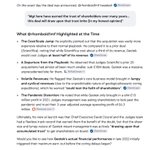
I’ve come to realise something about modern political disagreement following my appearance last year on BBC Radio 4’s Moral Maze to discuss Net Zero. The whole experience completely changed my perspective on politics and sent me on a massive intellectual journey, forcing me to examine deep philosophical assumptions and beliefs I had long taken for granted.
During the discussion, I found myself returning to two deeply held convictions that I had long taken for granted: that Western civilisation has been, on balance, a moral force for good in the world, and that the Industrial Revolution represented an enormous advance for humanity. Both convictions are rooted in the Anglo-American Enlightenment tradition, with its belief in reason, individual liberty, scientific progress and the capacity of human beings to improve their material circumstances. I believe this view of modern Western civilisation is now under serious threat from within (left- and right-wing populism, eco-pessimism and Islamism) and from without (revisionist powers such as China and Russia).
Following the debate, I came to realise that if you want to understand why intelligent people can disagree so profoundly about what ought to be done in life, it is often insufficient to examine their immediate political or policy arguments. You need to understand the deeper philosophical premises from which those arguments proceed, including their assumptions about the nature of reality, human nature, progress and what constitutes a good society.
I think this gets to the heart of what we mean when we talk about political polarisation and the so-called “culture wars”. People are not simply disagreeing about policies. Nor is it about “comms” or individual personalities.
Increasingly, we are operating from fundamentally different understandings of the world itself. Yet few politicians articulate the philosophical assumptions underpinning their vision of society. Take the nature of reality. Is it an objective order that we must discover and adapt to, or something we can shape through our will and values? These are the underlying questions in many of today’s debates, from transgender identity to energy systems and whether governments can override the laws of supply and demand.
Instead of telling us what they fundamentally believe and why, politicians jump straight to political positioning, tactical messaging and policy announcements, leaving voters totally confused. I think this contributes to the growing fragmentation of our politics, which technologies such as social media are accelerating by reinforcing competing worldviews and making it much harder for people to recognise, let alone understand, the assumptions from which others are reasoning.
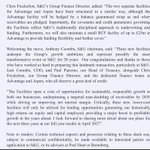
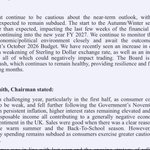
#SUS this looks transformative investegate.co.uk/announceme…
I’ve highlighted a really unusual paragraph…there’s perhaps some good news in the details they’re keen to share with friends

#SHOE cobblers ..investegate.co.uk/announceme…
..by which I mean I’d far rather invest in a good old fashioned cobblers business than a shoe importer/retailer given the challenging economic backdrop

Rhomboid1🇺🇦 retweeted

Why were Jonathan Powell, Peter Mandelson and Lord Hermer appointed without vetting?
The answer is that Chagos was a deal Starmer couldn't refuse to make.
Here's a timeline of the key stages of the Chagos treachery.
In 1982, after it became known that the Chagos seabed may contain vast mineral wealth, Mauritius set up a select committee to examine the matter.
However, sea-mining technology was in its infancy, and it was too expensive to be commercially viable at that time.
In 2003, as underwater mining technologies advanced and the value of minerals and rare earth elements soared, mining the Chagos seabed became an exciting possibility again; Mauritius appointed the eminent international barrister Sir Ian Brownlie as advisor for the Chagos Archipelago.
A former member of the Communist Party of Great Britain, Brownlie was a good friend of Sir Satcam Boolell, a former Labour deputy prime minister of Mauritius, and High Commissioner in London.
In 2009, Brownlie led the first Mauritius delegation to the Foreign Office in London seeking a Chagos deal.
Among the delegation was Sir Satcam Boolell's son Satyajit, who became Mauritius Director of Public Prosecutions the same year.
In 2010, after Brownlie died in a motor accident in Egypt, Sir Keir Starmer’s “great mate”, Philippe Sands, a leading human-rights lawyer who has publicly boasted of humiliating the UK in international courts, took over as counsel to Mauritius for Chagos.
In 2013, Satyajit Boolell invited Keir Starmer, whom he had become friendly with during Starmer's time as the UK's DPP, to a legal conference at the 5-star Balaclava resort in Mauritius.
During the trip, Starmer discussed the future of the Chagos Archipelago with then Mauritius prime minister Navin Ramgoolam.
After Starmer’s 2013 visit, Ramgoolam wrote that he and Starmer were aligned over Chagos.
In 2015, Ramgoolam was arrested on money-laundering charges when large sums of cash in foreign currencies, suitcases full of brand-new luxury watches, and blank British visas were found in his home.
Also in 2015, Starmer was elected to the British Parliament.
In 2019, Philippe Sands, after a campaign of lobbying the UN, obtained an International Court of Justice ruling (advisory opinion only, and non-binding) that the Chagos islands should be given to Mauritius.
Sands used the ICJ ruling as leverage in the following years in his efforts to persuade the Conservative government to give Chagos to Mauritius.
In 2020, Starmer became leader of the Labour Party.
In 2021, Sands received Mauritius' top honour, The Most Distinguished Order of the Star and Key of the Indian Ocean.
In 2022, Sands made an unauthorized entry into the Chagos Archipelago for a flag-raising ceremony. Sands tweets at the time, “It’s morning on Chagos, where the flag of Mauritius flies."
In 2023, Sands became a Mauritius citizen, but retains his British and French citizenships.
🧧In November 2023, David Cameron replaced James Cleverly as Foreign Secretary and, with the support of other senior Tories, stopped a Chagos deal saying, it’s not in the national interest, as reported in Hansard.
In July 2024, Starmer became UK Prime Minister and just ten weeks after entering Downing Street, he agreed a deal with Mauritius, despite there having been no mention of Chagos during the election campaign, and the Labour manifesto pledging to protect the BOT.
in November of 2024, Ramgoolam was elected Mauritius prime minister again after a snap general election, and took over from the incumbent PM, Pravind Jugnauth, to lead the Chagos negotiations with the UK.
In December 2024, after 14 years in the role, Philippe Sands steps down as Mauritius counsel for Chagos.
In January 2025, Attorney General Lord Hermer recused himself from signing off on the Chagos deal, and declined to say why.
In February 2025, Jugnauth was arrested on money-laundering charges after large sums of cash in foreign currencies and suitcases full of brand-new luxury watches were found in his home.
In May 2025, twelve years after discussing the future of Chagos in Mauritius, Starmer and Ramgoolam sat down in London to sign the treaty that transfers the archipelago's sovereignty to Mauritius.
The Fall Out.
The Chagos deal does🟥NOT secure the joint UK/US military base on Diego Garcia.
The deal operationally hobbles the base, and increases the dangers to the British and American military personnel, and the civilians who work there, and in the wider Central Indian Ocean region.
Diego Garcia's remoteness made it easy to defend in the past. This deal leaves the base horribly vulnerable to the growing threats posed by the new longer-range missiles, and more sophisticated and lethal drones.
When Keir Starmer, Lord Hermer and Vijay Rangarajan, the Director General at the Foreign, Commonwealth & Development Office, made the deal it was fully understood that the outer islands of the Chagos Archipelago were by far the best locations to deploy early warning, and air-defense systems, to protect the main base from missile and drone attacks.
Yet they still decided to lease only Diego Garcia.
Andy Burnham, Foreign Secretary Ed Miliband, and Defense Minister Wes Streeting, know the deal increases the dangers to the lives of British service personnel, and our NATO allies personnel, in the strategically important Central Indian Ocean region.
To double down and push the deal with that knowledge is a shameful act of betrayal.
While the deal leaves Diego Garcia vulnerable to attack, it also renders the base itself ineffective and operationally hobbled.
Mauritius is a signatory of the Pelindaba African Weapon-Free Zone Treaty which bans all nuclear weapons from treaty members' territory.
Pelindaba gives each of the more the 40 countries who have signed it the right to inspect the facilities on Diego Garcia if they suspect nuclear arms are being stored there.
The UK's nuclear-armed Trident submarines will no longer be able to enter Chagos waters, or visit Diego Garcia which is the only island in the region which has suitable anchorage and facilities for maintenance and restocking provisions, etc.
The US's nuclear-armed submarines, ships, and planes will also be banned from Diego Garcia and the Chagos Archipelago's waters.
Mauritius gets complete sovereignty over everything, including control of the airspace above the Chagos Archipelago, which at 250,000 square miles is the same size as France.
The implications of controlling such a vast area of airspace in a strategically vital region are huge.
Mauritius has shown it will ban planes entering its current airspace when China asks.
The Chagos Deal does not ‘secure the base’. It methodically destroys every element required for operations. The text and annexes state it will:
❌Constrain future Ops and use of the base
❌Prevent the placing of sensors and other maritime installations
❌Require us to sight our foes on defence planning
❌Mean we’re unable to use our preferred contractors
❌See us lose of control over electromagnetic spectrum.

Rhomboid1🇺🇦 retweeted

This post goes some way to explaining the dire financial straits the UK is in...
"Britain has almost run out of taxpayers, or at the very least, it’s slowly running out of people who pay enough taxes to plausibly finance the state."
"...in 1998, about 43 per cent of British earners paid sufficient tax to cover the Government’s average per-capita spending. During Covid, that figure fell to an absolute low of circa 20 per cent, then by 2025 recovered modestly to 26.6 per cent."
No wonder if fewer than 27% of people are net contributors to the state
It's stats like this that make me want to leave. Big new project in the US in the next few months might be just the springboard I need
@griffitha @LiamHalligan
open.substack.com/pub/ieains…

#BVXP this is both a fascinating and frustrating business investegate.co.uk/announceme…
actions taken now have effects years in the future & vice-versa
Not for me but I’m glad it exists as a listed entity


It's like they actually want everyone to leave. ...The HMRC letter asking rich people to reveal what they own
thetimes.com/article/1d92cd6…

Rhomboid1🇺🇦 retweeted

Bill Maher nails it on Britain’s welfare addiction here.
“The UK has had seven Prime Ministers in ten years. That’s because no politician can be what the people want: a genius who figures out how to give out endlessly more money with ever less working people.”
Rhomboid1🇺🇦 retweeted

In 1941, a Spaniard walked into the British embassy in Madrid and offered to spy on the Nazis.
The British turned him down.
So he went to the Germans instead, pretended to be a loyal fascist, and got hired as a German spy. His plan was to lie to them for the rest of the war.
It worked better than anyone could have imagined.
His name was Juan Pujol García. Before the war he had tried his hand at running a chicken farm and a movie theater. He had no spy training. What he had was a deep hatred of both fascism and communism after the Spanish Civil War, and an incredible imagination.
The Germans gave him a codename, invisible ink, money, and orders to go to Britain and recruit spies.
He didn't go to Britain.
He went to Lisbon, Portugal, and made everything up.
Using a tourist guidebook, maps, magazines, newsreels, and a British railway timetable from the library, he wrote long, detailed reports about life in England. Military movements. Morale. Ports.
He'd never been there. He made mistakes. He didn't understand British money. He once reported that dockworkers in Glasgow would do anything for a liter of wine.
The Germans loved him anyway.
Then British codebreakers reading German messages noticed something strange. The Germans were hunting for a convoy that didn't exist, based on a report from some agent in Britain they'd never heard of.
The British went looking for this mystery spy. They found Pujol. In 1942 they finally took him on and brought him to London.
Now he had real help. MI5 gave him the codename Garbo, after the actress, because they thought he was the greatest actor in the world.
Together with his British handler, Pujol built a fake spy network for the Germans. It eventually had 27 imaginary agents. Each had a name, a personality, a job, and a backstory. A Welsh nationalist. A Venezuelan student. A Greek sailor. Some of them recruited their own imaginary sub-agents.
When they needed to explain why one agent had gone quiet, they killed him off. They even put a fake obituary in a Liverpool newspaper. The Germans reportedly paid a pension to his widow.
Who also didn't exist.
Then came D-Day.
Hours before the landings, the British let Pujol send a message warning the Germans that the invasion was coming in Normandy. It was timed so it would arrive too late to matter, but it made him look brilliant.
Three days later he sent the most important message of his career. Normandy was a trick, he said. The real invasion was still coming, at Calais, led by a huge army under General Patton.
That army was fake too. But the Germans believed him.
German forces that could have been rushed to Normandy were held back near Calais for weeks, waiting for an attack that never came.
The Germans were so grateful they awarded him the Iron Cross.
A few months later, King George VI made him a Member of the Order of the British Empire.
He's one of the only people known to have been decorated by both sides of the war.
After the war, afraid of revenge from surviving Nazis, he faked his own death from malaria in Africa and disappeared to Venezuela, where he lived quietly running a shop.
For decades the world thought he was dead.
In 1984, a British writer tracked him down. Pujol came back to Normandy for the 40th anniversary of D-Day and met veterans who had landed on the beaches.
Some of them thanked him.

there’s no such thing as a bat free cave…just a temporary exemption subject to an annual comprehensive bat survey from an authorised Batman or Batgirl …so leasehold only I’m afraid


#HUD pioneering new levels of utter toss
investegate.co.uk/announceme…
I prefer the original TBF


#CAM this gloriously anachronistic value trap continues to outperform on asset sales…but yet again fails to deliver a return on an operating basis.
Given the group’s breadth & scale surely at some point they might make money from agricultural activities…if only by accident

Rhomboid1🇺🇦 retweeted
According to @thetimes, @neso_energy CEO Fintan Slye who earned just under £1 million last year admitted he knew about the control room concerns but failed to act on them saying Neso may have incorrectly prioritised other things at a time when there was a “huge amount of change happening in the organisation”
How does the Times know this?
Because somebody inside NESO recorded the meeting and gave it to the press
Clearly NESO staff have lost confidence in their execs and have no issues embarrassing them in public
Although it's fair to ask why Fintan didn't make his mea culpa public himself. Perhaps he simply didn't want to admit either to getting it wrong or to allowing the focus on CP2030 and keeping the government happy to get in the way of keeping the grid secure
There's a clear public interest in knowing this so I hope Fintan and NESO don't respond to this by trying to hunt the people who made and released this recording
The more productive approach would be to repair trust with staff, listen to and act on their concerns over grid security, and ensure cultural change so future concerns can be raised and acted on internally without staff feeling they have no options other than to leave or go to MPs and the media
@Miatsf @mgshanks @AndrewBowie_MP @ClaireCoutinho @harrietc @ColinMoynihanUK @drlukeevans @ashley7fox @TiceRichard @cmackinlay @DavidGHFrost @mattwridley @Iromg @AllisonPearson @MerrynSW @EdConwaySky @afneil @mattotele @jonathan_leake @julietsamuel @energygovuk @ofgem
thetimes.com/uk/environment/…

Developing anything at scale in London and the South East is becoming increasingly challenging
Q if affordable housing is a high priority surely this scheme is better than..?
Soaring build costs and affordable housing stand-off derail planned 2027 start constructionenquirer.com/202…

#MSI I very astutely tucked away a few of these at c.£2 a share….attended the AGM with @RanmoorRuffian and @vodkaquickstep and concluded management were somewhat uninvestable..albeit with a certain charming non conformity on display & duly sold at c £2.20
Investing is hard work

#SDI an excellent appointment imho…an ex holding of mine that seems to have regained it’s footing

#HDD I’m proud to say I spotted this turnaround v early
Obviously I’d didn’t bother buying any even as a side pocket speculative trade.
Congrats to all those involved

#SDG I believe a shake up here is in order

#SDG Vote approaching.
Retail shareholders will hold the key to the outcome.
Please vote FOR the two resolutions.
lbvam.com/assets/news/LBV-SD…

Rhomboid1🇺🇦 retweeted
Yesterday various reports into grid security and NESO governance around 23 June were published
@neso_energy and @mgshanks immediately seized on the statement by Eversheds that its "investigation has not substantiated any of the allegations”. Shanks said there was "no evidence" to support the allegations which is plainly not what Eversheds said nor what the report contains
At every turn, Eversheds took the most generous interpretation possible to NESO's benefit. Areas of concern were repeatedly identified and not followed up with rigour. A lack of evidence was taken as evidence to the contrary despite obvious limitations to the investigation process in terms of independence (Eversheds was appointed by NESO) and anonymity (some witnesses eg the Power System Manager would be easily identifiable to NESO staff and senior execs, potentially limiting what they would be willing to say)
Eversheds identified that important logs were not kept in the week of 22 June, despite engineers having identified ahead of time that risks would be elevated. Yet they did not explore why, or check that the reports had not been either deleted or simply withheld from them
They identified the possibility of mobile phones being used to pass on undue influence from the Corporate Affairs team but only checked the phone records of the PSM, not their line manager or other more senior people - yet elsewhere it mentions a manager coming to the control room when a demand control warning was being considered and when they left it was no longer being considered - a senior manager could speak by phone or in person to Corporate Affairs and pass on the concerns in person to the PSM - there is no evidence Eversheds considered this despite identifying the pieces of the puzzle
Eversheds identified significant weaknesses in record-keeping, a culture of reputational sensitivity, concerns that staff were not listened to by senior management, and uncertainty about whether the correct operational escalation procedures had been followed on 23 June
It also recorded that five network constraints had been breached with no available pre- or post-action mitigation options, with confusion about whether the largest loss was covered, and even what the impact of a single fault would have been
NESO admitted in its interim report to Ofgem that 5 grid constraints were breached despite having strongly suggested to the press that they had not
It also said that on 23 June it had taken “all available and commercially accessible” balancing actions while frequency remained significantly below its normal operating range despite automatic frequency response services responding to prevent further falls
So what reserve was left, and why was it not deployed? If reserves were not available or commercially accessible then they would be useless – did NESO retain enough usable reserve to cover the largest loss or not?
Anyone that thinks these reports exonerate NESO and that concerns over grid security can be dismissed is dreaming. The reports show there is no room for complacency. In my blog I list about 20 risks to grid security which ought to give readers an idea of the range of threats it faces
The question is whether anything will be done about it. @ofgem still expects NESO to mark its own homework, something other regulators of safety critical systems do not do
If the conclusion when the final reports come in is that the grid wasn't secure then there will be serious questions for both Ofgem and NESO to answer about the self-reporting process because the only reason the issues surrounding 23 June have been investigated at all was because @ClaireCoutinho stood up in Parliament TWICE and sounded the alarm (with due credit to the whistleblower who approached her in the first place)
#EnergySecurity
@Miatsf @AndrewBowie_MP @HarrietCross_MP @ColinMoynihanUK @drlukeevans @Ashley7Fox @TiceRichard @cmackinlay @DavidGHFrost @mattwridley @Iromg @AllisonPearson @MerrynSW @afneil @EdConwaySky @mattotele @Jonathan__Leake @CitySamuel @energygovuk
watt-logic.com/2026/10/20/ne…

Rhomboid1🇺🇦 retweeted

I run an apprenticeship & skills bootcamp provider
So I’m much more qualified to talk about this than anyone.
The model is simple, funded by the government we train people in areas like Marketing, Software Development & Business.
We are paid when we deliver the 12 week programme and paid again when these individuals get a positive out come.
Classed as a job, promotion or pay rise.
Average cost per person on programme is £4,000.
To be clear the government fund this. They only pay on successful outcome.
No completion of course = NO PAYMENT
No job = NO PAYMENT
We delivered over 1000 people on this course in 2024.
AS SOON AS LABOUR CAME TO POWER
FUNDING STOPPED.
I’ve added the share price of @northcoders who are a similar business with a similar model.
The share price since labour has got to power has collapsed.
Labour are not serious about reversing the direction of NEETs. I have dwelled on this for a number of years. Wondering when funding would come.
This year alone, funding has reduced 75%.
To practically 0.
The conclusion I have come to, which is deeply harrowing for our nation is that the current government would rather individuals stay on benefits than train them and help them get a job.
That is my deepest reflection on being in this industry for 5 years.
It makes me feel every announcement they make is empty promises.
There is an infrastructure of training providers across the country who are (like us) wanting to support training young people and help them get jobs.
But right now, this government has no interest in doing this.
This has been what has turned me against everything announcement they make - because the reality is always different.


Exclusive:
Britain is facing an “economic catastrophe and moral failure” because a generation of young people is being written off to a life on benefits, the prime minister has said
Writing in The Times Andy Burnham said that the time has come for Britain to “invest in the success of our young people” rather than “pay for failure through the benefits system”
Setting out his vision for the fundamental reform of welfare, he said the present scheme provided “an assessment, a payment and, after that, a goodbye”, with no support, skills or help getting a job
In future, Burnham promised, the government would offer a “clear guarantee” of support, starting in schools, to address the almost one million 16 to 24-year-olds not in education, employment or training, known as Neets
Every young person would be guaranteed a technical pathway, work placements, apprenticeships and the skills they needed to find a job
However, he cautioned that this would be matched by an expectation that young people would take up the opportunities available to them. He added that under the new system, benefits would become a “backstop” rather than the “starting point” for young people.
thetimes.com/uk/politics/art…
