



Rick retweeted

SpaceXAI hires engineers at $132K-$195K a year because they know how to build agents nobody has to double-check
In a free 1-hour workshop, she shows exactly how she got there
step 1 → give the agent a skill to test itself - no more guessing, it runs the real app
step 2 → hand it a map of the whole product - now a vague bug report is enough
step 3 → test the skill like code - grade blind copies before trusting the real one
step 4 → let it fix bugs unsupervised - a cloud agent reproduces and ships the fix itself
step 5 → stop running one agent, run a crew - a planner, a coordinator, workers that ship while she sleeps
SpaceXAI calls this architecture "Dune"
Most engineers still review every PR their agent opens
At SpaceXAI, eight in ten already run a crew of ten agents or more
The crew isn't what got her here - five months of banning shortcuts in the codebase did
The workshop is free. The architecture took five months to build
Bookmark it before you build agent eleven
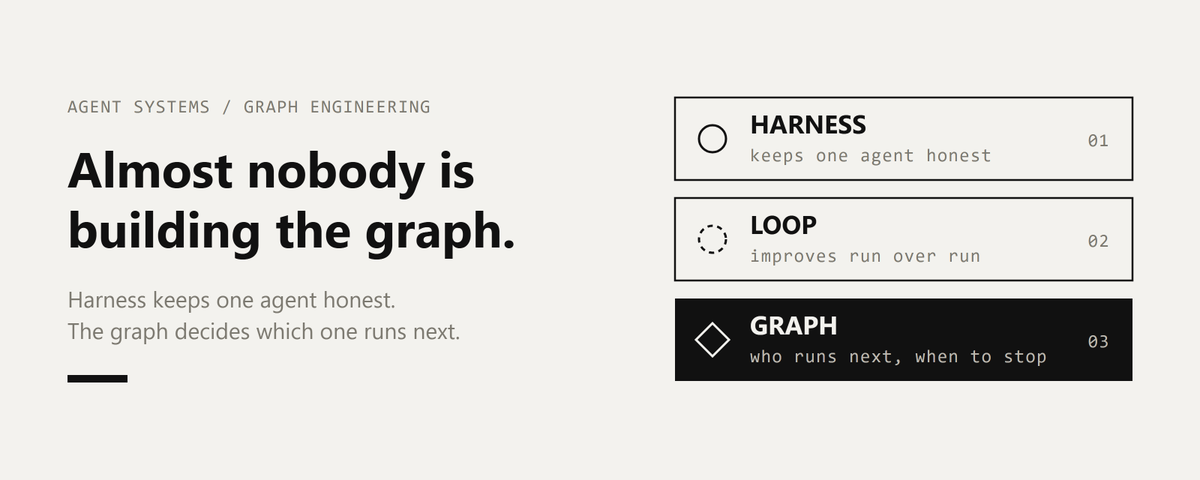
The graph underneath a crew like hers is what I broke down today, below ↓

Rick retweeted

Don’t spend 2 years trying to become an AI agentic engineer in 2026.
Andrew Ng has put together a complete 1-hour roadmap to help you understand AI agents from the ground up.
• 00:00 – AI agent fundamentals
• 12:12 – Agentic workflows & design patterns
• 53:27 – Practical tips for building AI agents
• 1:20:30 – Self-improving agent loops
• 1:30:19 – Multi-agent AI systems
I watched it recently, and it made the path feel much simpler.
You don’t need years to get started.
Save this, watch the course, and start building your own AI agent.

🚨 BREAKING NEWS!
The engineer behind Claude Code just released a 28-minute video showing how to write prompts that actually produce better results.
It covers CLAUDE.md files, memory shortcuts, parallel sessions, and prompting techniques that most people still aren’t using.
I’ve seen $300 courses that don’t provide this much practical value.
And the best part?
It’s completely FREE. No fluff.
If you use Claude or want to get better results from AI, this is definitely worth watching.
Save it. Watch it. Share it.
Rick retweeted

INSTEAD OF WATCHING NETFLIX TONIGHT. Spend 2 hour with this. Claude AI FULL COURSE that teaches you how to BUILD and AUTOMATE anything. The people who watch this tonight will wake up tomorrow with a new skill. Watch it and bookmark it now.


Rick retweeted

Just finished this book - Bad Therapy by @AbigailShrier
This is one of the most eye-opening books I've ever read. It's a must read for any parent, any teacher, and should be required reading for any school administrator as well.
The book dives into trying to figure out why kids are having so many mental health problems, when there are so many resources devoted to improving mental health outcomes.
Anxiety, depression, suicide, etc are all higher than they've ever been with kids, even though their lives are arguably better than ever before. It just doesn't make sense.
A few key takeaways from the book:
A constant attention on how kids are "feeling" or "thinking" is causing negative outcomes.
Constantly ruminating on your emotions and how you feel negatively impacts your mental health. If all you do is focus on your emotions, you are destined to be anxious or depressed.
We incessantly ask kids how they're feeling, if they're happy, how their mental health is, etc, and this is creating kids who think they're fragile instead of resilient.
Trying to solve every problem for kids has caused a generation who can't do anything for themselves.
We (Gen X) were told to "suck it up" or "you'll live" or "rub some dirt on it" all the time. Many of us came to the conclusion this is "bad parenting" because our feelings were neglected, and we vowed not to do this to our own children.
Because of that, kids immediately over-dramatize everything that happens to them, making mountains out of molehills, and thinking the world must revolve around their emotions and feelings.
You develop confidence and strong mental health by doing things, not by thinking or via therapy.
You can't think your way out of anxiety. You don't gain confidence by analysis of your thoughts or mental health issues.
You gain confidence and eliminate anxiety by doing gradually more difficult tasks, excelling at them, and realizing you are a competent, capable person.
The non-stop attention therapy gives to these small, common emotions we all feel blows them out of proportion to their seriousness (not talking about genuine disorders here, just normal anxieties that millions of people go to therapy to try to avoid).
One of the best ways to decrease your happiness is to chase it.
Our society constantly tells kids they should be "happy" and asks them if they are.
Happiness isn't a state you should be in 24/7. That's not realistic. Joy and bliss aren't permanent states - they are fleeting.
Contentment, stillness, and being even-keeled are much better goals to aim for mentally.
The happiest, most well adjusted kids come from families with loving parents that have strict rules for the household.
This one really set off the confirmation bias in me... I feel really blessed we have 2 well adjusted middle school kids who do great in school, are very respectful and well mannered, and we barely even need to parent them.
But for years, we were very strict with them. Bedtimes, family rules, how we do things, etc. The in-laws and lots of friends thought we were totalitarian.
In reality, we just had high standards. And it's really paying off right now. I found it really interesting that strict rules equals happy kids. Makes sense, though, as kids need to know what their boundaries are.
Constantly surveying school-age kids about their mental health causes more issues than it solves.
Mental health resources is big money. Districts need to validate all the resources allocated towards mental health, and they often do that via surveys.
Asking kids non-stop questions like:
- Have you thought about self harm?
- Have you thought about suicide?
- Have you been so anxious you can't get out of bed?
Etc, etc puts into their heads the idea that themselves, or many of their peers are broken and cannot function properly in the real world.
It normalizes situations that would be incredibly rare at any other time in history.
There's a lot of other takeaways, too, but I'll stop there.
It's a fantastic book. Go pick it up and read it. This isn't an affiliate thing or a promotion thing at all. I just really enjoyed it, and it will further shape the way I parent moving forward.

Rick retweeted

Forget LinkedIn!
LinkedIn isn't your golden ticket for remote work.
Here are 13 websites that pays in USD for remote jobs:
[🔖 Bookmark for later]


Rick retweeted

❄️Good morning, BC motorists! Snowfall has returned to several parts of #BritishColumbia, including the #Coquihalla and #RogersPass.
Remember, winter tires are required on most #BCHwys. Look for a 3.5mm+ tread & "M+S" or snowflake/3-peaked mountain symbol❄️/🏔️.
#ShiftIntoWinter


Rick retweeted

Buy Apple stock, not iPhones
Have you ever thought about how much money would you have if you bought Apple stock instead of a new phone every year?
The figure above shows how much money you would have if you invested in Apple stock only once, for each year of the iPhone's release.
If every year instead of buying a new iPhone, you spent its value on Apple stock, you would have $143,600 worth $AAPL today

Rick retweeted
The infatuation of @elonmusk with the name X.com goes way back. Here are some excerpts from my upcoming book, amazon.com/Elon-Musk-Walter-…
"When his cousin Peter Rive visited in early 1999, he found Musk poring over books about the banking system. “I’m trying to think about what to start next,” he explained. His experience at Scotiabank had convinced him that the industry was ripe for disruption. So in March 1999, he founded X.com.
His concept for X.com was grand. It would be a one-stop everything-store for all financial needs: banking, digital purchases, checking, credit cards, investments, and loans. Transactions would be handled instantly, with no waiting for payments to clear. His insight was that money is simply an entry into a database, and he wanted to devise a way that all transactions were securely recorded in real time. “If you fix all the reasons why a consumer would take money out of the system,” he says, “then it will be the place where all the money is, and that would make it a multitrillion-dollar company.”
Musk was able to entice the influential head of Sequoia Capital, Michael Moritz, to make a major investment in X.com. Moritz then facilitated a deal with Barclay’s Bank and a community bank in Colorado to become partners, so that X.com could offer mutual funds, have a bank charter, and be FDIC-insured.
One of Musk’s management tactics, then as later, was to set an insane deadline and drive colleagues to meet it. He did that in the fall of 1999 by announcing, in what one engineer called “a dick move,” that X.com would launch to the public on Thanksgiving weekend. In the weeks leading up to that, Musk prowled the office each day, including Thanksgiving, in a nervous and nervous-making frenzy, and slept under his desk most nights. One of the engineers who went home at 2 a.m. Thanksgiving morning got a call from Musk at 11 a.m. asking him to come back in because another engineer had worked all night and was “not running on full thrusters anymore.” Such behavior produced drama and resentments, but also success. When the product went live that weekend, all the employees marched to a nearby ATM, where Musk inserted an X.com debit card. Cash whirred out and the team celebrated.
One driver of growth was a feature that they originally thought was no big deal: the ability to send money by email. That became wildly popular, especially on the auction site eBay, where users were looking for an easy way to pay strangers for purchases.
[After a merger, with a company cofounded by Peter Thiel and Max Levchin, the company became known as PayPal.] "Musk insisted that the company’s name should be X.com, with PayPal as merely one of its subsidiary brands. He even tried to rebrand the payment system X-PayPal. There was a lot of pushback, especially from Levchin. PayPal had become a trusted brand name, like a good pal who is helping you get paid. Focus groups showed that the name X.com, on the contrary, conjured up visions of a seedy site you would not talk about in polite company. But Musk was unwavering, and remains so to this day. “If you want to just be a niche payment system, PayPal is better,” he said. “But if you want to take over the world’s financial system, then X is the better name.”
Levchin and Musk soon clashed on an issue that sounded technical but was also theological: whether to use Microsoft Windows or Unix as the main operating system. Musk admired Bill Gates, loved Windows NT, and thought Microsoft would be a more reliable partner. Levchin and his team were appalled, feeling that Windows NT was insecure, buggy, and uncool. They preferred using various flavors of Unix-like operating systems, including Solaris and the open-source Linux.
One night well after midnight, Levchin was working alone in a conference room when Musk walked in primed to continue the argument. “Eventually you will see it my way,” Musk said. “I know how this movie ends.”
“No, you’re wrong,” Levchin replied in his flat monotone. “It just isn’t going to work in Microsoft.”
“You know what,” said Musk. “I will arm-wrestle you for it.”
Levchin thought, correctly, that this was the stupidest imaginable way to settle a software-coding disagreement. Plus, Musk was almost twice his size. But he was loopy from working late hours and agreed to arm-wrestle. He put all his weight into it and promptly lost. “Just to be clear,” Levchin told him, “I’m not going to use your physical weight as any sort of a technical decision input.”
Musk laughed and said, “Yeah, I get it.” But he prevailed.
[Musk told me, even before he took control of Twitter, that he planned to rebrand it X.com and to try to make it a platform that would fulfill his original vision from 1999. A passage from later in the book:]
In the days leading up to his takeover of Twitter at the end of October 2022, Musk’s moods fluctuated wildly. “I am very excited about finally implementing X.com as it should have been done, using Twitter as an accelerant!” he texted me out of the blue at 3:30 one morning. “And, hopefully, helping democracy and civil discourse while doing so.” He said that he would turn it into the combination of financial platform and social network he had envisioned twenty-four years earlier for X.com, and he added that he planned to rebrand it with that name, which he loved. A few days later, he was more somber. “I will need to live at Twitter HQ. This is a super tough situation. Really bumming me out :( Sleep is difficult.”
Here is Musk with Peter Thiel and the X.com card in 1999, and celebrating with Pappy van Winkle, @pappyvanwinkle , the world's best Bourbon, on the day he bought Twitter:


Rick retweeted

We are excited to share that we have received the FDA’s approval to launch our first-in-human clinical study!
This is the result of incredible work by the Neuralink team in close collaboration with the FDA and represents an important first step that will one day allow our technology to help many people.
Recruitment is not yet open for our clinical trial. We’ll announce more information on this soon!
Rick retweeted
I’m excited to share the trailer for Working. In this series, I talk to American workers across various industries – from hospitality and technology to home care – to understand their jobs and hopes for the future. I hope you’ll check it out on @Netflix on May 17.
Rick retweeted

Halftime Show Super Bowl LVII
xitter.gq/i/events/1623025570127…


Rick retweeted

My parents were the only people to fly from South Africa to Australia in a single engine plane. You can see the tip of the plane’s wing in the photo of Angkor Wat.


Angkor Wat; a temple complex in Cambodia and is largest religious monument in the world. It was built in late 12th Century CE, by Khmer empire.
#archaeohistories