
Research Scientist at Xyme interested in Bayesian machine learning for biotechnology applications & causality. Previously a postdoc at Imperial College London.
London
Joined December 2020
- Tweets28
- Following135
- Followers62
- Likes8



Ruby Sedgwick retweeted

Active testing enables label-efficient model evals but can be computationally expensive.
We show how to reduce costs and scale up to LLMs.
arxiv.org/abs/2508.09093
Work led by Gabrielle Berrada. Find her at EurIPS, or @janundnik and me at NeurIPS in San Diego.

Ruby Sedgwick retweeted

Causal inference assumes a known graph, but what if you're unsure about the structure?
In our #NeurIPS2025 work, we show how to compute interventional distributions from (observational) data, taking structural uncertainty into account.
📜Paper: arxiv.org/abs/2507.05526
🧵1/10

Ruby Sedgwick retweeted
There’s a lot of confusion around uncertainty in machine learning.
We argue the "aleatoric vs epistemic" view has contributed to this and present a rigorous alternative.
#ICML2025 with @janundnik @eleanortrollope @markvanderwilk @adamefoster @tom_rainforth
1/5

Excited to be presenting this work at ICML!
Our Bayesian method allows for causal discovery using more flexible assumptions that better reflect real-world data.
Come chat to us: Tues 4:30pm East Exhibition Hall A-B E-1912
Paper: arxiv.org/abs/2411.10154


📢New #ICML2025 paper: "Continuous Bayesian Model Selection for Multivariate Causal Discovery".
We propose a Bayesian causal model that allows for scalable causal discovery without restrictive model assumptions.
Paper: arxiv.org/abs/2411.10154
Code: github.com/Anish144/Continuo…
🧵1/14

2
144
Check out the paper here: arxiv.org/abs/2402.09122
Was a pleasure working with @james_ac_odgers, Chrysoula Kappatou, Ruth Misener, and Sarah Filippi on this project! If you are interested in knowing more, we’d love to hear from you.
27
We demonstrate this approach on a synthetic test case, a spectroscopy dataset and oil flow data. Compared to baselines like inverse linear model of coregionalisation, classical least squares and partial least squares, WS-GPLVM achieves competitive or better performance.
1
31
This means not only do we get predictions of the component weights, but also a measure of uncertainty in these values. The Bayesian component weights and latent variables make the calculation of the evidence lower bound more challenging, and we show how this can be done.
1
12
At the core of this approach is the idea that each pure signal depends on a latent variable, and these signals combine linearly. We also treat the component weights in a Bayesian way, allowing for the inclusion of useful priors, such as summing-to-one.
1
11
This variability makes the separation task much harder. Most existing methods assume fixed pure signals. We introduce WS-GPLVM - a Bayesian nonparametric model that relaxes those assumptions.
1
11
Take spectroscopy for example: following Beer-Lambert’s law, the observed spectra is a linear combination of the spectra of the pure components, but these pure component spectra vary depending on experimental conditions.
1
9
In many real-world datasets, each observation is a mixture of underlying signals, with no observations of the pure signals. Think: chemical spectra, audio sources, hyperspectral images.
But what happens when the pure signals vary between samples due to some unobserved variables?
1
9
New paper at #AISTATS2025:
Weighted-Sum of Gaussian Process Latent Variable Models (WS-GPLVM)
We tackle a core challenge in signal separation where pure components vary nonlinearly across samples using latent variable Gaussian processes.

1
2
48
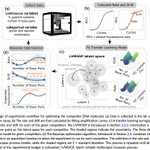
We're excited about how transfer learning can reshape experimental workflows in biotech, cutting costs and time. Big thanks to Prof Dame Molly Stevens, @RuthMisener, @markvanderwilk, and @BioGoertz. Interested? Drop me a message or read here: doi.org/10.1002/bit.28854 (10/10)

1
98
Our method isn't just for DNA design; it could also apply to other bioengineering challenges where data is limited but tasks are related. (9/10)
1
72
The key takeaway: By leveraging data from previous tasks, we can design new DNA sequences more efficiently, even when experimental data is limited. (8/10)
1
20
The key advantage of LVMOGP? It captures nonlinear relationships between tasks, making it especially effective when working with small datasets—common in biology. (7/10)
1
17
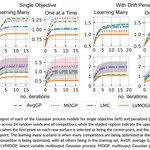
We found the Latent Variable Multioutput Gaussian Process (LVMOGP) performed best, offering more accurate predictions with less data and requiring fewer experiments for optimising DNA sequences. (6/10)

1
31
Our approach compares different multi-ouput Gaussian process models, like the MOGP, LMC, and LVMOGP, assessing how they transfer knowledge between DNA design tasks to improve predictions. (5/10)
1
24
The study focuses on optimising competitor DNA molecules for a PCR-based diagnostic assay, where precise control over DNA amplification properties is key to accurate measurements. (see: biorxiv.org/content/10.1101/… for more details on the application) (4/10)

1
22