
Previously: Research Scientist @UCBerkeley • Postdoc @MIT_CSAIL @MIT • PhD from @SCSatCMU @CarnegieMellon • Generative AI and RL 🤖
Berkeley, CA
Joined March 2010
- Tweets388
- Following649
- Followers1.2K
- Likes2.3K





Siddharth Ancha retweeted

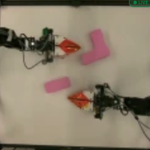
13/17 — Open-loop
Revisiting Open-Loop Execution in Robotics: Toward Reactive, Higher-Performing Policies
With real-time chunking, longer history came out ahead on our robots.
@michzeng_, Abhinav Agarwal, Ajay Bati, Brian Lee, @siddancha, @RussTedrake


Siddharth Ancha retweeted

When we first started working on Diffusion Policy, which felt like an "unlock" for fitting human demonstration data, the explanation I gave myself was that "human demonstration data was subtly much more multimodal than we thought, so we need the modeling power of denoising diffusion to fit it properly."
What Michael's paper brings to light is that some of this multimodality was probably exacerbated (more than I realized) by the fact that we've only been giving our models incredibly short observation context lengths.
For me, this is pretty compelling evidence that we should be pushing for policies with long-context lengths and short action prediction horizons.

Action chunking — especially executing long action sequences open-loop — is widely used in imitation learning for robotic manipulation. Why is it so effective and do we really need it? We find a key reason:
Long open-loop execution helps short-context policies imitate non-Markovian experts.
With this insight, we show how to move beyond open-loop execution: extending policy context restores reactivity while achieving even higher task performance.
🧵(1/5)
Siddharth Ancha retweeted

boston dynamics uses mjlab btw :)

Siddharth Ancha retweeted

F2D2 is accepted at #ICLR2026 ! To celebrate, we have added a new JAX codebase & new results w/ Lagrangian self-distillation in camera-ready! Check them out on our project page: kellyyutonghe.github.io/f2d2…
P.S. I will present F2D2 Apr 23 10:30 AM – 1:00 PM P3-#1911, see yall in Rio🇧🇷

Diffusion/Flow-based models can sample in 1-2 steps now 👍 But likelihood? Still requires 100-1000 NFEs (even for these fast models) 😭
We fix this! Introducing F2D2: simultaneous fast sampling AND fast likelihood via joint flow map distillation.
arxiv.org/abs/2512.02636
1/🧵

Siddharth Ancha retweeted

⚠️Public Service Announcement for ICLR folks headed to Rio: Rio is beautiful, but getting a travel adapter in Brazil is a pain in the ass, and they don't use similar outlets to other major regions (US, UK, Europe, China). Buy a Brazil-specific adapter before traveling. Enjoy :)
Siddharth Ancha retweeted

Deformable manipulation has long stalled simulation adoption. SoftMimicGen reduces this barrier with 4 embodiments, scalable data generation, and proven sim-to-real results.
Check out Masoud’s thread below for more!

Simulations scale for rigid objects, but deformable objects remain an open frontier.
SoftMimicGen generates large-scale training data from just a handful of demonstrations.
softmimicgen.github.io
Siddharth Ancha retweeted

good take actually
this popular tennis ball machine costs $10k, usually bought by a tennis center and rented per hours to members
meanwhile the robot is only twice that price. i bet you could charge 2x more per hour for a ball machine that actually plays full points!


OMG it's finally here! Humanoid lawn tennis!!! 🤖+🎾
zzk273.github.io/LATENT/
I have a feeling that robot tennis/table-tennis will be the first successful consumer application of humanoid robots even before they start doing household chores.
Siddharth Ancha retweeted

Coming soon to mjlab: heterogeneous worlds, aka every world gets its own object 👀
Siddharth Ancha retweeted
Powered by MuJoCo Playground 🙂
OMG it's finally here! Humanoid lawn tennis!!! 🤖+🎾
zzk273.github.io/LATENT/
I have a feeling that robot tennis/table-tennis will be the first successful consumer application of humanoid robots even before they start doing household chores.
Siddharth Ancha retweeted

State-of-the-art robot policies often need hundreds of hours of data. What if we needed none?
Introducing TiPToP: a manipulation system that zero-shots open-world tasks from pixels and language using vision foundation models and GPU-parallelized Task and Motion Planning (TAMP).
Siddharth Ancha retweeted

There’s a discussion going on rn about two recent robotic reward models: TOPReward⛰️ and Robometer🌡️
Which one is better? It depends entirely on your objective!
Here is a deep dive into the conceptual differences, strengths, and weaknesses of both. 🧵👇

Siddharth Ancha retweeted
Super grateful to be invited for the talk and very excited to meet with everyone next month!

Excited to announce our workshop on flow-based generative models at CMU:
Frontiers of Flows for Generative AI
March 26-27, Pittsburgh PA
cmu-l3.github.io/flows2026/
We have an amazing lineup of featured talks, panel discussions, and lightning talks. Registration is now open!


Siddharth Ancha retweeted

Some exciting takeaways in addition to Brent's post:
• We show flow policies working for sim2real humanoid locomotion & motion tracking without distillation or shortcut models.
• The same recipe works for both from-scratch RL and BC → RL fine-tuning for manipulation---no bells and whistles.
Code will be released: github.com/amazon-far/fpo-co…


New project! Flow Policy Gradients for Robot Control
tldr; a simple online RL recipe for training and fine-tuning flow policies for robots
co-led w/ @redstone_hong: hongsukchoi.github.io/fpo-co…
Siddharth Ancha retweeted
mink 1.0.0 is out! You can now enforce tasks as strict QP equalities. One neat application is "locking" certain DoFs. In this example, joints 1 & 2 of the Panda are locked when the cube is red and then unlocked when it turns green.
Siddharth Ancha retweeted

Interesting name “Harmonic Reasoning” — Indeed, orchestrating asynchronous, multi-frequency, continuous-time streams of sensing and action is what makes robot learning challenging and unique.
It’s great to see more learning architectures designed specifically to address these properties, rather than simply relying on a network built for other domains, such as vision or language.

Siddharth Ancha retweeted

Consistency models, CTMs, shortcut models, align your flow, mean flow...
What's the connection, and how should you learn them in practice?
We show they're all different sides of the same coin connected by one central object: the flow map.
arxiv.org/abs/2505.18825
🧵(1/n)


Siddharth Ancha retweeted

🚀 First demonstration of learning-accelerated trajectory optimization in space! Our team used a neural network to warm-start trajectory optimization for the @NASA's Astrobee free-flying robot on-board the @Space_Station, cutting solver iterations by up to 60% while maintaining safety constraints.
🎥 Video: youtu.be/NVDMd88XFhs
📄 Paper: arxiv.org/abs/2505.05588
📅 Submitted to iSpaRo 2025
With @SomritaBanerjee and @ACauligi