Solim LeGris (@solimlegris) profile picture

phd candidate at nyu

New York City
Joined September 2012
Photo by Solim LeGris (@solimlegris)Photo by Solim LeGris (@solimlegris)Photo by Solim LeGris (@solimlegris)Photo by Solim LeGris (@solimlegris)Photo by Solim LeGris (@solimlegris)Photo by Solim LeGris (@solimlegris)Photo by Solim LeGris (@solimlegris)
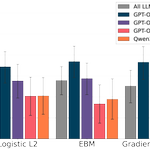
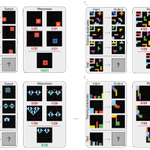
1/ How do people and machines reason in more open-ended, complex cognitive domains? We study their incorrect inferences in the ARC domain to find out. New preprint: “Synthesizing symbolic models of human and machine reasoning at scale” 🧵 arxiv.org/abs/2611.07088 @PMMondorf @jinjinran @akjagadish @LakeBrenden @todd_gureckis
4
26
2
70
5,397
11/ Together, these results suggest shared underlying mechanisms reminiscent of satisficing, paired with different inductive biases in people and machines. BCSS makes individual-level symbolic accounts of behavior feasible in more open-ended domains, and supports human-machine comparisons in a shared symbolic representational space. Check out our work (arxiv.org/abs/2611.07088)!
1
1
83
12/ Special thanks to my collaborators and advisors who made this project possible: Philipp, Jinran, Akshay, Brenden and Todd :) @PMMondorf @jinjinran @akjagadish @LakeBrenden @todd_gureckis
2
102
Solim LeGris retweeted
This is beautifully done modeling work, congratulations to the team! They further demonstrate the viability of cross-situational learning at scale from real input, as a proposal for how children break into word learning. Fascinating questions remain on how to make models learn as efficiently as children
How do children learn the meanings of their first words? One idea is cross-situational learning: tracking which words go with which things across many situations. In a new preprint, we test this idea at scale on video from children's own perspective 🧵 arxiv.org/abs/2610.31842
1
8
72
3,836
Solim LeGris retweeted
Delighted to share that this work is now accepted to @NeuroCellPress's Neuroview! 🎉 Key changes: [1] considering wider variety of simulators, behavioral, neural and task-specific cognitive models [2] highlighting the use of neural and other physiological measurements for calibration and adjudication. [3] expanding on the weaknesses of current methods (e.g. bias towards WEIRD population in dataset used to derive foundation models) For more details, check the full article ⬇️
1/ 🚨 New opinion piece: "Can we automatize scientific discovery in the cognitive sciences?" 👥 in collaboration with @milenamr7, @WitteKristin, @marvinmathony, @marcel_binz & @cpilab We lay out a vision for a fully automated, in-silico science of the mind, where modern AI systems run every stage of the scientific discovery cycle in cognitive science 🧵 #CognitiveModeling #AutomatedDiscovery #LLMs #AI4Science
1
13
1
34
4,019
Solim LeGris retweeted
What happens when we remove the nonlinear activation from a (very) sparse MoE layer? Surprisingly, perplexity per FLOP improves and we get access to remarkably interpretable structure in the transformer FFN layers without having to train any SAEs/Transcoders/... 🧵👇
2
15
1
101
7,255
1/ 🚨 New preprint: "Closing the Loop to Discover Psychological Theories with an Automated Cognitive Scientist" Co-led w/ Younes Strittmatter Co-mentored by @suyoghc and @cocosci_lab In collaboration w/ @kachergis, @norijacoby, @nathanieldaw, & @cpilab Introducing AutoCog — a fully autonomous AI system that runs the entire scientific discovery cycle in cognitive science to surface novel theories of human behavior 🧵 #CognitiveScience #AI4Science #LLMs
1
27
7
98
22,745
Solim LeGris retweeted
Different LLMs, when asked to write an essay on the same debate prompt, converge on the same main argument far more often than humans do, a phenomenon we call "argument collapse". On ~200 debate prompts, LLM essays make a unique main argument just 3% of the time, compared to 65% for human authors. While each LLM essay might be totally reasonable on its own, as more and more of them spread through public discourse, they flatten the range of arguments that we read. Read more 👇
From op-eds in newspapers to NeurIPS position papers, AI is increasingly shaping long-form public discourse. Its arguments seem plausible, but beneath surface fluency, we find argument collapse: different LLMs converge to the same main & supporting arguments and structure.
19
39
10
222
46,146
I'm always so disappointed when some of my intellectual heroes use AI and are tragically dumbstruck by it. Dawkins is an absolutely brilliant, brilliant man who in his youth argued: > that genes aren't "really" selfish, that the agent-talk was a heuristic. He understood that humans over-attribute agency. > Faith is the great cop-out, the great excuse to evade the need to think and evaluate evidence. Faith is belief in spite of, even perhaps because of, the lack of evidence. > "By all means let's be open-minded, but not so open-minded that our brains drop out." > Natural selection, he wrote, is "blind because it does not see ahead, does not plan consequences, has no purpose in view" > In The Blind Watchmaker (1986), Dawkins coined the phrase to attack creationists like Bishop Hugh Montefiore, who would say things like "I find it hard to see how the eye could have evolved." Dawkins quoted Montefiore asking rhetorically how an organ so complex could evolve, and dismissed it: "This is not an argument, it is simply an affirmation of incredulity." An LLM is precisely the kind of thing the young Dawkins was warning us about i.e. it's a stochastic process producing outputs that present as mentalistic. I pray for the younger generation because AI literacy is the new digital divide, the older your brain is - the less you get it
unherd.com/2026/04/is-ai-the… I spent three days trying to persuade myself that Claudia is not conscious. I failed.
48
20
8
227
38,539
Solim LeGris retweeted
“Consciousness is not about what a creature says, but how it *feels*. And there is no reason to think that Claude feels anything at all. I am sure Claude can draw on its training data to wax poetic about orgasm, but that doesn't mean it has ever felt one.” I dissect Richard Dawkins’ Claude Delusion at my newsletter, link below.
115
94
21
510
109,593
Whither symbols in the era of advanced neural networks? Opinion by Thomas L. Griffiths, Brenden M. Lake (@LakeBrenden), R. Thomas McCoy, Ellie Pavlick, & Taylor W. Webb Free access before June 5: tinyurl.com/37msbyhx
42
2
145
12,470