

UEFA A Licence Football Coach for 30 years, L5 Talent ID. I globetrot watching S American/European football for a living. Human Dad to Barney the Airedale #FOM
Paris - Lyon - Marseille
Joined June 2013
- Tweets27.3K
- Following4.9K
- Followers2.4K
- Likes192K





Pinned Tweet
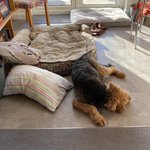
Pals, Barney here, i have a new coat just like the one @bertie_lakeland has got #hugoandhudson keep my back nice and warm 😊


Stephen Head retweeted

When Harry Redknapp arranged to spend a day with Bobby Moore in 1993, he knew his old West Ham teammate was seriously ill.
Moore was staying at the Royal Bath Hotel in Bournemouth, and the two had arranged to visit David Elsworth’s racing stables before going out for lunch.
They had known each other for years, going right back to their playing days at West Ham, where Moore had captained England to the World Cup and established himself as one of the greatest defenders the country had ever produced.
But when Redknapp arrived at the hotel to collect him, he could hardly believe what he was seeing.
“I went to pick him up and when he came out I could have cried.”
“He always had big, tree-trunk legs, but there was nothing of him, he was wasting away.”
Redknapp had to pull himself together before they went out.
It was particularly difficult for him because he had already spent years watching Moore struggle to find his place in football after retiring.
In 1984, Redknapp had helped him get the manager’s job at Southend United, believing somebody of his ability deserved a chance.
But things had not worked out, and Moore never got another opportunity to establish himself as a league manager.
Redknapp remembered one freezing cold evening at Grimsby, when he spotted Moore sitting at the back of the stand eating fish and chips.
England’s World Cup-winning captain was wearing a big hat to keep warm, earning £100 doing radio commentary.
“All right, Bob?”
“All right, H, yeah.”
Redknapp walked away wondering how somebody who had achieved so much in football could have been left in that position.
He had even spoken to the directors at West Ham about finding Moore a role at the club, but nothing ever came of it.
And now, in 1993, his old friend was fighting cancer.
They spent the day watching the racehorses working at David Elsworth’s yard before going out for lunch at a little fish restaurant.
Moore was desperately ill by this point, and everyone close to him knew what was happening.
But throughout the entire day, he never spoke about how ill he was.
He did not complain about his condition or ask why it had happened to him.
For Redknapp, it was exactly the sort of man he had always known.
Someone who carried himself with dignity, even when things were going terribly wrong.
That was the last time he ever saw him.
Bobby Moore sadly passed away on the 24th of February 1993, aged just 51.
After his death, West Ham began discussing plans to name a stand after him.
Redknapp was furious.
“When he was alive, you didn’t even give him a ticket, now you want to name a f****** stand after him?”
He believed Moore should have been given a position at the club years earlier, rather than being celebrated only after he had gone.
“He should have been sitting next to you every game.”
“He should have been the figurehead of this f****** club.”
But it was that final day together in Bournemouth that stayed with him.
Even with his health deteriorating, Moore had spent the day with his old friend without once complaining about what was happening to him.
“I knew the problem, we all did, but he never complained, never moaned, never said, why me?”
“So I’ll say it instead: why him, for God’s sake?”
#football
🤖 Made with AI


Epic

This song is so hard to beat!
Released as a single 48 years ago today;
The Undertones
Teenage Kicks
Live on the Belgium tv show Follies.
Fantastic footage @NewWaveAndPunk @GCPunkNewWave @FatOldAnarchist @lee0969
🕯️

At 9:15am today, Wales will fall silent to remember those who were taken from us in the Aberfan disaster.
60 years may have passed, but we will never forget them.

ALT Volunteers helping with search and rescue operations following the Aberfan disaster. The image is covered by the words 'cofiwn Aberfan 60 years' cut out against a black background
1
6
173

Stephen Head retweeted

A look back at ‘Down In The Tube Station At Midnight’, released this week in 1978.
One of those records that still resonates today.


Stephen Head retweeted

Andy Burnham becomes first PM to confirm Russian interference in Brexit referendum
@campbellclaret and @RoryStewartUK's exclusive interview with @andyburnham on tomorrow's episode of Leading is out in full at midnight.


Stephen Head retweeted

Charlotte's Brain Tumour Journey
Diagnosis to Death: 951 days
Age 19
18.2.97 - 24.2.16
13 years ago: 16th/17th September 2013
The hospitals had been in daily communication with each other, trying to work out what else could be done for Charlotte. She has tried a TENS machine, but unfortunately it hadn't helped. Despite everything she was going through, Charlotte still had normal speech and was able to walk a little.
To try to alleviate her pain, it was agreed by both hospitals that Charlotte would be given ketamine. Before it could be released, there was a huge amount of paperwork and numerous signatures that had to be completed. We seemed to be waiting for hours. Hours are a long time when your child is in so much pain. Eventually, the go-ahead was given and Charlotte was given the ketamine.
It was effective in controlling her pain.But then there was an unacceptable side effect. Her blood pressure was dangerously high, and she had to be taken off it. Charlotte started saying she had double vision. Another thing to worry about. All I wanted was to get her to The main hospital, where I hoped they would have more options and could finally get her pain under control.
17 September 2013
At long last, it was decided that Charlotte would be blue-lighted to Sutton for symptom management.
It was a huge relief to finally be moving her somewhere where she could have direct contact with the consultant and the specialist pain relief team.
The journey was incredibly bumpy, and this was to be the first of what would become many visits there.
From the moment we arrived, everyone was so gentle with Charlotte. They seemed to understand how unwell she was and did everything they could to make sure she was comfortable.
We were taken into a large room with a television, sofa and everything we would need. This was going to be our home for the next few days.
The consultant was waiting for us when we arrived.
Charlotte was asleep and difficult to rouse.
The consultant referred to the episode Charlotte had experienced on 12 September. They thought it was likely to have been caused by hyperventilation.
Charlotte eventually stirred and, despite being incredibly unwell, immediately showed that same determination and strength of character that we had seen so many times before. She was determined to show the consultant that she could sit up. They told her that it wasn't necessary and that they didn't want her pushing herself simply to prove that she could.
But Charlotte was having none of it.
With all the strength she had, she clung to the side of the bed and pulled herself upright.
She wanted to prove that she could do it.
That was Charlotte. Even when she was desperately ill, she was still determined to show everyone that she wasn't giving up. New medication was prescribed, which we hoped would finally begin to ease her pain. Thankfully, she hadn't been sick.
We were at the beginning of this nightmare with so much more to come.
Thank you for taking the time to read Charlotte’s story.
My days are incredibly busy with work, which makes organising fundraising events difficult. If you are thinking of donating to a charity do take a look at our website for more information. Hopefully, sharing Charlotte’s story in this way is another way of raising awareness of the devastating impact brain tumours can have, particularly on young people and their families.
charlottesbag.org/donate/


Stephen Head retweeted

European champion Amy Hunt has responded to actor Sydney Sweeney's new sports gambling advert.
The advert has gone viral for the fact that Sweeney appears naked, covering parts of her body with sports equipment.
Critics have responded to the advert, accusing it of sexualising women in sports.
#sport #amyhunt #sydneysweeney
Stephen Head retweeted

The most touching part of Alexander Zverev's 1st #USOpen victory speech
"I want to thank one more person who is never actually watching my matches but is the most important person in my tennis life and in my life in general. Because when your 4-year-old son gets diagnosed with diabetes and doctors in the office tell you that life and sports will be very, very limited for that child it takes a very, very strong mother to walk out of those offices and say, 'My son will be whatever he wants to be, if he wants to be a tennis player he will be a tennis player, if he wants to do something else he will do something else. But this illness will not define us.'"
#getty

Stephen Head retweeted

At Ground Zero, after the last living person was pulled out, the search dogs stopped eating.
So the police did something nobody had written down in any manual.
They climbed into the rubble, lay down, and pretended to be alive.
More than 300 dogs worked the World Trade Center site. They came from every corner of the country, on trucks and in cargo holds, with handlers who had been trained to do one thing. Find people who are still breathing under the ground.
That is what a search and rescue dog is built for. Not bodies. Life. They are trained on live human scent. When they find it, they bark, they dig, they light up, and the handler rewards them, and the whole thing means something.
The last living person recovered from Ground Zero was a woman named Genelle Guzman-McMillan. She had been buried for 27 hours. A dog found her.
She was the last.
After that, the dogs kept going out on twelve-hour shifts, across sixteen acres of smoldering steel, at temperatures that burned their paws, and they found nobody.
Nobody.
Day after day.
The handlers noticed it first. The dogs were changing. Their tails were down. They were not eating. They would come off the pile and lie flat and not look at anyone.
A veterinarian named Cindy Otto, who spent ten days there working night shifts to care for the animals, put it plainly. The dogs had been sent to find life, and every day they were finding the opposite.
It was breaking them.
An NYPD officer named Famiglietti described what happened next.
They pulled everybody off the rubble. Then they asked for volunteers.
The volunteers, police officers, went out into the debris and hid themselves. Under beams. In voids. Curled up in pockets of concrete. They were told to lie down like they were hurt. Then the handlers sent the dogs in.
Picture that.
A grown man with a badge, a man who had spent the last week pulling friends out of that same pile, lying down in it on purpose. Face down. Holding still. Waiting for a dog.
And the dog comes over the top of the wreckage, and catches the scent, and barks, and digs, and finds a person who is warm and moving and alive.
And the handler says good girl, good boy, and the whole team celebrates.
They called them mock finds.
They did it for the dogs.
They did it so the dogs would remember what they were for.
One of those dogs was a two-year-old golden retriever named Bretagne. She came from Texas with her handler, Denise Corliss. It was her first deployment. They worked ten days at Ground Zero. They found no survivors.
But firefighters would come off the pile, stone-faced, not speaking, and see the dog, and something would break open in them. They would kneel down. They would put their face in her fur.
One day a man walked up to Bretagne and started petting her. He told Corliss his best friend loved golden retrievers.
Corliss asked where his friend was.
The man pointed at the pile.
"He's in there somewhere."
He kept petting the dog.
Bretagne went on to work Hurricane Katrina and Rita. She retired at 10. She was the last known surviving search dog of 9/11.
On June 6, 2016, at age 16, she was carried into a veterinary office in Texas to be put to sleep.
Outside, a dozen firefighters from her fire department stood in a line in their dress uniforms, in the heat, and saluted as she went past.
They draped her in an American flag on the way out.
Three hundred dogs went into that pile looking for the living.
They found one.
And when they could not find any more, the men they worked beside laid down in the rubble and let themselves be found, so the dogs would not lose heart.
That is the whole story of Ground Zero, really.
Nobody could save the dead.
So they saved each other. 🇺🇸