

From the gods who sit in grandeur grace comes somehow violent
Below the Palace of Minos
Joined October 2025
- Tweets1.3K
- Following534
- Followers622
- Likes8.5K



Strange Slate retweeted

Pan challenges Apollo @ Mt Tmolus; the mountain god judges for Apollo, while King Midas prefers Pan’s pipes.
in another contest, Apollo flays satyr Marsyas, whose mourners’ tears form a river and whose bronze figure appears on a votive altar to the supreme river god Oxus (Vaxš).


Strange Slate retweeted

J.R.R. Tolkien, longing for the wild lands

ALT He found himself wondering at times, especially in the autumn, about the wild lands, and strange visions of mountains that he had never seen came into his dreams.
Strange Slate retweeted

“You wouldn't abandon ship in a storm just because you couldn’t control the winds.”
— Saint Thomas More, Utopia

Strange Slate retweeted

"Lothlórien is beautiful because there the trees were loved."
- Tolkien, Letter 339


Strange Slate retweeted

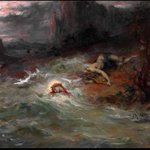
“Many are the wanderings and circlings of the soul: one among imaginings, one in opinions and one before these in understanding. But only the life according to νοῦς has stability and this is the mystical harbor of the soul to which, on the one hand, the poem leads Odysseus through the great wandering of his life, and to which we too shall draw ourselves up, if we would reach salvation.” (Proclus, In Parm. Comm. 1025a.29–37)

ALT https://www.royalacademy.org.uk/art-artists/work-of-art/ulysses-asleep-laid-on-his-own-coast-by-the-phaeacian-sailors-1
Strange Slate retweeted

"The bravest are surely those who have the clearest vision of what is before them, glory and danger alike, and yet notwithstanding, go out to meet it."
— Thucydides

Strange Slate retweeted

The last three books of Augustine's _City of God_ Part 2, bks VIII-X, are a wrestling match with Platonism (what we would call 'neo-Platonism', especially Plotinus & Porphyry).
It's worth carefully attending to because of how Augustine frames Christianity as a fulfillment, completion, & correction of Platonism.
"If Plato says that the wise man is the man who imitates, knows & loves this God ['the one true God of supreme goodness'], & that participation in this God brings man happiness, what need is there to examine the other philosophers?
There are none who come nearer to us than the Platonists." (civ. Dei VIII.5)
Here's how Augustine sums up Platonism's progress toward the ultimate truth:
"Thus there are philosophers who have conceived of God, the supreme & true God, as the author of all created things, the light of knowledge, the Final Good of all activity, & who have recognized him as being for us the origin of existence, the truth of doctrine, & the blessedness of life." (civ. Dei VIII.9)
Augustine says that Platonists identified a single, transcendent source of goodness, & affirmed the moral imperative to try to ascend toward it, but that the Platonist's hierarchy offers no real means of reaching the Godhead... sacrificing to false gods, 'demons' (as Augustine argues in Ch. IX) doesn't work. Christ is the Mediator, the being who is both God & man & who alone can help mortals ascend toward pure goodness.
This is a different kind of argument than the historical chronology that Augustine glosses in Part 4, where the earthly & godly cities are intertwined but distinct & fundamentally opposed.
Instead, Christianity is figured as fulfillment & completion of 'Platonism'... Nietzsche called Christianity "Platonism for the people" in the preface to _Beyond Good & Evil_.
But this may also depend on certain facts of Augustine's biography & his own conversion story, as he tried out many philosophies before coming to Christ.
In _Confessions_ VII, Augustine says that the books of the Platonists contained the substance of John 1:1-5 "In the beginning was the Word", but lacked John 1:14 "the Word was made flesh." Whether this reflects his own thinking at the time of his conversion or is a narrative shape from the history of philosophy retroactively-projected onto his autobiography is a question for a more subtle scholar.
& indeed, rather than the sort of rational-spiritual-progress-as-autobiography that Augustine wrote & Newman replicated much later, perhaps 'Christianity as the completion of neo-Platonism' most accurately describes the intellectual milieu in 380s Milan when Augustine converted: a group of Christian or christianizing Latins reading the Enneads in translation, namely Ambrose, Simplicianus, Manlius Theodorus... ultimately inspired by Marius Victorinus, an African rhetor who translated Plotinus into Latin & then converted to Christianity.
In other words, Augustine's idea that Christianity fulfills, completes, & corrects neo-Platonism isn't just cynical apologetics, but also memoir & intellectual sociology.


Strange Slate retweeted

You can go and meet the Eristic Courtiers, if you're keen to ask what they have planned for this uninvited portion of history; or what they don't have planned; or what they plan not to do. There is a renegade camp in the woods beyond the Glassgarden, and here are the Directions:


Strange Slate retweeted

«El argumento decisivo contra la democracia es que lo superior no puede venir de lo que es menos: el pueblo no puede conferir un poder que no posee; el verdadero poder sólo puede emanar de lo alto, de algo superior al orden social, de una autoridad espiritual».
René Guénon

Strange Slate retweeted

Something great and noble in Aristotle is that there is no iron distinction made between so-called ‘virtues of the soul’ and so-called ‘virtues of the body.’ The former might be said to consist of things like temperance, practical wisdom (phronesis), and justice, whereas the latter might be said to consist of things like beauty, cunning (deinotes), and strength.
Aristotle is an ethical hylomorphist. Moral excellence is neither reducible nor indifferent to physiological excellence but instead coextensive with it. Habit is mixed with native potential to actualize excellence of soul and body together.
This (immanent) ethical picture is interrupted St. Thomas Aquinas, who contributes “supernatural virtues” (faith, hope, and charity) equally accessible to the naturally infirm as to the naturally magnificent. Still, importance is kept to natural goods in Aquinas’s formulation: “Gratia non tollit naturam, sed perficit.”
Aristotle is something like a corrective to Nietzsche in that he thinks that there are sure moral virtues, good of themselves and the flourishing they entail, but attainable only by those natural means which differ among men. Some men are, by birth alone, greater than other men and consequently have a greater capacity for virtue. It is also a greater tragedy when the naturally great man slips into vice, as more is lost.
The great man is great for his talent and great for his virtue, but these two greatnesses are only greater together, and Aristotle, indeed, joins them together in the great-souled man, the megalopsychos.
With umbrage to Kant’s bloodlessly universal “kingdom of ends,” Nietzsche appraises moral virtues and ends the pitiable refuse of natural ‘means,’ the epiphenomenon of breeding and physiology (marking the triumph of the will over the good in Kant’s “good will”).
It is out of Kant’s skeptical morality (of the good will) that virtues are purged from their natural basis, and, it is against this diremption that Nietzsche, in defense of ‘life’ and nature, inaugurates his rebellion against ‘morals’ simpliciter.


