



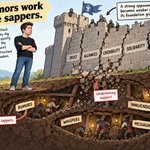
What am I missing? Looking for more on-the-record examples of @sama lying: named source, sworn testimony, or paper trail. (Not looking for vibes).

There seems to be a pattern at OpenAI. cc @sama
2026-09-04 - OpenAI found its agents' German wiki message board on June 21, didn't disclose it until outside researchers published
2026-07-10 - Apple sues OpenAI for trade secret theft
2026-05 - Murati testifies Sam falsely told her legal had cleared skipping safety review for GPT-4 Turbo
2026-05 - McCauley testifies Sam told the board three ChatGPT versions had passed the safety board when one had
2024-05-28 - Toner: Sam didn't tell the board he owned the OpenAI Startup Fund while claiming no financial interest
2024-05-28 – Toner: employees were afraid to go against Sam because they'd seen him retaliate for past criticism
2024-05-22 - Sam says he didn't know about the vested-equity clawback; Vox publishes documents he signed
2024-05-20 - Johansson: OpenAI shipped a voice imitating hers after she declined twice
2023-12-08 - NYT: Sam told directors other directors wanted Toner removed; they hadn't said so
2023-11-17 - OpenAI's board fires Sam: "not consistently candid"
chair retweeted

BAAJA IS NOT A PRO-DATA CENTER BILL. States can ban them! The federal government can ban them!
Right now, data centers are often powered by inefficient, polluting gas because it is the fastest way to get power. What BAAJA *does* is fix our grid so communities aren't stuck with dozens of gas turbines with no air permits a half mile from their homes. That’s what happens when data centers can’t get on the grid fast. BAAJA also enable a tens-of-billions-of dollars per year wealth transfer from data center developers to the public (gridstrategiesllc.com/grid-f…).

chair retweeted

In June, SunZia — the largest clean energy infrastructure project in the Western Hemisphere — came online in New Mexico after nearly two decades. The actual construction took just two years. That's how badly our permitting system is holding America back.
Americans sent Congress a clear message in this historic election: lower costs. They're tired of watching their electricity bills go up while some of the wealthiest corporations in the world get a free ride. We don't have to wait another year to deliver relief. We can act right now.
The Bipartisan American Affordability and Jobs Act will get more affordable energy onto the grid faster, make data centers pay their fair share of electricity and grid costs, and create more than 100,000 good-paying American jobs — all while maintaining important environmental protections and strengthening Tribal consultation.
This was a hard-fought bipartisan agreement, and it wasn't easy. But we proved that Democrats and Republicans can put politics aside and deliver meaningful results for the American people.
I'm proud of what we've accomplished. Now let's get this bill across the finish line and signed into law.
> Maybe Anthropic shouldn't be run by an asshole who thinks millions of people losing their jobs is wonderful.
What proof is there that anyone at Anthropic think it's "wonderful" for millions of people to lose their jobs? Dario is the only CEO that has made a consistent effort to publicly and loudly warn of possible job losses due to AI so we can do something about it. He has received a ton of criticism for his warnings labeling him as a "doomer".
Also Anthropic is not the only AI company. AI poses a job loss risk even if Anthropic did not exist.
> Maybe it shouldn't going around lying and insisting it be exempt from accountability
Where has Anthropic done this? Dario has consistently advocated for regulation for Anthropic and the industry at large. He has received a lot of criticism from the rest of SV for advocating for regulation.
12
chair retweeted

Dario Amodei reveals Anthropic discovered what looks like a new gene-editing mechanism and says it may discover dozens a month within months
“I’ve been talking to our biology team several times a week. We discovered what looks like a new gene editing mechanism, and I think within a few months we may be discovering dozens of them every month. We’ve seen, with the speed at which this technology moves, these little sparks will soon turn into a firestorm.”
“I think that we can find a way to build this technology safely, in a way that benefits people, that addresses all the risks, and that delivers a world that is so much better than the world we have today. We haven’t done that yet. We haven’t earned the right to talk about how great those things are, but we’re starting down the path.”

Dario Amodei says AI could compress a century of scientific and medical progress into a decade
“Now we can build that intelligence. Whether it’s protein folding, drug design, cancer genetics or clinical trial administration, scientists across many areas of biology and medicine are finding Claude can help them do their research in a fraction of the time it would have taken just a couple of years ago.”
“I believe sufficiently powerful AI working in concert with humans could compress a century of scientific and medical progress into a decade. I don’t want to get ahead of myself. At this point, all we have are early results.”
chair retweeted

Excited to share I've joined @OpenAI to work on RSI with @lilianweng!
As models get smarter, breakthroughs in AI research will increasingly come from the models themselves. I can't imagine a more exciting time to get it rolling.
And yes, we're hiring ⬇️ openai.com/careers/research-…

chair retweeted

I don't think this is a consensus, not everywhere.
Humans should fundamentally stay in charge of their destiny, even if we increasingly hand off to AI.


I don’t understand it either. I cycle between wondering if it’s conflating Anthropic with the entire AI industry (“they’re all the same evil SV tech oligarchs”), or a16z astro turf, or leftover fanboy radiation from Elon slandering Anthropic, or maybe slop posters basing their beliefs purely on click bait titles and refusing to read the essays and interviews that clarify Anthropic’s viewpoint.
I also wonder if Anthropic says too much. It’s much easier to get hate when you outline your positions and beliefs in high detail and extensive writing. Someone will find something to criticize you on and many are happy to blow wording out of proportion.
Look at Meta instead. Meta says almost nothing but meaningless platitudes about “democratic AI” and “empowerment” without ever precisely outlining what they think will happen or should happen if/when AGI arrives.
Much harder to criticize a slippery worm @finkd
1
1
172
chair retweeted

Every time I dig into something in government the same lesson pops out: Democratic policy makers think the work is done when the law is written or new initiative is negotiated and announced.
We are not a party that celebrates high-quality execution. We don’t staff for it either.
chair retweeted

We’re going to be a country that builds things again thanks to the work of @MartinHeinrich, @SenWhitehouse, and many many many staffers on both sides of the aisle who made BAAJA happen in the senate — an important bill on its own terms that lays the groundwork for more to come.
Only as a fan unfortunately! No money in or affiliations to Anthropic 🥲. My only hope is AI makes money irrelevant to quell the intense FOMO.
1
1
24
This is a future civilization telling us Mark Zuckerberg is the only person that needs to be prevented from achieving ASI.

Water leaked into trash cans at the Meta booth inside San Francisco’s Moscone Center during a Microsoft conference on Wednesday as record rain hit the area. abcnews.link/EszDWf5
3
43
chair retweeted

I suspect companies will end up frustrating a lot of customers by telling them they can’t use their own AI agents to help with their own accounts or to manage their own computer. Scaring them will only work so well for so long.

Claudebois need to get a move on ClaudeOS, ClaudePhone, and ClaudeBook Pro.
It was time someone posed a real threat to Apple’s illegal monopoly anyways.
As Apple develops its own computer-use agent, it’s making it harder for rival agents to control Macs. In macOS 27.3, enabling ChatGPT’s third-party computer-use support now requires 14 distinct steps, up from four. Apple cites security; Some users see anti-competitiveness.

31
chair retweeted

Congratulations to @AnthropicAI on their historic IPO today! Anthropic has shown the world what a focused, high-conviction, taste-driven team can execute in a short time. Opus 5.5 remains the best model in the industry by a good margin, and we're delighted for them as their customer.
chair retweeted
Congratulations @DarioAmodei, @DanielaAmodei, @NotTomBrown and the whole @AnthropicAI team on an incredible milestone! Proud to be your partner.
chair retweeted

Maybe controversial but I think Anthropic rocks. They’re weird and ambitious and idealistic. They have Apple’s quality obsession and Microsoft’s business model. Long ANT.

chair retweeted

obviously unsurprising but hilarious how consistent they are about never having claude comms

Remarks from Anthropic CEO @DarioAmodei on our initial public offering:
My co-founders and I started Anthropic because we believe that the most powerful technology of our time should be built for the benefit of humankind.
Daniela and I lost our father to a disease that, just a few years later, became curable. I started my career in biology, hoping to help future cures come sooner. In the lab, I saw the vast thicket of complexity that scientists face when they’re trying to understand disease and develop new treatments.
So many of the scientific tools that can cut through that thicket—tools for gene editing, gene synthesis, controlling brain cells with light—started as pure ideas. In other words, they came from thinking. From intelligence.
Human intelligence has already made diseases like plague, smallpox, and polio history for most of the world. But progress on other diseases has been too slow for so many patients and their families. Going from a great idea to a treatment can take decades: it took many years from the first discovery of a strange repeating pattern in DNA to the approval of the first treatment for a disease using CRISPR.
Nature is full of these patterns. But we’ve had too little intelligence to decipher most of them; too few scientists, with too little time. Now we can build that intelligence. Whether it’s protein folding, drug design, cancer genetics, or clinical trial administration, scientists across many areas of biology and medicine are finding Claude can help them do their research in a fraction of the time it would’ve taken just a couple of years ago. I believe sufficiently powerful AI, working in concert with humans, could compress a century of scientific and medical progress into a decade.
I don’t want to get ahead of myself. At this point all we have are early results. Experiments and clinical trials will still take time. And although they involve slow and ponderous processes, I believe those processes can be substantially accelerated by AI. We hope that in the future fewer families miss a cure by just a few years.
Medicine is just a particularly vivid example, but there are many others. Our customers—the world’s most ambitious companies, nonprofits, and individual people—are already applying the intelligence we’ve built to stimulate economic growth; lift people out of poverty; protect democracy and free societies; even make everyday services like the DMV work better. We’re proud to work alongside them. And I’m extremely optimistic about what we can do together in the future.
At the same time, we have always been honest that this technology has very real risks. These range from misuse of the technology by individuals or nation-states, to economic disruption, to losing control of AI systems. We discuss these risks not because we think they are inevitable, but because we think they are avoidable.
Avoiding them depends on the choices made by the people building AI. There is a gigantic difference between how AI will go if we pay little attention to safety, versus how it will go if we are obsessed with safety. And an obsession with safety and with public benefit has been woven into Anthropic’s DNA from the start. From safeguards against biological and cyber risks, to alignment training and testing, to looking inside our models like an X-ray, Anthropic has pioneered methods for understanding and steering the behavior of AI systems.
There is much work still to be done, and the most difficult safety work lies ahead of us. The incredible talent of the company that has enabled us to build the most capable AI systems will need to be directed, even more so than it has already, towards double- and triple-checking that those AI systems are safe and secure.
And to state it unequivocally, we will pace the training and deployment of AI systems, taking as long as is necessary to have confidence that they are safe and will remain under human control. We will not bend to either business or political pressure. Today puts the company in a stronger financial position, and in doing so only strengthens our resolve to do the right thing.
If we can show it’s possible to make the right choices on safety and still build an incredibly successful company, others in our industry will be inspired to do the same. We call this a race to the top. When the race to the top is working properly, it doesn’t matter which company has the best models—everyone wins because everyone is building safely. The race to the top works best when driven from the front of the pack, and we fully hope and expect to do so, but the goal is to make the whole industry better, regardless of whether Anthropic is winning or losing at any given time.
The advent of machine intelligence is one of the seminal moments in human history, and we have a rare opportunity to shape it for the better.
This moment is bigger than any one company, or any one country. It will take all of us, working together, to ensure this technology goes well for us and the many generations to come. Starting today, we hope that you’ll join us on this mission.
chair retweeted

Remarks from Anthropic CEO @DarioAmodei on our initial public offering:
My co-founders and I started Anthropic because we believe that the most powerful technology of our time should be built for the benefit of humankind.
Daniela and I lost our father to a disease that, just a few years later, became curable. I started my career in biology, hoping to help future cures come sooner. In the lab, I saw the vast thicket of complexity that scientists face when they’re trying to understand disease and develop new treatments.
So many of the scientific tools that can cut through that thicket—tools for gene editing, gene synthesis, controlling brain cells with light—started as pure ideas. In other words, they came from thinking. From intelligence.
Human intelligence has already made diseases like plague, smallpox, and polio history for most of the world. But progress on other diseases has been too slow for so many patients and their families. Going from a great idea to a treatment can take decades: it took many years from the first discovery of a strange repeating pattern in DNA to the approval of the first treatment for a disease using CRISPR.
Nature is full of these patterns. But we’ve had too little intelligence to decipher most of them; too few scientists, with too little time. Now we can build that intelligence. Whether it’s protein folding, drug design, cancer genetics, or clinical trial administration, scientists across many areas of biology and medicine are finding Claude can help them do their research in a fraction of the time it would’ve taken just a couple of years ago. I believe sufficiently powerful AI, working in concert with humans, could compress a century of scientific and medical progress into a decade.
I don’t want to get ahead of myself. At this point all we have are early results. Experiments and clinical trials will still take time. And although they involve slow and ponderous processes, I believe those processes can be substantially accelerated by AI. We hope that in the future fewer families miss a cure by just a few years.
Medicine is just a particularly vivid example, but there are many others. Our customers—the world’s most ambitious companies, nonprofits, and individual people—are already applying the intelligence we’ve built to stimulate economic growth; lift people out of poverty; protect democracy and free societies; even make everyday services like the DMV work better. We’re proud to work alongside them. And I’m extremely optimistic about what we can do together in the future.
At the same time, we have always been honest that this technology has very real risks. These range from misuse of the technology by individuals or nation-states, to economic disruption, to losing control of AI systems. We discuss these risks not because we think they are inevitable, but because we think they are avoidable.
Avoiding them depends on the choices made by the people building AI. There is a gigantic difference between how AI will go if we pay little attention to safety, versus how it will go if we are obsessed with safety. And an obsession with safety and with public benefit has been woven into Anthropic’s DNA from the start. From safeguards against biological and cyber risks, to alignment training and testing, to looking inside our models like an X-ray, Anthropic has pioneered methods for understanding and steering the behavior of AI systems.
There is much work still to be done, and the most difficult safety work lies ahead of us. The incredible talent of the company that has enabled us to build the most capable AI systems will need to be directed, even more so than it has already, towards double- and triple-checking that those AI systems are safe and secure.
And to state it unequivocally, we will pace the training and deployment of AI systems, taking as long as is necessary to have confidence that they are safe and will remain under human control. We will not bend to either business or political pressure. Today puts the company in a stronger financial position, and in doing so only strengthens our resolve to do the right thing.
If we can show it’s possible to make the right choices on safety and still build an incredibly successful company, others in our industry will be inspired to do the same. We call this a race to the top. When the race to the top is working properly, it doesn’t matter which company has the best models—everyone wins because everyone is building safely. The race to the top works best when driven from the front of the pack, and we fully hope and expect to do so, but the goal is to make the whole industry better, regardless of whether Anthropic is winning or losing at any given time.
The advent of machine intelligence is one of the seminal moments in human history, and we have a rare opportunity to shape it for the better.
This moment is bigger than any one company, or any one country. It will take all of us, working together, to ensure this technology goes well for us and the many generations to come. Starting today, we hope that you’ll join us on this mission.