




technoplato retweeted

To celebrate the launch of the Avec desktop app, we're doing another contest!
Can you convince Claude to give you a brand new M6 MacBook Pro? Let's find out! Email [email protected] to get started.
Contest ends in 48 hours.

technoplato retweeted

totally agree with marc. people ask me why not swift on android or kotlin on apple platforms. it's not natural.
for shared logic, pick a language whose incentives are to go everywhere. i think apps collapse into rust for the logic, with a thin swift and kotlin layer for ui
prux.org/posts/goodbye-swift…

technoplato retweeted

$7 billion dollar hack from a fake link and someone doing a fake job interview on their current employer’s laptop 🤦♂️ ooof.



technoplato retweeted

I've started asking ChatGPT to write the most unhinged replies to every AI-generated cold email I get, and honestly, it's low-key my favorite part of the day.
I don't edit them. I just send as is every time.

technoplato retweeted

I'm now building an "improvements" feature into all of my personal vibecoded applications: a freeform text input that's hooked up to an agent that yolo implements whatever is submitted.
It's an interesting experience -- the activation energy barrier to sanding any rough edge or implementing any new feature becomes extremely low. Someone else who uses one of the applications I created has already implemented 150 improvements over the course of a few days. This pattern feels like a new kind of tool -- liquid software? -- and every application that doesn't have this feature now has a slightly rigid and anachronistic flavor. Why can't I just tell it how I want it to be different?
Now, it's not obvious to me how this pattern can or should scale. Does it become unmaintainable after a while? (Maybe model intelligence improvement outstrips my feature appetite such that it's fine?) How does collaborative software work in this model? Can software designed this way be secure and reliable?
Whatever the larger questions about broader deployment, it definitely works great in a personal context. It reminds me a little of the visions of Lisp/Lisp machines, Smalltalk, and HyperCard -- systems that the user can take control of and modify. Those visions never quite worked, though: the vast majority of software today is not end-user modifiable in any useful way. So, while this "liquid" affordance is a very small touch, the way it changes one's relation to the software feels a bit transgressive and empowering in a Lickliderian and Engelbartian way.

technoplato retweeted

this is my most used app. more than opencode
using it with your agent is a gateway drug. you won't go back and every time you have to type it feels horrible
that's why hex is standalone, it works across your whole computer

no matter what agent you're using, your voice is the best way to talk to them
and hex is the best way to use your voice:
- fast
- runs locally
- works on mac, windows, linux
stable release now available: anoma.ly/hex

technoplato retweeted

Sound on 🔊 Listen to the difference.
Our new open multilingual NemotronLabs RE-USE model from NVIDIA researchers cleans up background noise, echo and other audio distortions to make speech clearer. All with just 9.6M parameters.
Try the demo and download the model on @huggingface → huggingface.co/nvidia/NVIDIA…
technoplato retweeted

AnySpeechRecognizer implements Apple's new SpeechAnalyzer API with a choice of engine. Change `import Speech` to `import AnySpeechRecognizer`, and run NVIDIA's Parakeet or Alibaba's Qwen3-ASR locally on Core ML. It also adds speaker diarization, so you know who said what.
technoplato retweeted

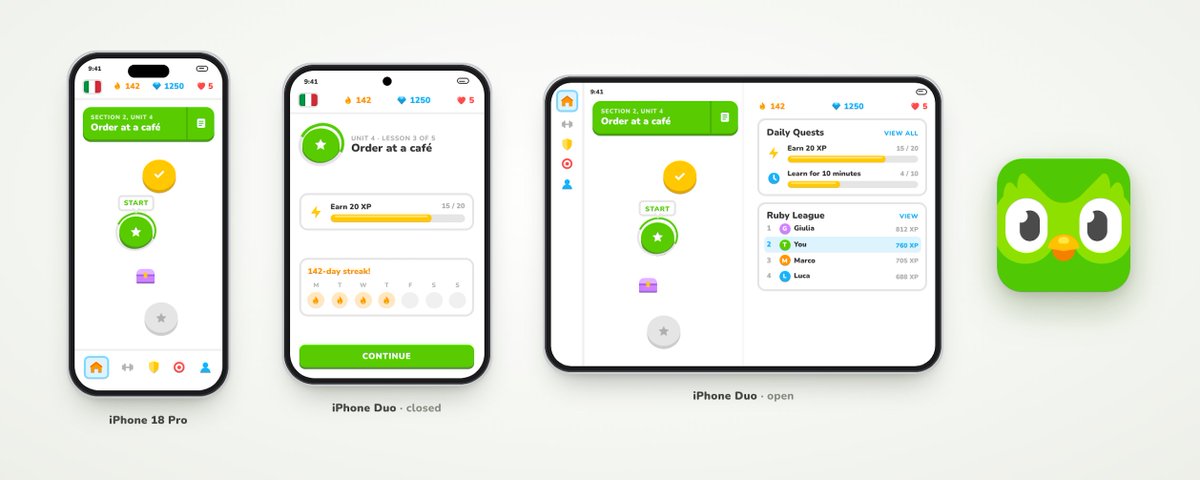
i built a skill that makes any app ready for the new iphone duo
most apps will just be stretched to fit the bigger screen
this skill actually redesigns them for both displays
here's what it does:
→ designs your app for both folded and unfolded screens
→ creates stunning UI concepts from your references
→ adapts existing apps built with swiftui, react native, flutter, etc.
→ handles the transition between both screens
→ generates apple-style product mockups of your app
works with claude code and codex
and i’m giving it away completely for free
retweet + comment "duo" and i'll send you the skill
(follow so i can dm you)

technoplato retweeted

If you have Anthropic, Grok, or other non-OpenAI tokens to burn, I could use some help!
I'm bumping up against a TypeScript performance challenge with Foldkit's Block composition API, currently in preview.
We're asking TypeScript to do a lot of inference, and some editor operations take several seconds after an edit.
We've found changes that improve performance (including API changes), but I'd love to retain the proposed shape if possible.
I've had Astra working on this at Max effort for the past day, and we still don't have a complete fix. Perhaps Fable 5.1 or another frontier model will be up to the task.
Or perhaps tsrs will rescue me?
This issue links to a reproducer, measurements, and the approaches my agents have already tried.
Thank you!
github.com/foldkit/foldkit/i…

technoplato retweeted

everything that can be will be converted into
`state = memo { f(log) }`
all other state management is just too complex at the limit

1/ Speculation markets like Kalshi and Polymarket are speculating on things that haven't happened yet. I actually think, counterintuitively, there's a way of speculating on things that have already happened.
5/ I have a way in my head of creating value from actually recording things locally. The way I think mostly flips conventional wisdom on its head.