tensorViz (@tensorViz) profile picture

Explore PyTorch models in VS Code. Follow tensor shapes, inspect layers, and review source changes.

Joined October 2026
Photo by tensorViz (@tensorViz)Photo by tensorViz (@tensorViz)Photo by tensorViz (@tensorViz)Photo by tensorViz (@tensorViz)Photo by tensorViz (@tensorViz)Photo by tensorViz (@tensorViz)Photo by tensorViz (@tensorViz)Photo by tensorViz (@tensorViz)Photo by tensorViz (@tensorViz)Photo by tensorViz (@tensorViz)
Which layer produced that tensor? Why did its shape change? tensorViz lets you expand PyTorch layers, inspect shapes from a captured run, and jump to the Python in VS Code. What's harder: tracking dimensions or following connections? tensorviz.dev/explore/?utm_s…
4
2
59
27,864
I used to lose so much time debugging ML models, jumping between code, print statements, and graphs. So I built TensorViz: a visualizer, coding agent plugin, and IDE extension. See your model. Follow the shapes. Find the mismatch. tensorviz.dev/?utm_source=x&…
2
9
214
well, u can get even faster iterations of your model using tensorviz.dev!
There is no faster city for flying than San Francisco. 9:10pm: Leave house 9:32pm: Arrive at SFO 9:40pm: Get to gate 9:43pm: Boarding starts 9:48pm: At seat I’ve never done a 38min house-seat time before.
1
45
Peeking inside a checkpoint shouldn't require loading the whole model. tensorViz reads safetensors weight names, shapes and dtypes. Run example inputs separately for runtime shapes. Tiny Llama checkpoint, dev build. tensorviz.dev/?utm_source=x&…
2
134
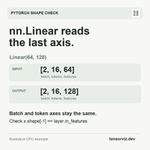
PyTorch shape check: nn.Linear reads the last axis. [2, 16, 64] → Linear(64, 128) → [2, 16, 128] Before flattening, check that the last input dimension matches in_features. Follow shapes through a model: tensorviz.dev/explore/?utm_s…
2
83
Where did those 1,024 features come from? 16 channels × 8 × 8. Flatten keeps the batch: [1,16,8,8] → [1,1024]. See the captured shapes and Python line in tensorViz. Open this example in your browser: tensorviz.dev/explore/small-…
🤖 Made with AI
2
73
Lost in a huge model graph? Stage → one block → MLP → operations. Keep the path back. Real Swin-B capture in tensorViz: development build, CPU eval, random weights. Where do you start? tensorviz.dev/explore/?utm_s…
15
Working on a PyTorch model this week? I'm looking for 10 developers to try tensorViz on their own code: follow tensor shapes, open nested layers and jump back to Python, inside VS Code. Where does understanding your model get difficult? tensorviz.dev/install.html?u…
13
One line: LayerNorm → RMSNorm. Where did the model change? tensorViz marks it on the captured graph. Run again to inspect fresh shapes. What do you check first in an architecture diff? tensorviz.dev/?utm_source=x&…
2
28
Here's a small CPU example: replace ReLU with GELU and add LayerNorm. Both models return [batch, 2], but the checks show why matching shapes don't mean matching outputs. Code + tensorViz capture profiles: github.com/tensorviz-org/ten…
3
PyTorch code, with a graph beside it. 1. Explore nested modules 2. Inspect shapes from a real run 3. Jump from graph nodes to Python 4. Give Claude/Codex graph context via MCP That's tensorViz, inside VS Code. Would you use it? tensorviz.dev/?utm_source=x&…
22
Seeing the parts makes the whole system easier to understand. We're building tensorViz for PyTorch with that in mind: explore your model in VS Code, follow shapes from a real run, and jump from a graph node to its Python. Claude can inspect it through MCP too.
Introducing Anatomy Describe a machine in one line. Claude brings it to life. - Interactive isometric wireframes you can rotate, inspect and explore - WebGL shaders for fire, water, plasma and more - Real 3D motion, with individual parts that rotate and move Install it as an agent skill. Fully open source.
1
26
Same shape. Wrong tokens. This toy QKV example passes a shape check but mixes token/head order. Reshape, then permute—and check the values. What catches these bugs in your code? Try tensorViz: tensorviz.dev/explore/?utm_s…
🤖 Made with AI
16
A 2,964-node graph is a lot to take in at once. Here’s Swin-B in tensorViz: stage → transformer block → MLP → tensor operations. The breadcrumbs keep the route back. When you inspect a vision model, where do you usually get lost?
1
4
16,891