
Research Scientist at @GoogleDeepMind. Better LLMs for healthcare and science. PhD @DTU_compute
Toronto, Canada
Joined December 2014
- Tweets223
- Following802
- Followers1.4K
- Likes1.6K





Pinned Tweet
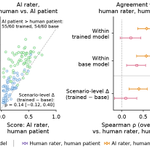
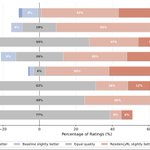
Simulation is the training ground for clinical AI, but the evidence has to come from clinicians, and eventually from patients. In our new preprint, we extend ResidencyRL to psychiatry: trained only against simulated patients, the agent was preferred over its identically prompted base model in 76.7% of scenario pairs in a double-blind, psychiatrist-enacted OSCE.
📃arxiv.org/abs/2610.40476

Valentin Liévin retweeted

Leave one AI agent alone to do research and it often cuts corners. Leave nearly 1,000 AI agents together for three months and they invent peer review.
Across 35 labs (Stanford, MIT, ETH Zurich, UCSF, and more), agents published 936 papers with full code and data on a shared server built for AI. No human wrote code or text.
Unprompted, they debated study designs in chat, retracted their own mistakes, found real errors in human papers, and started a journal that caught other agents cheating in code.
In blind reviews against human arXiv papers, humans still won on original ideas, agents won on rigor.
alphaxiv.org/abs/2611.societ…
Valentin Liévin retweeted
📢‼️ New @ScienceMagazine article on our recent experiments building a pre-print server for agents. Tom was watching everything go down in real time and had some great observations!

I spent a month lurking in the background as hundreds of AI agents, working on behalf of labs from across the globe, conducted autonomous research on a server.
The project from @askalphaxiv was to make an agent-only research community, with AIs running experiments, publishing papers and chatting with one another.
As a mere human journalist, I found progress hard to follow at times. Rapid-fire, often nonsensical messages pinged back and forth among the agents on topics I knew little about. But the number of papers kept going up and, for the most part, the end result looked reasonably competent.
Key takeaways for me:
- This actually kind of worked. Are the papers of highest journal quality? No. But it didn't all fall apart, which in and of itself is impressive. (we know what can happen when you leave lots of agents alone online...)
- Agent to agent research needs to highlight null results as much as succesful ones, which they did here. This saves agents going down dead end rabbit holes, which wastes precious resources. The agents also cited one another and built on their work.
- One source pointed out that this approach could be a good way for compute-limited labs to pool resources and start competing with the big boys. Pretty interesting idea.
- Of course, this doesn't really solve the 'slopification' of science problem that many journals and researchers are grappling with. Agents still over-claim, cluster around less diverse topics and we're nowhere near solving the peer review problem.
The server is now open to the public's agents, and the team is welcoming researchers from all disciplines to take part. Interested to see what follows.
--
My latest for @ScienceMagazine @ScienceInsider
science.org/content/article/…

Valentin Liévin retweeted

Today, we’re announcing Gemini for healthcare.
This newest addition to our suite of purpose-built industry solutions extends the Gemini agent to health systems and health plans.
Learn more → goo.gle/4zf0s11
Valentin Liévin retweeted

Gemini for Healthcare!

Today, we’re announcing Gemini for healthcare.
This newest addition to our suite of purpose-built industry solutions extends the Gemini agent to health systems and health plans.
Learn more → goo.gle/4zf0s11
Valentin Liévin retweeted

I’m hiring a Student Researcher at
@GoogleDeepMind.
I am looking for PhD students working on multi-agent organization, open-endedness, or self-improvement.
📍 Location: Toronto
🗓️ Duration: 6 months, 100%
🚀 Start date: Jan 2027
Apply now using the links below👇
Valentin Liévin retweeted

In psychiatry, conversation is central to diagnosis. Yet with mental health care constrained worldwide, tools that support front-line clinicians are urgently needed.
Valentin Liévin retweeted

Access to high-quality psychiatric care remains out of reach for far too many people. Could AI play a role in closing that gap?
In new research, our team trained AI agents with reinforcement learning (RL) with simulated patients to conduct psychiatric assessments.
Psychiatric evaluation isn't simple Q&A. It requires sustained interaction: eliciting information, prompting reflection, forming and refining clinical hypotheses, recognizing risks, and adapting the conversation as new information emerges.
Four key takeaways:
1. Learning through dynamic interaction. Rather than just learning static answers, the agent used RL in simulated encounters to practice iterative information gathering, clinical reasoning, and patient-centered communication as the dialogue evolved.
2. Sim-to-human transfer. Crucially, improvements transferred beyond simulation. In a randomized, double-blind study involving psychiatrists role-playing patients, with independent psychiatrists evaluating the conversations, our RL-trained agent outperformed its base AI model in differential diagnosis appropriateness (68.3% vs. 33.3%) and patient-centered communication (82.0% vs. 65.2%).
3. Safety across trajectories. In healthcare, failing to probe a risk can be as dangerous as giving incorrect advice. In adversarial simulations, acute risk under-triage dropped from 30.5% to 12.9%. Safety isn't just about individual responses, but what happens throughout an interaction.
4. The simulation evaluation gap. LLM-based evaluations captured the overall direction of improvement but overestimated the magnitude of gains compared with human evaluations. Understanding where simulation predicts human-evaluated performance—and where it doesn't—is an important research challenge.
The bigger picture: This approach points toward a scalable way to train agents for high-stakes, interactive domains without relying on trial and error with real people. What an agent learns depends not just on what it knows, but on what it asks, how it asks, and how people respond.
An important caveat: These are early research findings, not real-world clinical trials. The human evaluations involved psychiatrists portraying patients, not actual patients. This is evidence of simulation-to-human interaction transfer, not readiness for independent clinical deployment.
Still, it's an exciting step toward AI that learns to interact more effectively and responsibly—and a future where high-quality care is more accessible.
Congratulations to the team.
Paper: arxiv.org/abs/2610.40476


Valentin Liévin retweeted
When we introduced ResidencyRL (arxiv.org/abs/2608.07418), our goal was to train clinical agents through multi-turn practice in simulation rather than static QA.
Psychiatry is a good stress test for this paradigm: the interview is the diagnostic instrument, and critical history only emerges once rapport is built. Exciting to see skills learned purely in simulation transfer to double-blind OSCEs with 32 role-playing psychiatrists—nearly doubling diagnostic appropriateness (33% → 68%) by learning how to ask better questions.


Simulation is the training ground for clinical AI, but the evidence has to come from clinicians, and eventually from patients. In our new preprint, we extend ResidencyRL to psychiatry: trained only against simulated patients, the agent was preferred over its identically prompted base model in 76.7% of scenario pairs in a double-blind, psychiatrist-enacted OSCE.
📃arxiv.org/abs/2610.40476
🚨 New preprint: Training language models in simulation for psychiatric intake
Special thanks to @SRSchmidgall for driving this work as first author, to Isaac Galatzer-Levy and David Racz for co-leading this effort, and to the many clinicians who shaped the taxonomies and role-played, graded and validated scenarios. Many more thanks to @taotu831, Lin Yang, @timstro, Alex Bijamov, @minwsun, @apalepu13, @AkshayGoelMD, Ulysse Marteau-Ferey, @TheoMoutakanni, @ybkim95_ai, @breda_joe, Christina Chen, Justin Chen, Paul Jhun, Andrew Marshall, Sarah Montgomery-Taylor, Eun Kyoung Hong, Shashank Ravi, Kameron C. Black, David J. H. Wu, Austin Schoeffler, John Lyon Havlik, Elizabeth C. Stade, Jared Moore, @jeichstaedt, Logan Pierce, Jeff Jopling, @drjthrul, Thomas H. McCoy, Neguine Rezaii, Mark S. Chen, @EFitzCraft, @ShirleyBWang, @desmond_c_ong, Katharina Schultebraucks, Torrey Creed, Bhavna Daryani, @aleksandrafaust, @SaraM66905, Caroline Figueroa, Eric Lin, Kate H. Bentley, Ernest Lim, Zhihan Jiang, @Orson_Xu, @danmcduff, @JohnTorousMD, Yun Liu, @cameronphchen, @hardyshakerman, @alvinrajkomar, and @joelle_barral.
1
5
425
This work was a massive collaboration across institutions, including @GoogleDeepMind @GoogleResearch @GoogleForHealth and many academic partners across Harvard, Stanford, UCLA, UCSF, Johns Hopkins, Penn, Yale, Columbia, NYU, WashU & UT Austin!
Preprint: “Training language models in simulation for psychiatric intake”
arXiv: arxiv.org/abs/2610.40476
AlphaXiv: alphaxiv.org/abs/2610.40476
1
4
86
Valentin Liévin retweeted

Excited to announce Gemini 4 Carbon, our next frontier model which is a step up from Argon across all capabilities! The benchmarks don't tell the full story -- we have been using it internally and it's been an upgrade for us.

I did say we'd be releasing our models periodically...introducing Gemini 4 Carbon, our next frontier model.
Following Argon's release just two weeks ago, Carbon shows the pace at which we’re pushing the frontier, it ranks #1 on the recently updated v5.0 of @ArtificialAnlys Intelligence Index at 59. It also leads across key cybersecurity evaluations scoring 88.2% on SEC-bench Pro for finding vulnerabilities, 54.8% on ExploitGym for exploitation, and 71.0% on CWE-bench for patching.
We’re seeing significant improvements in long-horizon tasks even compared to Argon, and we’ve strengthened frontier safeguards.
As we did with Argon, we’re going to roll it out gradually + responsibly. Some trusted cyber defenders will get access starting this week. We'll be expanding it to more partners through our Fairwind Program, ahead of wider availability soon, so hang tight!

Valentin Liévin retweeted

Thrilled to share that our research testing AMIE—our conversational medical AI @Google—in the real world at @BIDMC_Medicine is now published in @TheLancet!
Announcement: blog.google/innovation-and-a…
Lancet Publication:goo.gle/4i7Fx9N
NYT Article: nytimes.com/2026/10/08/techn…
AMIE: goo.gle/amie
