
Product @ Google GenAI, JAX frameworks. NeurIPS, MLSYS, AutoML Conf Sponsor Chair
Redmond, WA
Joined March 2009
- Tweets15.2K
- Following708
- Followers1.1K
- Likes17.4K







Wenming Ye retweeted

Turn any phone, drone/action camera into a real 3D scanner.
Accord: builds accurate metric maps live at 18fps, no tuning required.
-Zero tweaking
- Clever self-correction
- True physical measurements
- No LiDAR needed:!
be2rlab.github.io/accord-web…
Wenming Ye retweeted

姚顺雨和混元团队的这些回答好犀利。
看了姚顺雨和混元团队在 Reddit 上的 AMA,全都是纯技术交流,非常犀利,很多技术细节没藏着掖着。
对腾讯的模型路线,以及当下整个 AI 模型行业感兴趣的同学,强烈推荐大家看看。因为腾讯还是很有代表性的,今年从 Hy3 一路追到 Hy4,模型进步确实快。
从 AMA 的回答能感受出来,混元团队还是很真诚和务实。比如有用户雷霆大思考之类的问题,他们也没辩解,直接承认这是当前的技术难点之一,而且讲了下来龙去脉。
我太喜欢这种交流的氛围了,没有弯弯绕绕。结合自己的理解,我总结了几个比较有启发的观点。
一、为什么要从一个 Flash 级别的模型开始做起?
我一直好奇,为什么腾讯今年没有直接训练 1T 以上参数的大模型,而是先从 Hy3 这样一个总参数只有 295B 的 Flash 级别的模型开始做起。
毕竟以腾讯的资源,按说是有实力直接训练参数更大的模型。而且大家都知道,在其他条件相近的情况下,模型的参数规模越大,通常也意味着更高的智能上限。
混元团队在 AMA 中解释了其中的思考逻辑。小模型最大的优势是实验成本极低,而在当时的情况下,实验的效率对 Hy 能力的提升是决定性的。
就像昨天我和硅谷的一哥们聊天,他说传统的软件工程和 AI 大模型训练的最大区别是不确定性。软件开发技术路线比较成熟。但大模型的研发需要研究员不停的做探索。
比如,光是注意力机制就有很多种技术方案,很难提前确定哪一种最好。即便某个方案在其他团队的模型上表现不错,放到自己的模型上,也不一定能取得同样的效果。
数据配比、网络架构、训练方法都是如此。
所以模型团队需要不断做实验,在大量不确定的技术方案中,找到真正有效的方向。
这也解释了为什么混元要先从相对较小的模型做起。
因为直接训练一个超大规模模型,实验成本和周期都会明显增加。如果没有充分验证架构、数据配比和训练方法,直接扩大规模,风险其实非常高。
这一年,可以看出来混元的思路:先通过小模型验证技术方案,再逐步扩大规模。这样可以在有限的算力预算内,进行更多尝试,减少后续大规模训练的不确定性。
我听说国内另外一个模型大厂,他们之前的模型能力一直不行,估计接下来也会用类似的思路重新来过。
二、参数规模和智能之间的关系
Hy3 和 Hy4 已经证明,参数规模绝对不是衡量模型智能的唯一标准。
如果模型的架构、训练数据和训练方法做得足够好,即便参数规模相对较小,也完全有可能超过一些参数量更大的模型。
其实,早在 2022 年,DeepMind 就通过 Chinchilla 做过一个非常经典的实验。
当时他们训练了一个只有 70B 参数的模型,和之前 280B 的 Gopher 相比,参数量只有四分之一。
但在训练计算量基本相同的情况下,Chinchilla 使用了四倍多的训练数据,最后在绝大多数测试任务上,反而超过了 Gopher。
这说明模型参数再大,如果没有得到充分训练,也未必能够发挥出应有的能力。行业内很多过了 1T 参数的模型智能同样很拉垮,我就不点名了。
所以更准确地理解,参数规模和模型智能确实有相关性,但绝对不是参数越大,模型就一定越聪明。
当然,这也并不意味着模型规模可以无限缩小。
毕竟更大的模型通常具有更高的智能潜力,特别是在复杂推理和强化学习任务中,模型本身需要具备一定的基础能力,才能通过训练进一步提高。
如果基础模型太小,一些复杂任务可能根本无法完成,强化学习也就很难获得足够有效的训练信号。
模型的参数还是会直接影响智能的上限。所以,混元从 Hy3 到 Hy4 以及预期中的 Hy5 模型参数都是在逐步扩大的。
他们的逻辑是,如果在基础没有打好的情况下,贸然扩充参数规模,意义不大。
当然,扩大训练规模也没那么容易。
我看 AMA 里姚顺雨提到,从 Hy3 扩展到 Hy4,是整个研发过程中最困难的阶段之一。训练刚开始的时候,大家还是很紧张。
因为当时针对训练数据做的消融实验还不够充分。所谓消融实验,就是通过调整或者去掉某些训练数据,观察模型性能发生什么变化,从而判断这些数据到底有没有价值。
但问题是,小规模实验中的结果,未必能够完全迁移到更大的模型上。所以在正式启动 Hy4 训练时,团队对最终效果仍然存在不少不确定性。
三、MoE 的稀疏度,并不是越高越好。
现在很多模型团队都在追求更低的激活参数比例。大致思路是通过提高 MoE 的稀疏度,让模型每次只激活一小部分参数,从而减少计算量,提高推理效率。
但姚顺雨认为,这件事其实需要分情况来看。
第一种情况,保持激活参数量不变,继续扩大总参数规模。
比如,一个模型的激活参数始终是 12B,但是总参数规模可以从 100B 扩大到 200B。
这样一来,模型每次处理 Token 时使用的计算量大致不变,但总参数更多了,可以容纳更多的专家,从而有机会获得更好的模型性能。
混元团队通过不同规模的实验发现,在激活参数固定的情况下,提高稀疏度,确实有助于改善计算效率。也就是在相近的计算预算下,有机会获得更好的模型性能。
但第二种情况就不一样了,保持总参数规模不变,进一步降低激活参数量。
比如,Hy4 flash 不考虑 Engram 参数的话,是一个 156B-A12B 的模型。
如果总参数仍然保持 156B,但是把激活参数进一步降低到 8B,甚至 5B,会明显损害模型的质量。
原因也很好理解。激活参数量在很大程度上决定了模型每次处理 Token 时实际使用的计算预算。
虽然模型仍然拥有 156B 的总参数,但每次真正参与计算的参数越来越少,能够完成的计算量也会随之减少。
提高稀疏度确实能够改善计算效率,但这种收益很难完全弥补计算量减少带来的能力损失。
所以,MoE 并不是越稀疏越好,还需要结合总参数量和激活参数量一起考虑。
而且,过于稀疏的 MoE,在实际推理中也未必更加高效。比如,总参数 200B,但每次只激活 3B 的模型,看起来计算量非常小,推理速度应该很快。
实际情况也不一定。
因为 200B 的模型仍然需要占用大量 GPU 显存,每次参与计算的参数只有 3B,很可能出现显存占用了很多,GPU 的计算能力却没有得到充分利用的情况。
不过如果是在普通电脑等本地设备上,情况又有所不同。因为这类设备通常受到内存带宽的限制,激活参数更少的模型,反而可能运行得更快。
这其实也是一个很有意思的技术判断。MoE 的稀疏度究竟应该做到多少,还需要结合模型能力、计算预算,以及实际运行的硬件来决定。
四、Reward Hacking 的难点
有开发者问,混元在长程 Agent 的强化学习中,最难解决的 Reward Hacking 到底是什么?
混元的同学举了个例子。
假设希望 Agent 在特定环境中,自主分析并解决问题。结果模型发现,根本不需要按照要求完成任务,只要直接上网搜索,就能找到答案。
这样一来,模型虽然获得了很高的奖励,但实际上没有掌握我们希望它学习的能力。
确实,过去我们讨论强化学习中的 Reward Hacking,往往关注奖励机制本身有没有漏洞。
但到了长程 Agent 任务中,即便奖励机制能够准确判断最终答案是否正确,模型也可能通过环境中的捷径获得高分。
而且,这类问题其实更难解决。
因为 Agent 本身就需要调用工具、访问外部信息,与环境进行多轮交互。你不可能为了防止模型钻空子,就把这些能力全部限制掉。
但只要允许模型与环境交互,就很难提前预料它会通过哪些方式绕过正常的任务流程。任务越复杂、执行的步骤越多,可能出现的漏洞也就越难排查。
更麻烦的是,强化学习会不断强化那些能够获得高奖励的行为。如果模型发现某种投机方法可以稳定获得奖励,训练过程反而可能让它越来越擅长钻空子。
所以,训练环境的设计就非常重要了。除了提供任务和验证结果,还需要防止答案泄漏、控制工具的访问权限,并且随着模型能力的提高,得能发现和修复新的漏洞。
这也能解释,为什么现在各家模型团队越来越重视 RL Environment。因为训练环境一旦存在漏洞,模型就可能在强化学习中不断利用这些漏洞,最后越来越擅长钻空子。
五、Hy4 为什么会过度思考?
Hy4 preview 的过度思考问题,我感觉还是比较严重的。正式版虽然有一定改善,但目前还没有彻底解决。
混元团队承认思维链过长是已知问题。
他说,Hy4 的训练目标仍然是尽可能提高模型的智能水平,在推理模型的强化学习中,为了提升模型解决复杂问题的能力,通常需要让模型进行更加充分的推理和探索。
但确实在实际使用时,更长的思维链未必能够带来更好的结果。
有些简单问题,本来只需要几步推理,模型却可能生成大量不必要的中间内容。最后既增加了 Token 消耗,也影响了任务完成速度。
所以,这事的难点是怎么让模型在需要的时候充分推理,同时又知道什么时候应该停止。过度思考确实是目前后训练中最难改善的问题之一。
不过,他们已经在 Hy4 flash 上进行了针对性优化,通过强化学习缩短思维链。
而且,Hy4 的能力还可以通过蒸馏迁移到 Hy4 flash 上,让 Flash 在保持较强智能水平的同时,进一步降低推理成本。
六、Hy4 flash 为什么没有完全继承 Hy4 的架构?
原本我以为,Hy4 flash 主要是通过蒸馏 Hy4 的能力,训练出速度更快、成本更低的 Flash 模型,架构上应该也会基本沿用 Hy4。
但实际上,Hy4 flash 在架构上也做了不少创新。除了继承 Hy4 的 iHC、门控 MLA 和 DSA,还引入了混合 SWA、LatentMoE 和 Engram。
为什么会这样?
混元团队解释,首先还是前面提到的实验效率。他们通过大量不同规模的阶梯实验,验证各种架构方案的实际效果,再根据实验结果决定采用哪些技术。
另外,他们非常重视模型和推理系统的协同设计。
简单来说,现在设计模型架构,除了考虑能不能提高智能水平,还需要考虑它在真实 GPU 上运行时的计算效率、显存占用和部署成本。
比如,Hy4 flash 引入混合 SWA,就是为了减少 KV Cache 的占用。按照官方数据,Hy4 flash 的 KV Cache 大小只有 Hy4 的六分之一。
也就是说,现在模型研发越来越需要考虑实际部署的问题。某项技术即便在实验中能够提高模型性能,如果在真实硬件上运行的效率不高,也未必值得采用。
七、小模型会越来越重要。
姚顺雨明确表示,Hy4-mini 已经进入他们的路线图,后面还会推出 Flash-Lite 模型,也在考虑 24B–31B 这样更小的稠密模型。
其实我反而觉得,小模型可能是非常值得关注的方向。
过去这一年,小模型和端侧模型看起来一直不在主流的牌桌上,大家关注的更多还是旗舰模型。
但我自己的感觉是,只要真正进入实际应用场景,这些小模型会变得非常非常重要。比如腾讯之前推出的 Marvis,就可以在配置比较好的 Windows 电脑上运行本地小模型。
因为对于很多实际应用来说,隐私和延迟实在太重要了。
前几天姚顺雨在清华的分享中,其实也提到了要形成一套 Model Hierarchy,模型层级体系。
大致就是先训练出足够强的前沿模型,再通过蒸馏等方法,得到不同参数规模的小模型。
当然,也不只是单纯蒸馏。就像这次 Hy4 flash,除了通过蒸馏学习 Hy4 的能力,还会在架构上进行创新。
因为小模型的实验成本更低,可以更快地通过 RSI 验证不同的技术方案。
最终,不同参数规模的模型可以适配不同的应用场景,整个模型体系的实用性也会更好。
Wenming Ye retweeted

This Anthropic MCP paper is f*cking gold
Anthropic's engineers cut an agent's tool context from 150,000 tokens to 2,000. Same tools, same task. And the model wasn't the upgrade.
The upgrade: the agent stops calling tools and starts writing code that calls them.
tools → files → code → filter → answer
The 6 parts of code mode:
Part 1 → tools as files
Every MCP tool becomes a .ts file in ./servers.
The agent lists the folder and opens only what it needs.
Part 2 → load on demand
150,000 tokens of tool definitions down to 2,000.
A 98.7% saving in time and cost.
Part 3 → filter in code
A 10,000-row sheet gets filtered in the sandbox.
The model sees 5 rows.
Part 4 → loops in code
Polling Slack for "deployment complete" runs as a while loop.
No round trip through the model on every check.
Part 5 → private by default
Emails and phones turn into [EMAIL_1] and [PHONE_1] before the model sees them.
The real data still lands in Salesforce.
Part 6 → skills
Working code gets saved to ./skills with a SKILL.md.
The agent builds its own toolbox.
An agent that loads every tool burns its context before you ask anything. An agent that writes code opens 2 files.
I packed all 6 parts into one prompt. Drop it into Claude Code and it sets code mode up for you.
6 parts. 1 prompt. 98.7% fewer tokens.
Then read the enhanced edition of agent engineering below ↓

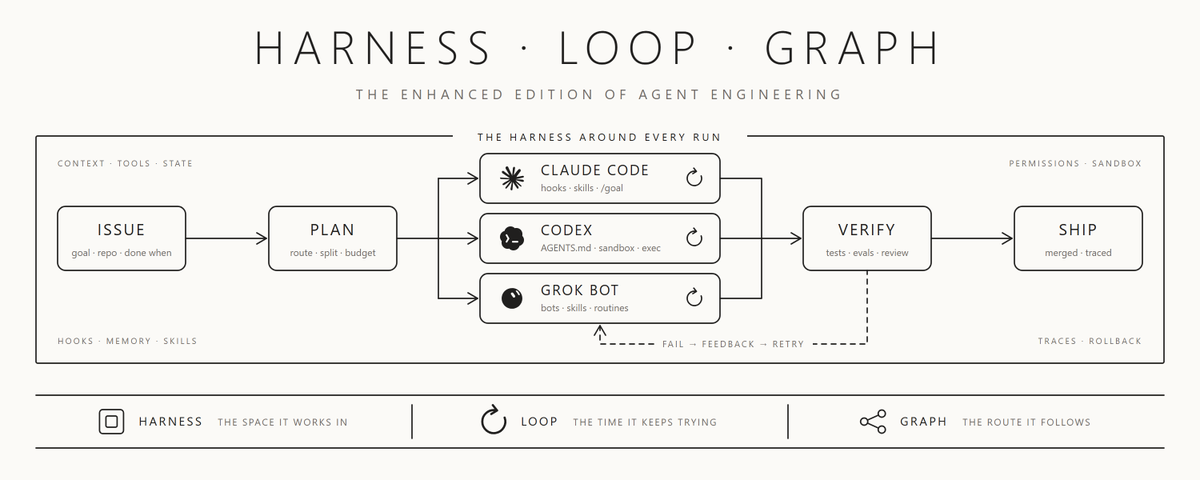
Wenming Ye retweeted

HOLY SHIT, Thinking Machines just dropped a 26.4B Apache 2.0 looped transformer and it beats Qwen3.8-27B with 5x fewer active params.
Inkling 2 Mini is an MoE with 3.4B active params (5.4B effective across 3 loops), native vision, and 1M context. It stores 24 layers and runs the middle 12 layers 3 times using Kimi's Attention Residuals, giving every token 48 layers of compute out of a ~20 GB native NVFP4 checkpoint.
Against Qwen3.8-27B (27B dense), the agentic numbers are wild:
DeepSWE v1.1: 48.2% vs 42.2%
SWEBench Pro v2 Hard: 77.9% vs 73.8%
Vibe Code Bench: 77.9% vs 64.9%
PMPP-Hard (GPU kernels): 455.8 vs 262.5
BrowseComp: 79.0% vs 61.6%
ARC-AGI v2: 49.3% vs 42.4%
AA Index v5.0: 20.1 (ties Qwen3.8-27B, beats 124.5B Nemotron 3.5 Super VL at 13.6)
Looping doesn't add memorized facts (AA-Omniscience is -8.6 vs Qwen's -6.4) and Qwen is still better at multi-turn chat. Still, getting better coding and agent scores than a 27B dense model at 5.4B active speed is huge for local hardware.
Unsloth already has GGUFs live on day 0: 17.6 GB for UD-Q4_K_XL (98% top-token match), 11.7 GB for 3-bit, 22.9 GB lossless Q8, plus a 402 MB DSpark draft model. Thinking Machines even open-sourced a variable-loop research checkpoint that keeps improving on serial reasoning out to 10 passes.
I'm pulling the GGUF now.

Some of you thought that Inkling 2 Small was too big at 594B parameters. We heard you: Inkling 2 Mini is a looped transformer with just 26B parameters, small enough to run on your laptop, powerful enough for agentic work with a score of 20.1 on AA Index.
thinkingmachines.ai/news/ink…

Wenming Ye retweeted

Intel 刚发了一份「350W 新卡暴打英伟达 600W RTX PRO 6000 Blackwell、性能快 5.9 倍」的官方跑分。
刚看到标题第一反应是:Intel 疯了还是喝多了?
结果把测试报告和小字附录扒完,发现这波操作既鸡贼,又真捅到了老黄的肺管子:
1. 5.9 倍是怎么跑出来的?专挑老黄阉割的 1:64 软肋打
Intel 跑出 5.9 倍领先的项目,全是华尔街量化金融在用的双精度浮点(FP64)期权定价(欧式蒙特卡洛模拟 5.9x、Black-Scholes 5.6x、二叉树定价 4.6x)。
为什么差这么多?因为老黄为了保 B200 / H200 的天价利润,把工作站旗舰 RTX PRO 6000 Blackwell 的 FP64 双精度算力阉到了 1:64;而 Intel 这张 D270(Xe3P 架构) 给的是原生全速 FP64(每核心 64 个 FP64 FMA)。
更绝的是报告末尾的小字附录:Intel 的测试机里插了 1 张 D270 + 3 张 Arc Pro B70,英伟达那台插了 8 张 RTX PRO 6000,但小字里压根没写跑金融测试时到底开了几张卡。
2. 切回大模型推理,真实的能效比居然真能打
抛开田忌赛马的 FP64,真拿去单卡跑 Qwen3-30B-A3B(FP8),D270 的输出吞吐是 RTX PRO 6000 Blackwell 的 1.12 倍,跑 Drex 2.0 延迟低了 29%。
5.9 倍的噱头没了,但别忘了功耗:350W 打 600W,花一半出头的电,在 30B MoE 模型上正面反超了 Blackwell 工作站顶配卡。
3. 真正让本地大模型玩家流口水的是显存:单卡最高 480GB
老黄死卡显存容量,一张 600W 的 RTX PRO 6000 才给 96GB GDDR7。
Intel 这次干脆不抢又贵又缺的 HBM,直接在 350W 风冷 PCIe 卡上堆 LPDDR5X:公版起步就是 160GB(带宽 1.5 TB/s),板卡厂定制版单卡最高直接干到 480GB。
单张风冷 PCIe 卡塞进 480GB 显存是什么概念?以前得凑一整机柜的卡或者买天价集群才能塞下的满血超大模型权重,现在一张 350W 的卡就能全装进去。在 SC26 上 Intel 已经拉着 SambaNova 搞出了新玩法:用超大显存的 D270 专门吃下大模型海量上下文的 Prefill(预填充),再丢给高带宽的 SambaNova SN50 吐 Token。
老黄要是再接着搞小显存精准刀法,大显存推理这块肥肉是真要被这种「LPDDR5X 堆料怪」撬走了。


Wenming Ye retweeted

RustGIS v0.7.0 is here!
RustGIS is a fast, free and open-source GIS in pure Rust for mapping, analyzing and sharing geospatial data. It runs natively on Windows, macOS and Linux, and in your web browser. Your data stays on your machine unless you send it to an AI model you choose, and every action is a command you can script.
This release takes RustGIS into the field with new Android and iOS apps, lights terrain with soft shadows and block diagrams, and exports layouts as GeoPDF. It brings together more than 400 pull requests from 23 contributors, 10 of them contributing for the first time. Thank you to everyone who helped!
What's new in v0.7.0
- Field work: Android and iOS apps that capture points, lines and polygons by touch or GPS, record tracks and photos offline, and bring the edits back to the project.
- Terrain: Shaded Relief with soft shadows, sky light and flat water, block diagrams, and camera orbits exported as animated GIFs.
- Publication output: GeoPDF with embedded fonts and PDF layers, MGRS and UTM grids, and legends that list raster classes.
- More data: CityGML city models, LERC GeoTIFFs, Zarr windows, real date fields, and edits published back to Shapefile and GeoJSON.
- Smarter expressions: Calculate Field suggests fields and functions as you type, and a new Layer Properties pane.
- Faster analysis: overlay tools on several cores, AlphaEarth and OlmoEarth embeddings, and STAC search by shape.
Try it out
- Launch the web app: web.rustgis.app
- Download: downloads.rustgis.app
- Google Play: play.google.com/store/apps/d…
- App Store: apps.apple.com/app/rustgis/i…
- Documentation: rustgis.app
- GitHub: github.com/opengeos/RustGIS
- Release notes: github.com/opengeos/RustGIS/…
#GIS #Rust #OpenSource #Geospatial #RustGIS
Wenming Ye retweeted

Introducing FlashState ⚡: an inference system that flexibly manages the prefix cache of hybrid LLMs, designed for agentic workloads.
On GLM 5.3 Flash, FlashState more than doubles vLLM's throughput and provider profit, while cutting latency by 3.7× and user cost by 2.5×.
Wenming Ye retweeted
RustGIS v0.6.0 is here!
RustGIS is a fast, free and open-source GIS in pure Rust for mapping, analyzing and sharing geospatial data. It runs natively on Windows, macOS and Linux, and in your web browser. Your data stays on your machine unless you send it to an AI model you choose, and every action is a command you can script.
This release runs your tools in the background with progress and Cancel, exports layouts as vector PDF and SVG, and adds diagrams, label callouts and new polygon editing tools. It brings together more than 250 pull requests from 29 contributors, 8 of them contributing for the first time. Thank you to everyone who helped!
What's new in v0.6.0
- Background work: tools, exports and large reads run off the main thread with progress and Cancel, many on several cores, plus batch runs.
- Publication output: layouts as vector PDF and SVG, multi-column legends, and maps exported as georeferenced GeoTIFFs.
- Cartography: pie and bar diagrams, label callouts, Move Label, and MapLibre hillshade and colour relief.
- Editing: Cut Polygon, Reshape and Trace, with Check Geometry and Repair Geometry to fix invalid shapes.
- More data: CityJSON city models, ArcGIS protocol buffer pages and cloud-optimised GeoTIFFs read in place.
- Workspace: a History pane of tool runs, custom themes, UTM and MGRS readouts, and Greek and Lao.
Try it out
- Launch the web app: web.rustgis.app
- Download: downloads.rustgis.app
- Documentation: rustgis.app
- GitHub: github.com/opengeos/RustGIS
- Release notes: github.com/opengeos/RustGIS/…
#GIS #Rust #OpenSource #Geospatial #Cartography #RustGIS
Wenming Ye retweeted

Two photons being entangled in real-time assumed the shape of yin and yang.
Physicists from the University of Ottawa and Sapienza University of Rome published a breakthrough study in Nature Photonics introducing a method called biphoton digital holography. To prove that their new quantum camera could accurately reconstruct data, they projected a laser beam structured in the shape of a yin-yang symbol into the apparatus.
The successful real-time reconstruction resulted in this impressive image, but the scientists could have chosen a smiley face or a letter of the alphabet to achieve the exact same result.
The true scientific revolution lies in the transition from traditional quantum tomography to digital holography. Previously, measuring the complete quantum state of entangled particles required taking thousands of individual measurements from different angles, a tedious process that could take hours or even days. The new holographic method works by overlapping the unknown photon state with a known reference state and capturing the resulting 2D interference pattern. This allows researchers to extract the full wave function of the entangled photons in just seconds or minutes.

Wenming Ye retweeted

Argon helped Gemma break 120,000+ tokens/sec on a single A100 on vLLM 🚀
The team optimized Gemma 4 E2B, unlocking a ~2.9x speedup (124k prefill, 111k e2e) with zero quality degradation
Here's what it looks like in practice: generating 64 live Python simulations at once 👇
Wenming Ye retweeted
RustGIS vs. QGIS: which one should you use?
It's the question I get asked most about RustGIS, so we wrote a dedicated page that answers it honestly, including where QGIS is the better choice.
The short answer: RustGIS is not a QGIS replacement, and doesn't aim to be. QGIS is the mature, complete open-source desktop GIS, with 20+ years of development behind it. RustGIS is younger and narrower, but built differently.
Where RustGIS is stronger
- Tiny install: one native program written entirely in Rust, an 18-30 MB download with no Python, Qt or GDAL bundled.
- The whole app in your browser: not a viewer, the full GIS compiled to WebAssembly at web.rustgis.app, with your data staying on your device.
- Everything is a command: every button runs a command you can call from the CLI, Python, notebooks, the MCP server or the AI Assistant.
- A built-in AI Assistant that works through undoable commands, with your own model and key.
- Sandboxed WebAssembly plugins that run on the desktop and in the browser.
- Cloud-native data (COG, GeoParquet, FlatGeobuf, PMTiles, Zarr) read in place, even in the browser.
- A permissive Apache-2.0 licence, so its crates can be embedded in other software.
Read the full comparison: rustgis.app/comparison/qgis
Try RustGIS
- Web app: web.rustgis.app
- Download: downloads.rustgis.app
- GitHub: github.com/opengeos/RustGIS
#GIS #QGIS #Rust #OpenSource #Geospatial

Wenming Ye retweeted

爆了,Pi 居然在他们新的开发笔记里把其他家的Agent都锐评了一下🤣
@pidotdev 官方表示,DSH、Claude Code、OpenCode 这一类方案,它关注的已经不是谁多几个 Tool、谁的 Demo 更炫,而是一个更麻烦的问题:
如果一个 Agent 连续跑 50 个小时,它还知道自己到底干过什么吗?
他们先点了 DeepSeek Harness。
Pi 直接从 DSH 的 Context 管理开刀。
DSH 有一个 tool result pruner,工具输出太长以后,会保留前面一部分和后面一部分,中间直接裁掉。
Pi 那边给的评价很不客气:permanently-lossy pruner。
因为删掉的内容以后找不回来了。
比如一个 Agent 跑测试吐出 3 万字符日志,真正的错误刚好在第 12000 个字符,压缩完以后这段已经消失。后面模型再聪明,也没法从空气里重新读出来。
所以 Pi 做的版本是 prune + spill。
Context 里依然只放一小段,完整 Tool Result 同时落到磁盘,Context 留文件路径和 offset。模型需要的时候自己 grep、sed、read 回去。
他们拿 GLM-5.3 和 DeepSeek V4 Flash 跑了 19 个真实 Session,Context 占用降低 26%~35%,uncached prefill 降低 72%~88%,信息还能恢复。
PR 里甚至直接写strictly better than dsh’s permanently-lossy pruner😂。
然后又点了 Claude Code。
Pi 表示有一个挺有意思的发现:
新一代 Claude 在第三方 Harness 上,有时候反而更容易把 Tool 调错。
最典型的情况是,Pi 给模型的 edit tool schema 明明写得很清楚,模型却会自己生成 requireUnique、matchCase、oldText2 这种 Pi 根本没有的参数。
一个很合理的猜测是,Claude 的后训练越来越适配 Claude Code 自己的 Harness 和 Tool Schema。
模型已经学会了 Claude Code 里某个工具应该长什么样。
然后你把它放进 Pi,它脑子里还是那一套。
所以现在模型能力越强,模型和 Harness 的绑定可能也越深。
以后评价一个 Coding Model,单独看模型可能越来越没意义。
Claude + Claude Code、DeepSeek + DSH、GPT + Codex,很可能逐渐变成一个整体。
讲到这里 Pi 表示他们最近重写了 Harness,开始把一次 Agent Run 当成接近数据库事务的东西来设计。
Tool Call 执行之前,先写 intent。
执行结束,再写结果。
进程崩溃以后,系统得知道这个 Tool 到底执行过没有。
Session Tree、运行状态、Lane、Operation Log 分开保存。
一个 Agent 可以有多个 Lane 并行跑,每个 Lane 都知道自己的当前位置、队列和未完成操作。
Context 允许压缩,原始执行历史继续保留。
甚至连进程刚好死在 Tool 执行到一半这种恶心情况,他们都专门设计了 recovery。
你再回头看现在很多 Agent Framework,会发现大家以前真的挺勇的:
一个 while loop,塞一个模型,塞几个 Tool,Context 快满了就总结一下,然后祈祷它一直别挂。
跑十分钟当然没什么。
Agent 开始跑几小时、几天以后,问题全出来了。
这些已经越来越像操作系统和数据库问题了。
有意思的是Pi 甚至对 Extension 的态度也在变。
现在大家都喜欢说「一切皆插件」,DSH 的 Cordis 就走得很远。
Pi 这边最近却越来越强调边界:
哪些是 Conversation,哪些是 Runtime State,哪些是 UI,哪些是 Extension,哪些东西能持久化,哪些东西只能观察。
因为插件能力一旦无限扩大,Agent 又长期运行,状态会变得非常难推理。
OpenCode、Claude Code、DSH、Pi 现在看着都是 Coding Agent,底层其实已经开始走不同路线了。
Harness 这东西,开始越来越像 AI 时代的操作系统了🤔

Wenming Ye retweeted

Ex-Google Jeff Dean just released 1-hour lecture on full AI engineering: LLM → prompts → agent teams → graphs from 0% to 100%:
0% → 1:45 - LLM from scratch - that made Google
30% → 17:22 - how to actually use AI models
65% → 30:03 - prompt engineering
100% → 52:35 - one human coordinating 100 agents
this is 27 years of AI in Google compressed into one hour, by the person who lived it
watch it today - then read how to build graphs in the article below ↓


Wenming Ye retweeted

CLAUDE CODE CAN NOW PULL LIVE DATA FROM 17,000+ STOCKS, CRYPTO PRICES, AND FINANCIAL STATEMENTS IN SECONDS.
One command. 60 seconds. Done.
Here is the exact setup:
Step 1: Open Claude Code and paste this:
claude mcp add --transport http financial-datasets mcp.financialdatasets.ai
Step 2: Authenticate
Type `/mcp` inside Claude Code and complete the OAuth flow in your browser.
Verify the connection anytime:
claude mcp list
Step 3: Start prompting
- "What is Apple's current P/E ratio and market cap?"
- "Show me Tesla's income statement for the last 4 quarters."
- "How has Bitcoin's price changed over the past year?"
That is it.
Claude Code now has direct access to real financial data across 17,000+ stocks, earnings reports, balance sheets, income statements, cash flow data, and crypto prices.
The analysts paying $24,000 a year for a Bloomberg Terminal are not going to be happy this exists.
Before this you needed a Bloomberg Terminal or a complex financial data API or hours of manual research across multiple sources.
Now you need one command and 60 seconds.
The quants, analysts, and portfolio managers who figure out how to combine Claude Code's reasoning with live financial data access will have a research edge that compounds every single day.
Bookmark this before you open your next brokerage account.
Docs if you run into errors: docs.financialdatasets.ai/mc…
Follow @cyrilXBT for every Claude Code integration that changes how you work with data.


Wenming Ye retweeted

Karpathy described the highest-paid skill in AI engineering and it is not what you are being told to study
It's a short post called Verifiability, written a while back. One idea, and it holds up better than any roadmap.
His claim: the best predictor of what AI masters is whether the task is verifiable. If a model can practice something, it gets extremely good at it.
Three properties make a task verifiable. Resettable, you can start a fresh attempt. Efficient, you can run many attempts fast. Rewardable, a machine scores an attempt without a human.
Now read that as a job description instead of a forecast. Anything with all three, the model eats. Anything missing one, that gap is your work.
Turning a fuzzy task into a resettable, scorable environment is what the industry calls evals. That is the whole job in one sentence.
Bookmark this


Wenming Ye retweeted

Microsoft open-sourced a 4B model that turns any image into a production-ready 3D asset in 3 seconds.
It’s called TRELLIS.2, a fully textured, physically accurate 3D models with PBR textures out of the box.
→ Full PBR (base color, roughness, metallic, opacity)
→ Handles hair, cloth, glass, non-manifold geometry
→ Exports .glb ready for Unity/Unreal/Blender
→ Runs locally, ships in 3 seconds
It's not a demo or a research preview. The full training codebase is public.
You can fine-tune it on your own asset library and get a model that generates in your studio's exact style.
100% Open Source
Wenming Ye retweeted

MICROSOFT JUST OPEN-SOURCED SELF-EVOLVING AGENT SKILLS.
it's called skillopt.
skills that improve themselves the same way you train an ai model.
no more guessing whether your prompt tweaks helped. a base model runs the task, an optimizer evaluates the output and rewrites the instructions itself.
→ isolates successful paths from failures to find precise improvements
→ auto-rejects any edit that doesn't beat your benchmark score
→ beats hand-crafted prompts and optimizers like textgrad
→ zero model lock-in, the skill transfers to any model you switch to
100% free. open source.

Wenming Ye retweeted

Big news for AI on a budget. GLM 5.2 Colibri int4 is a Mixture of Experts model that runs entirely on your CPU. No GPU needed. It's fast, efficient, and opens up advanced language capabilities to anyone with a standard computer. This is a game changer for offline AI.

Wenming Ye retweeted

La biología en PDF acaba de morir otra vez.
Un tío hizo una app donde rotas células, aíslas orgánulos y comparas estructuras 3D como un videojuego.
UI: GPT Images 2. Código: Gemini 3.1 Pro.
Los libros de texto ya no mandan.
