
Assistant Professor at CUNY School of Public Health. Causal inference. Likes *are* endorsements, but possibly by my 3 year old who stole my phone.
Brooklyn, NY
Joined December 2008
- Tweets269
- Following841
- Followers196
- Likes808





I think this one made me laugh the hardest at the time but isn't really the "best":
youtube.com/watch?v=fJvpOxem…

"She is a Japanese woman," Ohtani said through an interpreter. "I don't really feel comfortable talking about when I got married exactly, but she's a normal Japanese woman."

If you want to estimate heterogeneous treatment effects on a survival outcome (maybe with competing risks), Shenbo Xu just developed a nice approach to let you use any of those fancy "learners" people are always talking about: arxiv.org/abs/2401.11263

Most of the learners were developed for continuous outcomes. Shenbo came up with transformations of survival outcomes that you can just plug into the learners. And he derived bounds. You have a lot more options now, especially for competing risks.
Can anyone recommend a good discussion of when you might prefer the ATT to the ATE? #Causalinference
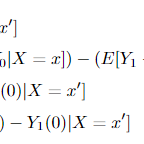
I found a little DiD related result that's so simple that somebody must have noticed it before. But I'm not a great googler and couldn't find it anywhere. DiD knowers, is this new? arxiv.org/abs/2306.11030🧵

The subgroup parallel trends assumption isn't stronger than the standard parallel trends assumption across treatment groups and sometimes can be more plausible. If effect modification is of interest, you might consider subgroup DiD whether or not a control group is available.
ok, tagging a few DiD knowers I follow to hopefully tell me if this is even a new thing: @jondr44 @pedrohcgs @ambilinski @CdeChaisemartin @laura_tastic @causalinf #EconTwitter #Causalinference
Zach Shahn retweeted

Congratulations, Dr. Chloe Mirzayi on your amazing research exploring how different classes of antibiotics impact the gut microbiome and on good reporting practices in microbiome research - you are a rock star! @LeviWaldron1 @CUNYSPH @maryschooling @zshahn @cunyisph #CUNYProud
Zach Shahn retweeted

🚨 Announcing my first preprint in the diff-in-diff space! A brief 🧵below. Looking for feedback/critiques!
arxiv.org/abs/2206.05788
#epitwitter #EconTwitter #causalinference
Updating with a couple extensions-identification of controlled direct effects (CDEs) and sensitivity analysis for violations of parallel trends. arxiv.org/abs/2204.10291.

Sorry @KhoaVuUmn. In our new "working paper" (are non-economists allowed to have working papers #EconTwitter?), we show that Structural Nested Mean Models are identified under time-varying conditional parallel trends assumptions. (This is good!) 🧵 arxiv.org/abs/2204.10291
And if you're willing to assume parallel trends for arbitrary possibly dynamic treatment regime g:
6. Learn E[Y(g)]
And if you'll buy no effect modification by unobserved confounders:
7: Learn the optimal dynamic treatment regime