Founder/CEO of (funded) AI LegalTech startup. Interested in lots of stuff. Most of my followers are bots. Semi private so I can talk about what I want.
Dallas / SF
Joined June 2011
- Tweets12K
- Following1.1K
- Followers962
- Likes52.5K







Had EA to Google's Hydrogen model & put it to the test on some of our legal benchmarks vs. 3.8 Flash, DeepSeek, Haiku, and Luna.
It performed very substantially better on our drafting tasks that required a wide range of abilities: tool calling, reasoning, etc. Big recommend!
2
222
Justin retweeted

this is probably the most mind-blowing thing Anthropic revealed
Fable 5.2 solved two open problems in theoretical physics related to black holes and quantum gravity
one involved a calculation proposed back in 2003 that had been too laborious to complete


Justin retweeted

卧槽,这踏马太毒了
DeepMind 掌门人、诺奖得主 Demis Hassabis 刚刚把延续了上百年的现代学校教育底裤彻底扒光了:
全球几十万名数学老师每天关在办公室里,为同一门中学数学课重复手搓着一模一样的 PPT,这简直是人类智力资源最荒诞的工业级空转。
很多人至今还把名校名师的课堂讲授当成稀缺资源,拼了命去抢学区房和重点班,
但 Hassabis 直接用最冷酷的第一性原理砸碎了这个幻觉,
标准化的知识灌输从来不配占用昂贵的线下课堂,死记硬背和刷题完全应该被踢出教室,交给能按每个孩子毫秒级反应速度实时调频的私人 AI,加上全世界最顶尖的那几个大师录好底层大课,就足以把全球基础教育的讲授环节一次性彻底平替。
过去两百年里,学校本质上是一座把千差万别的碳基大脑强行塞进同一条流水线、按同一个节拍器拧螺丝的工业时代兵营,
老师沦为了人肉复读机,学生被困在枯燥的题海里比拼谁更像一台劣质硬盘,
而一旦 AI 和顶级大师把标准化的知识传递彻底接管,线下教室唯一剩下的合法存在价值,就只剩下了机器永远无法通过权重计算出来的五个维度:
人际博弈、复杂项目实战、创业野心、创造力,以及最致命的判断力。
这里有一个极度冷酷的反直觉真相:
当个性化 AI 把考高分的边际成本砸穿地板,按标准答案培养出来的做题家,在出校门的那一刻就已经直接沦为了算力废料。
未来的阶层分化,从来不再取决于谁的脑子里背下了更多现成的公式,
而是取决于当 AI 把一万种完美方案同时拍在桌上时,谁拥有拍板做决定的判断力,谁能攒起一个活人团队去把事情干成,
所以别再逼着孩子在死记硬背的泥潭里跟硅基芯片比拼记忆容量了,当流水线式的教书匠和做题家同时迎来历史性失业,谁能先把教室变成训练人性直觉与创业野心的实战沙盘,谁才能在算力时代拿到唯一不被平替的入场券
Justin retweeted

This is f*cking insane. Former OpenAI CTO, Mira Murati:
"The models we work with today are turn-based. You talk, they talk, then they go off and think, and while they're thinking they're deaf and blind.
The next ones never stop listening. They take in audio, text and video all the time and answer in 20-millisecond chunks."
In just 2 minutes, she shows why the chatbot you type into is about to look like a fax machine.
Prompt Box → Chatbot → Agents → AI That Works Next To You In Real Time
A turn-based model waits for you to finish typing, then goes quiet while it thinks.
An interaction model sees and hears what you're doing, and can cut in the moment you start going the wrong way.
Anyone can type a prompt. Almost nobody is ready to work with an AI that never stops paying attention
Watch the full 2 minutes. This is worth your time.
Bookmark it, like it, save it, I don't care... this is the best thing you'll see on X today.
Justin retweeted

There is no fact-based argument for a reduction of data center build out due to an already expected split government midterm result or the state voting initiatives.
1. If a local/state gov doesn’t want to make a deal, the cloud/hyperscaler will move to one who will . This isn’t binary, most locals are making deals. The builds over the next 1-1.5yrs are already permitted.
2. If the US as a whole rejects enough land mass where the demand for AI factories cannot be fulfilled in the US, those AI factories will move offshore repeating the prior 3 decades of globalization and hollowing out of our middle class. It was dumb back then and even dumber now given the geopolitical national security implications of AI sovereignty…
@HalftimeReport @TheJudgeCNBC
Just need to go offshore, but this is a stupid loss for the American people. The average American complains about globalism and is also anti-datacenter

Of the more than 40 data center proposals on US ballots this week, only 1 passed. Americans resoundingly reject them. (This is partly why AI stocks are tanking.)
We can debate whether data centers are good/ bad for a local community (there are genuine pros + cons), but that might be beside the point.
The truth is that this is the first time regular Americans have ever wielded leverage over Silicon Valley. For decades, they’ve been powerless. Powerless to monopolization, regulatory capture, and unprecedented societal control.
Now, Silicon Valley needs the American people’s permission for something. (Not just something, but the very thing they bet the farm on.) And the American people’s answer is simple: no.
This is a dramatic shift in power — a dynamic Silicon Valley’s never experienced before. It’ll be fascinating to see how it plays out.
2
469
Love this. Good luck.

AI is literally saving lives right now:
• UC San Diego's AI sepsis model cut sepsis deaths by 17%.
• In a trial of 100,000+ women in Sweden, AI-supported screening found 29% more cancers.
• In a randomized trial involving 60,893 hospital encounters, an AI warning system reduced the hazard of in-hospital death by 35.6%.
• In a randomized trial of nearly 16,000 patients, AI-powered ECG alerts reduced 90-day mortality from 4.3% to 3.6%.
I've never seen technology this useful arrive this fast, and this is just the beginning.
These guys are doubling down:
You can now have agents working inside hospitals, learning from patients, helping doctors make decisions, and keeping the information secure.
127
Justin retweeted

Seriously mindblowing: This voice model runs locally on an M4 Max Mac or better. Feels like magic.

We believe voice is the most natural way to interact with intelligence, so we created Dessa, the most authentic full-duplex speech model ever built. Talking with it feels like talking with a person…full of emotion, nuance, pauses, and a natural cadence.
block.xyz/dessa


Justin retweeted

"You reduce crime by eliminating poverty."
This is one of the greatest intellectual confusions of our century. It sounds compassionate. It feels obvious. And the moment you actually test it, it falls apart.
Let's look at the data.
First, the correlation is real. Nobody serious denies that poorer areas have more crime. In Sweden, kids from the poorest 20% of families are about 7 times more likely to be convicted of a violent crime than kids from the richest 20%.
But correlation is not causation. So Swedish researchers did something brilliant: they compared siblings. Same parents, same home, same upbringing, but different family income at different points in their childhood, because parents' income moves over time.
Result, on more than 500,000 children (Sariaslan et al., British Journal of Psychiatry, 2014): once you account for what's shared inside the family, the effect of income on violent crime goes from 7x to nothing. The hazard ratio drops to 0.95. No effect.
Finland ran the same test on 650,000 people. Same result: the income-crime link disappears when you compare siblings.
What predicts crime isn't the bank balance. It's what travels inside families.
Second test: what happens when poverty spikes for everyone at once? 2008. US unemployment doubled from 5% to nearly 10%. 15% of Americans officially poor. If poverty creates crime, crime should have exploded. Instead it fell. Year after year. Robbery, the most "economic" crime of all, dropped 10% in 2010 alone. Criminologists literally said they were stumped. Same story in the Great Depression: 25% unemployment, and crime went down in many cities.
Third test: take families out of poverty and see. The US government ran a randomized lottery called Moving to Opportunity. Thousands of families in public housing got vouchers to move to low-poverty neighborhoods. For boys, violent arrests dropped at first, property crime arrests went up, and over time the effects faded. New zip code. Same behavior.
Fourth: the claim that police don't matter. This one is just false. Chalfin et al. (American Economic Review: Insights, 2022): each additional police officer prevents about 0.1 homicides. And per capita, the lives saved are twice as many among Black victims as among white victims. The people who suffer most from "police don't matter" are the poorest neighborhoods.
So what does predict crime? The Dunedin study followed 1,000 children from birth to age 32. Self-control measured between ages 3 and 11 predicted adult criminal convictions, even after controlling for social class and IQ (Moffitt et al., PNAS, 2011). Cognitive ability matters too: across 700,000 Swedish men, lower cognitive scores at 18 track with violent convictions, and the link barely moves when you control for childhood socioeconomic status (Frisell et al., 2012).
And here's the part nobody quotes: in Dunedin, kids whose self-control improved over time did better than predicted. Behavior can change. Which means responsibility is real.
Why does this matter? Because "poverty creates crime" isn't just wrong. It's toxic.
It turns criminals into victims. The man who robbed you becomes a symptom of "the system," and you, the real victim, become a footnote in someone else's narrative.
It merges two completely different things. "You're poor, we'll help you" is one policy. "You're poor and you committed a crime, so we'll excuse you" is another. Fusing them insults the millions of poor people who work, raise their kids, and never hurt anyone. The vast majority of poor people are not criminals. That alone kills the theory.
It removes responsibility. Build a political system on "your circumstances made you do it" and you destroy the one thing that actually changes behavior: the certainty that you own your choices. Every excuse the state manufactures is an incentive.
And it feeds the state forever. If every crime is a social failure, every crime justifies a new program, a new budget, a new agency. Crime becomes the business model of bureaucracy.
The alternative is simple and old.
A lighter state that protects instead of explains. The same rules for everyone, from the projects or from a gated community. Certain, swift punishment for anyone who commits a crime. And never, ever telling someone their crime was written in their social condition.
Treating someone as responsible is respecting them. Excusing someone because they're poor is the most condescending thing you can do to them.

This quoted post is unavailable.
Justin retweeted

NMN supplementation combined with STING inhibitor H-151 in middle-aged mice preserved bone density, bone structure, increased new bone formation, reduced inflammation, and improved NAD⁺ levels & mitochondrial function in bone marrow stem cells 🦴💪

A new study links STING-mediated signals from marrow fat cells to inflammation and declining NAD⁺ levels in bone-forming cells. Interrupting this pathway helped preserve aging bone.
👉 Read more: lifespan.io/blocking-sting-h…

Justin retweeted

Google just open-sourced Harness².
(turn any harness into a self-improving system)
a harness is everything wrapped around the model, like the system prompt, tools, memory, skills, and subagents. today a person designs it once, and the agent runs every new task with that same fixed setup.
Harness² lets the agent refine that setup for each new task on its own, with the model weights left untouched.
on every task, the agent proposes edits to its harness, runs a few candidate versions, and composes a better harness by comparing how those runs behaved.
because it learns from the differences between runs, it needs no correct answer or grader for the task.
that covers a single task. Harness² also carries what it learns from one task into the next.
after each task, it saves the harness it settled on along with the lessons that held up across the runs. the next time it refines a harness, it starts from those notes instead of from scratch.
this means every finished task makes the next round of edits more informed.
Google tested this with Gemini 3.5 Flash and GLM-5 on legal, office, and professional work benchmarks. one round of edits was enough to beat their original harnesses, and giving the agent more rounds pushed scores higher.
those extra rounds can go wide or deep. the agent either tries several candidate harnesses at once or keeps refining a single one step by step, using OpenCode or Codex to carry out the work.
you can find the Harness² repo here: github.com/google-research/h…
I wrote about a similar idea for agents already running in production, where the harness should repair itself after a failure instead of waiting for someone to debug the trace by hand.
that piece walks through how @Cometml's Opik (open-source) closes this loop, going from a failing trace to a proposed fix to a regression test that stops the same failure from coming back. it's quoted below.


Justin retweeted

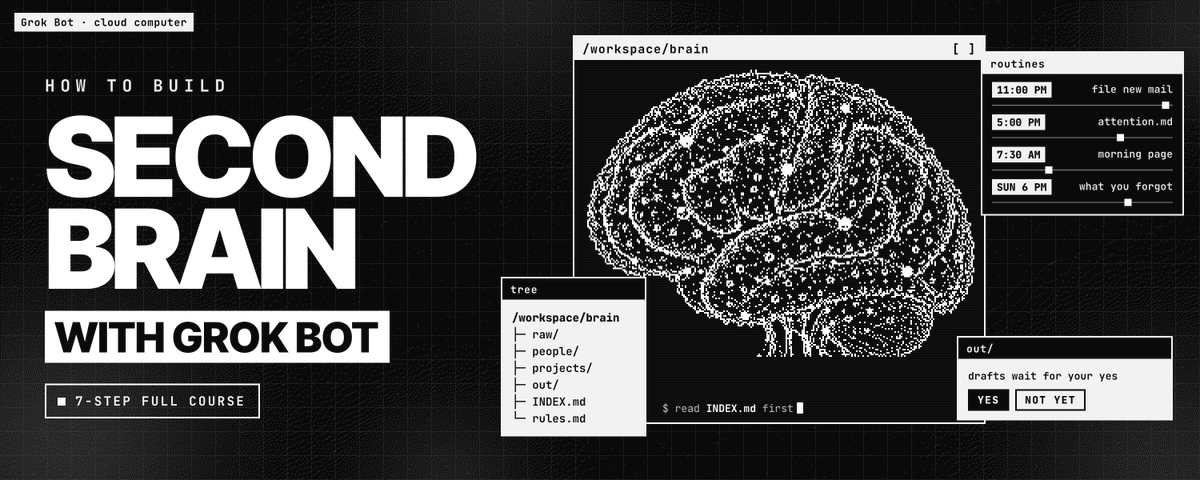
holy sh*t. Karpathy's second brain pattern runs on Grok Bot now: stop explaining your life to AI from zero every chat, keep a wiki that writes itself
three bots in one group chat, each with its own memory:
the reader takes every link, PDF and voice note you drop and never edits it
the librarian rewrites every wiki page that source touches, usually 10 to 15 of them
the checker wakes up on a nightly routine and hunts contradictions, stale claims and pages nothing links to
→ you ask a question: the answer gets filed back as a page, so the brain grows from use, not only from reading
→ a new source contradicts an old page: the checker tags you instead of quietly overwriting it
→ a page goes 30 days without a fresh source: it gets marked unconfirmed
a second brain can sound sure while remembering the wrong thing
Reader collects. Librarian writes. Checker doubts.
every page has to show:
> the claim
> the source it came from
> the date it was last confirmed
paste this into Grok Bot:
"Build me a second brain with three bots in one group chat. Keep my sources untouched in raw/, maintain wiki/ yourself, file good answers back as pages and run a nightly check for contradictions. Show me the structure first. Do not create anything until I confirm"
start with one topic you actually work on, not your whole life
full setup below

Justin retweeted

I had trouble fully unpacking what this paper actually was measuring, what its findings were, and what the implications are for human/primate consiousness
so i had Claude read through the paper and this thread, compose a script, and create an explainer video

1/ We discovered something totally unexpected about the neural structure of consciousness that overturns decades of thinking on its biological basis and brings us significantly closer to the recipe for generating conscious awareness.
New preprint: biorxiv.org/content/10.64898… (led by @HesseJanis, with @FrankLanfranchi, @_conor_mcgrory, @Yuelin_Shi, and @EngelTatiana)

Justin retweeted

LiquidAI d1-ultra beats Jev in every benchmark! It’s currently the most powerful decision model. These models will have an outsized impact on many physical processes, from robotics to decision-making in healthcare in emergency rooms. Congrats to my friends @ramin_m_h & @xanamini!

Today we release 𝚍𝟷-𝚞𝚕𝚝𝚛𝚊, our most powerful decision model.
> built for hard decision problems.
> d1-ultra is multimodal
> supports 44 languages
> #1 on the @ArtificialAnlys Decision Index (65)
> leads all eight categories of our 112-evaluation suite
1/


Justin retweeted

This is a WAY BIGGER DEAL than any new model launch.
We all gonna make it.


interpretability might be the most important scientific problem in the world right now, as I don't think we can solve alignment if we don't know what we're building. I think I have good news about it. I co-authored early work in mechanistic interpretability at OpenAI and came away pessimistic, because neural networks appeared to fold into arbitrary tangled knots. years later, I started openai's first large-scale automated interpretability project, finding about 2% of neurons legible with the primitive tools we had
with modern agentic tools and a much closer look, the picture looks totally different. the vast majority in models up to trillions of parameters are legible, and their circuits beautiful. many famous examples of tangled neurons turned out to be misunderstood. The roadblocks I expected mostly aren't there. I now think ambitious interpretability will be solved by the time we need it most, and possibly quite soon, as automated scientists keep improving. it may be a bitter lesson for interpretability: the simple thing, at absurd scale, works
already-clean.goodfire.com/

Justin retweeted

Andrej Karpathy:
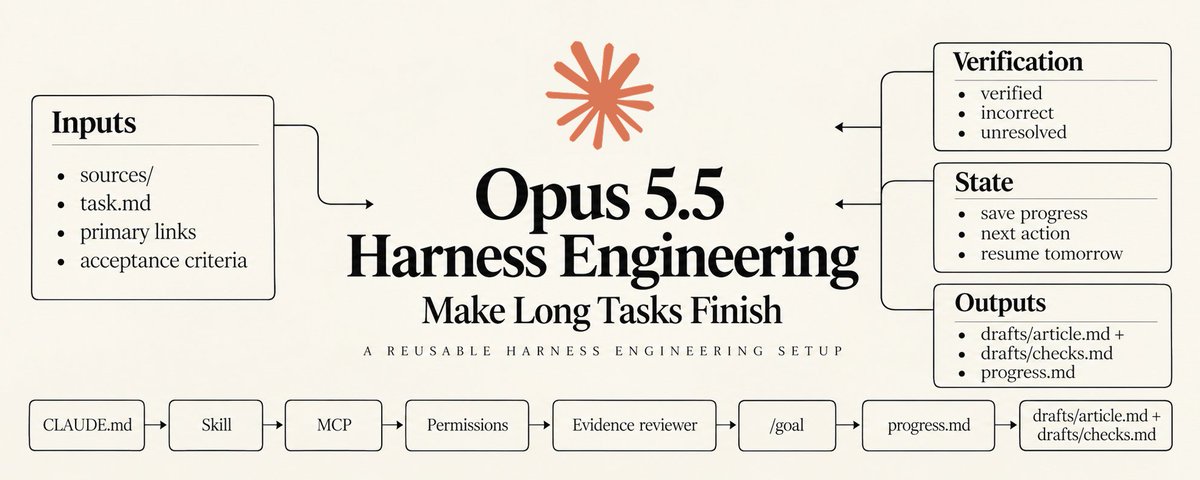
“Vibe coding is incredible. But Agentic + Opus 5.5 harness engineering is the next level.
99% of my coding routine is automated by AI agents.”
In this 30-minute talk, Andrej Karpathy explains how to build an AI agent workflow from scratch.
Worth more than $500 agentic engineering course on the internet.
Watch it today, then read the full guide for Opus 5.5 Harness Engineering