

Financial news and resources for high-net-worth investors and strategists
San Diego, CA
Joined June 2011
- Tweets14.8K
- Following913
- Followers11.2K
- Likes173



Financial Sense retweeted

The Perfect Energy Storm: Physical Scarcity, Phantom Inventories, And The Macro End Game
Mentions: $OIL $UCO $USO $BNO talkmarkets.com/article/the-…



Financial Sense retweeted

BREAKING: Brent crude oil prices surge above $112/barrel for the first time since May 6th.
Inflation expectations continue to push higher as gas prices in the US hit an average of $4.33/gallon.


Financial Sense retweeted

The Mathematical Certainty of the Coming Debt Storm: Why the Fed Is Trapped
🎩 by Jim Puplava @FinancialSense_ @JamesJPuplava
"We are shifting from an era where paper assets and financial engineering ruled, to an era where the cost of capital matters again. As the Fed is eventually forced to monetize the debt to stave off a sovereign default, the currency will be the ultimate release valve." 🎯
financialsense.com/blog/2181…

Financial Sense retweeted

BREAKING: Iran announces a large UAE-owned container ship carrying more than 2,500 containers hit a naval mine, exploded and sank this morning in the US-backed southern Omani corridor of the Strait of Hormuz.
It is the first vessel sunk by a mine in the war.
Initial reports indicate the cargo ship was carrying luxury perfumes and iPhones from Dubai.


Financial Sense retweeted
BREAKING: Israel is preparing to join the campaign against Yemen's Houthis, with Netanyahu seeking Saudi Arabia's approval through US mediation, per Haaretz.

Financial Sense retweeted

President Trump announced Russia has agreed to provide the world with millions of tons of diesel fuel over the next several months in a bid to decrease skyrocketing global prices. cbsn.ws/4jPkSJP

Financial Sense retweeted

JUST IN: The Pentagon is reportedly directing U.S. Central Command to finalize preparations for potential major combat operations and strikes against Iran, with planning reportedly underway ahead of the midterm elections.
@TreyYingst reports on the military preparations as questions grow over whether the U.S. could take further action against Tehran.

Financial Sense retweeted

Great to talk to Jim again. Trump has talked about inflating away the debt a few times now; this is a discussion about how that might happen and how you can protect yourself

Tindale: “You can’t pay the debt. You haven’t got the fiscal discipline. So you inflate it away.”
@ctindale calls it Financial Repression 2.0: higher rates to suck capital in, then lock it, then inflate.
The tell is gold. Central banks are taking it home. $9.5T is rolling from ~1% into ~4.5%. He thinks the regime breaks inside 12 months.
Full interview on Financial Sense Newshour:
financialsense.com/podcast/2…

Financial Sense retweeted
BREAKING: The US 30Y Note Yield rises above 5.60% for the first time since June 2002.
That’s another +36 basis points this month alone.
8% mortgages will arrive next week.

Financial Sense retweeted

Two weeks ago, AI was going to wipe out humanity.
Now, 88% of the species will survive.
Amazing improvement!

AI is powerful enough to kill a billion people if it falls into the wrong hands, Bill Gates has warned, as the Microsoft co-founder urged tougher government regulation of the technology. ft.trib.al/apO3uEU

Financial Sense retweeted
BREAKING: Brent crude oil prices rise above $107/barrel after the Houthis say they attacked a Saudi Arabian military site.
US oil prices are now back above $95/barrel.

Financial Sense retweeted

I sat down earlier this week with Cris Sheridan of Financial Sense to discuss my recent report on "The AI Trade". I broke down my concerns about enterprise adoption rates, unit economics, and buildout constraints. This year will see roughly $200 billion in enterprise AI spend. By best estimates, that number must reach $2.5 trillion to offset AI CAPEX, more than the tech sector's combined revenue currently. Enterprise AI usage is still plagued by model weaknesses, from hallucination to agentic token burn to a bias to please. Meanwhile, domestic and Chinese competition is compromising pricing power. And the buildout faces seemingly intractable supply chain, labor, and electricity limitations alongside an intensifying political backlash.
You can read the executive summary of my report on "The AI Trade" here: sageroadresearch.com/product…
You can listen to a few minutes of the interview here:
financialsense.com/podcast/2…

Financial Sense retweeted
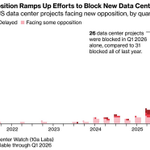
WSJ: "The AI build-out is on track to become the biggest economic bet in US history, dwarfing investments made to fund other huge US infrastructure projects such as the railroads, the highway system and the plumbing for the internet. Investment in data centers and related AI infrastructure is projected to total $10.3t from 2025 to 2032, according to new estimates by economist Stijn van Nieuwerburgh. That is a staggering 3.6% of GDP a year, on average. Never before has the US economy been so dependent on the build-out of a single industry."
Deeply concerning given how deeply AI spending is now woven into the US and global economy and how many threats remain that could derail expectations of AI ROI on any reasonable timeline. For just a snapshot overview of the AI vulnerability, here are some stats from my report on "The AI Trade" (sageroadresearch.com/product…):
"To put some numerical context to AI bubble warnings, in our December report on “GenAI & Productivity”, we cited a calculation by former IMF Chief Economist Gita Gopinath: “A market correction of the same magnitude as the dotcom crash could wipe out over $20t in wealth for American households, equivalent to ~70% of American GDP in 2024.” She also calculated that foreign investors would lose ~$15t. She made those calculations in late 2025 and given how AI-trade concentration has increased since, undoubtedly those numbers are now greater.
AI investment now accounts for 25% of US GDP growth and 8% of total GDP, exceeding the dotcom-bubble’s peak of 6.5% of GDP. The value of AI-linked firms has climbed ~$27t in the past three years, equivalent to 36% of the value of the entire US stock market. As a result, the five biggest companies in the S&P 500 now account for ~30% of the indexes’ total market cap, up seven percentage points versus five years ago. And AI-driven concentration is not just a US equity phenomenon—the top 10 firms in the MSCI Emerging Markets Index account for 41% of its total market cap, with just three semiconductor manufacturers making up 29%. Then there’s the debt picture: roughly a quarter of US gross investment-grade debt issuance this year has come from AI-related companies. And the venture capital picture: over the past 12 months, AI companies have received roughly two-thirds of all US venture capital dollars."
History does not lend confidence about AI's path forward. As the FT wrote in late June, recapping findings of a BIS study: “Historical episodes of investment booms provide ‘instructive parallels’—among them the expansion of canals in the 1830s, railways in Britain in the 1840s and the dotcom boom of the late 1990s. These all had one key feature in common, a genuine technological breakthrough that attracted capital in excess of what commercial returns could ultimately justify.”
WSJ link: wsj.com/economy/the-ai-build…

Financial Sense retweeted

The world isn't running out of oil. It's running out of places to turn it into diesel.
Crude is actually cheaper than it was in 2022, with Brent around $99 a barrel versus roughly $123 at that year's peak. Yet diesel just hit an all-time record.
Of the $2.25 jump in U.S. diesel prices since February, just 68 cents came from crude. The refining margin alone added an estimated $1.71, with other components offsetting part of the increase.
The wars didn't take out the oil fields, they took out the refineries.
Damage and disruption in the Middle East and Russia, plus China holding back its own refiners, have knocked roughly 5 million barrels a day of refining capacity offline.
The Gulf hit is the big one, with around three times more diesel supply lost there than in Russia.
That's after Gulf states spent a decade building giant refineries and overtaking North America as the world's top diesel exporter.
Meanwhile the West went the other way.
Western oil companies haven't built a major new refinery in decades, more than a dozen have closed across the U.S. and Europe since 2015, and Britain went from 9 refineries at the start of the century to just 4.
U.S. refineries have been running in the high 90s, leaving very little room to push harder, while restarting old plants or building new ones takes years.
The usual emergency fix won't help much either. America's Strategic Petroleum Reserve holds crude, not diesel.
And some available capacity is stuck for political reasons too. A Lukoil refinery in Romania remains idle while its proposed sale to Carlyle crawls through Washington approvals.
For decades the energy security question was who controls the oil.
Turns out it's who can actually refine it.
Sources: WSJ, Agricultural Economics, OilPrice, Business Standard / Writer: Julie


Financial Sense retweeted

#Space is being weaponized, #oil is heading to $150, and the world’s geopolitical red lines are being crossed one by one — is your portfolio ready? 🚀🛢🔥
@TheMacroButler is back on the @FinancialSense_ Podcast for a wide-ranging deep dive into the fault lines that will define the second half of 2026 and beyond. He connects the geopolitical dots the consensus keeps ignoring:
🚀 The weaponization of space — with the Pentagon now openly admitting on-orbit weapons, the arms race has added a third dimension, and the strategic implications for markets are only beginning.
🛢 $150 oil — why the diesel crack spread at record highs, two closed chokepoints, an SPR at a 40-year low, and a war cycle with no off-ramp are pointing crude far higher than the consensus dares forecast.
⚔️ Geopolitical red lines — from Hormuz to the Black Sea to Taiwan, the map of escalation is expanding, and every crossed line reprices risk the market hasn’t yet absorbed.
🥇 Where the smart money shelters — gold, silver, energy producers, and the hard assets that thrive when paper promises break.
Zero hopium. Zero soft landings. Just the macro playbook history keeps validating.
🎧 Listen to the full conversation on the Financial Sense Podcast now.
themacrobutler.substack.com/…