

Exploring new models & mechanisms for public goods funding, via events, residencies, hackathons & real-world pilots. Incubated by @ProtocolLabs. 🤝
The Commons
Joined June 2022
- Tweets5.2K
- Following798
- Followers8.9K
- Likes50.6K






Funding the Commons retweeted

What is a philosopher-builder?
A philosopher-builder is someone who starts from a thesis about human flourishing.
Rather than simply looking for a gap in the market, they start out with a vision of the human capacities that are worth developing, what constrains them, and how we can expand them.
They reason from first principles about human potential and translate those insights into products or institutions.
To understand what a philosopher-builder is, it’s important to grasp what they are not:
1. They are not philosopher-kings. They do not have a blueprint for a society or a theory about how everyone out to live. Some of our most importance capacities are independent judgment, creativity, and the pursuit of knowledge. They seek to expand these capabilities, not prescribe outcomes
2. Open to disconfirming evidence. A strong philosophical starting point is open to rational criticism and has to be tested against reality. Their hypothesis is open to challenge and evidence should not only inform how they build their product, but potentially cause them to revise their underlying thesis. Philosophical seriousness demands intellectual humility.
3. Not a nihilistic iterator. “Make something people want” is a powerful entrepreneurial discipline, but by itself, it cannot establish whether satisfying people’s immediate wants advances human flourishing. You cannot outsource your belief in which ends are worth pursuing to market feedback.
The philosopher-builder is someone who combines philosophical conviction with empirical discipline. They have a vision, ambition, and an openness to revision.
We believe that AI isn’t a normal technology like the internet or the smartphone that society will simply absorb. Instead, it will create the biggest opening for institution-building since the American founding and philosopher-builders will be more important than ever.
If this vision of how to build resonates with you, we want to hear from you.
Funding the Commons retweeted

Announcing our first Long Now Labs awardees in partnership with the Protocol Institute. We received 370+ exceptional submissions — and we’re thrilled to unveil the three awardees chosen to develop their concepts into prototypes. The awardees for Book of Time are:
▪️Matthew Caren and Anastasha Rachel Gunawan for “Lagu Hantu,” a handmade instrument installation that remembers everyone who has ever played it.
▪️Eirini Malliaraki (@irinimalliaraki) with “One Billion Clocks” a kinetic sculpture that tracks the metabolic time of soil
▪️Sarah Friend (@isthisanart_) for “Thermodynamic Clock for LLMs” which will test whether giving models access to different experiences of time will alter their behavior
Over the coming year, each team will develop its concept into a working prototype with $25,000 in funding and support from Long Now. Their work will appear alongside 27 selected submissions in the Book of Time anthology, coming in spring 02027.
For our second Lab, Epistemic Cycles, UC Berkeley scholar Nina Begus (@ninabegus) will serve as Lab Lead. She’ll convene an interdisciplinary working group to build an atlas of information ruptures (from writing to generative AI) and of how societies have repaired them.
Our third Lab, Interspecies Protocols, launches in 02027.
Thank you to everyone who applied, to our partners at the Protocol Institute, and to our review panel. Read the full description of these incredible projects on Ideas here: na2.hubs.ly/H08xGzF0


仁, the Chinese character for humaneness, is made of a person and the number two.
Our humanity lives between people, not inside our heads. Worth remembering as we build what comes next.

This is perhaps one of the great ironies of our time: China is increasingly shaping the future of AI, yet very few people in the West have the faintest idea how its key thinkers see it - its philosophers, sociologists or ethicists.
As is too often the case, we - much like the frog in the well - assume our own AI debate covers every possible view, when much of it springs from the same cultural soil, built on assumptions about what defines us that we don’t even know we’re making.
Take for instance the assumption that intelligence is a key part of what makes us human. It’s so intuitively obvious to us that we literally named our species after it - Homo sapiens (Latin for "wise man").
If you think about it, just this assumption explains a large share of the anxiety: if intelligence is what makes us human, then artificial intelligence - or super intelligence - threatens the very thing that makes us us: we’re about to compete with artificial or super “us”. No wonder this feels existential.
But China has a tradition of thought as old as ours, if not older, and every bit as rich and sophisticated, which never placed intelligence at the core of what makes us human, and so meets the thinking machine from a completely different starting point.
Have you, for instance, ever heard of Zhao Tingyang? Probably not, and yet he may be the most original thinker on AI you’ve never read. He’s one of China’s most prominent philosophers, at the Chinese Academy of Social Sciences. While Silicon Valley spends billions trying to make AI share our values, he for one argues that doing so “may very well be a suicidal mistake”.
Sounds pretty important to hear him out, don’t you think?
Or take Liu Yongmou, a philosopher of technology at Renmin University in Beijing. His thinking is almost the opposite of ours. Where we fear machines that become more and more like us, he says that “humanity’s biggest problem is the machinization of humans, not the humanization of machines.”
You could even go back to antiquity, when, in many ways, we started asking questions about AI.
Did you know, for instance, that Aristotle, in the Politics, imagined a world where “the shuttle would weave and the plectrum touch the lyre without a hand to guide them”, and wondered about the social order consequences of this (mostly whether slaves would still be needed)?
There are Chinese equivalents to this. For instance, in the Zhuangzi, a foundational Taoist classic, you’ll find a similar thought experiment, with a completely different worry attached. An old gardener is watering his vegetables by hand, hauling water out of a well jar by jar. A visitor shows him a labor-saving device, and the gardener turns it down for the reason that whoever uses machines ends up with 机心 (jīxīn), a “machine-heart” - a mind that schemes, calculates and loses its simplicity. “It is not that I do not know [the machine],” he says, “but I should be ashamed to use it.”
Two labor-saving machines, two very different questions: where Aristotle wondered what automation would do to the social order, the Zhuangzi wondered what it would do to us, on the inside. Which, you’ll notice, is exactly Liu Yongmou’s worry, more than two thousand years earlier.
In fact, as we’ll see, 心 (xīn), the heart, is a motif that runs deep through the Chinese AI debate. It appears both in the fear, from Zhuangzi to Liu Yongmou, that machines could give us a “machine-heart” and its mirror image: the ambition to give machines a heart of their own. Zhu Songchun, who heads the Beijing Institute for General Artificial Intelligence, wants “to set a heart for machines” (为机器立心, wèi jīqì lì xīn).
“Heart” in the Chinese sense, that is, which differs totally from the Valentine's Day fluff we’ve reduced it to. 心 (xīn) means heart and mind at once: it’s where we feel but also where we think, tell right from wrong and care for others.
And, crucially, it’s in the heart that the quality Confucianism sees as the very definition of a human being takes root: 仁 (rén). We need two words to translate it, “benevolence” and “humaneness”, but in Chinese they’re one and the same: to be benevolent is to be human. It’s not about intelligence.
This is the entire point of my new article: to step out of our well for a moment and peer over the edge of China's.
What you’ll find there will, I think, surprise you, with questions you’d never thought to ask: from Zhao Tingyang warning that AI’s bad consequences can at least be fought, but that “humanity may die of all the good things AI creates”, to whether the fear that AI will make us “useless” rests on the false premise that a person is worth what they’re useful for.
A premise that a 2,300-year-old Taoist tree, which survived precisely because it was useless, demolished long ago. Could our predicted uselessness turn out, much like that tree’s, to be our saving grace?
Chinese thinkers’ answers to these questions are, I think, among the most interesting anyone has given to the defining question of our time. Whether or not you agree with them, they’re the intellectual backdrop of a country shaping much of AI, and with it our future: you might as well know what they think.
Enjoy the read here: arnaudbertrand.substack.com/…


Funding the Commons retweeted

In less than a month, Vision Weekend returns to San Francisco. This time to mark 40 years of Foresight!
Across iconic locations like the USS Hornet, @internetarchive, The Fold, and Lighthaven, the weekend brings expert talks, office hours with your favorite orgs, $10K pitch competition, behind-the-scenes lab tours, 1:1 connections, a sci-fi book swap, plus our main 40th anniversary celebration in the US.
Full lineup:
Secure, Sovereign & Resilient AI
• @woj_zaremba, OpenAI Foundation
• @ilblackdragon, NEAR Protocol
• @sebkrier, Google DeepMind
• Jenny Read, ARIA
• @gladstein, Human Rights Foundation
• @zweinberg, ex ante
Neuro AI & AI for Neuro
• @SumnerLN, Merge
• Matt Angle, Paradromics
• Matthew MacDougall, Neuralink
• @maxhodak_, Science Corporation
• @JoanneZPeng, Amaranth Foundation
• @AdamMarblestone, Convergent Research
Life Unlimited: Biotech & Biosecurity
• @thekaransinghal, OpenAI
• @mattkrisiloff, Conception bio
• @hannu, Red Queen Bio
• @velychko_s, Soxogen Bio
Molecular Manufacturing, Nanotech, Energy & Space
• Ralph C. Merkle, Institute for Molecular Manufacturing
• Ivan Jayapurna, ARIA
• @schingler, Planet Labs
• @erika_alden_d, Pioneer Labs
• @ltelkins, UC Berkeley - Space Sciences Lab
New Funding & Innovation Paradigms
• @tkalil2050, Renaissance Philanthropy
• @FutureSaenko, Future Ventures
• @v_maini, Mythos
• @_mattmandel, Cosmos Ventures
Nonprofit Funding Perspectives
• @nanransohoff, Public Goods at Stripe
• @rohan_subramani, Coefficient Giving
• @seemaychou, Astera Institute
Existential Hope
• @mattbotvinick, Anthropic
• @RosieCampbell, Eleos AI Research
• @PracheeAC, Astera Institute
• @sreeramkannan, Eigen Labs
• @NicoleOzer, Electronic Frontier Foundation
+ an Anti-Debate hosted by @Liv_Boeree
With the All Access pass, you’re invited to join speakers, sponsors, fellows, and grantees at exclusive gatherings across the Bay Area, including lab tours at @E11BIO, @LongshotSpace, @calwave_energy, @DolphinLabs, and @ScienceCorp_ , plus attend our 40th anniversary soiree. A limited number remain.
Links in thread.
Powered by: @protocollabs, @eigenlabs, @paradromics, @RetroBio_, FUTO, and @d_model_ai
We won’t always agree. We won’t always get it right. But we can keep deciding together what matters, and act on it.
A thought from @mdennedy_ for builders.
youtube.com/watch?v=gLI36_XP…

Funding the Commons retweeted

📅 One week.
For eight weeks, we've been showing you tools you can use to save, discover, contribute, and connect.
On October 21, we're bringing those ideas together.
🏛️ Democracy's Library: Tools for Participation
One celebration. A lot of ways to participate.
▶️ ONLINE:
eventbrite.com/e/democracys-…
🎟️ IN PERSON in San Francisco:
eventbrite.com/e/democracys-…
#ToolsYouCanUse

ALT Cream promotional graphic pairing an Internet Archive tools grid with a panel reading "Democracy's Library: Tools for Participation," a matching circuit-line doodle, and event details: Wednesday, October 21st, 5pm-10pm, Internet Archive, 300 Funston Ave., San Francisco.
Does AI have to end up in a few hands?
@TheDRC_ asked the people building the alternatives, 36 of them, and walked the whole stack to find out. In two places, yes, for now. Everywhere else, no.
thedrcenter.org/research/alt…

Funding the Commons retweeted

Vision Weekend @foresightinst 40th Speaker Sneak Peek
Secure, Sovereign & Resilient AI
+@woj_zaremba, OpenAI Foundation
+@ilblackdragon, NEAR Protocol
+@sebkrier , Google DeepMind
+ Jenny Read, ARIA
+@NicoleOzer, Electronic Frontier Foundation
Neuro AI & AI for Neuro
+@SumnerLN, Merge
+ Matthew MacDougall, Neuralink
+@maxhodak_ , Science Corporation
+@JoanneZPeng, Amaranth Foundation
+@AdamMarblestone, Convergent Research
+@Matt_R_Angle, Paradromics
Life Unlimited: Biotech & Biosecurity
+@thekaransinghal, OpenAI
+@mattkrisiloff, Conception Bio
+
@hannu, Red Queen Bio
+@velychko_s, Harvard University
Nano, Energy & Space
+ Ralph Merkle, Institute for Molecular Manufacturing
+Ivan Jayapurna, ARIA
+@schingler, Planet Labs
+@erika_alden_d, Pioneer Labs
+ @ltelkins, UC Berkeley Space Sciences Lab For Profit
Funding Paradigms
+@v_maini, Mythos
+@zweinberg, Ex Ante
+@_mattmandel, Cosmos Ventures
Nonprofit Funding Paradigms
+@nanransohoff, Frontier Climate
+@rohan_subramani, Coefficient Giving
+@seemaychou, Astera Institute, Navigation Fund
+@tkalil2050, RenPhil
Existential Hope+
+ @mattbotvinick, Anthropic
+@RosieCampbell, Eleos AI Research
+@PracheeAC, Astera Institute
+@robinhanson, George Mason University
+@gladstein, Human Rights Foundation
+ Anti debate with @Liv_Boeree
+ Office hours with our favorite orgs, @AsimovPress, @BuckInstitute, @BlueDotImpact, @activatefellows, @farairesearch, @collect_intel, @Spec__Tech, @JoinEdgeCity, @LBF_org, @PrincInt, @TheIHS, and more.
+ Sci-fi book swap, unconference, pitch competition, tech demos, anniversary festivities, tea social, and more. + Speaker & Sponsor Gatherings like pre-party aboard the USS Hornet aircraft carrier, lab tours at @E11BIO, @LongshotSpace, CalWave,@ScienceCorp_, Dolphin Labs, plus a Foresight 40th Anniversary Soiree.
It's hard to overstate how excited I am for this weekend celebrating futures of Existential Hope unlocked by science and technology. Thanks to our partners for making this event possible @protocollabs, @paradromics, @RetroBio_, @eigenlabs, @FUTO_Tech, @d_model_ai
Event page & tickets: foresight.org/events/vision-…

We’ll be at @foresightinst’s Vision Weekend in SF, Nov 13–15, running office hours.
About 300 researchers and founders in AI, neurotech, longevity, and space, in a room with the people who fund them, plus a full track on new ways to fund that work. 🌐
foresight.org/events/vision-…


Funding the Commons retweeted

We're excited to share the projects selected in our latest privacy funding round. 100 ETH up for grabs in matching funds thanks to @GolemFoundation
Meet the Epoch 13 cohort:
@0xCurvy
@BlockchainComns
@CorpusCoreHQ
@hisoka_io
@OfflineProtocol
Private Proof of Innocence
@session_app
@ShutterNetwork
@SimpleXChat
@staycloakedxyz
@torproject
@UmbraCash
@unredacted_org
@vocdoni
@wslyvh
Allocation Window: 14 October - 21 October, 2026
You can allocate for 7 days.
Participation is open to:
- All GLM lockers who've accrued WETH rewards on Octant
- All Ethereum users who can directly contribute in ETH

Funding the Commons retweeted

Governance is often treated as overhead until something breaks.
If we want it to receive serious attention and investment, we need to become better at explaining what risk it prevents, what value it protects, and what better governance actually changes.
luma.com/sh98otew

Funding the Commons retweeted

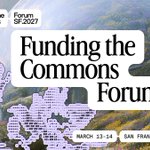
Funding the Commons in SF, March 2027, is going to be amazing!

Thank you to everyone who has registered, applied to speak, and shared the Funding the Commons Forum in San Francisco so far.
We've moved it to March 13–14, 2027. It was a tough call, but we need more time to make the Forum what we know it needs to be for the question at its heart: what public goods, shared infrastructure, and institutions look like in the age of AI.
If you've wanted to speak, partner, or curate with us, there's now more room to do that, so please reach out at [email protected].
More on the Forum: fundingthecommons.io/events/…

Will abundant intelligence become the widest shared inheritance in history, or the narrowest concentration of power ever assembled?
On November 7-8, the Funding the Commons Forum comes to San Francisco.
200 researchers, engineers, policymakers, and funders, gathering to shape the answer.

The forum has been moved to March 13-14, 2027.
xitter.cf/FundingCommons/status/…
Thank you to everyone who has registered, applied to speak, and shared the Funding the Commons Forum in San Francisco so far.
We've moved it to March 13–14, 2027. It was a tough call, but we need more time to make the Forum what we know it needs to be for the question at its heart: what public goods, shared infrastructure, and institutions look like in the age of AI.
If you've wanted to speak, partner, or curate with us, there's now more room to do that, so please reach out at [email protected].
More on the Forum: fundingthecommons.io/events/…
AI could become the widest shared inheritance in history, or the narrowest concentration of power ever assembled.
It can still be the first, but only if the people building the models, mechanisms, and policies work together.
200 of them in SF. Nov 7-8.
luma.com/ftcforum-sf-2026

The forum has been moved to March 13-14, 2027.
xitter.cf/FundingCommons/status/…
Thank you to everyone who has registered, applied to speak, and shared the Funding the Commons Forum in San Francisco so far.
We've moved it to March 13–14, 2027. It was a tough call, but we need more time to make the Forum what we know it needs to be for the question at its heart: what public goods, shared infrastructure, and institutions look like in the age of AI.
If you've wanted to speak, partner, or curate with us, there's now more room to do that, so please reach out at [email protected].
More on the Forum: fundingthecommons.io/events/…
Funding the Commons retweeted
Restricting access to knowledge can have consequences far beyond a single blocked user. 🔒
Publisher Charles Watkinson of University of Michigan Press warns that locking up content can damage the open ecosystem and limit collaboration in knowledge production.
On the Future Knowledge #podcast, Watkinson joins educator Lisa Petrides and librarian Chris Bourg for OPEN FOR WHOM? 📚
🎧 Listen & subscribe ⤵️
futureknowledge.transistor.f…
@mchris4duke @Lisa4Trustee @charleswatkinso
The more memory we hand to machines, the more the human kind needs keeping.
Stephan Zimmerli's Studiolo of Exile does that in charcoal, drawn live from the memories of people who had to leave home.
One of our favorite art activations at FtC.
youtube.com/watch?v=HRj-o1J5…

The people who saw AI coming built labs, benchmarks and safety teams. What they haven't built yet: the schools, courts, funds, and markets for the world those labs are making.
@chalmermagne and @lawhsw for @cosmos_inst on getting started.
blog.cosmos-institute.org/p/…
