

Research: DeFi | RWAs In Web3 Since 2017. Survived 3 cycles. Founder @tokastra | Advisor @DinariGlobal
Joined January 2023
- Tweets39.6K
- Following2.2K
- Followers41.3K
- Likes63.9K
Hercules | DeFi retweeted

why is @aave blocking my wallet for no reason?
the reason is @trmlabs. aave uses them to screen every wallet that connects to the app. @StaniKulechov replied and said he'd look into it.
honestly aave shouldn't be using them at all.
> 2022: someone sent 0.1 eth from tornado cash to 600+ random wallets. aave's site, running on trm, blocked all of them, @justinsuntron included.
> 2022: uniswap blocked 253 addresses through trm in 4 months. banteg went through the logs. about 30 had ens names and were probably just regular users.
> 2023: trm tagged all of pulsechain as "decentralized investment fraud". people who just used the bridge got blacklisted on celer.
> 2026: tron and tether ran a crime unit with trm. it was quietly shut down in august, bloomberg says because of slow response times. they started a new one with chainalysis.
> a researcher, richard sanders, wrote a piece called "trm exposed: paid by tether to lie" and later accused firms like trm of conflicts of interest in the rusi journal.
> trm has won $135m in us government contracts (ice, fbi, irs), including a $94.6m no-bid deal with ice. their real customer is the government.
> @chainalysis sued over that ice deal, saying the rules were written to fit trm. some accounts called it a "corrupt" deal.
> some people also tied it to ice deportations.
> last week trm promoted a partner that uses "breached data" to link people to their online accounts.
> and when trm gets it wrong, nobody is responsible. trm says it doesn't block anyone, it only sells "risk data".
> us flagged mexc for money laundering in november (not an ofac sanction, mexc disputes it). htx was sanctioned by the uk in may, not by the us.
> people who just withdrew their own money from mexc or htx to their wallet are now getting flagged on trm
> and trm pushes it further. it tells compliance teams to go beyond the official htx list and use its tool, which catches new htx wallets "as they appear" and "indirect exposure".
do you think the biggest defi protocol should still use something like trm?
yes i know, i can still call the contract directly. but i've been a big aave user for years. i shouldn't have to go through etherscan to reach my own money because their website suddenly decided i'm a risk.


Hercules | DeFi retweeted
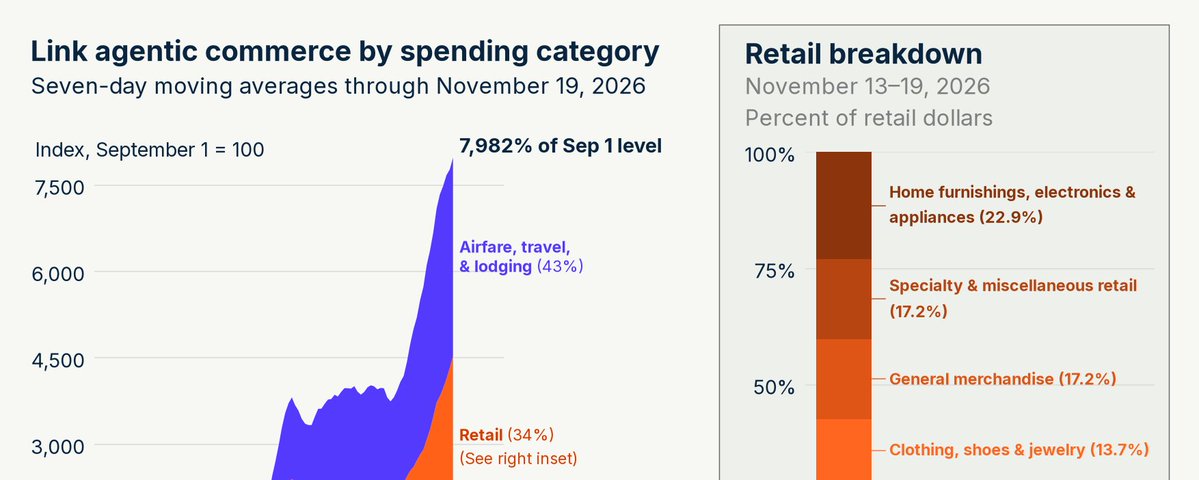
the agentic commerce boom


We're releasing new @Stripe agentic commerce data today, telling the story so far as we look ahead to the kickoff of the holiday season next week.
Hercules | DeFi retweeted
BTC plunged near $55K.
yet DeFi TVL continues to climb.
The opportunities right now are honestly hard to ignore.👇
----------------------
➢ @SuiNetwork launched Hashi on mainnet, bringing Bitcoin-backed lending to Sui, with @0xfluid enabling users to borrow USDC against hBTC and @upshift_fi launching BTC and USDC vaults.
----------------------
➢ @1inch integrated @HyperliquidX perps into its dApp and wallet, allowing users to fund positions with existing tokens converted into USDC without leaving 1inch.
----------------------
➢ @Morpho expanded its partnership with @coinbase, bringing Coinbase Borrow to New York and completing its rollout across all 50 US states.
----------------------
➢ @aave launched its Android mobile application while its V4 deployment on @base recorded $7.7M in stock-backed loans.
----------------------
𝐘𝐢𝐞𝐥𝐝 𝐅𝐚𝐫𝐦𝐢𝐧𝐠 𝐏𝐨𝐨𝐥𝐬
➢ sd-PYcrvUSD-vault
DApp: @StakeDAOHQ
Chain: @ethereum
Supply APY: 11.60% (30d avg)
Category: Yield Vaults
TVL: $16.76M
➢ USDS-1
DApp: @yearnfi
Chain: @ethereum
Supply APY: 10.91%
Category: Yield Vaults
TVL: $16.0M
➢ USDC
DApp: @HyperliquidX
Chain: @HyperliquidX
Supply APY: 10.69% (30d avg)
Category: Derivatives
TVL: $151.75M
➢ USDC
DApp: @NawaFinance
Chain: @ZIGFinance
Supply APY: 9.33% (30d avg)
Category: RWA
TVL: $3.4M
➢ zSMB
DApp: @centrifuge
Chain: @pharos_network
Supply APY: 8.57% (30d avg)
Category: RWA
TVL: $1.01M
➢ fUSDC
DApp: @0xfluid
Chain: @ethereum
Supply APY: 7.17% (30d avg)
Category: Lending
TVL: $146.24M
➢ ZIG
DApp: @Valdora_finance
Chain: @ZIGFinance
Supply APY: 5.38% (30d avg)
Category: Liquid Staking
TVL: $4.91M
➢ BTC
DApp: @Chainflip
Chain: Chainflip
Supply APY: 4.50%
Category: Liquidity Provision
TVL: $3.97M
➢ aInkWlUSDT
DApp: @tydrohq
Chain: @inkonchain
Supply APY: 3.94% (30d avg)
Category: Lending
TVL: $212.79M
Which did I miss? Lemme know in the comments 👇

Hercules | DeFi retweeted
Is crypto actually dead, or has CT just lost faith?
> stablecoin transfers are approaching 6B quarterly, with USDC now matching USDT in several quarters.
> tokenized equity supply has climbed to $3.75B, with bStocks emerging as a major contributor alongside @Ondo and @xStocksFi.
> finance apps now generate 43% of crypto project revenue, that mark a significant shift away from onchain-led revenue.
> DEX spot volume has reached 25.5% of CEX volume, putting DEXs at roughly a quarter of CEXs trading activity.


Hercules | DeFi retweeted
only 5-month-old and @RobinhoodCrypto has processed over $132B in DEX volume.
the growth makes sense when you look at what's happening across it.
> $989M in TVL across the chain.
> $132.17B in cumulative DEX trading volume.
> $989M in stablecoin market cap.
> over $1B in daily perps trading volume.
➥ 𝐃𝐄𝐗𝐬
Robinhood opened its public testnet in February.
testnet had processed millions of transactions before mainnet in July.
mainnet brought another wave of liquidity and trading activity.
@Uniswap expanded its presence through v4 and programmable hooks.
hooked pools have generated $25.72B in volume across 32,800+ initialized hooks.
Robinhood now leads every chain in hooked volume.
the VolatilePair hook introduced dynamic fees for the ETH/USDG pool.
@PancakeFi rolled out The Flip, giving LPs 88% of swap fees on v3 and Infinity pools.
@Uniswap, @aeroxyz and @metricxyz are among its leading DEXs.
➥ 𝐑𝐖𝐀 𝐚𝐧𝐝 𝐭𝐨𝐤𝐞𝐧𝐢𝐳𝐞𝐝 𝐚𝐬𝐬𝐞𝐭𝐬
RWA is still one of the most important parts of Robinhood's direction.
it introduced its new stock tokens alongside the mainnet launch.
this opened up new opportunities for devs to build around tokenized equities.
@Uniswap, @ArrowFinanceio and other protocols began integrating these assets into trading and lending products.
we also saw some events that even added to the growth.
> @TheIndexFi introduced a mechanism that uses trading fees to purchase tokenized stocks.
this gave holders more exposure to stocks like NVIDIA, TSLA etc.
> @ArrowFinanceio introduced borrowing markets backed by tokenized stocks and crypto.
> @vimenprotocol also came with tokenized baskets, giving users a way to gain exposure to groups of Stock Tokens.
> @arcus_xyz expanded the trading side with perps for tokenized equities and other assets.
RWA adoption has continued growing on robinhood.
➥ 𝐃𝐞𝐅𝐢
DeFi on robinhood has grown through new financial products and infra.
the v4 hooks was brought by @uniswap and it has generated over $25B in volume
> @Morpho also joined the lending infra behind the robinhood earn.
the flip was launched by @PancakeFi and this infra is giving LPs 88% of swap fees.
> @RamsesExchange brought concentrated liquidity and ve(3,3) infrastructure.
> @0xT3tris introduced managed yield vaults operated by independent managers.
also, robinhood chain runs on @arbitrum orbit stacks and the collab has been good.
@arbitrum just launched the second cohort of its mentorship program with robinhood.
it is backing early-stage teams building on arbitrum one and robinhood chain.
this is another measure to see more developments.
➥ 𝐌𝐞𝐦𝐞𝐜𝐨𝐢𝐧𝐬
we all could say robinhood brought huge volume on memes this year.
it was really one of the big surprises from the launch.
there were different memes that did billions in volume.
there was $CASHCAT, $PONS and many more.
$CASHCAT led the first wave, reaching over $200M in market cap within just over a week.
@ponsdotfamily emerged as one of the leading launchpads and its meme almost touched $1B market cap.
we saw @longdotxyz introduced a different approach by pairing memecoins directly with tokenized stocks.
it opened up markets such as Artificial Inu ($AI), which trades against tokenized NVIDIA.
a report from CoinGecko said memecoins accounted for 79.2% of Robinhood Chain's DEX volume on July 27.
that's how huge memes have been on robinhood.
Robinhood so far this year
it has had a remarkable first year, considering how old it is.
the growth across DEXs, perps, memes and tokenized equities shows how quickly its ecosystem has developed.
there is still so much we will see from robinhood.
especially as more tradFi assets are finding their way into the markets.
looking forward to seeing what the ecosystem brings in the coming year.




Hercules | DeFi retweeted
selling stocks isn't the only way to access liquidity.
tokenized equities are opening new opportunities across DeFi.
$300M in tokenized stocks has entered DeFi and grown 24x in a year.
the growth is opening another chapter for tokenized equities.
> tokenized stock deposits now represent 6.3% of market cap.
> that figure was only 2.4% one year ago.
> investors are beginning to use stocks as collateral.
the next phase is even going to be interesting.
➥ several protocols are expanding these opportunities.
@aave launched its Coinbase Equities Hub on Base.
the September launch introduced 7 tokenized stocks as collateral.
these include Apple, Amazon, Nvidia and Microsoft shares.
eligible holders can now borrow USDC against them.
@chainlink provides the pricing feeds for these collateral markets.
@Morpho has also expanded its tokenized stock lending markets.
@RobinhoodApp Stock Tokens became available as collateral on Morpho.
eligible holders can borrow stablecoins against supported stock tokens.
the integration initially brought assets like NVDA and GOOGL.
➥ yield strategies are adding another growth opportunity.
@krakenfx launched its xStocks Vaults through @Kamino.
the September integration supports SPYx, QQQx and NVDAx.
@veda_labs provides vault infra for these yield strategies.
@SentoraHQ handles strategy curation and risk management.
the vaults use tokenized equities as lending collateral.
borrowed stablecoins are deployed into additional yield strategies.
rewards are converted back into the deposited equities.
this allows holders to pursue additional stock-denominated yield.
➥ the growth potential across these markets looks really good.
tokenized equities are becoming increasingly useful within DeFi.
> holders can borrow without selling shares.
> lending markets are attracting more equity collateral.
> yield strategies are encouraging additional equity deposits.
i believe this is another important growth opportunity for the ecosystem.


Hercules | DeFi retweeted
do you even know if your DeFi yield depends on a weak asset?
a vault could hold an A-rated protocol while its underlying asset carries a BB rating.
that difference could change the risk rating of the entire strategy.
this is why you need to understand how these ratings work.
and how @Shift_DeFi is making use of it well
➥ 𝐓𝐡𝐞 𝐭𝐡𝐫𝐞𝐞 𝐫𝐢𝐬𝐤 𝐥𝐚𝐲𝐞𝐫𝐬.
a DeFi strategy can depend on multiple assets, protocols, and networks.
each layer introduces different risks that can affect deposited capital.
@Shift_DeFi separates these factors into 3 blocks.
> asset risk evaluates the tokens used by a strategy.
> protocol risk examines the infra managing those assets.
> network risk considers the underlying blockchain infra.
assets and protocols receive individual ratings from AAA to B.
each component is assessed independently.
but it is very important to note that the weakest one determines the overall strategy rating.
an A-rated protocol holding a BB-rated token gets capped at BB.
leverage, liquidation risk, lock-ups, etc., also introduce additional strategy-level risks.
all of this makes weaknesses across layers easier to identify.
➥ 𝐇𝐨𝐰 𝐒𝐡𝐢𝐟𝐭 𝐦𝐨𝐧𝐢𝐭𝐨𝐫𝐬 𝐭𝐡𝐞 𝐫𝐢𝐬𝐤.
assigning ratings is only one part of managing DeFi strategies.
market conditions change, liquidity shifts, and collateral health deteriorates.
Shift monitors its active strategies with every new blockchain block.
the system tracks several important risk indicators.
> liquidity changes across the underlying markets.
> collateral health and stablecoin peg deviations.
> governance proposals and contract upgrades.
> oracle movements and price feed changes.
predefined thresholds determine when these conditions require attention.
triggers can alert the risk team to rebalance positions or exit strategies.
having a system like this will help many of us, really.
➥ 𝐓𝐡𝐞 𝐋𝐢𝐪𝐮𝐢𝐝 𝐔𝐒𝐃𝐂 𝐭𝐞𝐬𝐭.
on Oct 1st, a practical example of this monitoring system was shown.
liquidity dropped sharply across several Morpho markets used by Liquid USDC.
Shift's risk system detected the deterioration and triggered exits from affected positions.
this shows how quickly conditions can change across lending markets.
it is also more reason why monitoring must continue after capital enters a strategy.
because your position's risk can change when it becomes operational.
➥ 𝐓𝐡𝐞 𝐛𝐢𝐠𝐠𝐞𝐫 𝐃𝐞𝐅𝐢 𝐩𝐢𝐜𝐭𝐮𝐫𝐞.
better risk management can make a real difference across DeFi.
lenders can better understand the risks behind vaults holding their capital.
protocols can identify liquidity and collateral problems before they escalate.
vault managers can react faster when underlying markets become unstable.
investors can compare strategies beyond their advertised APY.
this can reduce avoidable exposure and improve how capital moves across the ecosystem.
stronger risk management could make DeFi more attractive to a wider range of participants.
🤝 Paid partnership

Hercules | DeFi retweeted
after weeks of researching the ecosystem and speaking with founders, I realized one thing....
tokenized stock data is fragmented across issuers, chains, and platforms.
i was looking for a SIMPLE platform that could bring all this information together.
couldn't find exactly what I wanted.
so I started building it myself.
Introducing @tokastra => the Intelligence Layer for Tokenized Stocks.
the goal is to build a single destination where anyone can:
> Discover tokenized equities
> Analyze stocks with relevant market data
> Compare assets across the ecosystem
> Track the rapidly evolving tokenized stock market
what started as a simple screener is now becoming something much bigger.
the vision is to make Tokastra the go-to intelligence platform for onchain equities.
today, I'm soft-launching the first version.
it's early, far from perfect, and there's a lot more I want to build.
but I believe the best way to build something useful is to get it into people's hands early.
if you're exploring tokenized stocks, I'd love for you to try it.
what's the ONE feature or piece of data you'd want from a tokenized stock intelligence platform?
Your Feedback will directly shape what we build next.
tokastra.com/

Hercules | DeFi retweeted

We are proud to be the API partner for @tokastra!
When we first spoke to @Hercules_Defi, it was clear that he has immense domain knowledge in the DeFi and RWA space.
We’re proud that he chose to build on our tech stack and can’t wait to see what comes next for Tokastra.

after weeks of researching the ecosystem and speaking with founders, I realized one thing....
tokenized stock data is fragmented across issuers, chains, and platforms.
i was looking for a SIMPLE platform that could bring all this information together.
couldn't find exactly what I wanted.
so I started building it myself.
Introducing @tokastra => the Intelligence Layer for Tokenized Stocks.
the goal is to build a single destination where anyone can:
> Discover tokenized equities
> Analyze stocks with relevant market data
> Compare assets across the ecosystem
> Track the rapidly evolving tokenized stock market
what started as a simple screener is now becoming something much bigger.
the vision is to make Tokastra the go-to intelligence platform for onchain equities.
today, I'm soft-launching the first version.
it's early, far from perfect, and there's a lot more I want to build.
but I believe the best way to build something useful is to get it into people's hands early.
if you're exploring tokenized stocks, I'd love for you to try it.
what's the ONE feature or piece of data you'd want from a tokenized stock intelligence platform?
Your Feedback will directly shape what we build next.
tokastra.com/
Hercules | DeFi retweeted
monthly AI-agent payment value dropped 94.5%.
it went from $29M to $1.59M in just a year.
i personally believe the biggest obstacle to agentic payments might be trust.
it is really an issue worth examining.
as AI agents are gaining more autonomy, security threats surrounding them are also growing.
we've already seen several confirmed incidents:
> a morse code prompt injection via AI cost @bankrbot $150k or more
> a DPRK-linked, AI-enabled social engineering cost @zerion $100K.
> HexagonalRodent malware exposed 26,584 wallets holding up to $12M.
> there are also reports of the @binance $6.34B breach being made possible by AI tools.
these incidents show how AI can amplify existing security threats.
giving autonomous agents access to wallets introduces another layer of financial risk.
Bankr's AI agent lost $200K after attackers manipulated it with prompt injection.
the one with Zerion was an AI-assisted social engineering attack.
these incidents show how compromised AI systems can expose financial assets.
malicious instructions or compromised tools could manipulate decisions.
agents could authorize transactions users never intended.
this is why wallet-level restrictions and spending limits are important.
the next phase of agentic payments will depend heavily on trust, security and user confidence.

Hercules | DeFi retweeted
perp DEXs recorded 438M trades in october.
that's an 8.4% increase MoM, and it's the highest we've seen this year.
trading volume also climbed 6% to $659B.
making it the 4th consecutive month of growth.
➢ Hyperliquid processed $229B in October.
➢ Variational reached $78B, ranking second.
➢ Lighter increased daily volume by 29%.
but there's more happening behind these numbers.
➥ @HyperliquidX had a major development through @tradexyz.
we all saw tradexyz announce a partnership with ICE, the parent company of the NYSE.
the partnership targets regulated 24/7 perp futures in the US.
it covers equities, indices, commodities, FX, and crypto.
tradexyz launched Anthropic pre-IPO perps also last month.
these developments are expanding the range of assets available to perp traders.
➥ @Lighter_xyz also recorded a strong October.
its average daily volume climbed from $1.9B to $2.5B.
that's a 29% increase between the first and last weeks.
its share of tracked perp DEX volume also rose from 10.8% to 13.1%.
➥ @grvt_io, @nadoHQ and @sodex_official also recorded notable growth.
GRVT increased daily volume by 14%, Nado with a 15% increase.
SoDEX recorded an even stronger 25% rise.
this is an indicator of how the growth is not just concentrated on particular trading venues.
it is everywhere.
➥ @variational_io also had a remarkable month.
its October volume reached $78B, this is almost 3x its $25B level in July.
it also moved into second place among perp DEXs.
it's good to see perp DEX activity picking up like this.
438M trades show how much progress the sector has made.
the infrastructure, new markets, and trading experiences being built are gradually paying off.
and i think this growth is a strong testament to the work happening across the perp DEX ecosystem.

Hercules | DeFi retweeted
DeFi now spans over 604 chains and 9,162 protocols.
TVL, volume, market value keep growing each day.
The opportunities right now are honestly hard to ignore.👇
----------------------
➢ @LidoFinance integrated @Firelightfi to introduce an additional layer of loss protection for its EarnETH and EarnUSD vaults, covering eligible losses before the existing Lido DAO protection applies.
----------------------
➢ @cardinal_labs is introducing yield perps powered by @derive_xyz, offering up to 5,000x leverage and 7+ digit APR positions. Traders can take long, short or range positions with no fixed expiry.
----------------------
➢ @aave received a strategic investment from @Payward, after its affiliated investment fund and clients acquired AAVE tokens through secondary-market purchases.
----------------------
➢ @NEARProtocol's Intents integrated @Ondo's 7 Intelligent Portfolios into its 1Click API, enabling developers to offer tokenized investment strategies
----------------------
𝐘𝐢𝐞𝐥𝐝 𝐅𝐚𝐫𝐦𝐢𝐧𝐠 𝐏𝐨𝐨𝐥𝐬
➢ BTC
DApp: @Chainflip
Chain: @Bitcoin
Supply APY: 14.81%
Pool type: BTC Boost Liquidity Pool
TVL: $4.90M
➢ USDG
DApp: @mellowprotocol
Chain: @RobinhoodCrypto
Supply APY: 9.98
Pool type: Stablecoin Yield Vault
TVL: $1.02M
➢ USDG
DApp: @0xT3tris
Chain: @RobinhoodCrypto
Supply APY: 6.08%
Pool type: Market-Neutral Yield Vault
TVL: $213.01K
➢ DJED
DApp: @liqwidfinance
Chain: @Cardano
Supply APY: 22.01%
Pool type: Lending Market
TVL: $3.43M
➢ NIGHT / ADA
DApp: @MinswapDEX
Chain: @Cardano
APR: 34.97%
Pool type: V2 Liquidity Pool
TVL: 6.39M ADA
➢ sUSDM
DApp: @monetrix_xyz
Chain: @HyperliquidX
Supply APY: 27.61%
Pool type: Yield Vault
TVL: $3.11M
➢ zvUSDC
DApp: @Zircuit
Chain: @ethereum
Supply APY: 5.00%
Pool type: Institutional Yield Vault
TVL: $1.49M
➢ USDC
DApp: @aave
Chain: @arc
Supply APY: 2.20%
Pool type: Lending Pool
TVL: $124.59M
➢ OUSD
DApp: @SentoraHQ, @Morpho
Chain: @tempo
Supply APY: 3.59%
Pool type: Morpho Lending Vault
TVL: $44.87M
Which did I miss? Lemme know in the comments 👇

Hercules | DeFi retweeted
less than 10% of stablecoins and tokenized assets are deposited into DeFi.
it only means one thing.
billions in existing assets are still waiting to become productive.
> $24B in stablecoins deposited, just 8.2% of supply.
> 8.9% of tokenized funds deposited into DeFi.
> $134M in tokenized commodities deposited.
> $297M in tokenized stocks deposited.
➥ stablecoins account for the largest share of DeFi deposits.
around $24B has entered DeFi, while 91.8% remains outside.
@circle's USDC, @tether's USDT, and @ethena's USDe are among the largest stablecoins driving this market.
@aave and @sparkfinance are important venues supporting these deposits through lending markets.
aave alone holds approximately $9B in stablecoin deposits.
and it has $7.2B in active stablecoin loans.
that's significant capital generating borrowing demand and supplier yield.
stablecoins might just have the clearest path to bringing more liquidity.
➥ tokenized funds have also been growing.
it reached $35.1B in October, but only $3.1B was deposited into DeFi.
U.S. Treasury funds account for $13.9B of the market.
and yet, just $58.6M has entered DeFi.
@Ondo, @BlackRock, and @FTDA_US are among the major issuers expanding this category.
@Morpho supports lending against tokenized funds and credit collateral.
while @FluxDeFi enables stablecoin borrowing against Ondo's OUSG.
yield and credit funds make up 98% of deposits.
we can still see more Treasury funds can still enter DeFi as collateral.
➥ tokenized commodities are another interesting sector.
it holds approximately $7.66B in assets, but just $134M has entered DeFi.
gold-backed tokens account for most of this category.
@Paxos issues PAXG, while @KinesisMonetary brings tokenized gold and silver.
there are DeFi venues for this sector also.
@Uniswap provides liquidity markets for gold-backed tokens.
while @TermMaxFi supports lending and borrowing against assets like PAXG and XAUT.
these integrations give holders more ways to use their commodity-backed assets beyond simply holding them.
➥ tokenized stocks are also gaining DeFi utility.
it has reached $4.84B, with just $297M deposited into DeFi.
@xStocksFi and @DinariGlobal are expanding access to tokenized equities and ETFs.
@Kamino allows users to use xStocks as collateral through lending markets.
@JupiterExchange's JupLend also supports tokenized stock lending.
this opens up opportunities to borrow against equity exposure and access liquidity.
the takeaway here is that the potential for DeFi is still huge.
the opportunity across these four categories is massive.
seeing more assets entering DeFi means more opportunities.
which means deeper liquidity, increased borrowing and trading activity, etc.


Hercules | DeFi retweeted
leanVM might be the solution to the quantum threat.
the threat is real, and @ethereum is preparing for it
it is advancing its post-quantum security roadmap across three major layers.
consensus, execution, and data availability.
one of the biggest developments is leanVM.
it's a minimal zk virtual machine designed to make quantum-resistant more efficient.
➥ 𝐭𝐡𝐢𝐬 𝐢𝐬 𝐭𝐡𝐞 𝐜𝐨𝐧𝐜𝐞𝐩𝐭.
ethereum currently relies on BLS signatures for validator attestations.
the proposed replacement is leanXMSS, a hash-based signature scheme.
it is designed to resist quantum attacks.
but these signatures can be larger and more expensive to verify.
replacing BLS without addressing this could introduce significant overhead.
this is where leanVM comes in.
and it works in these simple ways.
> validators generate leanXMSS signatures.
> eanVM processes multiple signatures.
> verification results are combined into one proof.
> ethereum verifies the aggregated proof.
this could make post-quantum verification more practical at Ethereum's scale.
and the progress so far is encouraging.
leanVM has demonstrated around 1,650 leanXMSS signature aggregations per second in reported benchmarks.
it also reports approximately 295 leanSPHINCS signatures per second.
the project is also pursuing end-to-end formal verification.
this helps establish assurance that the implementation follows its intended specifications.
but leanVM is only one part of the transition.
➥ 𝐞𝐭𝐡𝐞𝐫𝐞𝐮𝐦 𝐡𝐚𝐬 𝐛𝐞𝐞𝐧 𝐨𝐧𝐞 𝐭𝐨 𝐤𝐞𝐞𝐩 𝐮𝐩𝐠𝐫𝐚𝐝𝐢𝐧𝐠.
over the months, it has worked on the validator signatures
also worked on the transaction authentication
then the blob commitments for quantum resistance.
other Ethereum upgrades are also building towards a more flexible network.
the Pectra introduced EIP-7702 for smart account functionality.
Fusaka was last year, and it brought PeerDAS to improve data availability for rollups.
Glamsterdam is coming soon also.
and it is targeting improvements to execution and block-building infrastructure.
these aren't direct quantum-resistance upgrades.
but they form part of Ethereum's broader protocol development.
there's still significant research, testing, and implementation ahead.
➥ 𝐥𝐞𝐚𝐧𝐕𝐌 𝐢𝐬 𝐧𝐨𝐭 𝐲𝐞𝐭 𝐩𝐫𝐨𝐝𝐮𝐜𝐭𝐢𝐨𝐧-𝐫𝐞𝐚𝐝𝐲.
but really, the progress right now is meaningful.
ethereum is making sure this challenge doesn't pose a threat
while also working to preserve network efficiency.
the goal is a network that remains secure as computing technology advances.
and right now, we might be close.

Q-Day estimates have moved up, but so have estimates for achieving quantum-resistance on all three layers of Ethereum. How do we keep pace? @drakefjustin answers.
In the last few days, a key tool in shipping these upgrades, leanVM, has been formally-verified end-to-end. We remain optimistic in the face of AI-enabled attackers because defenders can use the same tools as attackers with one fundamental advantage: cryptography is on the side of the defender. Cypherpunks knew this decades ago, and we haven't forgotten. Ethereum's upgrade to post-quantum cryptography will keep the defender's asymmetry alive.
Hercules | DeFi retweeted
Two emerging RWA projects, two different opportunities: American home equity and high-yield stablecoin strategies.
Let's dive into the two exciting interviews👇
----------------------------
From Turkish credit products to Brazilian credit card receivables, almost everything is getting tokenized these days.
But what about the $trillions sitting in American home equity?
I recently came across @ManifestFinance, which is trying to make U.S. residential real estate exposure permissionless and composable across DeFi.
Here's what I found interesting upon interviewing @ns_dub. ↓
First, why American home equity?
The U.S. home equity market is massive, and lending activity can remain resilient even when the housing market slows down.
But accessing this market isn't exactly straightforward, especially for investors outside traditional financial channels.
That's the opportunity Manifest is going after.
----------------------------
So how does it actually work?
It's relatively simple.
> Mint USH using USDC or USDe.
> Stake USH to receive sUSH, which accumulates rewards from the underlying residential Real Estate strategy.
> Use USH and sUSH across DeFi protocols for additional opportunities.
The idea is to make an otherwise difficult-to-access asset class liquid and usable across DeFi.
----------------------------
But what exactly backs these tokens?
This is an important distinction.
Manifest acquires exposure to U.S. home equity investments, not direct ownership of houses.
The underlying assets are located in the U.S., meaning the structure has to navigate U.S. jurisdictional requirements and applicable securities laws.
----------------------------
And what's the role of USA?
USH and USA serve different purposes.
USH provides exposure to the residential real estate strategy.
USA is the governance token, giving holders voting rights over structural protocol changes and a claim on the Reserve Fund's surplus, subject to the protocol's terms.
TGE is around July, 2027.
----------------------------
What about funding?
Manifest has raised $3M, with backing from names including:
@vaneck_us, @alliance, @lattice_fund, @compoundvc, @SALTConference, and CV VC.
----------------------------
My takeaway:
We've seen plenty of projects tokenize real-world assets.
But tokenization is only the first step.
What matters is whether those assets can actually become useful across DeFi.
That's what makes Manifest worth following.
If the team can bring American real estate exposure onchain and build meaningful liquidity around it, there's an interesting opportunity here.
Curious to see how this plays out.
------------------------------------------------------
------------------------------------------------------
40% yield on stablecoins? Where does it actually come from?
I recently explored @Elara_HQ, a treasury management protocol part of the @BrilaFinance ecosystem.
Here's what I learned the interview with @sebbydavies👇
1. What exactly is Elara Finance?
Elara is building a treasury management product that allows users to deposit stablecoins and earn yield through actively managed liquidity strategies.
At the center of the ecosystem is ELUSD, a stablecoin backed by a pool of other stablecoins, somewhat similar to USDe.
Here's how it works:
> Deposit USDC, USDT, or USDe to mint ELUSD.
> Stake ELUSD to receive sELUSD.
> As yield is distributed, the value of sELUSD increases relative to ELUSD.
Pretty straightforward.
---------------------------------------------
2. Where does the yield actually come from?
This is where things get interesting.
Unlike protocols that rely primarily on lending yields, Elara generates returns through concentrated liquidity market-making strategies on stablecoin pairs.
These strategies are managed by @ArkenYield, which specializes in liquidity management.
The idea is to capture trading fees and optimize liquidity positions while limiting exposure to volatile assets.
---------------------------------------------
3. How does the infrastructure work?
There are three key components:
> Elara Engine: Receives deposited stablecoins and determines how treasury capital should be allocated.
> @utila_io: Provides wallet and MPC infrastructure for secure asset management.
> @ArkenYield: Executes concentrated liquidity market-making strategies to generate returns.
Essentially, Elara handles treasury allocation, Utila provides the custody infrastructure, and Arken manages yield generation.
---------------------------------------------
4. What does the traction look like?
Elara currently manages approximately $200K in treasury assets.
The team reports yields of around 40% at present.
That's an attractive number, but the important questions are how sustainable those returns are, how much capital the strategies can absorb, and how they perform under stressed market conditions.
---------------------------------------------
5. What about compliance and distribution?
Elara has integrated KYC into its onboarding process.
For distribution, the team is initially focusing on:
> Friends and family networks.
> Direct conversations with potential liquidity providers.
Rather than pursuing mass retail adoption immediately, the focus appears to be on building an initial liquidity base.
---------------------------------------------
6. What's next for Elara?
The team plans to raise approximately $1M to expand its liquidity pool.
After that, it intends to pursue a separate fundraising round for Elara itself.
The bigger ambition is to turn Elara into a treasury management layer that allocates stablecoin capital across yield-generating strategies.
---------------------------------------------
My takeaway:
Stablecoin yield products aren't new.
What's interesting about Elara is its approach to combining treasury allocation, institutional wallet infrastructure, and active liquidity management.
The real test will be whether it can maintain attractive risk-adjusted returns as TVL grows beyond its current $200K.
Expecting the yields to come down to 12-15% with maturity.
One to watch.
---------------------------------------------
Your thoughts on Manifest & Elara?

Hercules | DeFi retweeted
RWA has surpassed $39B onchain.
capital is moving, and the competition between chains is heating up.
> $39.03B in distributed RWA value.
> 5.48M RWA holders across 39 chains.
> @ethereum holds $15.1B in RWA value.
> @BNBCHAIN holds $6.1B, while @solana holds $5.1B.
➥ @ethereum's tokenized stocks reached $827M in the last 30 days.
it grew 170% YoY.
several developments are behind this growth.
@Ondo and @AlpacaHQ introduced in-kind conversions for Ondo stocks on Ethereum.
institutions can now mint tokenized stocks using existing share inventory.
Ondo also launched what they called Intelligent Portfolios.
this combines tokenized stocks and ETFs into single investment tokens.
the portfolios crossed $45M in combined TVL within weeks.
we also @xStocksFi crossed $1B in AUM in October.
this expands its offering to over 1,500 global assets.
these developments show growth across issuance, institutional liquidity, and distribution.
what is happening on ethereum is more than tokenized stocks already.
it's developing the infras needed to support their wider financial use.
➥ @solana had very good RWA inflows.
it reportedly attracted $891M in RWA inflows over 30 days.
and October brought several important developments.
@Securitize launched 12 tokenized U.S. equities on Solana.
which included APPL, NVDA, and TSLA.
@jumptrading provides liquidity, while RQD handles clearing, custody, and settlement.
@lifiprotocol also connected Ondo tokenized stocks and ETFs to over 1,000 integrated apps and wallets.
this expanded distribution beyond Ondo's own platform.
@jpmorgan also brought its MONY and JLTXX tokenized money market funds to Solana.
qualified investors can now access these funds through Morgan Money.
we also saw @Kamino introduce lending against tokenized equities
this was made possible through its @Backpack Market.
RWA ecosystem expands every day, and this is what we are here for.
the next phase is really looking good.
when the growing base is made into deeper liquidity and more financial activity.
that's where we fly.


Hercules | DeFi retweeted
Recent hacks have put DeFi security back in the spotlight
but the ecosystem keeps moving regardless.
The opportunities right now are honestly hard to ignore.👇
----------------------
➢ @JupiterExchange partnered with @BitGo to launch a dedicated validator, allowing institutional clients to stake SOL directly through their existing custody accounts.
----------------------
➢ @Uniswap introduced TJAR, allowing applications to collect fees in multiple tokens and automatically convert them into a single preferred asset.
----------------------
➢ @steerprotocol is bringing its automated liquidity management infrastructure to @Cardano, marking its first expansion beyond EVM chains.
----------------------
𝐘𝐢𝐞𝐥𝐝 𝐅𝐚𝐫𝐦𝐢𝐧𝐠 𝐏𝐨𝐨𝐥𝐬
➢ BNCB / WBNB
DApp: @pancakefi
Chain: @BNBCHAIN
Supply APR: 27.18%
Pool type: V3 Liquidity Pool
TVL: $5.42M
➢ BTCB / BNB
DApp: @thenafi_
Chain: @BNBCHAIN
Supply APR: 14.4%
Pool type: V3 Liquidity Pool
TVL: $647.5K
➢ USDC / JUSD
DApp: @jusd_finance
Chain: @ethereum
Supply APY: 12.50%
Pool type: Credit Vault
TVL: $25.78M
➢ USDC
DApp: @aave
Chain: @ethereum
Supply APY: 5.61%
Pool type: Lending
TVL: $2.29B
➢ JupSOL
DApp: @JupiterExchange
Chain: @Solana
Supply APY: 5.30%
Pool type: Liquid Staking
TVL: $493.39M
➢ darcV2USDC
DApp: @ArcadiaFi
Chain: @base
Supply APY: 10.47%
Pool type: Lending
TVL: $2.95M
➢ TAU cbETH
DApp: @ipor_io
Chain: @base
Supply APY: 9.99%(7-day avg)
Pool type: Leveraged Looping
TVL: $5.41M
➢ reUSD
DApp: @re
Chain: @ethereum
Supply APY: 6.80%
Pool type: Reinsurance Yield Vault
TVL: $373.14M
➢ USDG
DApp: @maplefinance
Chain: @ethereum
Supply APY: 5%
Pool type: Institutional Lending
TVL: $3.61B
➢ USDT0
DApp: @Reental_co
Chain: @0xPolygon
Supply APY: 11.42%
Pool type: Lending
TVL: $8.07M
Which did I miss? Lemme know in the comments 👇

Hercules | DeFi retweeted
RWA goes beyond Treasuries as tokenized equities rise.
𝘍𝘳𝘰𝘮 𝘗𝘦𝘯𝘥𝘭𝘦 𝘣𝘳𝘪𝘯𝘨𝘪𝘯𝘨 𝘭𝘦𝘷𝘦𝘳𝘢𝘨𝘦𝘥 𝘴𝘵𝘰𝘤𝘬 𝘦𝘹𝘱𝘰𝘴𝘶𝘳𝘦 𝘵𝘰 𝘋𝘦𝘍𝘪, 𝘑𝘗𝘔𝘰𝘳𝘨𝘢𝘯 𝘵𝘢𝘬𝘪𝘯𝘨 𝘑𝘗𝘔 𝘊𝘰𝘪𝘯 𝘵𝘰 𝘌𝘵𝘩𝘦𝘳𝘦𝘶𝘮, 𝘢𝘯𝘥 𝘚𝘰𝘍𝘪 𝘦𝘹𝘱𝘢𝘯𝘥𝘪𝘯𝘨 𝘵𝘰𝘬𝘦𝘯𝘪𝘻𝘦𝘥 𝘥𝘦𝘱𝘰𝘴𝘪𝘵𝘴, 𝘵𝘩𝘦 𝘙𝘞𝘈 𝘴𝘦𝘤𝘵𝘰𝘳 𝘬𝘦𝘦𝘱𝘴 𝘦𝘹𝘱𝘢𝘯𝘥𝘪𝘯𝘨.
Here are some RWA developments in the past days👇
-----------------
➢ Tokenized RWAs reached $39B, with tokenized stocks surging 86% to $3.2B in Q3. With the market more than doubling YoY, this year is shaping up to be a strong year for RWA adoption.
-----------------
➢ @pendle_fi launched PendleLoop for leveraged exposure to tokenized U.S. stocks on @base, using @aave markets to borrow USDC against eligible stock tokens.
-----------------
➢ @jpmorgan's $JPMD is now on @ethereum, $JPMD is a dollar-denominated deposit token and now have an extension on a public chain.
-----------------
➢ @SoFi introduced SOFIE, the the first and only national bank-issued tokenized deposit for consumers. It is a tokenized deposit product offering yield and federal deposit insurance.
-----------------
➢ @Dune launched Dune market feeds, it is a real-time onchain market data feeds covering more than 200 venues. This gives analysts additional infra for tracking tokenized markets.
-----------------
➢ @Backpack introduced tokenized $META on Solana. It is now available across Solana apps for trading, it is live onchain by @sunrise.
-----------------
➢ @injective partnered with BDACS to bring a Korean won stablecoin into its ecosystem. This is to make its won-backed KRW1 stablecoin the exclusive settlement asset.
-----------------
➢ @txEcosystem launched USTX, a stablecoin designed to support onchain settlement for tokenized stocks on its ecosystem and across chains. It was issued by @brale_xyz.
-----------------
➢ @Securitize partnered with @Anchorage to support direct stablecoin issuance, strengthening the connection between regulated banking and tokenized assets.
-----------------
➢ @vantagemarkets and Rio Bank used tokenized deposits to settle a loan payment on Ethereum, this shows how blockchain can make payments effective.
-----------------
➢ @bitget outlined its Super Match liquidity framework for tokenized equities, aiming to build institutional-grade liquidity and to improve market-making, price discovery.
Which development stands out most? Let me know in the comments 👇

Hercules | DeFi retweeted
$369K+ has been drained so far from this exploit.
and it raises bigger questions about cloud security.
Railway's security breach may have exposed sensitive customer credentials.
some encrypted environment variables are getting decrypted.
these could include API keys, database credentials, and more.
so far, $369k+ has been moved as reported.
its connection to Railway remains officially unconfirmed.
but the incident highlights a bigger problem across cloud infrastructure.
developers often store powerful credentials inside their deployment environments.
it is very important to do security checks right now on your works.
> rotate exposed environment secrets and revoke old credentials.
> replace API keys and change database passwords.
> check GitHub repositories for accidentally committed secrets.
> review deployment logs and API usage for suspicious activity.
> update registry credentials and redeploy secured applications.
the same risks apply across cloud platforms and web apps.
including PHP applications that rely on environment files.
Railway has paused deployments while investigating its security incident.
the suspected wallet activity remains unconfirmed as breach-related.
this year has shown us how important security really is.
as AI advances every day, new vulnerabilities will continue to emerge.
and developers need to stay ahead of these evolving threats.
regular security checks should become part of building any product.
because protecting users requires constant attention.
even the smallest overlooked vulnerability could create serious consequences.
security has to evolve alongside the technology we're putting out.
because fixing a breach is always harder than preventing one.
