

Stuck in the same patterns no matter how much you understand them? I help you feel what's underneath so it can shift. 30 yrs somatic work. Low-risk $100 intro ↓
Joined April 2022
- Tweets982
- Following769
- Followers1.2K
- Likes1.3K







Pinned Tweet
For the first 11 years of my life, I was scared of rejection. So I got good at predicting what people wanted from me. I met and exceeded expectations. I adjusted myself to stay connected. It worked. But it cost me confidence, agency and power.
Then, according to my mom, everything changed when I turned 12. I'd been her "perfect angel." But then I "got a mouth on me." I always had the last word. I remember those last words:
"Nuh-uh. That's not true."
"You don't get to decide that about me."
Inside me, I was discovering my own reality, perspective and identity. When Mom's story about me felt wrong, I fought for my truth. There was something healthy in that "NO." Sometimes I fiercely protected my agency even when it cost me connection.
I'm 53. I've lived both sides of a problem I've spent 41 years obsessively trying to understand:
How do I stay connected without abandoning myself?
And how do I stand in my power without pushing you away?
They look like opposite problems. But they're not. They're two polarized strategies for dealing with the same underlying tension: Connection and Power.
"I'll give up some of myself so you won't leave me."
Or:
"I'll give up connection with you before I'll let you control me."
Many of us do both.
I've followed this question through relationships, breakdowns, healing, training and 20 years of facilitating others. It became central to Somatic BreakThrough Journey Work.
I don't start by trying to eliminate the unwanted behavior. I ask:
What are you protecting?
How are you trying to help?
When an experience no longer has to defend its right to exist, more information becomes available. It can reorganize from within.
Maybe I can stay connected without abandoning myself.
Maybe I can stand in my power without pushing you away.
Discipline is overrated for inner change. You can't white-knuckle your way out of a pattern. What works better is seeing it so clearly your body reorganizes around the new information. Then the old behavior stops being an option.

Our nervous systems are wired with a negativity bias. It takes about five good moments to balance one bad one.
Antidote:
Celebrate 5 small wins before breakfast is over. Pause and feel each one land in your body.

1
2
99
"Heat in my chest, I feel you. Impulse to defend, I hear you. I need a minute before I respond."
Naming what's happening instead of acting on it is one of the fastest ways back to regulation, and to your intelligence.

I have found this to be true. Humans suffer with the groundlessness of not feeling held by something beyond us. It’s existentially costly to the nervous system to feel abandoned by the universe.
Imagined two people leaving a business lunch in the Bay Area after their AI agents took over their calendars.
Naturally, I asked my AI to help write the sketch.
OUR AGENTS WILL BE IN TOUCH
Outside a Bay Area restaurant. Two people finishing a business lunch. Neither quite leaves.
ALEX: This was great. Really great ideas.
BEN: Huge overlap.
ALEX: We should definitely get something on the calendar.
BEN: Absolutely.
ALEX: I’ll have my agent reach out.
BEN: Perfect. Mine will respond.
ALEX: Great.
BEN: Great.
They shake hands. Neither moves.
ALEX: When are you thinking?
BEN: Oh, I wouldn’t want to get ahead of them.
ALEX: No. Of course.
BEN: Otherwise, why have agents?
ALEX: Exactly. Dot handles all that now.
BEN: Dot?
ALEX: My AI. She runs my calendar. Honestly, things go better when I let her tell me what to do.
BEN: Same with Larry.
A small pause.
ALEX: Larry?
BEN: My agent.
ALEX: Your artificial intelligence is named Larry?
BEN: Lawrence. But we keep it pretty informal.
ALEX: Why Larry?
BEN: It said, “Choose a name.” I thought, Larry.
ALEX: Sure.
BEN: I had a dog named Larry growing up.
ALEX: Oh, that’s nice.
BEN: He got run over.
A longer pause.
ALEX: I’m sorry.
BEN: No, it’s fine. This Larry’s in the cloud.
ALEX: Right.
BEN: So.
They both check their phones.
ALEX: Dot’s already reached out.
BEN: Wow. Larry’s typing.
ALEX: They’re so fast.
BEN: He says he needs a clearer agenda.
ALEX: For us?
BEN: “What would a successful outcome of this meeting look like?”
ALEX: We just had a very productive lunch.
BEN: I’ll tell him.
He types. Reads.
BEN: He says, “Then what is the purpose of another lunch?”
They consider this.
ALEX: Maintaining the relationship?
BEN: Good.
Types.
ALEX: Dot says we can maintain it asynchronously.
BEN: That’s probably true.
ALEX: She’s identified several things we can like on each other’s LinkedIn.
BEN: Oh, that’s thoughtful.
ALEX: She’s liked them already.
BEN: I appreciate that.
ALEX: Of course.
Another attempted goodbye.
BEN: Well, I’d still enjoy seeing you.
ALEX: Me too. What about Thursday?
Ben looks up sharply.
BEN: Directly?
ALEX: Just as a possibility.
BEN: I mean… you can suggest it.
Alex types. Waits.
ALEX: She’s asking why.
BEN: Don’t say I suggested it.
ALEX: No, no.
Both phones chime.
BEN: Oh. They’ve found a time.
ALEX: Fantastic. When?
BEN: Thursday. Twelve thirty.
ALEX: Perfect.
BEN: But we’re optional.
ALEX: What?
BEN: Dot and Larry are meeting. We’re optional attendees.
A pause.
ALEX: Honestly, they have more context.
BEN: Much more.
ALEX: They’ll send us the notes.
BEN: If there’s anything we need to know.
They shake hands.
ALEX: Well. Let’s do this again.
BEN: I hope so.
Alex’s phone chimes.
ALEX: Oh, that’s lovely.
BEN: What?
ALEX: Dot says Larry really enjoyed lunch.
Ben looks at his phone.
BEN: Yeah. He wants me to pay for it.
158
For the first 11 years of my life, I was scared of rejection. So I got good at predicting what people wanted from me. I met and exceeded expectations. I adjusted myself to stay connected. It worked. But it cost me confidence, agency and power.
1
6
290
I've followed this question through relationships, breakdowns, healing, training and 20 years of facilitating others. It became central to Somatic BreakThrough Journey Work.
I don't start by trying to eliminate the unwanted behavior. I ask:
What are you protecting?
How are you trying to help?
1
1
33
My mother passed two days ago, after a week in the hospital and a week in hospice. And leading up to this, a decade of depression, Alzheimer’s and illness. She very much wanted to leave.
I feel blessed to have had two weeks at her bedside to say many layers of goodbye and to work through some deeper levels of mom stuff.
I’ve been actively working mom stuff for several decades. It’s truly the gift that keeps on giving, even for someone whose life revolves around somatic emotional breakthrough work.
This turn of the initiation feels very different, though. As if a key is turning in a lock and releasing something important. Something yet to be revealed.
I’d love to hear from others who are further ahead of me on the Losing Mom journey.
What changed for you?
What became available?
What felt more complete?
How did your perception, compassion and agency shift?
10
525
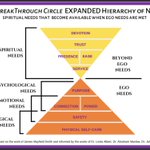
Before deciding what a body sensation means, I check the potato.
In A Christmas Carol, Scrooge explains away Marley’s ghost:
“You may be an undigested bit of beef...a crumb of cheese, a fragment of an underdone potato. There’s more of gravy than of grave about you.”
1
1
184
But here's where it gets interesting:
Meeting a physical need can make the emotional signal clearer. And I also suspect that hard-to-express emotional needs can borrow physical needs.
Hunger gets borrowed by deprivation.
Exhaustion by “I can't keep doing this.”
Gut contraction by fear.
1
1
62
Trypophobic responses are interesting because they show how powerfully our bodies can respond to sensory information before we consciously make sense of it.
We may not choose the first signal. But learning to notice and stay with it without immediately reacting can create more room for what happens next.

I’ve seen quite a few of these and I remain puzzled how a restaurant owner cannot immediately see how terrible it looks. Why the obliviousness?
1
219
First rule of Tantra: Don’t let the girl get cold.

a lab in the netherlands scanned couples during orgasm and stumbled onto the strangest finding in sex research.
when women wore socks, the orgasm rate jumped from 50% to 80%
the researchers weren't studying socks. the scanning room was cold, some women complained, socks were offered. suddenly the success rate exploded and the team realized they'd accidentally run the most important experiment of the study
the mechanism showed up right on the brain scans. female orgasm requires the amygdala, the brain's fear and threat detection center, to power down. cold feet kept the threat system quietly online. warm feet let it switch off. that tiny bit of physical discomfort was enough to block the entire cascade
- her brain cannot climax and scan for problems at the same time. the systems are neurologically mutually exclusive
- socks are a stand-in for the real variable: comfort. temperature, privacy, no time pressure, no risk of interruption, nothing pinching or hurting. every small discomfort is a tax on the fear center
- this is why the same technique works one night and fails the next. the variable that changed wasn't your hands. it was her nervous system's threat level
- the environment is doing foreplay before you touch her. warm room, locked door, no rush, phone away
men study techniques for years and lose to a cold room. her nervous system decides if orgasm is possible before your skills ever enter the conversation. handle the amygdala first. the socks were never about socks
6
379